How can community college career centers build track-based support for different student pathways?
Community college career centers can improve student outcomes by replacing four-year university models with track-based frameworks built around commuter realities, adult learners, certificate pathways, transfer goals, and immediate workforce needs. Effective models embed career milestones into academic programs, use regional labor market data, align with employers, and validate both technical and durable skills across each student track.
Community college career services cannot simply borrow the four-year university playbook.
Students often move through shorter, less linear pathways while balancing work, childcare, commuting, transfer plans, certificate goals, and immediate income needs.
A model built around optional office visits, late-stage resume help, and senior-year recruiting misses too many students too early.
That matters institutionally because community colleges are judged not only by completion, but by transfer momentum, workforce placement, regional employer alignment, and economic mobility.
Career support has to become embedded, track-specific, and measurable across academic pathways.
This guide explains how career teams can redesign support for community college realities, including multi-track student pathways, transfer and workforce balance, commuter-friendly delivery, employer alignment, guided pathways integration, labor market data, and readiness validation.
Why standard four-year university career center models fail community college students?
Traditional four-year career models rely on a linear, residential timeline that assumes students have years to explore and build networks. Community colleges serve commuter, part-time, and adult learners who need immediate, integrated employment outcomes. Replicating university models ignores the urgent financial and structural realities of the community college demographic.
Traditional university career offices focus heavily on a predictable, multi-year pipeline: sophomore exploration, junior internships, and senior on-campus interviewing.
This approach completely collapses in an open-access environment.
According to the American Association of Community Colleges (AACC), public community colleges educate roughly 10.5 million students across the United States, anchored by a mission of rapid, agile upskilling and direct entry or re-entry into the workforce.
When your average student balance includes childcare, full-time employment, and zero hours of campus residency, a passive "drop-by our office in the student union" model is functionally broken.
Community college students often measure their academic lifespans in months or credit hours, not years. If your career interventions are backloaded to graduation semester, you are missing the vast majority of your population.
Also Read: How Can Career Centers Improve Career Readiness for Transfer Students?
How can career teams support multiple diverse student pathways simultaneously?
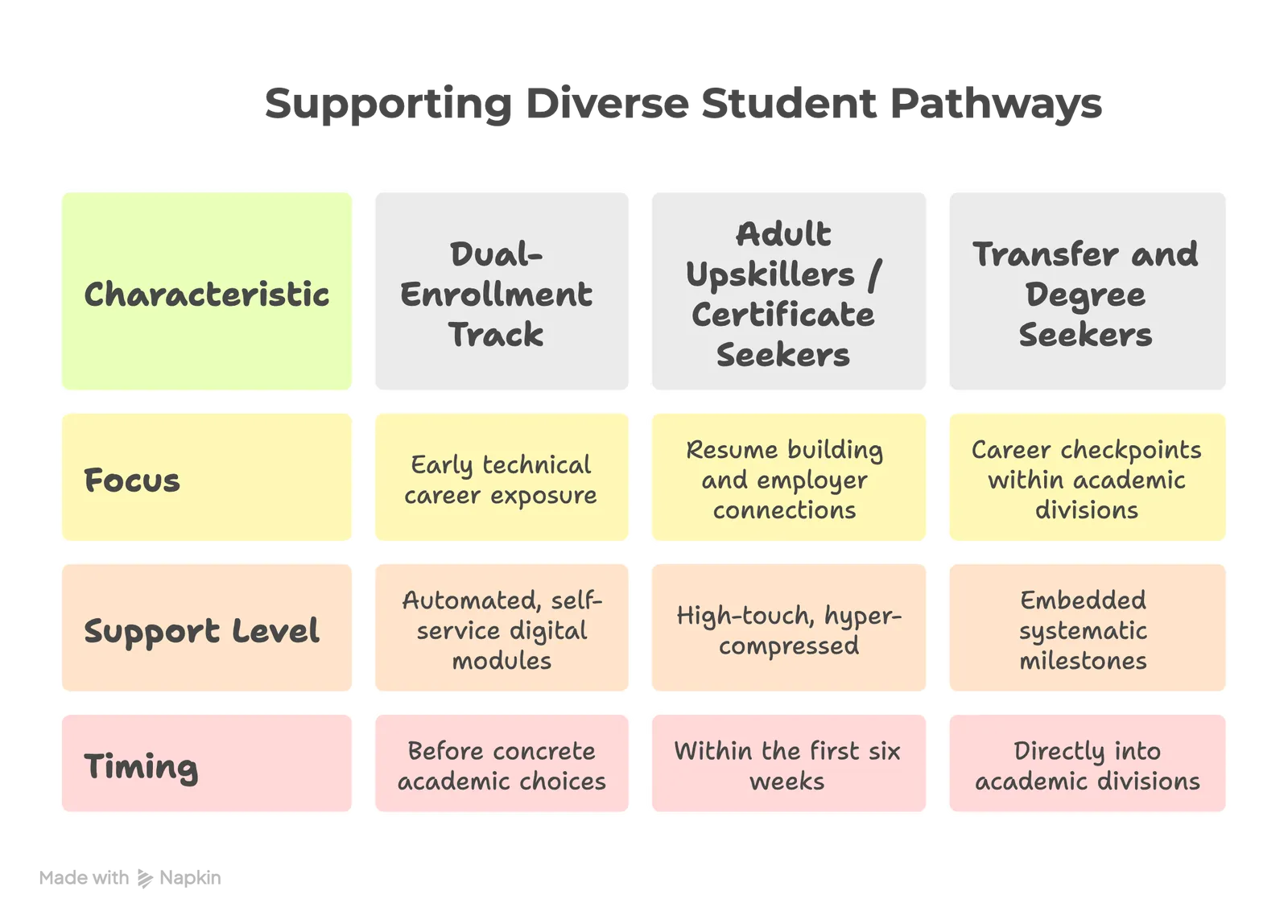
Career teams must operationalize a multi-track support framework that caters concurrently to terminal vocational students, dual-enrollment high schoolers, adult upskillers, and transfer-bound learners. Instead of using a one-size-fits-all advising approach, teams must embed distinct, milestone-driven toolkits into specific academic divisions to address divergent student career trajectories effectively.
Operationalizing support for multiple tracks means dismantling the centralized career services silo.
According to research from Jobs for the Future (JFF), community colleges must build highly adaptive institutional frameworks to successfully serve "new traditional learners" who balance vastly different academic speeds.
For example, Lorain County Community College implemented its "Fast-Track" program specifically to deliver accelerated credentials and immediate, hyper-focused career coaching to adult learners requiring rapid workforce re-entry.
To duplicate this success, your team must execute parallel strategies:
- Dual-Enrollment Track: Deploy automated, self-service digital modules focused on early technical career exposure and digital literacy before students make concrete academic choices.
- Adult Upskillers / Certificate Seekers: Provide high-touch, hyper-compressed resume builds and immediate, direct connections to local employers within their first six weeks.
- Transfer and Degree Seekers: Embed systematic milestones directly into academic divisions, ensuring that career checkpoints are built straight into the syllabus.
How to balance university transfer prep with immediate workforce placement?
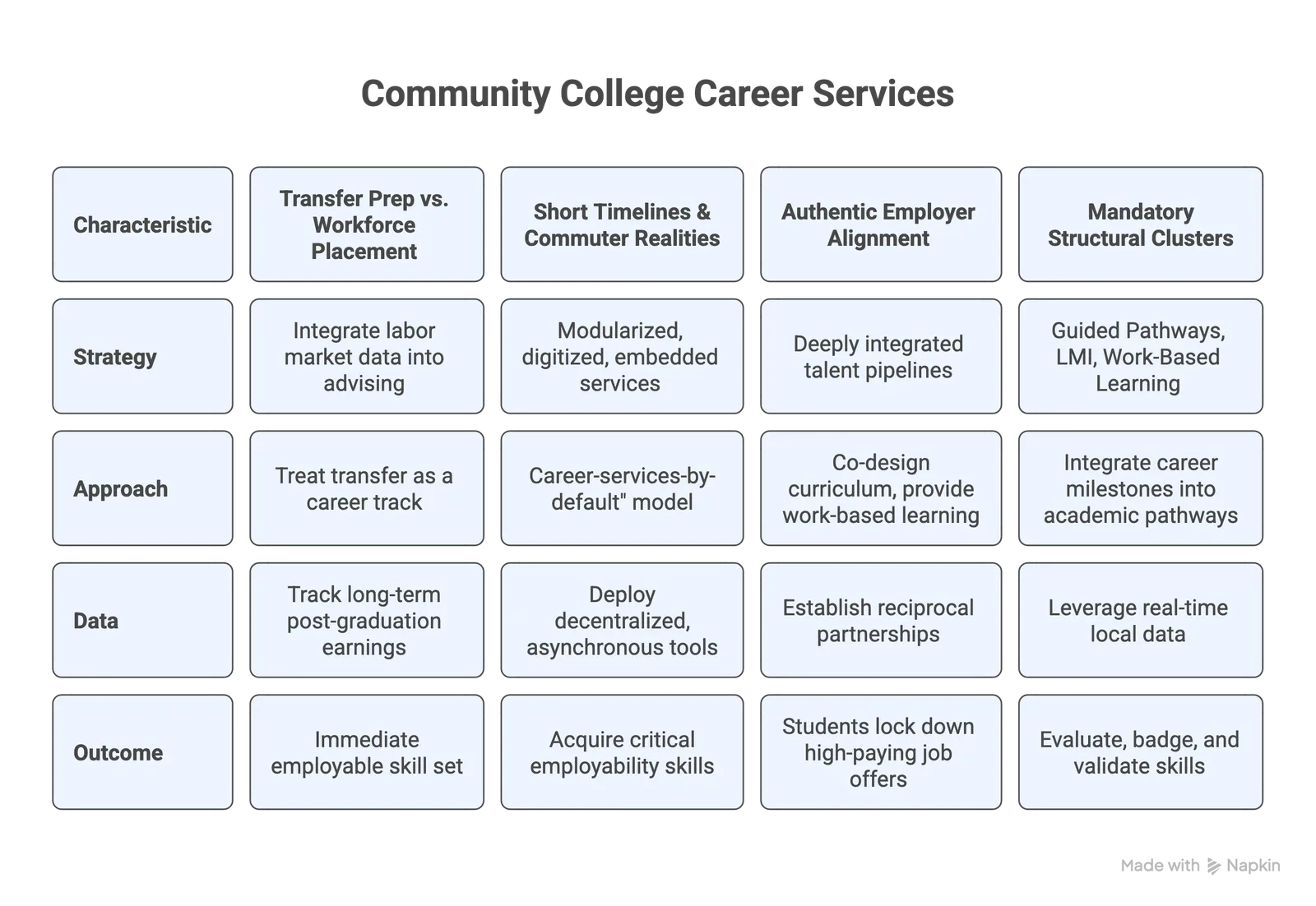
Balancing these outcomes requires decoupling "transfer" from "postponed career planning." Every academic track must be treated as a career track. Career services must integrate labor market data into early academic advising, ensuring that transfer students select majors aligned with regional economic demand, effectively merging academic progression with direct employment utility.
Too many institutions treat transfer preparation and workforce readiness as an either/or proposition.
This strategy actively harms students. According to The Workforce Playbook published by the Aspen Institute College Excellence Program, top-performing community colleges explicitly define regional labor market outcomes as a core pillar of student success, tracking long-term post-graduation earnings alongside baseline completion numbers.
Every transfer student needs an immediate employable skill set because a significant percentage will work their way through a bachelor's degree, or need an off-ramp if life interrupts their studies.
According to reports on the prestigious Aspen Prize for Community College Excellence, 2025 winner Southwest Wisconsin Technical College systematically restructured its program designs to ensure every single credential maps directly to high-demand, family-sustaining regional wages.
Whether a student exits with an associate degree or uses it to transfer to a four-year institution, their education yields immediate, non-negotiable marketplace leverage.
How do short timelines and commuter realities change career service design?
Commuter realities and high stop-out risks require moving away from optional physical office visits toward a "career-services-by-default" model. Services must be modularized, digitized, and directly embedded into mandatory first-year courses or learning management systems. This ensures that time-starved or transient students acquire critical employability skills before they face potential stop-out indicators.
If a student only steps onto your campus to attend class and immediately departs for a job, your physical career center is functionally invisible to them.
Furthermore, because community college students face high stop-out risks due to external financial or personal shocks, you cannot afford to wait.
According to Brunswick Community College, modern career centers must proactively combat these physical limitations by deploying decentralized, asynchronous tools like Career Coach Online.
This provides commuter and online students with immediate, localized salary information, occupational growth projections, and targeted employability skills training (such as resume and cover letter tailoring) that they can access at 11:00 PM from home.
To operationalize this, you must partner with faculty to push career assignments into the Learning Management System (LMS).
If a student stops out after their first semester, an effective career service model ensures they leave with a polished resume, a curated LinkedIn profile, and explicit knowledge of their local job market.
What does authentic employer alignment look like for community college career centers?
Authentic employer alignment goes beyond transactional career fairs to build deeply integrated talent pipelines with localized industry sectors. Career services must establish reciprocal partnerships where regional employers co-design curriculum, provide direct work-based learning, and commit to hiring targets. This shifts employers from passive recruiters to active partners in curriculum equity.
Banish the traditional, low-ROI advisory board that meets annually over lunch to review static PowerPoints. Effective employer alignment requires radical integration into the classroom.
According to a report by Community College Daily on the AACC and General Motors "EmployED" initiative, 18 forward-thinking community colleges joined forces to embed specific corporate technical frameworks and safety protocols directly into early technical training.
For example, at the Community College of Baltimore County (CCBC), automotive students work directly with original equipment manufacturer (OEM) training supplied by corporate partners like GM and Ford.
Because the training is entirely synchronized with real-world industry demand, students routinely lock down formal, high-paying job offers well before they even complete their certificates.
Career teams must negotiate these exact types of reciprocal agreements: your institution delivers the exact, rigorous skill-matching required by the regional economy, and in return, local employers provide modern equipment, fund specialized certifications, and guarantee interview spots or direct hiring tiers for your graduates.
Which structural cluster topics are mandatory to operationalize a community college career model?
To operationalize this high-impact model, career services teams must center their operations around three specific cluster topics: Guided Pathways integration, regional labor market intelligence data (LMI), and employer-backed work-based learning metrics. Focusing on these core clusters allows teams to dismantle silos, align with faculty, and build scalable career-readiness infrastructure.
To transition your career center from a passive service office to an economic engine, your team must master and operationalize three distinct operational clusters:
1. Guided Pathways Curricular Integration
Do not treat career readiness as an extracurricular activity. You must integrate specific career milestones directly into academic pathways based on credit accumulation.
- At 15 credits, a student should complete an automated career assessment and build a baseline resume.
- At 30 credits, they should complete an asynchronous mock interview tailored to their specific division.
2. Regional Labor Market Intelligence (LMI)
Stop advising based on gut feelings or generic national trends. Your team must leverage real-time local data.
According to the California Centers of Excellence for Labor Market Research (COE), colleges must actively use subregional workforce demand assessments and sector profiles to map exact occupational growth, employer hiring patterns, and specific required skill sets to their training programs.
If an academic program does not align with a local, livable-wage career trajectory, career services must work with administration to pivot resources.
3. Validation of Durable and Technical Skills
Your corporate partners need clear proof of student readiness. According to NACE Job Outlook Spring Update, while employers overwhelmingly seek baseline evidence of durable human skills like problem-solving, teamwork, and communication, the technical baseline is shifting with unprecedented speed - 16.5% of entry-level job descriptions now explicitly mandate AI literacy skills.
Your career service infrastructure must systematically evaluate, badge, and validate these exact technical and durable competencies within your student cohorts, giving your community college grads undeniable, data-backed proof of value the second they enter the regional hiring market.
Also Read: 4-Week Job Search Plan for Students: Career Advisor Playbook
Wrapping Up
Community college career services work best when they are built around the actual student journey: compressed timelines, commuter schedules, transfer uncertainty, adult learners, certificate pathways, and immediate workforce needs.
That means career readiness cannot sit at the edge of the institution. It has to be embedded into advising, academic programs, employer partnerships, and measurable student progress.
The strongest models give students early direction, practical job-search assets, repeated practice, and clear proof of readiness before they reach a final semester.
They also give career teams the infrastructure to manage cohorts, track engagement, document progress, and show institutional impact.
Hiration supports that kind of full-cycle model with Career Assessments, AI-powered Resume Optimization, Interview Simulation, LinkedIn optimization, and more, along with a separate Counselor Module for managing cohorts, workflows, and analytics.
For community colleges trying to scale career support without losing advisor oversight, it brings the student-facing tools and staff-facing visibility together in one secure, FERPA and SOC 2-compliant platform.
Community College Career Center Framework — FAQs
Why do four-year university career models fail community college students?
Four-year models often assume residential life, long timelines, and late-stage recruiting, while community college students may need immediate, flexible, embedded career support.
What is a track-based career services framework?
A track-based framework organizes career support around distinct student pathways such as transfer students, adult upskillers, certificate seekers, dual-enrollment students, and workforce-bound learners.
How should career centers support multiple student pathways at once?
Centers should create milestone-driven toolkits for each pathway and embed those supports into academic divisions, LMS workflows, advising, and employer-facing programs.
How can colleges balance transfer preparation with workforce placement?
Colleges should treat every academic pathway as career-connected by helping transfer students build employable skills, understand labor market demand, and prepare for immediate work options.
Why do commuter realities change service design?
Commuter students may have limited time on campus, making optional office visits less effective than embedded, asynchronous, classroom-based, and LMS-delivered career support.
What does authentic employer alignment look like?
Authentic alignment means employers help shape curriculum, provide work-based learning, support equipment or certifications, and create clear interview or hiring pathways.
Why is regional labor market data essential?
Regional labor market data helps career centers align advising, programs, credentials, and employer partnerships with local demand, wages, hiring patterns, and skill needs.
How should guided pathways connect to career readiness?
Career milestones should be embedded into guided pathways, such as career assessments, resume completion, mock interviews, and skill validation at specific credit points.
What skills should community colleges validate?
Community colleges should validate both technical skills and durable skills such as communication, problem-solving, teamwork, digital fluency, and AI literacy.
What is the biggest strategic shift community college career centers need?
Community college career centers must move from optional, centralized career services toward embedded, track-specific systems tied to transfer, workforce, employer, and economic mobility outcomes.