How can career centers build a scalable case interview readiness program?
Career centers can improve consulting preparation by treating case interview readiness as a staged pathway rather than a standalone workshop. Effective programs combine structured skill-building, guided practice, calibrated feedback, fit interview preparation, clear readiness checkpoints, and scalable staffing models. This approach helps students progress from awareness to independent performance while allowing advisors to allocate high-touch support more strategically.
A student shows up in September with a familiar request: consulting recruiting starts soon, they have watched a few case videos, and they want a mock interview tomorrow.
For career centers, that moment reveals whether case interview support is a structured pathway or a staff-by-staff scramble.
Case prep needs more than standard interview coaching.
Students have to practice problem framing, mental math, synthesis, and recommendation delivery until those skills hold under pressure.
This guide breaks down how career centers can build a repeatable case interview readiness framework.
It covers staged programming, skill checkpoints, staffing models, technology support, and metrics that show whether students are moving toward interview readiness.
How Should a Career Center Structure a Case Prep Program?
A career center should structure case prep as a staged pathway, not a standalone event.
The cleanest model is a four-part progression: awareness, framework building, guided practice, and independent performance.
That sequence reduces false confidence, creates usable checkpoints, and helps staff match support intensity to student readiness.

What belongs in the first stage
The first stage is selection and orientation, not deep coaching.
Students need a realistic picture of recruiting timelines, interview format, and the level of repetition required.
Many centers over-serve casual interest and under-serve committed candidates. A short advising conversation should sort students into three groups:
- Exploring students who need exposure to consulting roles, not intensive prep yet
- Committed candidates who are recruiting in the next cycle and need structured progression
- Late entrants who may still benefit, but need a compressed plan and direct readiness advice
Practical rule: Don't let every interested student enter mock interviews immediately. Require a foundation checkpoint first.
How to build the middle of the program
The second and third stages should do most of the developmental work.
Case interview preparation should teach students to use modular structures such as profitability analysis, market-entry logic, customer segmentation, cost breakdowns, and capability analysis rather than forcing every prompt into one memorized framework.
For career centers, this creates a scale advantage.
If advisors, peer leaders, and alumni all use the same structural language, feedback becomes more consistent. Students hear the same expectations across workshops, peer practice, advising appointments, and alumni mocks.
What the final stage should prove
The last stage is not more content.
It's proof of execution. Students should be able to open a case calmly, structure it without prompting, run clean calculations, synthesize findings, and close with a recommendation.
A one-off workshop can introduce consulting.
It can't validate readiness.
Programs that treat case prep like a sequence rather than an event usually make better use of advisor time because students arrive at high-touch support with a stronger base.
What Are the Core Components of Each Program Stage?
Program stages should change the type of evidence a student must produce.
Early participation shows interest.
Mid-program work should show that the student can structure ambiguous business problems with discipline.
Final-stage activity should show interview readiness under time pressure, with minimal coaching and consistent communication.

Which skills matter most in the build stage
The build stage is where many programs either become scalable or collapse into endless one-off advising.
Career centers need a narrow curriculum that staff, peers, and alumni can all reinforce the same way.
That usually means teaching students to restate the problem, ask clarifying questions, build a MECE issue tree, choose the highest-value branches, and end with a top-down recommendation.
Those process habits are what make practice usable in an interview.
If students skip the prompt clarification, notes, structure, or calculation walkthrough, advisors end up spending mock time correcting basic mechanics instead of testing judgment.
A practical build-stage curriculum should cover four repeatable skills:
- Problem framing through a clear restatement of the client situation and goal
- Structure building through issue trees, branch selection, and hypothesis-based prioritization
- Quant execution through visible math, unit discipline, and verbal explanation
- Recommendation delivery through concise synthesis tied to the original question
These skills transfer beyond consulting. They also help students perform better in strategy, corporate development, and analytical interview formats.
How should guided practice work
Guided practice should be scheduled in layers, not left to student initiative alone. One workshop introduces the standard.
Small-group sessions let students rehearse the same moves repeatedly. Peer or alumni case rounds then create the volume that a career center staff team usually cannot provide on its own.
The key trade-off is supervision. Too much staff oversight limits capacity. Too little oversight creates noisy feedback and bad habits.
A workable model uses staff to set the rubric, train facilitators, and review outlier cases, while peers and alumni handle much of the repetition.
Practice quality depends on consistency more than prestige. Students improve faster when every facilitator scores the same core behaviors and uses the same language for correction.
Teams that want a tighter coaching system can pair case practice with mock interview rubric design for career advisors so feedback from advisors, peers, and volunteers stays aligned.
Delivery mechanics belong here too.
Students need to speak in a structured way, manage silence without panicking, recover after a weak branch, and handle virtual case interviews with basic professionalism.
Centers often treat those as final-stage polish items. In practice, they should appear much earlier because communication problems are harder to fix in the last two weeks before recruiting.
Where fit interviews belong
Fit interviews should progress alongside case training, with stage-based standards that rise over time.
Early on, students need a credible reason for consulting and a basic understanding of target firms.
Midway through the program, they should be able to connect past experiences to client-ready behaviors such as ownership, teamwork, persuasion, and comfort with ambiguity.
Near the end, they should be able to answer fit questions with concise stories that sound specific rather than rehearsed.
Readiness decisions fail when case and fit are evaluated in separate tracks.
Career centers should treat fit as part of readiness evidence, not as a side workshop offered at the end.
Delivery failures usually come from stage design problems. Students were advanced before they had enough structure, repetition, or fit clarity.
How Can We Staff and Resource This Program for Scale?
A common failure pattern looks like this.
The career center launches strong demand, students sign up in large numbers, and within two weeks the bottleneck shifts to advisor calendars.
Staff start doing repeatable coaching in one-on-ones, peer practice runs without quality control, and final mock interviews become inconsistent because no one defined who owns readiness decisions.
The staffing model has to prevent that outcome before the first workshop goes live. For scale, assign work by judgment level, not by title alone. High-volume teaching and repetition should sit with lower-cost capacity.
Readiness calls, remediation, and employer-facing mock feedback should stay with staff or volunteers who are calibrated to the center's standards.

Who should own what
A practical division of labor usually looks like this:

The center's job is to design the system, set standards, and decide who advances. It should not try to personally deliver every practice repetition.
Students improve through volume, but program quality depends on controlled progression and shared evaluation criteria.
That trade-off matters.
If advisors spend their hours running basic practice, the center gets reach but loses judgment capacity where it matters most.
What usually breaks
The pressure points are predictable:
- Advisor bottlenecks when students expect individual casing support for early-stage questions
- Inconsistent coaching language when staff, peers, and alumni use different scoring standards
- Weak late-stage feedback when volunteer mock interviewers were never trained on the center's rubric
- Unowned operations for scheduling, no-show follow-up, virtual practice coverage, and peer lead management
The fix is operational, not conceptual.
Set service boundaries early. Publish which support formats belong in workshops, peer practice, drop-ins, and invite-only mocks.
Train every coach on the same rubric and sample feedback language. Review a small set of recorded or observed sessions each term to catch drift before students feel it.
Volunteer design also deserves more discipline than many centers give it. Alumni can be excellent mock interviewers, but only if the ask is narrow and the standard is clear.
For centers reviewing broader org design questions, the same logic appears in this career center staffing model for higher education teams.
A scalable case prep program protects expert time for decisions that affect employer readiness.
Resourcing decisions should also be tied to demand patterns. If consulting interest is concentrated in a short recruiting window, build surge capacity with peer fellows, recorded instruction, and pre-scheduled alumni mock blocks.
If interest is year-round, invest more in staff training and repeatable workshop delivery.
The right model depends less on theory and more on your actual volume, calendar, and tolerance for uneven student support.
How Can We Integrate Technology to Support the Framework?
A familiar failure point shows up in late September. Student demand spikes, advisors start fielding repeat questions by email, peer practice happens off the books, and no one can tell which students are getting better.
Technology should fix that operating problem first.
The right stack increases practice volume, standardizes what gets assigned, and gives the career center a usable view of readiness across the cohort.

A good setup mirrors the program stages, but it does not need a different tool for every task. In smaller centers, one platform may handle content delivery, practice assignment, and advisor review well enough.
In larger centers, a modular setup often works better because scheduling, assessment, and video practice tend to have different owners and different reporting needs.
The trade-off is clear. Fewer tools reduce admin burden. More specialized tools usually produce better intervention data.
Which tools map to which stage
Match the technology to the student behavior you need at each point in the pathway:
- Awareness stage needs role education, recruiting timelines, and short orientation modules
- Skill-building stage needs math drills, framework repetition, and case prompt libraries
- Guided practice stage needs scheduling, practice logs, and structured peer or coach feedback
- Advanced stage needs mock interview simulation, feedback storage, and readiness review across multiple interactions
Virtual case practice also deserves explicit support in the stack. As noted earlier, firms assess more than raw case content in remote interviews.
Students also need to handle screen presence, note organization, pacing, and collaboration over video.
If your platform supports only static content, staff will still spend too much time patching the gap with manual coaching.
What should be measured inside the platform
The platform should capture signals that help advisors decide who advances, who needs remediation, and who is not yet ready for an employer-facing mock.
Attendance is one input. It is not enough on its own.

Can an advisor open the record and decide, in under two minutes, what the student should do next?
If the answer is no, the system is collecting activity but not supporting program management.
One option in this category is our guide on AI interview preparation, which reflects the institutional need for assignable practice, counselor visibility, and cohort-level tracking.
The selection standard should stay operational.
Choose the platform that fits your progression model, integrates with your advising workflow, and produces intervention data staff will use.
What Metrics Should We Track to Measure Program Success?
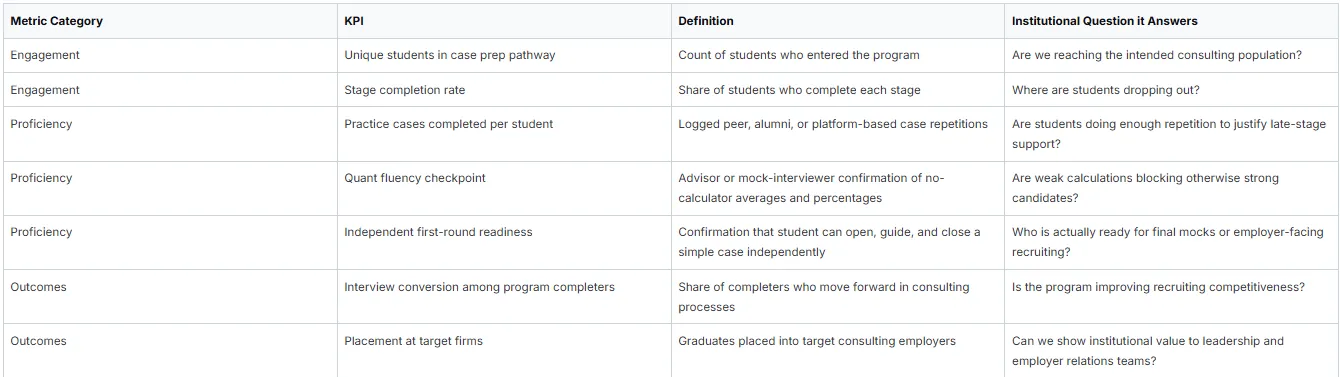
Track success across three layers: participation, proficiency, and outcomes. Attendance alone tells you whether students showed up.
It doesn't tell you whether they became interview-ready.
A useful case prep dashboard shows movement through the funnel, demonstrated skill, and eventual recruiting results.
Which KPIs matter most
A practical readiness benchmark should combine practice volume with demonstrated independence.
Students should not move from theory into advanced mock practice just because they attended a workshop or reviewed sample cases. They should advance when they can start, guide, and finish a simple first-round-style case with clear structure, sound calculations, and a direct recommendation.
The same guidance stresses doing averages and percentages without a calculator, which gives centers a concrete fluency marker to track.
That benchmark is helpful because it turns vague advisor language into a decision rule. “Seems prepared” is weak.
“Has completed enough repetitions and can independently guide a first-round case” is operational.
How should advisors use the data
Use metrics for intervention, not just reporting.
A student who attends everything but logs little practice needs a different conversation from a student who practices heavily but stalls on quant accuracy.
A simple review cadence works well:
- Mid-cycle check for stage progression and drop-off
- Pre-recruiting check for readiness and mock allocation
- Post-cycle review for outcomes, bottlenecks, and curriculum updates
For centers formalizing dashboards, this logic fits naturally with broader career center metrics and KPI design.
The strongest dashboard question is not “How many students attended?” It's “Which students are progressing toward independent performance, and where do they stall?”
Wrapping Up
A strong case interview readiness framework gives career centers a way to move beyond scattered workshops and one-off mock interviews.
The strongest programs segment students early, define stage gates, assign the right support owner, and track readiness before students reach employer-facing interviews.
Hiration supports this kind of structured readiness model through a full-stack career readiness suite that spans the student journey, including Career Assessments, AI-powered Resume Optimization, Interview Simulation, and more. Its dedicated Counselor Module also helps teams manage cohorts, workflows, and analytics within a secure, FERPA and SOC 2-compliant platform.
For centers refining consulting pipelines, the next step is to audit the current sequence: where students enter, how they practice, who evaluates readiness, and what evidence advisors can use before allocating high-touch support.
Case Interview Readiness Framework — FAQs
Why shouldn't case interview preparation be a one-time workshop?
Case interviews require repeated practice in problem structuring, quantitative analysis, communication, and recommendation delivery. A single workshop can introduce concepts but cannot validate readiness.
What are the core stages of a case interview readiness program?
A scalable program typically progresses through awareness, framework building, guided practice, and independent performance, with evidence-based checkpoints between stages.
What skills should students master during the build stage?
Students should learn problem framing, issue-tree construction, hypothesis-driven thinking, quantitative execution, and concise recommendation delivery.
Why is consistent coaching language important?
When advisors, peer leaders, and alumni use the same frameworks and evaluation criteria, students receive more reliable feedback and develop stronger interview habits.
How should guided case practice be structured?
Effective programs combine workshops, small-group practice, peer-led sessions, alumni case rounds, and advisor oversight to balance scale with feedback quality.
When should fit interview preparation begin?
Fit interview preparation should run alongside case training from the beginning, gradually increasing expectations for consulting motivation, behavioral stories, and communication quality.
How can career centers scale case interview support?
Centers can reserve advisors for readiness decisions and advanced coaching while using peer leaders, alumni volunteers, workshops, and structured practice sessions for repetition and skill development.
What role should technology play in case preparation?
Technology should support content delivery, practice assignments, feedback collection, scheduling, readiness tracking, and advisor visibility into student progression.
What metrics should career centers track?
Useful metrics include stage progression, practice volume, quant accuracy, mock interview performance, fit interview readiness, independent case completion, and recruiting outcomes.
How do advisors know a student is ready for employer-facing interviews?
Students should be able to independently structure a case, perform calculations accurately, synthesize findings, deliver recommendations, and explain their consulting fit with minimal coaching.