If your career center relies on one person to keep a platform running, a staff change can quickly become an adoption problem.
Based on nearly a decade of working with 120+ career centers, we’ve seen how much platform knowledge can sit with a single champion: why settings were configured a certain way, which student campaigns drive usage, how advisors use the platform, what gets reviewed each term, and how the vendor relationship is managed.
When that person changes roles or leaves, the technology stays in place, but the context around it can disappear. For lean career-center teams, that can slow student outreach, reporting, advisor use, and day-to-day platform management.
Plus, career centers often have limited time to train deeply on tools and can face internal coordination gaps across staff and administrators.
This guide explains how career centers can preserve that knowledge through shared documentation, secondary ownership, advisor enablement, clear operating practices, vendor continuity, and transition planning.
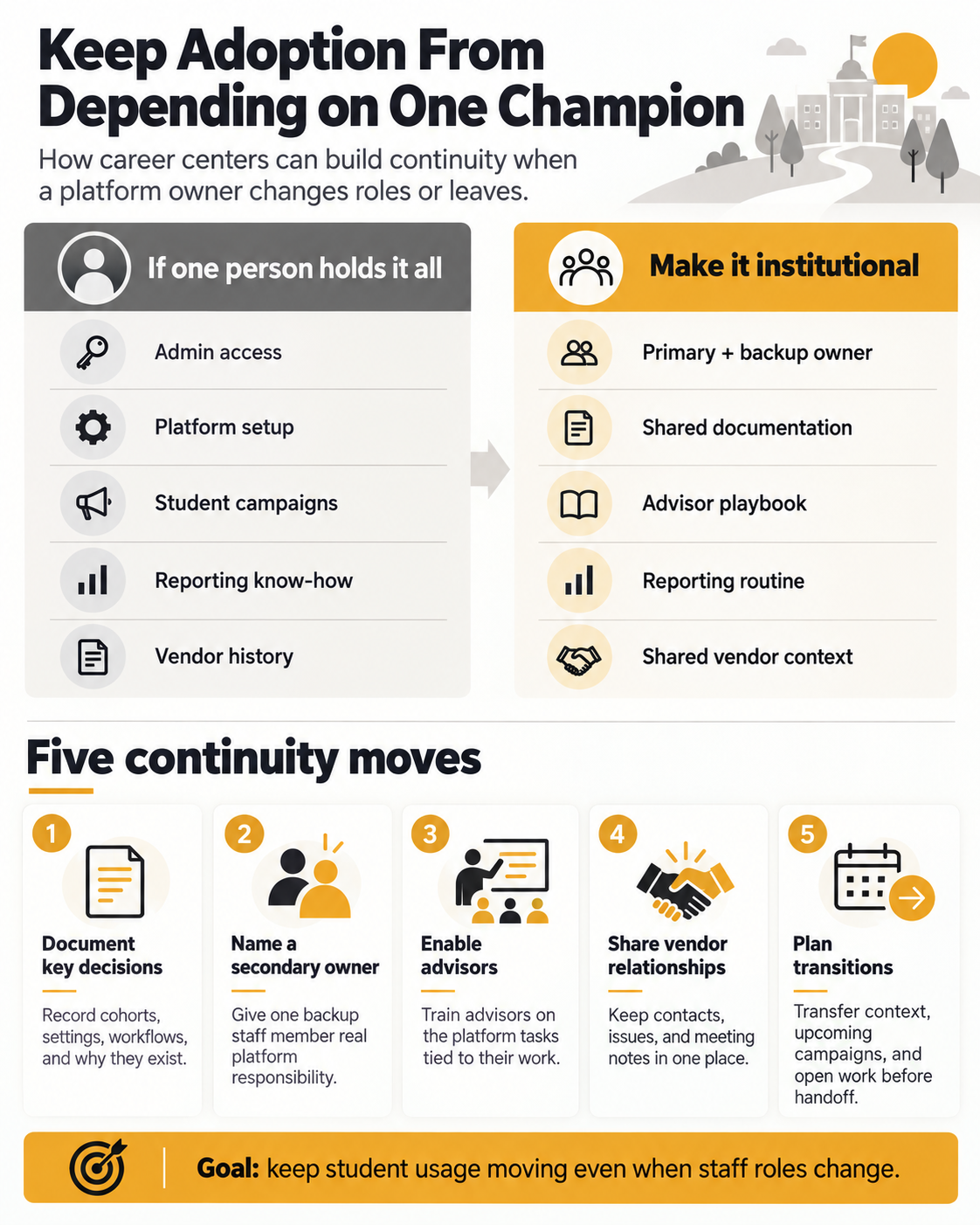
| If this lives with one person... | Make it institutional instead |
|---|---|
| Admin access and permissions | Primary + secondary administrator |
| Cohort setup and assignments | Documented configuration |
| Student communications | Shared templates and calendar |
| Advisor instructions | Short internal playbook |
| Usage reporting | Defined reporting cadence |
| Vendor contacts | Shared relationship history |
| Custom settings and decisions | Decision log with rationale |
| Renewal and implementation dates | Shared calendar |
| Platform training | Recorded walkthroughs + cross-training |
Why is Depending on One Staff Champion a Risk?
A strong champion can accelerate adoption, but the platform becomes vulnerable when that person is also the only administrator, trainer, vendor contact, and source of institutional knowledge. Career centers need to preserve the champion's expertise while moving recurring decisions, processes, and relationships into structures the wider team can continue.
Career technology often needs someone willing to push it forward.
That person may have led the evaluation, convinced colleagues to adopt it, configured the initial setup, trained advisors, and kept student usage visible after launch.
The risk appears when "champion" quietly becomes "only person who knows how this works."
Teams are often lean, operate around changing recruiting and academic cycles, and may already have limited time to explore or train on platforms.
Internal coordination between staff, faculty, and administrators can also affect implementation.
That makes rebuilding platform knowledge after someone leaves harder than simply transferring an administrator password.
NACE's professional standards for college and university career services also treat technology as an organizational capability.
They call for staff to understand relevant technology and for career services to maintain a strategic approach to selecting, replacing, updating, and integrating technology rather than treating it as an isolated individual responsibility.
A useful test is to ask:
If our platform lead were unavailable for the next month, what would stop?
If the answer includes student onboarding, advisor training, reporting, configuration changes, or communication with the vendor, there is a continuity gap.
This does not mean every advisor needs administrator-level expertise.
It means the institution needs enough shared knowledge to keep the platform operating without reconstructing its history from scratch.
What Platform Knowledge Should Career Centers Document?
Documentation should capture the decisions and routines another staff member would need to operate the platform, not every screen or feature. Prioritize access, configuration, recurring tasks, student communications, reporting, vendor contacts, and the reasoning behind institution-specific choices. Keep it short enough that staff will actually maintain it.
The wrong response to champion dependency is building a 70-page platform manual nobody opens.
Document what would be difficult to reconstruct.
Create a simple platform continuity file
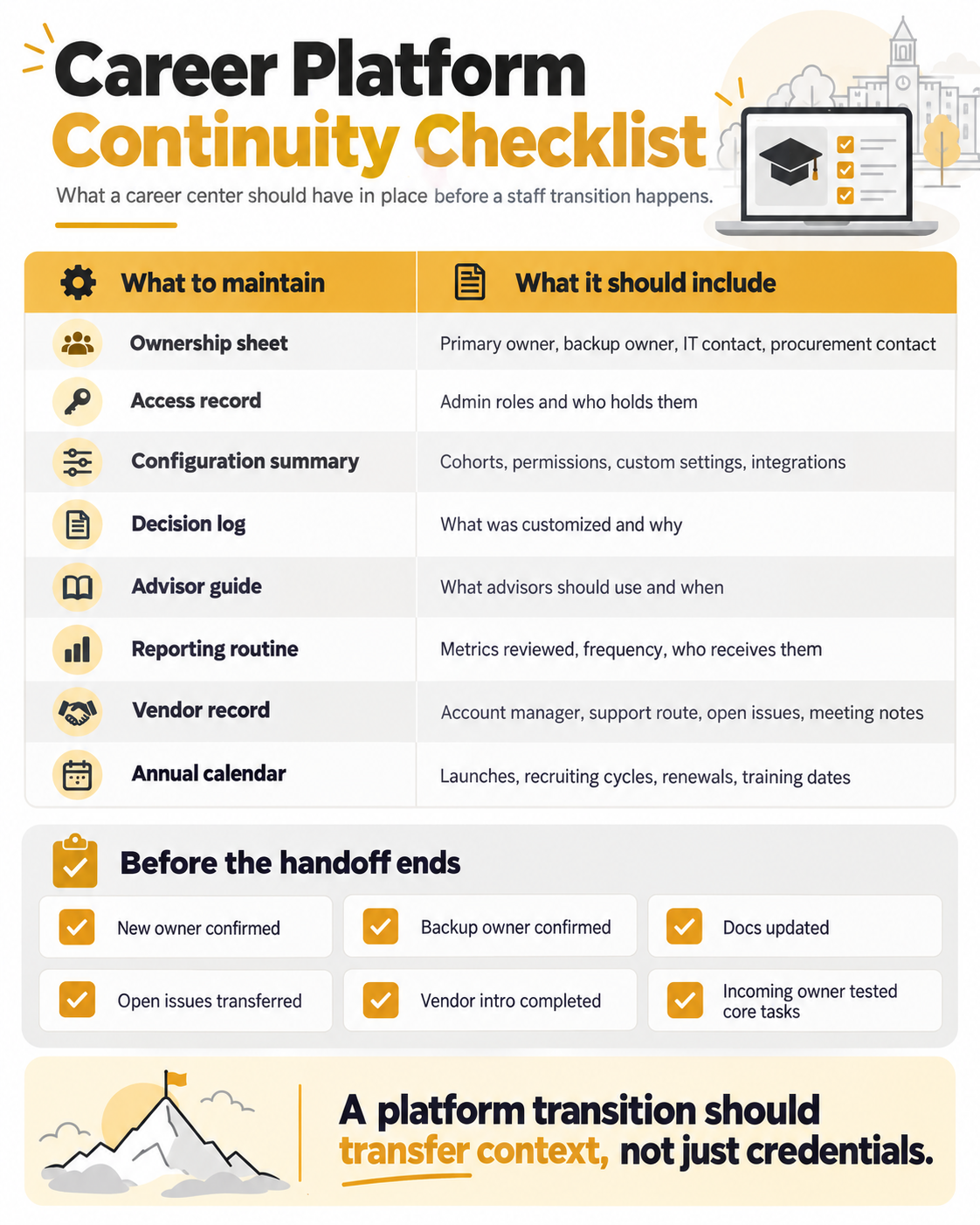
| Document | What it should contain |
|---|---|
| Ownership sheet | Primary owner, backup owner, IT contact, procurement contact |
| Access record | Admin roles and who holds each role |
| Configuration summary | Cohorts, permissions, custom settings, integrations |
| Decision log | What was customized and why |
| Student activation plan | Key campaigns, audiences, timing, links |
| Advisor guide | What advisors are expected to use and when |
| Reporting routine | Metrics reviewed, frequency, who receives them |
| Vendor record | Account manager, support route, open issues, meeting notes |
| Annual calendar | Launches, recruiting cycles, renewals, training dates |
| Transition checklist | What must be transferred when ownership changes |
The decision log is particularly important.
Knowing that a setting is enabled tells the next owner what exists. Knowing why it was enabled tells them whether it should remain.
For example:
Interview attempts limited to three for the MBA cohort because the activity is part of a graded course.
is much more useful than:
MBA interviews: three attempts.
This is also where institutional knowledge separates itself from product documentation. The vendor can explain what a setting does. Only the career center can explain why it chose that setting for its students.
EDUCAUSE's higher-education IT governance research similarly found that clear documentation of policies, processes, and responsibilities was one of the elements respondents identified as important to successful governance.
Stakeholder involvement and clear communication also ranked prominently.
Those same principles work internally. One shared record is more resilient than important decisions spread across one person's inbox, meeting notes, and memory.
How Should Career Centers Distribute Platform Ownership?
Keep one clearly accountable platform owner, but give at least one secondary owner enough access and knowledge to take over core responsibilities. Advisors should understand the platform functions connected to their work, while vendor and institutional relationships should involve more than one person where practical. Shared ownership should add resilience without making accountability unclear.
The answer to one champion is not six owners.
When everyone owns the platform, routine work can easily become nobody's responsibility.
Use layers instead.
A practical ownership model
| Role | What they should know |
|---|---|
| Primary owner | Full configuration, adoption plan, reporting, vendor relationship |
| Secondary owner | Core admin tasks, student setup, reporting, support escalation |
| Advisors | Student-facing functions relevant to advising |
| IT partner | Authentication, integrations, access dependencies |
| Leadership | Purpose, adoption indicators, contract/renewal context |
| Vendor contact | Institutional setup, goals, open issues, historical decisions |
The secondary owner matters most.
They do not need to duplicate everything the primary owner does each week. But they should periodically perform real platform tasks rather than simply being listed as the backup.
That could include:
- adding a cohort;
- pulling a usage report;
- assigning an activity;
- changing a staff permission;
- sending or reviewing a student communication;
- joining a vendor check-in;
- and handling one support escalation.
EDUCAUSE's transition guidance recommends knowledge-transfer approaches including cross-training, documentation, mentoring, workshops, temporary assignments, and job shadowing.
It also specifically suggests considering whether important knowledge should be transferred to more than one person. This is more useful than training everyone equally.
Enable advisors without turning them into administrators
Advisor enablement should focus on the platform decisions advisors encounter in their actual work.
An advisor may need to know:
- what students are expected to complete before an appointment;
- where to see student progress;
- how to review a submission;
- what to do when a student reports a platform problem;
- and which features or activities apply to their population.
They probably do not need to know how SSO was configured.
Hiration’s own account-management team uses practical walkthroughs instead of feature-heavy explanations and shares recorded resources to help career teams spread platform knowledge internally.
That makes a 15-minute role-specific walkthrough more useful for continuity than a broad annual product training session that staff rarely revisit.
Do not let the vendor relationship belong to one inbox
The same resilience principle applies externally.
If every implementation decision, support history, and strategic conversation with the vendor passes through one employee, their departure can remove important context on both sides.
At minimum, the secondary owner should:
- know the account manager;
- know the support route;
- have access to shared meeting notes;
- understand active requests and unresolved issues;
- and attend occasional vendor reviews.
The strongest setup is therefore continuity on both sides: institutional knowledge inside the career center and account history with the vendor.
What Should Happen When a Platform Champion Changes Roles or Leaves?
The transition should transfer operational knowledge before administrator access is simply reassigned. Career centers should review ownership, open issues, upcoming campaigns, vendor history, configuration decisions, reporting routines, and unfinished work. The replacement should then perform key tasks before the handoff is considered complete.
Do not wait for a resignation notice to invent the transition process. Create the checklist while the platform is running normally.
A useful handoff can be completed in four parts.
1. Transfer context, not just credentials
The incoming owner should understand:
- why the platform was purchased;
- which problems it is expected to solve;
- which student populations use it;
- how it is currently embedded into career services;
- what has worked or failed in driving usage;
- and which decisions are currently under review.
Otherwise, the new owner inherits buttons without strategy.
2. Review the next 90 days
Staff transitions become more disruptive when they collide with a career fair, recruiting season, course assignment, student campaign, or contract deadline.
Review:
- scheduled student communications;
- faculty or course integrations;
- advisor training;
- upcoming cohort additions;
- reporting dates;
- renewal or procurement milestones;
- open technical changes;
- and planned vendor meetings.
Over nearly a decade of working with 120+ leading institutions, we’ve seen platform usage rise and fall with recruiting, internship, and academic cycles.
When ownership changes, teams need to transfer that calendar context along with the platform itself.
3. Make the incoming owner do the work
A handoff should not end with: "Any questions?"
Before the outgoing owner leaves, the incoming owner should independently complete a few core tasks.
For example:
- pull the current adoption report;
- locate platform documentation;
- identify the vendor contact;
- add or modify a test cohort;
- find current student communications;
- explain one important configuration decision;
- resolve or correctly route a sample support issue.
If they cannot do those things without the departing champion, knowledge transfer is not complete.
EDUCAUSE documented the impact of staff turnover in higher-education technology projects through an Abilene Christian University project that lost several key team members and struggled to regain momentum.
Its recommendation was to prepare potential replacements and cross-train staff before turnover occurs.
4. Re-establish the vendor relationship
The outgoing and incoming owners should ideally attend one vendor meeting together. Use it to confirm:
- institutional contacts;
- administrator access;
- active issues;
- current adoption goals;
- upcoming activity;
- and any configuration or implementation work in progress.
The vendor should not be discovering that its only institutional contact left because emails started bouncing.
Career Technology Staff Handoff Checklist
| Before the handoff ends | Complete? |
|---|---|
| New primary owner confirmed | ☐ |
| Secondary owner confirmed | ☐ |
| Admin access reviewed | ☐ |
| Shared documentation updated | ☐ |
| Open issues transferred | ☐ |
| Upcoming campaigns reviewed | ☐ |
| Reporting routine demonstrated | ☐ |
| Vendor introduction completed | ☐ |
| Renewal dates confirmed | ☐ |
| Incoming owner completes core tasks | ☐ |
Wrapping Up
Career technology adoption should benefit from a strong internal champion without becoming dependent on one.
That means turning individual knowledge into institutional knowledge: a clear primary owner, a capable secondary owner, shared documentation, advisor enablement, documented platform decisions, and enough vendor context that a staffing change does not force the team to rebuild everything from scratch.
Hiration supports career centers across the full student journey, including career exploration, resume and CV building, cover letters, interview practice, job tracking, and AI-supported job search.
For career teams, the platform adds cohort management, assigned activities, student-performance visibility, admin controls, reporting, outreach, and review workflows.
Just as importantly, our support does not end once the platform is purchased.
Our team stays involved through walkthroughs, structured issue tracking, usage monitoring, regular follow-ups, and ongoing guidance to help institutions keep adoption moving as teams, priorities, and student needs change.
Book a walkthrough to see how Hiration can support your career center from implementation through long-term adoption, without leaving success dependent on one staff champion.