If your career center receives employer offers to sponsor events, student resources, or career development programs, deciding what sponsors should receive in return is only part of the challenge.
Contribution amounts, branding permissions, institutional approvals, and recruiting access all need clearly defined boundaries.
Unlike standard employer participation or strategic partnerships, sponsorships involve financial or in-kind contributions in exchange for specific benefits.
Without consistent packages and written agreements, career centers risk committing to benefits they cannot deliver or granting privileges that conflict with institutional policies.
This guide explains how career services professionals can approve sponsors, structure contribution tiers, define agreements, protect student access, and evaluate sponsorship renewals.
How Should Career Centers Select and Approve Employer Sponsors?
Career centers should evaluate sponsors against existing recruiting eligibility standards, institutional reputation requirements, and proposed benefit restrictions before discussing contribution levels. The approval process should establish who can authorize sponsorship benefits, classify financial contributions, and sign agreements. Employers should not receive sponsorship privileges until the required institutional reviews are complete.
A practical approach is to prepare a one-page sponsorship proposal containing four elements:
- Sponsor eligibility: Confirm compliance with institutional recruiting policies and identify reputational or conflict-of-interest concerns.
- Proposed exchange: Specify the financial or in-kind contribution and benefits requested.
- Existing commitments: Check whether the proposed recognition, branding, or exclusivity conflicts with existing institutional agreements.
- Approval ownership: Identify the offices responsible for financial classification, branding, contracting, and authorization.
According to UC Santa Barbara's sponsorship guidance, departments must route sponsorship agreements involving promotional or other benefits through Procurement Services.
Its Office of Finance and Administration reviews their fair market value, and approval must occur before sponsor promotions begin.
The University of Arizona's Sponsorship Policy provides another example.
Sponsorships valued at $25,000 or more annually require additional brand review, while multiyear and exclusive arrangements trigger additional review regardless of contribution size.
Practical application: Establish an internal approval matrix based on contribution value, duration, and requested benefits. Require additional institutional review when an employer requests exclusivity, university branding rights, or contractual commitments extending beyond the standard sponsorship period.
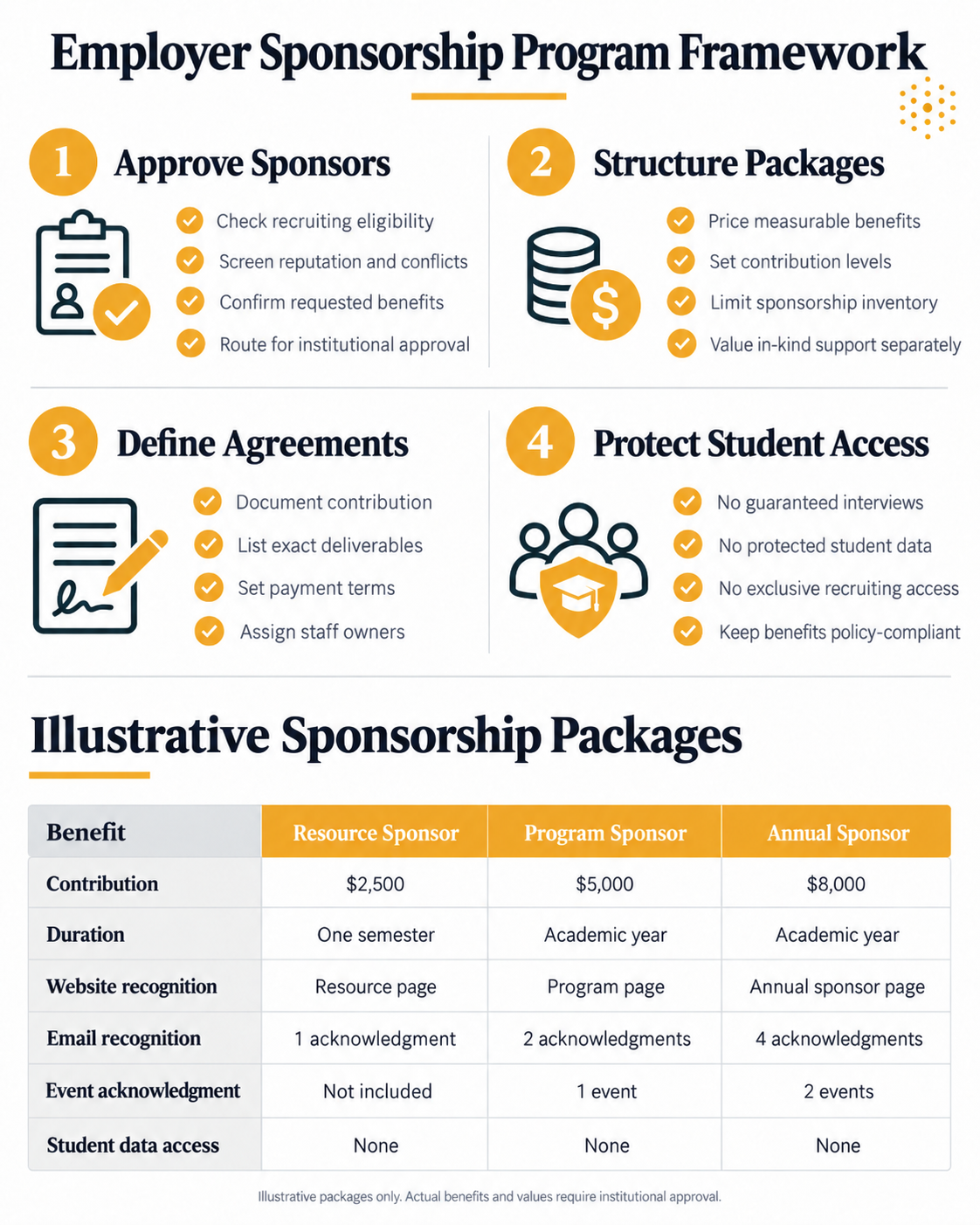
How Should Career Centers Design Sponsorship Tiers and Set Contribution Levels?
Sponsorship tiers should assign specific prices to measurable benefits, such as website recognition, event acknowledgment, or limited promotional placements. Contribution levels should reflect the fair market value of those benefits, sponsorship inventory, and fulfillment costs. Higher tiers should increase the scope of approved recognition rather than promise hiring outcomes or unrestricted student access.
Published college sponsorship packages provide useful examples of how institutions define and price benefits.
According to George Mason University's Employer Partnership Program, annual sponsorships range from $2,500 for Bronze to $10,000 or more for Platinum. The university also offers individual opportunities, including a $1,500 Resume Clinic sponsorship and a $2,000 Employer of the Month placement.
Similarly, the University of Michigan Career Center, annual sponsorship opportunities include a $2,500 Professional Headshot Photo Booth sponsorship and an $8,000 Clothes Closet sponsorship.
These examples demonstrate two practical approaches: annual packages with defined benefits and sponsorships attached to individual student services.
Illustrative sponsorship benefits comparison
| Benefit | Resource Sponsor | Program Sponsor | Annual Sponsor |
|---|---|---|---|
| Contribution | $2,500 | $5,000 | $8,000 |
| Duration | One semester | Academic year | Academic year |
| Website recognition | Resource page | Program page | Annual sponsor page |
| Email recognition | 1 acknowledgment | 2 acknowledgments | 4 acknowledgments |
| Event acknowledgment | Not included | 1 event | 2 events |
| Reporting | Fulfillment confirmation | Program summary | Semester reports |
| Student data access | None | None | None |
Three decisions make these packages more defensible:
- Price actual benefits, not expected employer outcomes. Define the number, duration, and placement of each recognition opportunity rather than promising applications, interviews, or hires.
- Set inventory limits. Specify how many sponsors may receive the same placement or event recognition. Limited inventory should not imply exclusive recruiting access.
- Value in-kind contributions independently. An employer offering equipment, printing, or career closet supplies should provide documentation sufficient for institutional valuation. Estimated retail value should not automatically determine sponsorship tier eligibility.
According to UC Santa Barbara's guidance, departments must document both the sponsor's contribution and the estimated fair market value of the benefits the university provides in exchange.
Career centers should also calculate fulfillment costs before finalizing prices.
A $5,000 sponsorship requiring substantial event expenses and staff time may provide less financial value than a smaller package with limited, clearly defined deliverables.
Career centers should assess sponsorship contributions alongside their broader career center budget optimization efforts, accounting for both revenue received and the institutional resources required to deliver sponsor benefits.
What Should Employer Sponsorship Agreements Include?
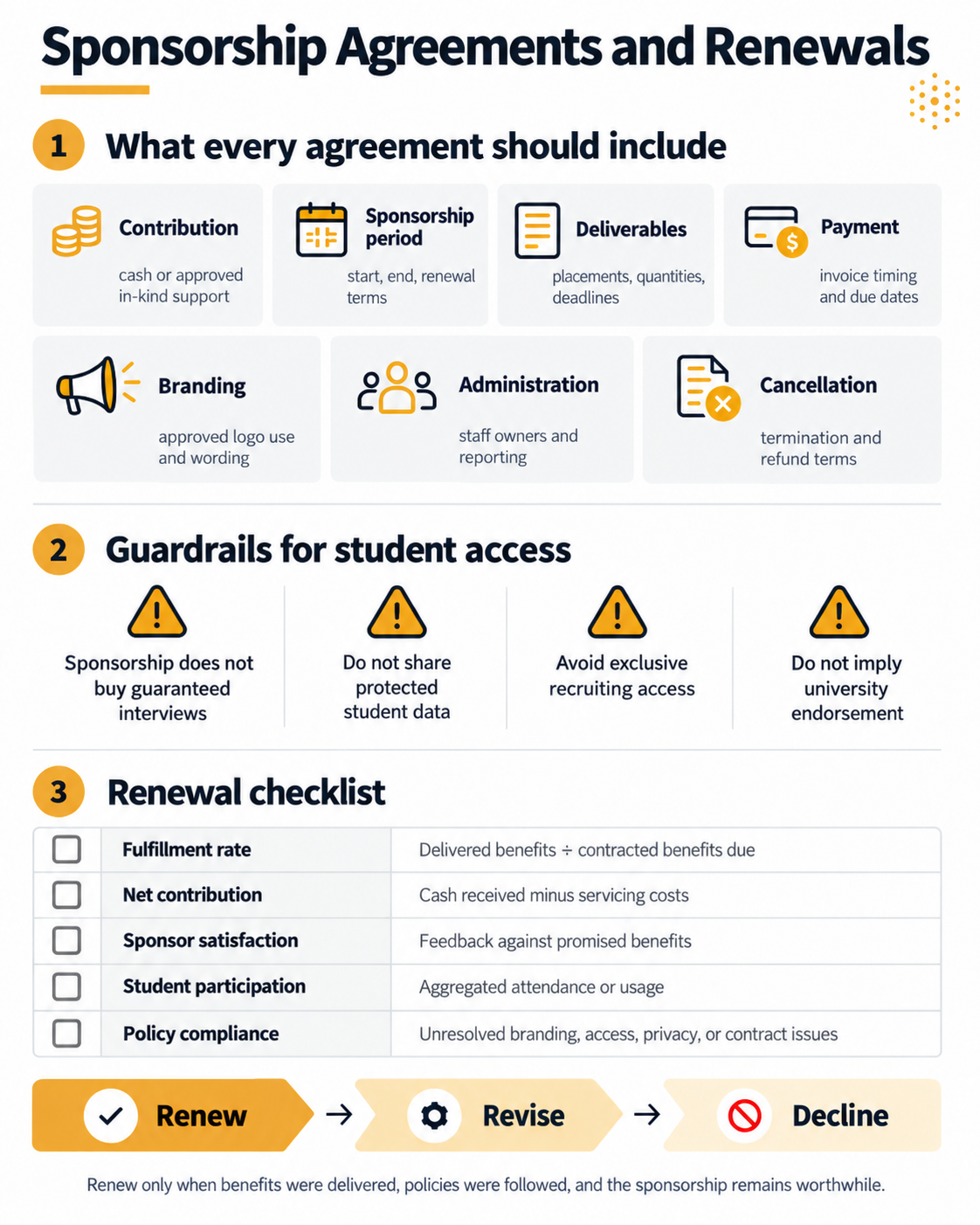
Sponsorship agreements should define contributions, deliverables, timelines, payment conditions, branding permissions, and staff responsibilities. They should also establish what sponsorship payments cannot purchase, particularly exclusive recruiting access, protected student information, or institutional endorsement. Each benefit should be specific enough that both parties can determine whether it was fulfilled.
Rather than relying on a promotional benefits sheet, career centers should have the approved agreement address these seven items:
| Agreement provision | Required detail |
|---|---|
| Contribution | Payment amount or approved in-kind support |
| Sponsorship period | Start date, end date, and renewal terms |
| Deliverables | Exact recognition placements, quantities, and deadlines |
| Payment | Due dates, invoicing, and nonpayment provisions |
| Branding | Approved logo use, acknowledgment language, and permissions |
| Administration | Responsible staff, reporting obligations, and fulfillment evidence |
| Cancellation | Termination conditions, refunds where applicable, and undelivered benefits |
The agreement should also prohibit or restrict requests that conflict with institutional policy.
According to NACE's Principles for Ethical Professional Practice, equitable access should not depend on an employer's financial contributions, gifts, affiliations, or in-kind services.
For career centers, this means sponsorship should not automatically entitle an employer to:
- Exclusive access to student populations or recruiting services.
- Guaranteed interviews, applications, or student participation.
- Protected student records or contact information.
- University endorsement of the employer or its products.
A useful distinction comes from the University of Michigan's sponsorship program, which offers a single annual premium sponsorship for its Clothes Closet and Professional Headshot Photo Booth.
Limiting a sponsorship opportunity to one employer is different from granting that employer exclusive access to students or restricting other employers' ordinary recruiting activities. Any exclusivity still requires review under the institution's policies.
Any proposed disclosure of identifiable student information should follow established FERPA compliance procedures, including appropriate consent and documentation requirements.
Practical application: Include a sponsorship benefits schedule as an attachment to the agreement. For every benefit, record the placement, delivery date, approval owner, and evidence required to demonstrate completion. Use institutionally approved, aggregated participation reporting rather than promising identifiable student information.
How Should Career Centers Measure Sponsorship Value and Manage Renewals?
Career centers should evaluate sponsorships using benefit fulfillment, contribution value, servicing costs, sponsor satisfaction, and student participation. Renewal decisions should depend on whether the agreement delivered its promised benefits, remained financially worthwhile, and complied with institutional policies. Employers should not be promised recruitment outcomes that the career center cannot control.
A sponsorship review needs only a small set of clearly defined measures.
| Measure | Calculation or evidence |
|---|---|
| Fulfillment rate | Delivered benefits ÷ contracted benefits due |
| Net contribution before overhead | Cash received minus attributable servicing costs |
| Sponsor satisfaction | Feedback against promised benefits |
| Student participation | Aggregated attendance or sponsored-resource usage |
| Policy compliance | Unresolved branding, access, privacy, or contractual issues |
For example, if a sponsor contributes $5,000 and the career center spends $1,200 on attributable delivery costs, the remaining contribution before overhead is $3,800.
That figure helps assess financial value but should not replace an evaluation of whether the agreed benefits were delivered.
Sponsorship renewal checklist
Before approving another term, career centers should confirm:
- All contracted benefits were delivered or outstanding obligations resolved.
- Contributions and servicing costs were reconciled.
- Sponsor feedback was reviewed against the agreed deliverables.
- Student participation was documented without inappropriate data disclosure.
- No unresolved institutional policy or access concerns remain.
- Proposed benefits, pricing, and authorized approvals are confirmed for the next term.
Renew when the sponsorship remains compliant, financially worthwhile, and deliverable under the proposed terms.
Revise when pricing or benefits require adjustment.
Decline when obligations cannot be fulfilled or material policy concerns remain unresolved.
The objective is not simply to retain paying sponsors. It is to maintain sponsorship arrangements in which every contribution has a clearly documented purpose, every benefit can be verified, and student access remains governed by institutional policy rather than sponsor spending.
Final Thoughts
A well-structured employer sponsorship program gives career centers a way to secure additional resources while maintaining clear boundaries around sponsor benefits, institutional policies, and equitable student access.
The priority is to make every contribution accountable, every commitment measurable, and every renewal financially and operationally justified.
Alongside sponsored initiatives, career centers also need the infrastructure to deliver consistent career support at scale.
Hiration offers a full-stack career readiness suite covering Career Assessments, AI-powered Resume Optimization, Interview Simulation, LinkedIn Optimization, and more. Its dedicated Counselor Module helps career services teams manage cohorts, student progress, and analytics within a FERPA and SOC 2-compliant platform.
Book a Hiration demo to explore how your career center can scale student career readiness while maintaining counselor oversight.