If your career center supports dual-enrollment students, simply giving them access to the same services as traditional undergraduates may not be enough.
These students sit between two systems. They may still rely on a high school counselor while also taking college courses, using college resources, and beginning to make decisions about programs and careers.
That creates practical questions for career teams around ownership, service access, referrals, communication with schools, and when students should move into the institution’s standard career-services pathway.
A separate dual-enrollment career-support track can make those decisions explicit without recreating the full undergraduate career journey too early.
This guide explains what that track should include, who should own each part, how access should work, and when dual-enrollment students should transition into broader career services.
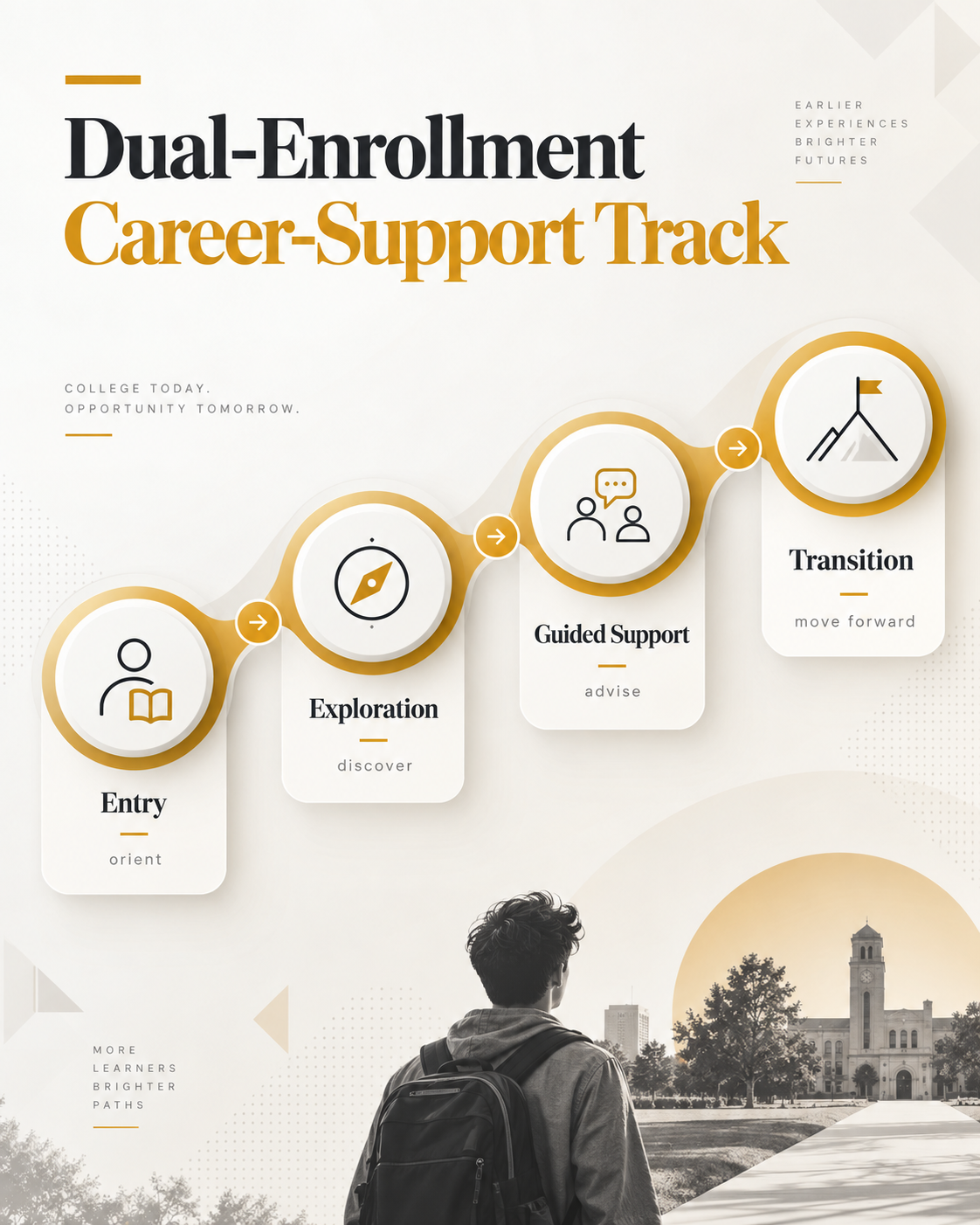
A dual-enrollment career-support track at a glance
| Stage | Primary purpose | Default career support | Primary owner | Move forward when |
|---|---|---|---|---|
| Entry | Establish orientation and access | Career-service introduction, career-resource access, initial interests and goals | Dual-enrollment team with career-center input | Student begins dual-enrollment coursework |
| Exploration | Connect coursework with possible directions | Career and program exploration, career literacy, pathway information | Career center + designated college/dual-enrollment advisor | Student identifies directions that require deeper planning |
| Guided support | Address individual career-development needs | Advisor referral, targeted career conversations, appropriate readiness resources | Career center | Student needs services beyond the baseline track |
| Transition | Move into standard college career support | Full onboarding into the institution's normal career-services sequence | Career center + receiving student-support team | Student matriculates or meets another defined transition trigger |
Why Do Dual-Enrollment Students Need a Separate Career-Support Track?
Dual-enrollment students need a separate career-support track because they are not yet traditional undergraduates, and many standard career services are either too advanced, poorly timed, or irrelevant to their immediate decisions.
A 16-year-old taking two college courses through a high school partnership may need to understand how those courses connect to degrees and occupations. They probably do not need the same recruiting sequence as a college junior preparing for internship applications.
The distinction is operational.
CCRC's Dual Enrollment Equity Pathways research treats career and academic exploration, advising, and planning as a specific component of effective dual enrollment.
Its 2025 Scale of Adoption Assessment asks colleges whether dual-enrollment students receive college advising before or during participation, career and college exploration, individualized program planning, and support at defined checkpoints.
That points toward a different model from simply granting dual-enrollment students access to the existing career center.
The career center should define a baseline dual-enrollment track first, then establish conditions under which individual students move into more specialized career support.
Our track-based community-college career-services model makes the broader case for treating dual-enrollment students as a distinct population. The next question is what that track actually contains.
A useful boundary is this: the dual-enrollment track should prepare students to understand pathways, make better education-to-career connections, and know where to seek additional support. It does not need to recreate the institution's entire undergraduate career-readiness program several years early.
This also prevents two common extremes.
One is under-service, where dual-enrollment students receive college credit but little career context around what those credits could lead toward.
The other is over-service, where students are dropped into career fairs, job-search programming, resume requirements, and recruiting tools simply because those services already exist for enrolled undergraduates.
A separate track allows the institution to sequence access instead.
Who Should Own Career Support for Dual-Enrollment Students?
No single office needs to deliver every component, but one office should be accountable for making sure the track exists.
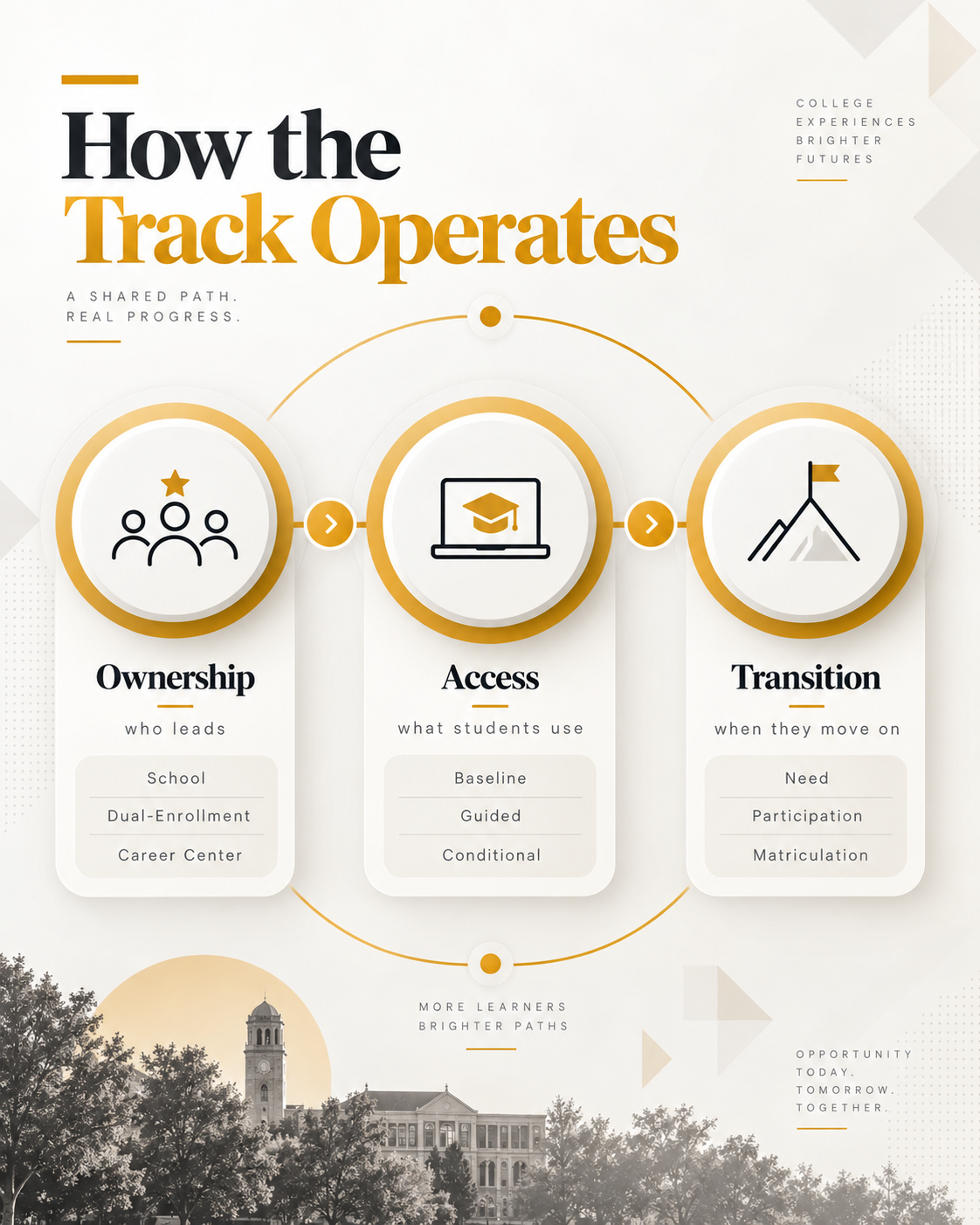
In most institutions, the dual-enrollment or K-12 partnerships team is best positioned to own the operational relationship with schools and students, while career services owns the career-development model, resources, and specialist interventions.
The high school retains responsibility for areas such as graduation planning, school-based counseling, scheduling, and other K-12 requirements.
Academic advising or program faculty should remain responsible for college program requirements, course sequencing, and academic policies.
Career services should own questions that require career-development expertise: connecting interests with occupational possibilities, helping students understand how programs lead toward careers, introducing appropriate career-readiness concepts, and taking over when a student needs more individualized career support.
This is similar to the ownership principle used between career services and academic advising: shared student support does not require duplicated responsibilities.
The important addition for dual enrollment is a coordinating layer.
CCRC's 2025 research shows several ways institutions organize that layer. Tri-County Technical College relies substantially on its regular program faculty and staff while a small specialized team handles school coordination and higher-touch support.
South Texas College uses a much larger dual-enrollment division that coordinates enrollment, advising, scheduling, student success, and school partnerships. The models differ, but both deliberately connect dual-enrollment operations with the college's core functions.
Career centers do not need to reproduce either staffing structure. They do need an explicit answer to four questions: who introduces career support, who delivers the baseline track, who receives referrals for deeper career needs, and who owns the transition into regular career services.
Without those answers, responsibility tends to default to whichever counselor, advisor, or staff member the student happens to contact first.
What Should the Dual-Enrollment Career-Support Track Include?
The track should be short enough to operate across partner schools but structured enough that students receive more than a link to the college career-center website.
A practical sequence has five components:
- Career-services orientation. Students should know that the college has career support, what it can help with, how they can access it, and which services are currently relevant to them. This is an orientation to the system, not a complete career-services onboarding.
- Career and program connection. Students should be able to see how the courses they are taking connect with college programs, broader fields, and possible occupations. CCRC specifically identifies course-to-program and program-to-career alignment as an important part of purposeful dual enrollment.
- Structured exploration. Students who are uncertain about direction should have a simple route to explore interests, skills, roles, and fields before making increasingly consequential academic choices. The dual-enrollment track only needs to establish this checkpoint. The deeper methodology can remain in the career center's existing career exploration framework.
- Career literacy. Students should acquire enough vocabulary to understand occupations, job functions, workplaces, educational pathways, and the difference between a degree, a major, and the range of careers that can follow from them. Career teams supporting students with limited exposure can use the existing career literacy framework rather than building a separate model for dual enrollment.
- Referral and next-step logic. Every baseline activity should tell the student what happens next. A student who wants to compare two programs may need an academic advisor. A student uncertain about possible careers may need a career coach. A student asking about transferability may need a different college resource. A student ready for a more advanced career-development activity may enter a higher-support tier.
CCRC's current practice assessment reflects a similar range of approaches. It asks whether colleges embed career exploration within dual-enrollment coursework, provide it through advising, offer events at high schools or on campus, provide information connecting courses to careers, and help students build individualized educational plans.
The key is not to require every student to complete every career activity.
A dual-enrollment track should establish a minimum common experience and then route students based on need.
That keeps the track scalable while avoiding a one-size-fits-all sequence for a population that may include everyone from a student taking one general education course to a senior completing a substantial portion of a technical pathway.
Which Career Services Should Dual-Enrollment Students Be Able to Access?
The simplest approach is not to decide service access one resource at a time. Career centers can establish three levels of access.
- Baseline access should cover services that help students understand pathways and make informed decisions. Career exploration resources, assessments used as conversation starters, career information, introductory workshops, occupational research, and appropriate advising referrals can usually sit here.
- Guided access can cover services whose usefulness depends on the student's situation. Resume support may make sense for a dual-enrollment student applying for a summer job, work-based learning opportunity, scholarship, or internship. Interview preparation may become relevant for the same reason. A student should not have to wait until full matriculation simply because the resource is normally marketed to undergraduates. The difference is that these services should enter in response to a real need rather than becoming mandatory milestones for the whole dual-enrollment population.
- Conditional access should cover services involving employer-facing participation, recruiting, internships, career fairs, job postings, or other activities where eligibility may depend on institutional policies, employer requirements, age, program design, risk-management rules, or the student's status.
Career centers should define those rules with the offices responsible for the relevant policies rather than allowing students or individual advisors to discover restrictions at the point of use.
This is particularly important because dual-enrollment students may be minors and because records can exist across both secondary and postsecondary systems.
The U.S. Department of Education notes that FERPA access and consent questions for dually enrolled students can depend on where records are maintained and who is requesting them.
The goal is therefore not "full access" or "limited access."
It is intentional access: students should receive the services appropriate to their current decisions, while the institution clearly defines which opportunities require additional eligibility checks or a later stage of enrollment.
How Should Career Centers Coordinate With High Schools?
Career centers should not create a second communication system that competes with the dual-enrollment relationship the institution already has with partner schools.
Career content should move through an agreed operating structure.
The college's dual-enrollment contact can remain the primary operational point of contact for the school. Career services supplies the career content, referral criteria, resource links, advisor availability, and escalation process.
High-school counselors then know which questions they can address directly and which should move to the college.
That structure becomes especially important when one college works with many schools.
Kirkwood Community College, for example, uses regional student academic support coordinators who coordinate with high schools to recruit and advise dual-enrollment students.
For career services, the equivalent is not assigning a career coach to every school.
A more scalable model is to give school partners a clear escalation path.
A high-school counselor should be able to recognize, for example, that "Which dual-enrollment course satisfies my graduation requirement?" belongs with the school or academic side, while "I like healthcare but don't know what kinds of careers exist beyond doctor or nurse" can trigger the career-support track.
Communication to students should follow the same principle.
Students should not receive the full stream of undergraduate recruiting emails simply because they now have a college email address. Messages should match the services currently available to them and identify one clear next action.
The career center can then reserve direct outreach for specific milestones, referred students, or opportunities that actually fit the dual-enrollment population.
When Should Students Move into the Institution's Broader Career-Services Ecosystem?
The transition should not depend on a single arbitrary marker such as "high school graduation." Some students will need broader support before that point. Others may participate in dual enrollment but eventually attend a different institution.
Career centers should instead define several transition triggers and use whichever becomes relevant first.
Full matriculation into the institution is the clearest trigger. A former dual-enrollment student who becomes a degree-seeking student should enter the standard career-services journey without being treated as a completely new participant.
A second trigger is career-readiness need. A dual-enrollment student pursuing a legitimate internship, work-based learning opportunity, competitive summer program, or other career-related opportunity may need access to services normally introduced later.
A third is depth of college participation. Students completing substantial credit, participating in structured career academies, or spending significant time on campus may need a different level of support from someone taking one course at their high school.
A final trigger is a significant decision point. Choosing between programs, considering whether to continue at the institution, evaluating a career pathway, or planning the transition after high school may justify specialist career support even if the student has not formally matriculated.
The transition rule should therefore be:
Move students into broader career services when their needs begin to resemble those of the population served by the standard career-services pathway, not simply when a calendar date arrives.
Once students matriculate, the institution's existing first-year career-engagement model can take over rather than extending the dual-enrollment track indefinitely.
Wrapping Up
Dual-enrollment students need a defined track that gives them the right support at the right stage, with clear ownership, appropriate access, and a deliberate handoff into broader career services when their needs change.
For career centers, the priority is consistency. Students should know what support is available, school partners should know when to refer them, and advisors should be able to see where each student is in the process rather than rebuilding context from scratch.
Hiration can support this kind of structured model with career exploration, resume and interview preparation, LinkedIn optimization, and counselor-side tools for managing cohorts, reviewing student progress, and maintaining advisor visibility across the student journey.
Book a walkthrough to see how Hiration can help your career center build a more structured, scalable support model for dual-enrollment students.