How can advisors turn career exploration into measurable student action?
Advisors can convert exploration into progress by treating interests as testable hypotheses rather than final answers. Effective action plans document target roles, evidence gaps, weekly actions, ownership, milestones, and review dates. When career centers standardize planning, follow-up, and evidence capture, exploration becomes a repeatable workflow that produces clearer decisions, stronger accountability, and measurable student advancement.
Students keep showing up with stronger awareness and weaker momentum.
They've taken an assessment, attended a panel, maybe even said they're interested in consulting, UX, policy, or biotech.
That gap is operational, not motivational.
Career centers lose value when exploration lives in intake notes, workshop attendance, or one good advising conversation and never becomes a documented sequence of decisions, experiments, and follow-up.
This guide is for career services teams that want a repeatable system. It focuses on the workflows, documentation standards, ownership rules, and KPIs that help career centers turn interest into measurable progress.

Why Does Career Exploration Fail When It Ends With Awareness?
Career exploration fails when it stops at self-knowledge because awareness alone doesn't change student behavior, advisor workflow, or institutional reporting.
It only becomes useful when the center turns insight into a documented decision, a near-term experiment, and a scheduled follow-up that someone owns.
Most centers already do the front half reasonably well. The assessment sits in the appointment summary, but no one converts it into a role hypothesis, an evidence-gathering task, and a decision deadline.
That's why exploration often feels productive in the room and stale a week later.
What the breakdown looks like in practice
A common pattern goes like this:
- The student leaves encouraged: They feel seen, and they've named a few possible directions.
- The advisor logs broad notes: “Interested in marketing, communications, or nonprofit work.”
- No next experiment gets assigned: There's no informational interview target, no research prompt, no skill-gap review.
- The next appointment starts over: The advisor redoes discovery instead of reviewing evidence.
That loop is expensive. It consumes staff time, makes progress hard to measure, and leaves centers reporting activity instead of advancement.
For career centers, the useful takeaway is that exploration needs visible activity structure before it can become an accountable plan.
Practical rule: If a coaching session ends without a decision, a task, and a date, the student is still exploring in theory.
A structured career coaching session template can help advisors make that close more consistent across 30- and 45-minute appointments.
If the center only tracks attendance, appointment volume, or assessment completion, it can't show whether students are advancing toward internships, applications, or informed career choices.
What actually changes the outcome
The fix isn't a better assessment. It's a better operating model.
The U.S. Department of Labor frames O*NET Career Exploration Tools as self-directed tools that help workers and students consider career options, preparation, and transitions.
That supports the operating point: assessment should feed a planning workflow, not sit as a one-time activity.
For many teams, the bigger shift is cultural.
Exploration can't be treated as a soft, open-ended stage that students leave “when ready.” It needs milestones. It needs evidence. It needs review dates.
One useful companion lens is this analysis of career services challenges in higher education, especially if your center is trying to reduce repeated intake conversations and create more consistent advisor workflows.
What doesn't work
Three practices usually undercut progress:
- Assessment without interpretation Students get results, but no one translates themes into occupational options or tests.
- Options without ranking Everything stays equally possible, so nothing gets tried.
- Follow-up without documentation Advisors remember the conversation, but the student doesn't have a usable plan.
If awareness is the endpoint, exploration becomes a parking lot. If awareness is the input to a documented workflow, it becomes career planning.
What Key Decisions Must a Student Action Plan Capture?
A student action plan should capture decisions, not aspirations.
At minimum, it needs a target role hypothesis, evidence to gather, experiences to pursue, skills to build, people to contact, and a deadline for reviewing what was learned and what changes next.
The fastest way to improve plan quality is to stop calling everything “next steps.” A real plan records what the student is deciding, what evidence would change that decision, and what action must happen before the next appointment.

The six decisions every plan should include
The operational point for career centers: assessment should lead to occupation matching and next-step planning, not just self-description.
Use that logic to require these fields in every plan:

What a complete plan sounds like
Weak plan: “Explore communications careers and network more.”
Strong plan: “Test internal communications and employer branding as target paths.
Review role descriptions, complete two informational interviews with alumni in those functions, compare required writing and analytics skills, and decide which path to prioritize by the next advising meeting.”
That difference matters because it gives the advisor something to review besides effort.
A plan should be detailed enough that if the assigned advisor is out, another staff member can continue the coaching conversation without redoing discovery.
This is where career coaching case note templates can help teams preserve continuity without turning every appointment into a long narrative record.
A simple documentation standard
Require every action plan to answer these prompts before the appointment closes:
- What am I testing
- Why this option is plausible
- What evidence I still need
- What action I will take next
- When I will do it
- What would make me keep, revise, or drop this option
That's enough structure to make plans reviewable without turning them into case files.
How Can Advisors Translate Student Interests into Weekly Actions?
Advisors should translate interests into weekly actions by treating each interest as a testable hypothesis.
Move students through a short sequence: define the hypothesis, gather evidence, try one experience, record what changed, and set the next review point before they leave the appointment.
“Interested in marketing” is not actionable.
“Testing content marketing versus product marketing by reviewing job postings, speaking with practitioners, and completing one small content sample” is.
Use a hypothesis script in every coaching session
A script helps advisors avoid broad encouragement and get to movement quickly.
Try this sequence:
- Name the hypothesis “What role or field do you think might fit, based on what you know now?”
- Define the evidence gap “What do you still need to know before you can take this option seriously?”
- Assign the smallest useful test “What can you do in the next week that would give you real evidence?”
- Set the review standard “What should be recorded afterward so the next appointment can focus on what changed?”
Here's the operational move that improves consistency. End every appointment with a “next physical action,” not a broad intention.
- Instead of “Network with alumni” Use “Find three alumni with recruiting, analyst, or coordinator titles. Send outreach to two by Thursday.”
- Instead of “Learn more about UX” Use “Review five entry-level UX or UX research job descriptions and list the recurring tools, portfolio expectations, and common skill requirements.”
- Instead of “Build experience” Use “Identify one campus office, student organization, or faculty project where you can do a communications, research, or data-related task this month.”
What weekly action planning should look like

Named examples matter because this has to fit real campuses.
UCLA’s career planning guidance points students toward informational interviews, internships, part-time work, volunteering, career fairs, and career-related programs.
Pair that with UF’s Career Action Plan model and the takeaway is simple: a student plan should turn reflection into activities that can be reviewed in the next appointment.
A worksheet can make this easier for staff.
This goal-setting worksheet for higher ed career centers is the kind of artifact that helps standardize what happens after a student says, “I'm not sure, but maybe this.”
How Should Career Centers Assign Ownership Across the Ecosystem?
Career centers should assign ownership by making the student responsible for actions, the advisor accountable for plan continuity, faculty consulted on academic alignment, and employers or alumni engaged at defined points for validation, exposure, and feedback.
Without role clarity, tasks drift and follow-up gets dropped.
Many plans fail because everyone is “supporting” the student but no one owns the workflow. The result is familiar. Faculty assume the career center will handle it.
Advisors assume a course, internship office, or mentor will reinforce it. Employer relations teams hear about the student only when they're applying late.

Use a simplified RACI for student planning

What this looks like on campus
Drexel’s co-op model is useful because it makes ownership visible: students act, advisors guide progression, and employers validate readiness.
Even without a co-op structure, the lesson transfers. When exploration moves toward experience, someone must own the handoff.
UCLA shows a similar distributed model through interviews, work, volunteering, and fairs. UF’s Career Action Plan reinforces the plan as the anchor across offices, advisors, and student touchpoints.
Management test: If a student misses a milestone, can your team say exactly who was supposed to notice, respond, and reset the plan?
For institutions building service tiers, this tiered student support model for higher education offers a useful frame for deciding which students need lighter-touch action planning and which need structured case management.
A workable ownership rule
Keep the rule simple:
- The student owns the work
- The advisor owns the plan
- Faculty clarify academic relevance
- Employers and alumni validate reality
That single distinction prevents a lot of dropped handoffs. If faculty are part of the handoff, career assignments embedded in coursework can create low-lift ways to turn exploration into graded, visible outputs.
How Can Advisors Follow Up Without Making Action Plans Feel Like Compliance?
Advisors can follow up without creating compliance fatigue by reviewing learning, not just task completion.
The tone should be “What did you notice, what changed, and what do we test next?” rather than “Did you do the assignment?” Students stay engaged when follow-up preserves agency and interpretation.
This is especially important after exploratory tasks like informational interviews.
If the follow-up only checks completion, students learn to perform activity. If it asks what evidence emerged, they learn to make decisions.
Compare compliance follow-up with coaching follow-up

Copy-ready follow-up prompts
Use prompts that keep the center of gravity on decision quality.
- After role research “Which target looks stronger now, and what evidence led you there?”
- After an informational interview “What surprised you about the day-to-day work, and what follow-up will you send within a day?”
- After no progress “Was the task unclear, too large, or no longer relevant?”
- After a pivot “What changed your thinking, and what path deserves the next test?”
Follow-up should feel like supervision of thinking, not surveillance of effort.
A short email can do this well:
Subject: Quick check on your career test
Hi [Student Name], You don't need a polished update. I'd like to know what you learned from the task you chose, what feels clearer now, and what you want to test next. If the original step no longer fits, reply with what changed and we'll adjust the plan.
That framing lowers the emotional cost of not having a perfect result.
What not to do
Avoid these habits:
- Stacking too many tasks: Students stop distinguishing critical actions from optional ones.
- Treating every missed task as low motivation: Sometimes the task was oversized or poorly defined.
- Ignoring relationship follow-through: If a student has an informational interview, the thank-you and update matter because they extend the relationship.
The advisor's posture matters. A good follow-up says, “Bring back evidence, not excuses.” That's demanding without being punitive.
What Metrics Indicate a Student Is Moving from Exploration to Action?
Students are moving from exploration to action when the center can see documented plans, milestone completion, evidence of external testing, and regular plan revisions.
The most useful metrics are leading indicators that show progression before internships, applications, or destination outcomes appear.
Many centers default to easy counts.
Workshop attendance, resume reviews, and appointment totals are useful service metrics, but they don't tell you whether exploration is converting into action.
The better dashboard tracks movement through milestones.

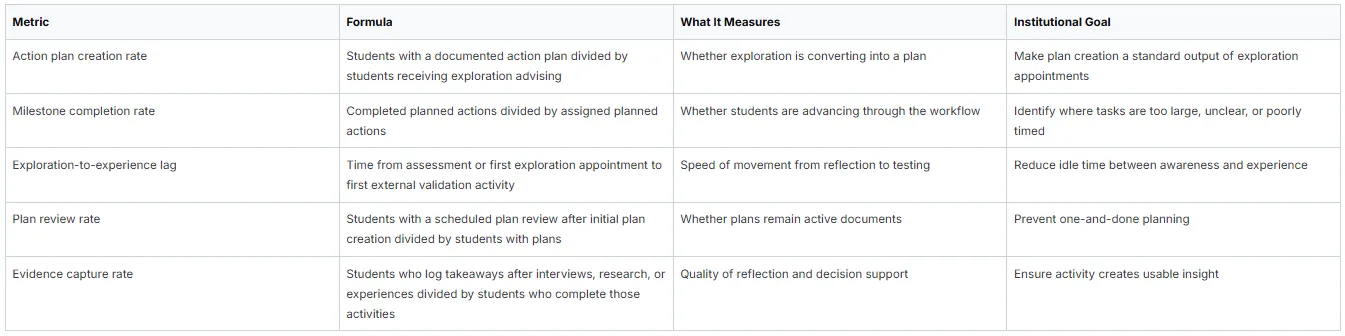
A useful KPI dashboard
What each metric reveals
If action plan creation rate is weak, advisors may be ending sessions with discussion instead of documented decisions.
If milestone completion rate is low, the issue is often task design. Students may be leaving with broad assignments rather than small, clear actions.
If exploration-to-experience lag is long, your center may be overinvesting in workshops and underusing job shadowing, informational interviews, campus projects, or employer touchpoints.
If evidence capture rate is poor, students may be doing the activity but not retaining what they learned. That creates repetitive advising because every meeting starts from memory.
What to instrument operationally
Track these fields in your CRM, advising notes, or planning tool:
- Plan status
- Current target roles
- Next milestone
- Due date
- Completion status
- Reflection captured
- Next review date
That's the minimum viable pipeline.
For centers trying to manage this across large cohorts, one option is to use a platform that combines student task tracking with counselor oversight.
The relevant point here isn't the brand. It's the operating model: advisors need one place to see who has a plan, who's stalled, and which milestone is slipping. The broader issue is covered well in this guide to career center metrics.
Track whether a student produced evidence, not just whether they showed up.
Wrapping Up
Turning reflection into action requires more than better advising conversations.
Career centers need a clear operating model: documented plans, visible milestones, advisor-owned follow-up, and progression signals that show whether students are moving from interest to evidence.
Hiration supports that operating model through a full-stack career readiness suite that spans assessments, resume optimization, interview simulation, LinkedIn support, cover letters, and counselor workflows.
Its higher education suite also includes a dedicated Counselor Module for cohort management, workflow tracking, and analytics within a secure, FERPA and SOC 2-compliant platform.
The goal is not to collect more data for its own sake.
It is to help advisors see who has a plan, who is stalled, which milestone is slipping, and where support should be routed next. As covered in our guide on career center metrics, the strongest teams track progression, not just participation.
Career Exploration Action Plans — FAQs
Why does career exploration often fail to create momentum?
Exploration frequently stops at awareness. Students gain insight but leave without documented decisions, evidence-gathering tasks, ownership, or follow-up timelines.
What should every student action plan include?
A strong plan includes a target role hypothesis, evidence to gather, experiences to pursue, skills to build, people to contact, review dates, and decision criteria.
Why are role hypotheses more useful than career interests?
Interests are broad. Role hypotheses create a specific pathway that students can research, test, compare, and either strengthen or revise with evidence.
How should advisors translate interests into weekly actions?
Advisors should assign small, specific tasks such as reviewing job descriptions, conducting informational interviews, completing projects, or identifying skill requirements for a target role.
What is the best way to structure career coaching conversations?
Effective coaching follows a sequence: define the hypothesis, identify evidence gaps, assign a small test, establish review criteria, and schedule a follow-up discussion.
Who should own different parts of the action-planning process?
Students own the work, advisors own plan continuity, faculty support academic relevance, and employers or alumni help validate career realities and expectations.
How can advisors follow up without creating compliance fatigue?
Follow-up conversations should focus on learning, evidence, and changed thinking rather than simply checking whether students completed assigned tasks.
What makes a career action plan reviewable?
Plans should clearly state what is being tested, why it is plausible, what evidence is needed, what action comes next, and how decisions will be evaluated.
What metrics indicate students are moving from exploration to action?
Useful indicators include action plan creation, milestone completion, informational interviews, experiential learning participation, reflection capture, and plan revisions.
What is the biggest strategic shift advising teams should make?
Advising teams should move from documenting interests and appointments toward managing visible action plans, milestones, evidence collection, and decision-making progress.