A student shows you an application notice saying the employer uses AI to evaluate candidates and asks a seemingly simple question: “Should I opt out?”
Your role is not to make that choice for them. It is to help them understand what the employer is actually asking, what the AI does, what may change if they opt out, and what the employer has or has not disclosed about the consequences.
That distinction matters because “AI screening” can mean very different things. One system may score a resume against job requirements. Another may categorize candidates for a recruiter. Another may analyze an assessment or assist with an interview. Employers also handle opt-outs differently.
So instead of relying on assumptions about AI hiring, you need a consistent way to separate documented process from speculation.
This guide explains how career advisors can interpret AI screening notices with students, answer common opt-in and opt-out questions, identify when more information is needed, and build a consistent advising response across the career center.
| When a student asks... | Establish first... | Avoid assuming... |
|---|---|---|
| “What is this AI doing?” | What information it evaluates and what output it produces | That every AI system automatically rejects applicants |
| “What happens if I opt out?” | Whether the employer describes manual review or another assessment | That opting out removes the student from consideration |
| “Will opting out hurt me?” | Whether the employer explicitly addresses candidate impact | That the outcome is either better or worse when the disclosure is silent |
| “I cannot use this assessment as designed.” | Whether an accommodation process applies | That an AI opt-out and an accommodation request are the same |
| “What should I keep?” | The notice, job posting, opt-out instructions and confirmation | That the same information will remain available later |
How Should Advisors Explain What “AI Screening” Actually Means?
Start by establishing what the technology actually does in that particular hiring process. Do not treat “AI screening” as one activity. The system may score, categorize, match, summarize or evaluate candidate information, and those differences affect what opting out may mean.
A student may read an AI notice and immediately assume that a machine is deciding whether their application gets rejected.
The employer's documentation may describe something more specific.
For example, Accenture's Hiring Process AI FAQ explains that its HiredScore system can generate a grade based on information supplied by the candidate and the requirements of the role.
Greenhouse's Talent Matching FAQ describes another model. Talent Matching evaluates resumes against employer-defined criteria and places applicants into match categories for recruiters. Greenhouse states that Talent Matching does not automatically advance or reject applicants.
HireVue's AI Interviewer operates at another stage of recruiting, using AI to assist with interview qualification and skill evaluation while recruiters retain the final hiring decision.
An employer may also use AI for several different purposes. In its Candidate Legal Notices, Datadog says automated tools may be used to highlight candidates, assess application or assessment information, transcribe interviews, or generate interview summaries.
That gives you a better starting question than:
“Are you comfortable being screened by AI?”
Instead, help the student establish:
“What does the employer say this particular technology will do with your application?”
Once you know that, you can have a much more useful conversation about the opt-out.
What Should Advisors Tell Students May Happen If They Opt Out?
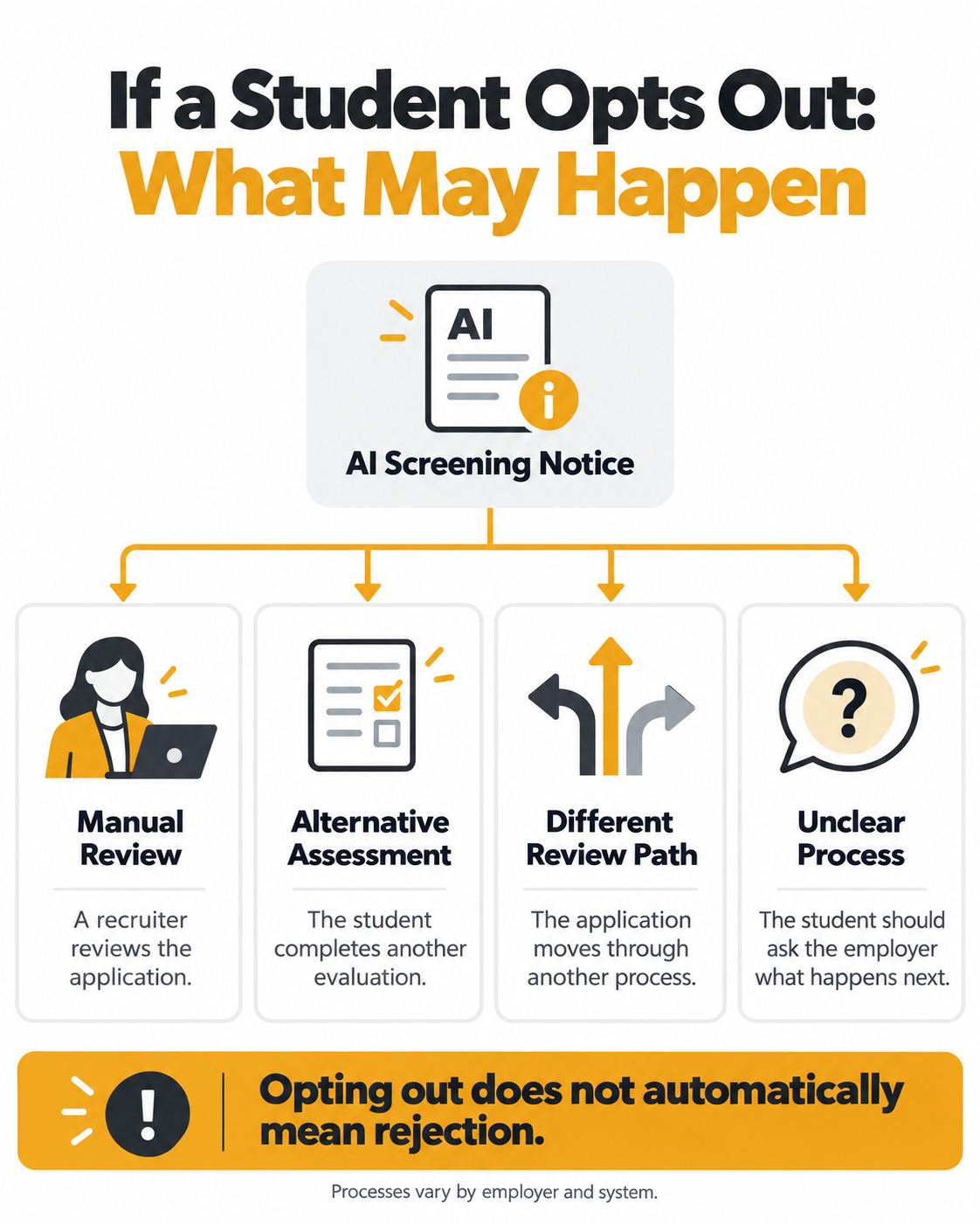
Explain that opting out does not produce one standard result. Depending on the employer and system, the student may receive manual review, complete an alternative assessment, move through another review process, or need to ask the employer what happens next.
Use the employer's documented process rather than generalizing from another company.
For example:
| Documented example | AI use | What the documented opt-out process indicates |
|---|---|---|
| Accenture | HiredScore grades application information against role requirements | Recruiting team reviews the candidate information without the AI grade |
| Greenhouse Talent Matching | Creates match categories for recruiters | When employer-enabled, opt-out applicants are flagged for manual review |
| HireVue AI Interviewer | AI-assisted interview qualification and skill scoring | HireVue describes AI and non-AI routes within its candidate process |
| Datadog | AI may highlight candidates, assess information, transcribe interviews or create summaries | Datadog says opting out where available does not affect candidacy |
Sources: Accenture, Greenhouse, HireVue, and Datadog.
The important advising point is not that these employers represent how every opt-out works.
They show why you cannot assume opting out means withdrawing from the hiring process.
They also show why you should not tell a student, “Don't worry, a recruiter will just review your application manually,” unless that employer actually says so.
Even the availability of an alternative process needs careful wording.
New York City's rules for certain automated employment decision tools, for example, require covered employers to provide specified notices.
The adopted rules address instructions for requesting an alternative selection process or reasonable accommodation, if available, but they do not themselves require an employer to provide an alternative selection process.
So do not turn “you may request another process” into “you are guaranteed another process.”
How Should Advisors Answer “Will Opting Out Hurt My Chances?”
While you cannot predict how opting out will affect a student's application unless the employer explains the process, you can establish what the employer has actually said. Some employers explicitly state that opting out will not disadvantage candidates. If the employer says nothing about the impact, treat that as an unknown rather than filling the gap yourself.
This is likely to be the hardest question students bring to you because they are asking for a prediction, not simply an explanation.
Start with the documented information.
Accenture states in its Hiring Process AI FAQ that candidates who opt out of its AI screening process will not be disadvantaged and that its recruiting team will instead review and process their information.
Datadog similarly states in its Candidate Legal Notices that, where an opt-out is available, choosing it will not affect candidacy.
These examples let you correct one assumption confidently:
Opting out of AI screening does not automatically mean opting out of consideration.
But do not stretch those examples into a universal promise.
If another employer only provides an “Opt out” button and says nothing about what happens afterward, you do not know whether both routes are handled identically.
Tell the student what is known:
“The employer gives you an opt-out option, but I don't see anything here explaining whether or how the evaluation process changes. We shouldn't assume either way.”
That is much more useful than reassuring the student without evidence or warning them about a disadvantage you cannot verify.
This question is becoming more relevant for career teams. In May 2026, NACE reported research in which more than 40% of surveyed students said they had declined an opportunity involving an AI-powered prerecorded video interview.
The same article reports concerns among students around fairness, authenticity and privacy.
When those concerns reach an advising appointment, your value lies in separating a student's understandable reaction to AI from what the employer's actual process says.
What Should Advisors Review With Students Before They Make a Decision?
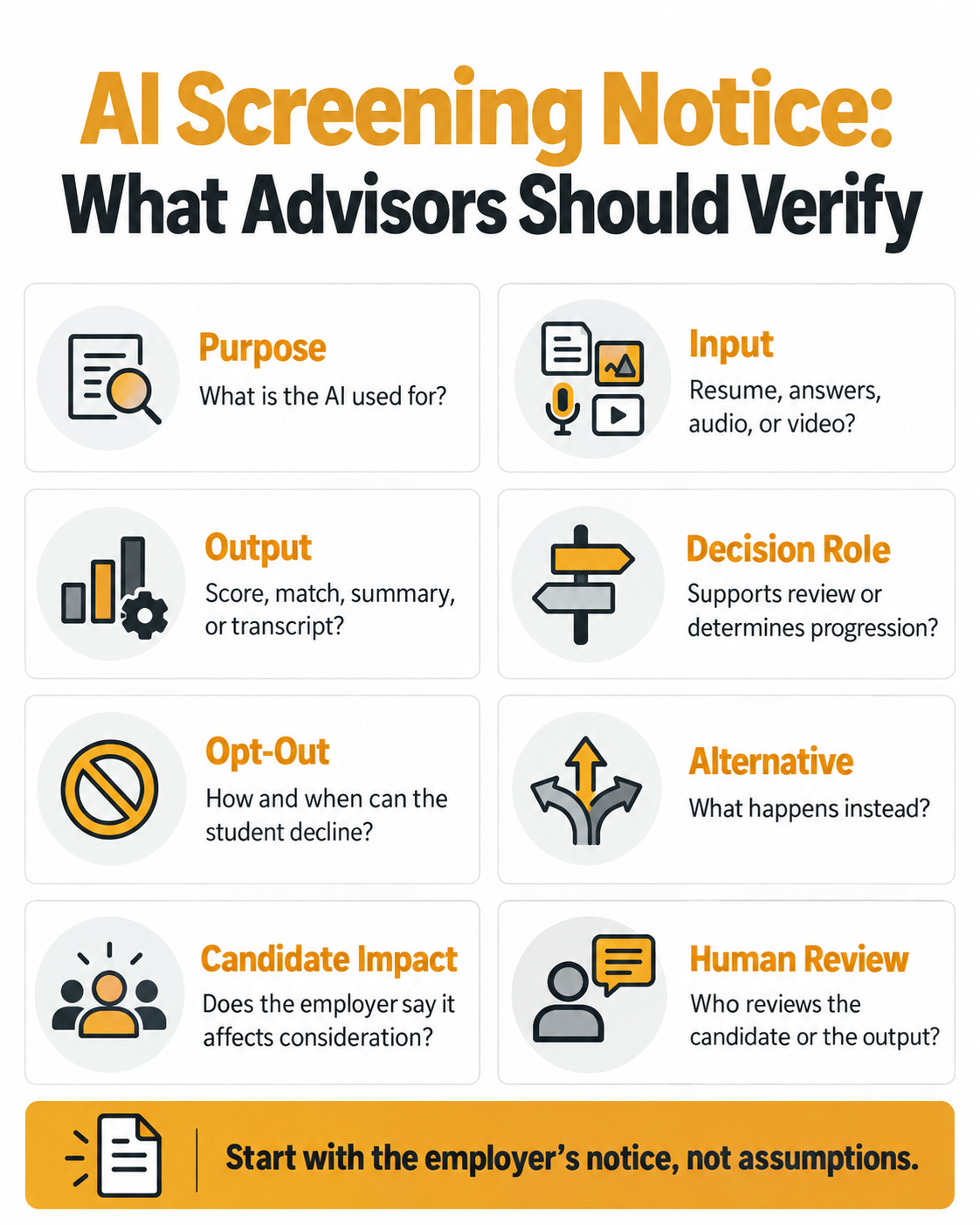
Walk the student through the disclosure rather than jumping directly to whether they should opt in or out. Establish what information the AI uses, what output it produces, how that output enters the hiring process, what opting out changes, and whether the employer explains human review, accommodations or data practices.
A simple review framework can keep the conversation focused:
| Check | What you are trying to establish |
|---|---|
| Purpose | What is the AI being used to do? |
| Input | Is it evaluating a resume, application response, assessment, audio, video or something else? |
| Output | Does it produce a score, category, recommendation, transcript or summary? |
| Decision role | Does the output support a recruiter or determine progression in the process? |
| Vendor | Is another company processing the student's information? |
| Opt-out | How and when can the student decline? |
| Alternative | What happens instead of the AI evaluation? |
| Candidate impact | Does the employer say whether opting out affects consideration? |
| Human review | Who reviews the candidate or the AI output? |
| Accommodation | Is there a separate process for requesting one? |
| Data | What does the notice say about collection, retention or privacy requests? |
| Contact | Who can answer questions the disclosure leaves unresolved? |
You will not find every answer in every notice. That is useful information in itself.
If the employer explains what the AI does but does not explain what happens after an opt-out, mark that as unresolved rather than trying to infer the answer.
You can also encourage the student to retain the relevant notice, job posting, privacy statement, opt-out instructions and any confirmation they receive.
Greenhouse, for example, advises candidates using its opt-out functionality to retain the confirmation email.
How Should Advisors Respond When the Employer's AI Disclosure Is Vague?
Do not guess. Help the student ask the employer a narrow process question. Focus on what changes after an opt-out, what alternative evaluation is used, whether the same application remains under consideration, and where accommodation questions should go.
For example, you can guide the student to ask:
“I am reviewing the AI screening notice for this position. If I choose not to participate in AI-assisted evaluation, could you clarify what alternative review or assessment process will be used and whether I will continue to be considered for the same position?”
This works better than trying to get the employer to answer a broad question like:
“Will opting out hurt my chances?”
A process-specific question is more likely to produce information the student can actually use.
You can also help the student ask:
- What information does the system evaluate?
- What output does it provide to the recruiting team?
- Does a recruiter review that output?
- What process applies if the student opts out?
- Is there a separate accommodation process?
Some employers already publish this level of detail.
Accenture identifies its screening provider and explains what happens when candidates opt out.
Datadog describes several ways automated tools may be involved in recruiting and addresses the effect of opting out where that option is available.
Visa's Candidate Privacy Notice describes uses including candidate identification against role requirements, suggested job matches, suggested skills and AI-assisted interview transcription, while stating that hiring decisions involve human judgment.
Use disclosures like these as examples of the information you are looking for, not as evidence of how another employer necessarily operates.
How Can Career Centers Build a Consistent Advising Approach to AI Screening?
Create a shared process for how your team reviews AI screening notices, verifies employer-specific information, handles unclear disclosures, and escalates accommodation or legal questions. This helps advisors give students consistent guidance without relying on individual assumptions.
A basic process could look like this:
| Advising stage | What your team should do |
|---|---|
| Identify | Ask the student to show the exact notice, application language or assessment invitation |
| Classify | Establish whether the AI is matching, scoring, ranking, interviewing, summarizing or performing another function |
| Verify | Check current employer and vendor documentation |
| Compare | Establish what changes between the AI and opt-out routes |
| Separate | Distinguish a general AI concern from a potential accommodation issue |
| Clarify | Help the student ask the employer when important information is missing |
| Document | Save frequently encountered employer/vendor disclosures with source dates |
| Escalate | Route legal interpretation or institution-level policy questions to the appropriate campus office |
You do not need to maintain a database of every hiring AI product. Start with the systems and employers your students encounter most often.
For each one, record:
- what the system does;
- what information it uses;
- what the employer says about opting out;
- what alternative process is described;
- what the employer says about candidate impact;
- the original source;
- and when your team last verified it.
The verification date matters because both hiring technologies and employer policies can change.
It can also help to give advisors a few approved responses for common questions.
For example:
“We can help you understand what the employer has disclosed, but we shouldn't predict an effect the employer hasn't explained.”
Or:
“Opting out does not automatically remove you from consideration. Some employers explicitly provide manual or alternative review, but let's check what this employer says happens.”
Those responses create consistency without asking individual advisors to become experts on every hiring system or emerging AI regulation.
To Sum Up
When a student asks whether to opt in or out of AI screening, you do not need to decide for them.
You need to help them get to a better-informed decision.
That means establishing what the AI is doing, what the employer says will happen if they decline it, whether candidate impact is addressed, what remains unknown, and whether an accommodation process is relevant.
As employers introduce AI at different stages of recruitment, having a shared advising framework also helps your career center avoid inconsistent answers based on individual assumptions.
Technology can handle more repeatable parts of career preparation, but questions like these still require context, judgment and advisor involvement.
Hiration supports this model with AI-powered tools for resumes, interviews, LinkedIn profiles, and cover letters, alongside counselor visibility and controls that help teams stay involved in student progress without adding more manual review.
Book a walkthrough to see how Hiration can help your team scale AI-powered career support while keeping advisors in control.