How can advising teams help students compare career options more effectively?
Advising teams can improve career decision-making by replacing the search for a single perfect path with a structured comparison process. Effective frameworks help students evaluate daily work, demonstrated skills, work environments, economics, and long-term trajectory while documenting evidence, weighing trade-offs, and building a defensible shortlist. The result is stronger decision quality, clearer next steps, and more consistent advising outcomes.
Students don't usually fail at career choice because they lack options. They fail because they can't compare options well.
Students often arrive with options, but no decision process: one is split between plausible paths, another is attached to a job title they barely understand.
That distinction matters institutionally.
If advising stays at the level of “explore your interests,” students leave with more inputs but not better judgment.
This guide helps career centers structure role comparison, trade-off analysis, shortlisting, and evidence-based career decision review.
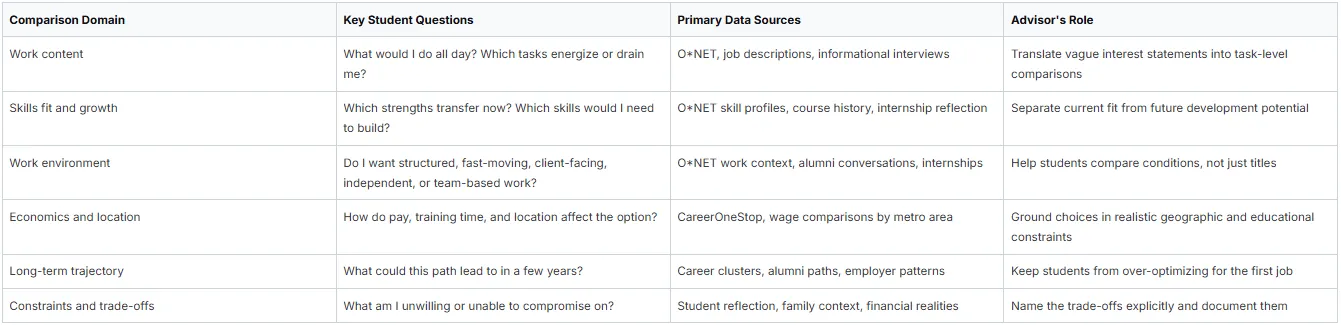
The Career Comparison Framework at a Glance
A usable comparison model has to be simple enough for frontline advising and structured enough for institutional consistency.
The table below works well as a common advising language across coaches, career courses, peer educators, and faculty partners.
Teams that need routing logic before comparison work can pair this model with an advising decision framework for career centers.
Why Is Comparison More Effective Than Seeking One Perfect Path?
Advisors improve career decision-making when they structure comparison across viable paths, not certainty around one ideal role.
Comparison reduces fantasy, surfaces trade-offs, and creates evidence students can act on.
It also aligns with what career centers can scale consistently through advising, labor-market tools, internships, and structured reflection.
The “find your passion” frame sounds student-centered, but it often creates paralysis. Students interpret it as a demand for emotional certainty before action.
In practice, many of them need permission to hold two or three good options at once while they test assumptions.

What the outcomes data suggests
Structured engagement matters.
The broader pattern is clear: students benefit when career centers move them through more than one touchpoint. Comparison advising works best when it connects exploration, research, reflection, and next-step planning rather than ending after one appointment.
That finding doesn't prove that comparison advising alone caused the difference. It does support a broader operational point.
Students benefit when the center moves them through multiple forms of engagement instead of a single appointment or one-off workshop.
Practical rule: If a student can name only one career target after an early advising interaction, the center usually doesn't have enough evidence yet.
What comparison gives advisors that “passion” doesn't
Comparison is more coachable because it creates observable behaviors:
- Students gather evidence: They review role descriptions, wage data, and training paths.
- Students test assumptions: They compare what they imagined with what professionals do in practice.
- Students narrow with reasons: They can explain why one option is stronger, not just why another sounds exciting.
This is also a better institutional story.
Career centers aren't in the business of delivering revelation. They're in the business of helping students make informed choices that connect interests, constraints, experience, and opportunity.
What Criteria Should Students Use to Systematically Compare Career Options?
A workable comparison framework should use five domains: daily work, demonstrated skills, work environment, economics, and long-term trajectory.
These domains give advisors a shared scoring structure and help students compare options with evidence rather than preference alone.
The goal is not to force a perfect answer in one meeting.
It is to create a decision record that shows why one path is stronger, what trade-offs the student understands, and what next steps should follow.
Compare the work itself
Students often compare titles. Advisors need them to compare the underlying work.
Two roles can sound similar and still produce very different weekly experiences.
A student interested in "helping people," for example, may place academic advising, human resources, and customer success in the same mental category.
Once students review common tasks, pace, communication load, conflict level, documentation requirements, and performance expectations, the differences become clearer. Teams can use career exploration activities to turn that comparison into evidence instead of reflection alone.
Use prompts such as:
- Task reality: What would fill most of a normal week?
- Energy pattern: Which activities would hold attention over time, and which would drain it?
- Output type: Does the role primarily produce analysis, service, coordination, design, sales, or decisions?
- Work context: How much ambiguity, interruption, or emotional labor comes with the job?
Advising becomes stronger at this point because students move from choosing an identity to evaluating the work they would actually do.
Separate present fit from future fit
Centers should score both current readiness and longer-term interest.
A stronger advising question is: "Could this be a good long-term direction, and is it a realistic near-term target?" Those are different tests.
One looks at motivation and possible growth. The other looks at evidence.
Ask for evidence in three categories:
- Current proof: Which relevant skills has the student already demonstrated through coursework, jobs, projects, leadership, or internships?
- Gap size: Which missing qualifications can be built during college, and which require additional time, credentials, or specialized training?
- Willingness to invest: Does the student want the preparation process enough to complete it?
Students need a visible gap analysis, not a vague sense that a path sounds promising.
Bring Environment and Economics Into the Comparison Early
Centers often leave practical constraints for the end. That creates rework.
By the time cost, location, scheduling, or entry barriers enter the conversation, the student may already be committed to an option that does not fit their circumstances.
Environment and economics should enter the comparison early because they determine viability, not just preference.

This is also where institutional equity matters.
Students facing financial pressure, caregiving responsibilities, visa constraints, or location limits are not less engaged in exploration.
A scalable advising framework should bring those constraints into the comparison process instead of treating them as exceptions or late-stage concerns.
Use criteria that can be scored
If a center wants consistent advising quality across staff, each criterion needs a simple rating method.
Ask students to rate each path as low, medium, or high fit across the five domains, then attach one evidence point to each rating.
That turns preference into a documented comparison. It also gives the center something to audit.
Advisors can use advisor oriented exploration questions to check whether students are citing job descriptions, internships, informational interviews, coursework, or labor-market research before scoring options.
How Can Career Centers Help Students Identify and Weigh Trade-Offs?
Career decisions improve when students name trade-offs directly and rank what matters most.
The right question isn't “Which option is best?” It's “Which option gives me the mix of tasks, conditions, preparation, and future possibilities I'm most willing to accept?” That's where advising becomes concrete.
Students then leave with a stack of notes and no basis for choice.
A simple decision matrix fixes that. It doesn't need to be mathematically complex. It just needs to force prioritization.

Use a weighted comparison worksheet
Ask students to list two or three options across the top.
Down the side, include personal criteria divided into requirements and preferences.

The scoring matters less than the discussion that follows.
If a student says social impact is essential but gives the highest weight to compensation and remote flexibility, you've found the core advising conversation.
What a good advisor does in this moment
A strong coach doesn't argue a student out of values.
They test whether the student understands the cost of those values in each path.
For example, Wake Forest University is often associated with reflective career narrative work. Don't ask students only what they want. Ask what they're willing to trade to get it.
Useful prompts include:
- Constraint check: What would make this option unworkable for you?
- Regret test: If you chose this path, what would you be giving up?
- Reality test: Which criterion matters on paper, but not enough to drive your behavior?
For location-sensitive roles, career centers can pair metro-level compensation, training requirements, and internal internship data with salary data advising practices so trade-offs are discussed before students overcommit to a path.
A trade-off named early is better than a surprise discovered after graduation.
What Is the Process for Turning Broad Comparisons Into a Viable Shortlist?
Career centers should move students through a defined sequence: build an option set, run a short comparison sprint, and end with a documented shortlist.
That process keeps exploration from drifting.
It also gives advisors clear checkpoints for intervention, follow-up, and measurement across different student populations.

Step one builds an option set
Start with three to five distinct paths.
Distinct matters. “Marketing at a startup” and “marketing at a nonprofit” may be useful later, but early comparison works better when the roles differ enough to reveal preference patterns.
Schools such as Louisiana State University have publicly highlighted using O*NET, occupational research tools, and LinkedIn-style career research in exploration workflows.
The transferable lesson is to combine role research with real people data, not rely on assessments alone.
Step two creates a comparison sprint
Give the student a bounded assignment window.
Two to four weeks is often enough for focused exploration, but the key point is the structure, not the duration.
Ask the student to complete:
- Role research: Review task, skills, and work context for each option.
- Market review: Compare wages, training, and location factors.
- Human evidence: Conduct informational conversations with alumni or professionals.
- Experience signal: Attend a relevant employer event, class talk, or industry panel.
Teams can make the sprint measurable by tying role research, informational interviews, employer panels, and reflection to a structured networking instruction model.
A simple outreach note works well:
Hello [Name], I'm a student exploring possible career paths in [field]. I'm comparing a few roles and hoping to understand your day-to-day work, how you entered the field, and what skills matter most early on. Would you be open to a brief conversation?
Step three ends with a documented decision
The final appointment should produce a record.
That record can include the top option, secondary option, top evidence used, biggest trade-off accepted, and next actions.
A center can't assess whether students are making stronger decisions if the advising note says only “discussed careers.”
What Metrics Indicate a Student Has Made an Evidence-Based Career Choice?
Start with decision quality, not enthusiasm.
An evidence-based choice is visible when a student can name the selected path, explain why it outranks close alternatives, identify the trade-offs they are accepting, and point to the evidence they used.
That standard gives advisors something concrete to assess and gives directors a cleaner outcome than vague notes about “career exploration.”
The practical test is simple.
If two advisors reviewed the same student summary, they should reach roughly the same conclusion about whether the student made a reasoned choice. That is why centers need a shared rubric.
Use a decision articulation rubric
A rubric turns judgment into a measurable advising output. It also helps teams calibrate quality across staff, peer advisors, and cohorts.
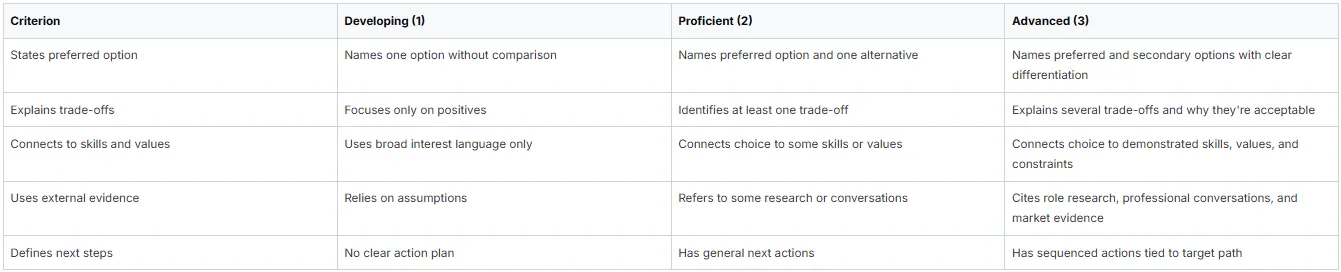
For implementation, score the rubric at the end of the comparison process, not at intake.
Centers that want cleaner assessment data can also score a sample of advising notes each term to check whether staff are applying the standard consistently.
Track center-level indicators that support the rubric
The student-level rubric is the primary measure.
Center-level indicators show whether the process around that decision is working at scale.
Useful indicators include:
- percentage of students who finish advising with a documented first and second option
- percentage who cite at least two external evidence sources
- average rubric score by class year, major, or advising channel
- conversion from comparison advising to next-step action, such as internship applications, networking outreach, or skill-building plans
- advisor consistency rates from periodic note audits
These measures can come from advising notes, workshop logs, appointment data, and follow-up forms. More importantly, they shift reporting from satisfaction to decision quality: did the student leave with a supported choice and viable action plan?
Our guide on career center analytics framework can help teams connect those signals to engagement, readiness, dashboards, and outcomes.
If a student cannot explain why one path ranks above another, the center should code that case as still in comparison, not yet decided.
Wrapping Up
Career comparison works best when it gives students more than encouragement. It gives them language, evidence, trade-off awareness, and a clear way to move from broad interest to informed action.
For career centers, the priority is to make that process repeatable across advising appointments, workshops, courses, and follow-up workflows. Students should not leave with only a list of possible paths. They should leave with a supported choice, a secondary option, and next steps they can explain.
Hiration supports that broader journey with a full-stack career readiness suite spanning Career Assessments, AI-powered Resume Optimization, Interview Simulation, and more, along with a separate Counselor Module to manage cohorts, workflows, and analytics within a secure, FERPA and SOC 2-compliant platform.
A stronger comparison process helps students make choices they can defend, act on, and revisit with better evidence.
Career Comparison Framework — FAQs
Why is career comparison more effective than searching for one perfect career?
Comparison helps students evaluate trade-offs, test assumptions, gather evidence, and narrow options based on realistic criteria rather than waiting for complete certainty.
What should students compare when evaluating careers?
Students should compare daily work, demonstrated skills, work environment, economics, and long-term career trajectory across multiple options.
Why should advisors focus on work rather than job titles?
Similar-sounding titles can involve very different tasks, expectations, environments, and success measures, making work analysis more useful than title comparison alone.
What is the difference between present fit and future fit?
Present fit measures current readiness and demonstrated skills, while future fit evaluates long-term interest, motivation, and willingness to invest in preparation.
Why should environment and economics be discussed early?
Factors such as compensation, location, schedule flexibility, credential requirements, and lifestyle fit influence viability and should be considered before commitment grows.
How can advisors make career comparisons more objective?
Advisors can use simple low, medium, and high ratings across comparison criteria while requiring students to provide evidence supporting each score.
What is a career comparison sprint?
A comparison sprint is a structured exploration period where students conduct role research, labor-market analysis, informational interviews, and employer engagement before making a decision.
How should advisors help students evaluate trade-offs?
Advisors should help students identify what they value most, what constraints matter, what sacrifices each option requires, and which trade-offs they are willing to accept.
What indicates a student has made an evidence-based career decision?
Students can clearly explain why one option outranks alternatives, identify accepted trade-offs, cite evidence sources, and describe concrete next actions.
What should career centers measure instead of enthusiasm alone?
Career centers should measure decision quality through documented options, evidence use, trade-off awareness, action planning, and consistency across advising records.