How can career centers identify and close career readiness gaps in students at scale?
Career centers can identify and close readiness gaps by diagnosing behavioral indicators of career indecision, using competency-based skill checklists, embedding career development into coursework, and tracking articulation and outcome data across the student lifecycle to drive targeted interventions.
The 2026 talent landscape has shifted the goalposts for Higher Education.
It’s no longer enough to “place” a student; Career Service Providers (CSPs) must diagnose and close specific readiness gaps before graduation.
With 89% of hiring leaders avoiding recent graduates due to perceived gaps in real-world experience and business etiquette, according to Hult International Business School, the stakes have never been higher.
Employers now expect proof of readiness, not just credentials, and students must demonstrate skills, translate experience into outcomes, and operate effectively from day one.
This shifts career services from a placement function to a diagnostic and development engine across the student lifecycle.
Here are the key behavioral indicators, skill benchmarks, and intervention strategies CSPs can use to identify and close readiness gaps at scale.
What are the behavioral signs of career unreadiness?
Career unreadiness manifests through "Career Indecision" and "Career Myth"-cognitive distortions that lead to behavioral inhibition, such as avoiding the career center or lacking a "vocational identity." Students often display physiological signs of this anxiety, including vocal tension and a general fear of commitment to a career path.
Beyond the surface-level "procrastination," career unreadiness is often rooted in deep-seated psychological barriers.
According to research published in PMC, there is a direct link between career unreadiness and high levels of anxiety, often mediated by "Career Myths" - the belief that a single career choice will solve all personal problems or that an "ideal" career exists without trade-offs.
CSPs should look for these specific behavioral indicators:
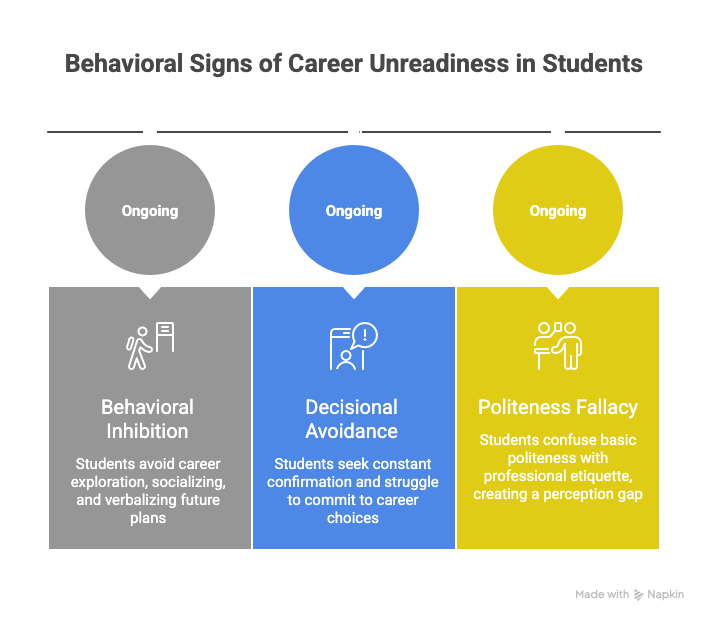
- Behavioral Inhibition: A student’s tendency to retard their own exploration, socializing, or verbalizing regarding their future.
- Decisional Avoidance: According to ResearchGate, unready students often show a "general need for confirmation" and an inability to make commitments even when presented with data.
- The "Politeness" Fallacy: Many students mistake basic politeness for professional etiquette. A 30% perception gap exists between students and employers regarding professionalism, according to NACE.
Also Read: Advisor Development Frameworks for Advanced Student Success Teams
What does a high-impact skills checklist look like across majors?
A modern readiness checklist must prioritize AI literacy, data-driven decision-making, and "micro-leadership" across all disciplines, including the humanities. While traditional soft skills remain vital, 97% of HR leaders now insist that new hires have a foundational understanding of technology like AI and data analytics, regardless of their major.
According to a 2025 survey by AAC&U, employers value "agility" as much as technical skill.
Here is a high-level checklist based on the 2025 NACE Competencies:
| Competency | High-Impact Readiness Marker |
|---|---|
| Technology/AI | Ability to ethically integrate AI tools to improve productivity (90% of employers view this as critical). |
| Communication | Framing ideas with respect to diversity of learning styles and cultural differences. |
| Micro-Leadership | Taking initiative on specific tasks without needing a formal title (the “President of the Club” myth is fading). |
| Critical Thinking | Gathering information from a diverse set of sources to proactively anticipate needs. |
According to Bain & Company, alumni who possess career-aligned credentials and networking experience outearn their peers by 10% or more, emphasizing the need for checklists to include "social capital" metrics.
Also Read: What are some career counseling techniques to ease student anxiety?
How can colleges map readiness gaps to specific interventions?
Effective mapping requires shifting from "reactive" services to "embedded" curricula where career competencies are taught in the classroom. Institutions should use tools like the STAR method to help students articulate skills, mapping their extracurricular and academic experiences directly to employer-valued behaviors through specialized inventories.
CSPs can no longer operate in a silo. To bridge the gap, colleges are turning to "Work-Integrated Learning."
For example, according to UConn, campus jobs (the "Work+" program) are being used as "labs" where students learn to "manage up" by asking for guidance before a task stalls - a key professionalism gap.
Other real-world interventions include:
- The University of South Florida (USF) uses LinkedIn Learning pathways for "Business Etiquette for Gen Z" to specifically target the professionalism gap, according to USF Career Services.
- Rice University utilizes the Career Launch NACE Career Readiness Inventory to provide students with feedback on experiential learning, ensuring they aren't just doing the work but can articulate it.
Also Read: What are the top 5 career services benchmarks every center must track?
What goes into an effective Career Readiness Plan (CRP)?
An effective CRP is a proactive, multi-year roadmap that integrates a student’s values and financial circumstances with their academic path. It should begin at enrollment, not senior year and include micro-credentials, e-portfolios for skill articulation, and structured mentorship opportunities that build the student's social network.
According to Complete College America (CCA) in their Purpose First 2.0 report, readiness is a core part of the student journey, not a "capstone" event.
Core CRP Components:
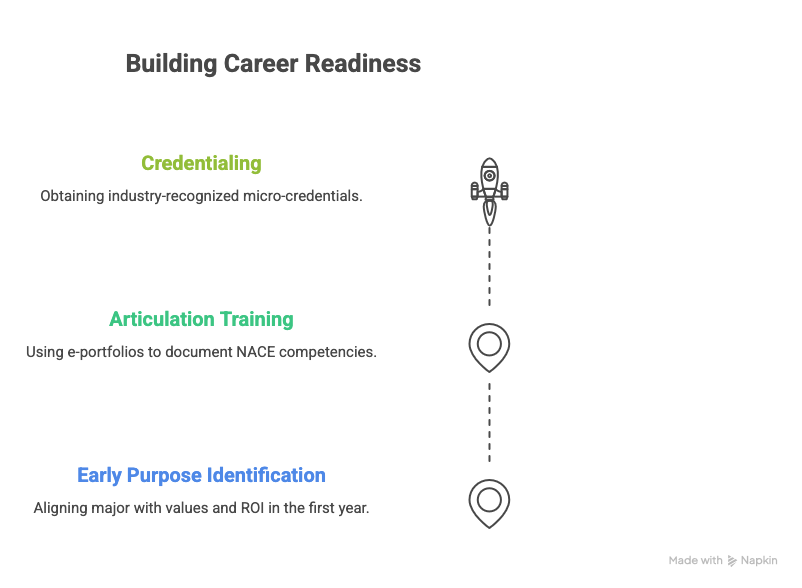
- Early Purpose Identification: Aligning the major with long-term ROI and personal values within the first year.
- Articulation Training: Using e-portfolios to document evidence of the 8 NACE competencies.
- Credentialing: Including at least one industry-recognized micro-credential (valued by 81% of employers, according to AAC&U.
Also Read: How can career services teams systematically identify and close student skill gaps in 2026?
How do we track and measure readiness improvements?
Colleges should move beyond "first destination" surveys to tracking "articulation scores" and utilizing the NSSE Career & Workforce Preparation module. Success is measured by a student's ability to demonstrate competencies through behavioral interviews (STAR method) and the narrowing of the perception gap between student self-assessment and employer feedback.
Tracking is currently a weak point in Higher Ed; only 31% of colleges implement competencies institution-wide, according to NACE Quick Polls. To improve, institutions are adopting:
- NSSE Modules: The Career & Workforce Preparation (CWP) module allows institutions to benchmark their contribution to students’ career plans against 95 other institutions, according to NSSE.
- Alumni ROI Tracking: Mapping how career-aligned internships (which boost income by 10%) correlate with long-term financial stability, according to Bain & Company.
Also Read: How to Give Resume Feedback in 5 Minutes?
Wrapping Up
Career readiness is no longer a final checkpoint - it’s a system that must run continuously across the student lifecycle.
The institutions making real progress are the ones treating readiness as a measurable outcome: diagnosing gaps early, embedding interventions in the curriculum, and tracking how well students can demonstrate and articulate their skills.
The constraint, of course, is scale. Most career teams are being asked to deliver deeper, more personalized support with the same, or smaller teams.
This is where having the right infrastructure becomes critical.
Career centers using platforms like Hiration’s full-stack career readiness suite bring the entire journey into one system - from career assessments to AI-powered resume optimization, interview simulation, and a dedicated counselor module for managing cohorts, workflows, and analytics, within a secure, FERPA and SOC 2-compliant environment.
As expectations continue to rise, the real question becomes: how will your career center operationalize career readiness at scale, without stretching your team beyond capacity?
Career Readiness Gap Analysis — FAQs
What are the behavioral signs of career unreadiness in students?
Common signs include career indecision, avoidance of career planning activities, fear of commitment, and confusion about professional identity or next steps.
Why do career readiness gaps persist despite career services support?
Gaps persist when career development is treated as an optional activity instead of being embedded into academic coursework and tracked systematically.
What skills should a modern career readiness checklist include?
A modern checklist should include AI literacy, data-driven decision-making, communication, teamwork, professionalism, and the ability to articulate skills using frameworks like STAR.
How can colleges map readiness gaps to interventions?
Colleges can align readiness gaps with structured interventions such as work-integrated learning, embedded course assignments, LinkedIn optimization, and interview preparation modules.
What is a Career Readiness Plan (CRP)?
A CRP is a multi-year roadmap that aligns a student’s academic path, skills development, and career goals with measurable outcomes and documented competencies.
How should institutions track career readiness outcomes?
Institutions should track competency articulation, experiential learning outcomes, and student progress using standardized rubrics and benchmark tools such as NSSE modules.
Why is articulation of skills critical for employability?
Employers evaluate candidates based on how clearly they can explain their skills, impact, and experience, not just the activities they completed.
How can career centers scale personalized support with limited staff?
Career centers can scale support by using standardized frameworks, embedded curriculum interventions, and centralized systems that track student progress and outcomes across cohorts.