How can career centers build scalable employer outreach systems for micro-internships?
Career centers can scale micro-internship programs by targeting agile employers, using project-first outreach, reducing employer friction, and operationalizing repeatable templates for outreach, objection handling, and pilot launch. Effective systems focus on employer ROI, short-term project value, and structured conversion pathways that transform outreach into measurable student opportunity.
Career centers are being asked to create more real-world experience for students, but traditional internships are not always built for scale.
They take time to source, often favor students who already know how to navigate employer networks, and leave many learners without accessible ways to prove their skills before graduation.
When students lack applied experience, placement rates suffer, employer engagement weakens, and career centers struggle to demonstrate impact to leadership.
This guide breaks down how to design, pitch, and operationalize micro-internships as a scalable alternative.
It covers provides templates, shows how to identify the right employers, structure outreach, handle objections, and convert interest into live pilot projects that deliver measurable outcomes for both students and institutions.
Who are the best employers to target for micro-internships?
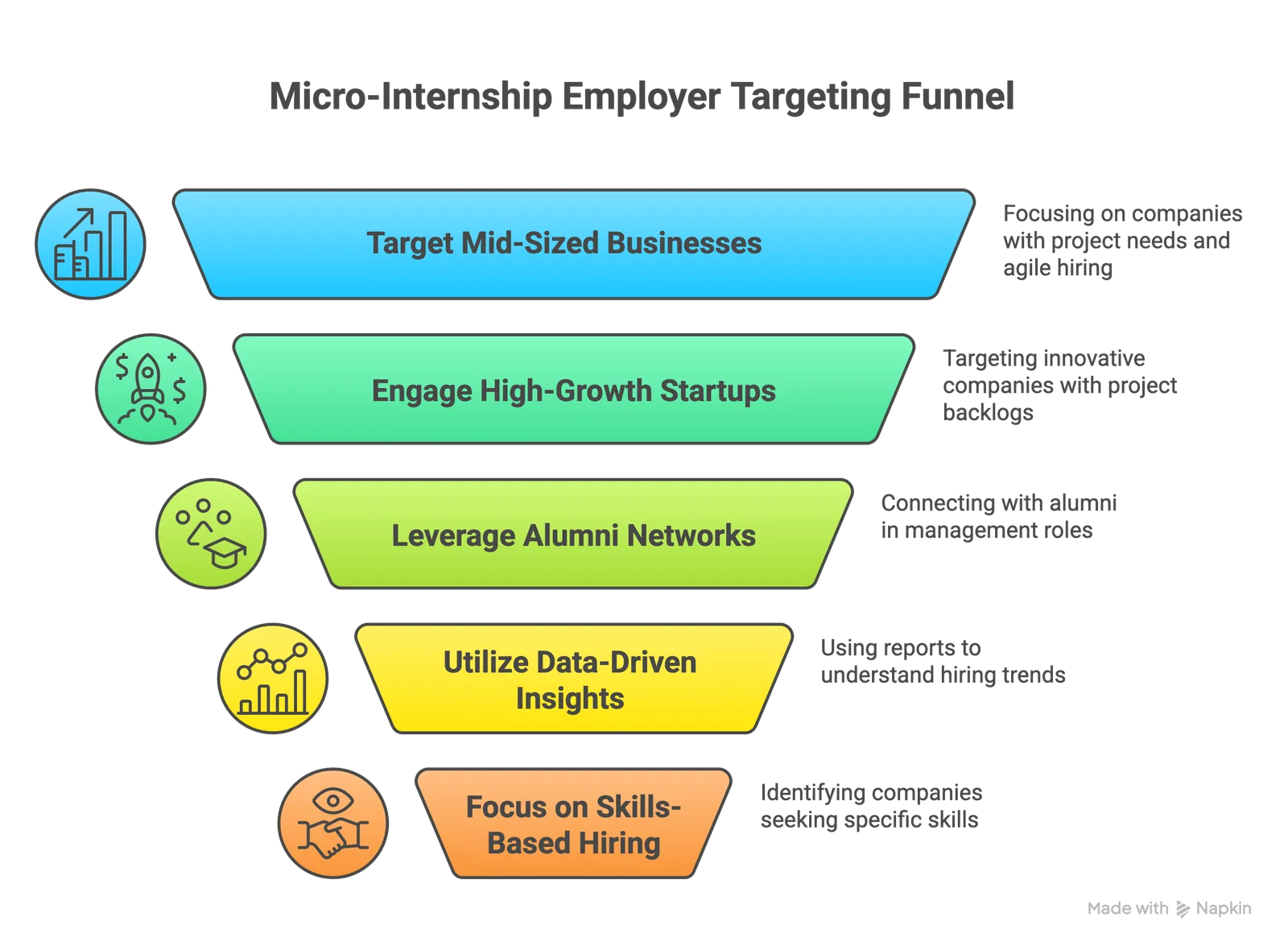
Target mid-sized regional businesses, high-growth tech startups, and local alumni networks. These groups often lack the massive campus recruiting budgets of Fortune 500s but desperately need short-term project support. Skip the rigid enterprise conglomerates and focus on agile companies that can make rapid hiring decisions.
When building your employer prospect list, rely on data. According to a February 2026 Parker Dewey report, nearly 70% of employers are pivoting to skills-based hiring.
Look for companies actively posting for freelance, part-time, or entry-level roles requiring immediate digital skills.
High-growth startups and small-to-medium enterprises (SMEs) are prime targets because they often have backlogs of "we'll get to it eventually" projects, think market research, CRM data clean-up, and social media audits.
Alumni who graduated within the last 5-10 years and now hold manager or director titles are your warmest leads.
They understand the exact caliber of your students and typically have the authority to greenlight a $300-$500 short-term project without needing endless executive approvals.
Also Read: How should career centers build a clear policy for paid vs unpaid internships?
What is the ROI for employers hosting micro-interns?
Employers save 80% on traditional campus recruiting costs while drastically reducing their time-to-hire. Instead of relying on resumes and interviews, companies get real work done while evaluating a candidate’s actual skills. It serves as an on-demand, low-risk, paid audition for entry-level talent.
The traditional recruiting playbook is expensive and slow. According to Parker Dewey's platform data, traditional campus hiring takes an average of 36 days to fill a role, whereas micro-internships fill within days, dropping the average cost-per-hire to just $600.
When pitching, focus heavily on this efficiency. The 2026 Parker Dewey NACE report notes that 74.1% of employers urge students to get experiential learning, and 80% weigh industry experience heavily in hiring decisions.
Remind employers that a micro-internship is an immediate productivity boost. They aren't inventing busywork; they are offloading 10 to 40 hours of essential tasks while building a diverse, proven talent pipeline before graduation season even starts.
Also Read: Designing Micro-Internships: A 5-Step Guide for Career Centers
How do I write a cold email sequence for micro-internships?
Start with a value-driven hook, not a generic university introduction. Focus entirely on the employer's need to clear their project backlog. Keep your emails under 100 words. Your sequence should include a personalized initial pitch, a value-add follow-up, and a brief break-up email.
Email 1: The Project-Focused Pitch (Send Tuesday morning)
Subject: Get [Specific Task, e.g., market research] off your plate this week
Hi [First Name],
I saw [Company Name] is currently expanding your [Specific Department/Initiative]. If your team has a backlog of tasks like lead generation, competitive analysis, or content creation, our [University Name] students can handle them.
We run a micro-internship program that allows you to hire vetted students for short-term, 10-40 hour paid projects. It’s a fast, low-risk way to get real work done while previewing early-career talent.
Are you open to a 5-minute chat next week to see how this works?
Best, [Your Name]
Email 2: The Proof Follow-up (Send Thursday afternoon)
Subject: Re: Get [Specific Task] off your plate this week
Hi [First Name],
Just bringing this to the top of your inbox. Recently, a local tech firm used our micro-interns to completely audit their CRM in just 15 hours. It’s an easy way to evaluate talent based on actual output, not just resumes.
Do you have 5 minutes next Tuesday to discuss getting a quick project off your plate?
Best, [Your Name]
Also Read: How can career centers implement effective DEI outreach strategies to improve student outcomes?
What is the best LinkedIn message template for employer outreach?
Keep your LinkedIn outreach extremely brief, direct, and focused on networking rather than selling. Use a conversational tone to ask a simple, low-friction question. Avoid long paragraphs; professionals skim their inboxes. Lead with a shared connection, like alumni status.
Connection Request (Under 300 characters):
Hi [First Name], I’m expanding our employer network at [University Name] Career Services. I noticed your recent work at [Company] and would love to connect to follow your updates.
Follow-up Message (After they accept):
Thanks for connecting, [First Name]! I’m currently talking to [Industry] leaders about a new model we are running: Micro-internships. Companies are offloading 10-40 hour projects (like data cleanup or social media audits) to our students to build a talent pipeline. Is your team currently facing a backlog of short-term tasks? Would love to share how local companies are tackling this.
Also Read: Employer Partnerships for College Career Treks: Implementation Guide
When and how should I follow up with unresponsive employers?
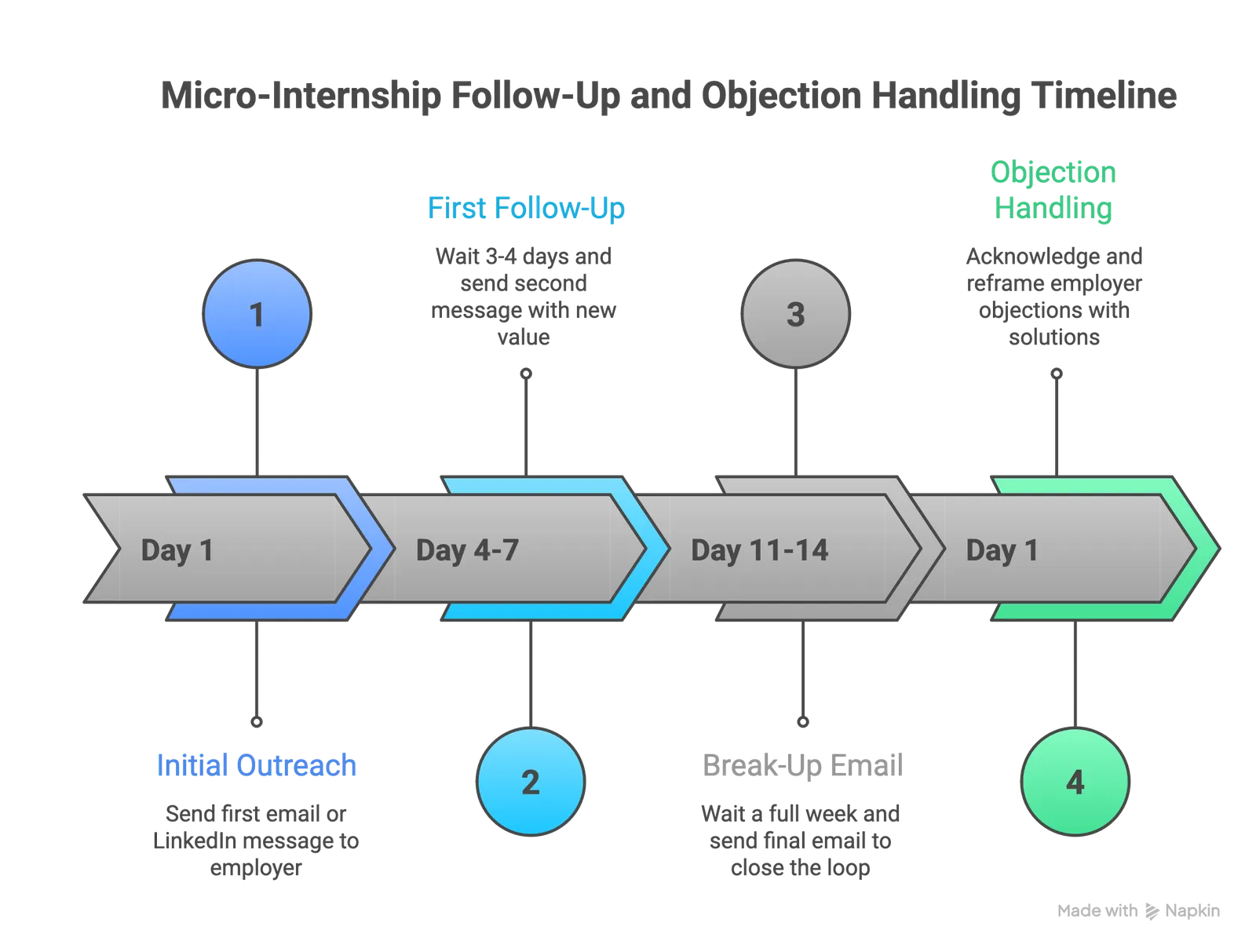
Wait 3-4 days between your first and second outreach. If they ignore the second message, wait a full week before sending a final "break-up" email. Provide tangible value in every follow-up, such as a quick statistic or a link to a successful project template, rather than just "checking in."
Never send an email that just says "following up on my last note." Always introduce a new piece of value.
Email 3: The "Break-up" Email (Send one week after Email 2)
Subject: Closing the loop on student project support
Hi [First Name],
I haven't heard back, so I assume getting short-term project support isn't a priority for [Company] right now.
I’ll stop reaching out. If you ever need a fast, low-risk way to clear your backlog while evaluating entry-level talent, you know where to find me.
Best,
[Your Name]
Also Read: How can career centers build a messaging playbook using student personas?
How do I handle common employer objections to micro-internships?
Acknowledge their concern immediately, reframe the objection as a misconception, and provide an exact solution. Employers usually fear that managing a student will take more time than doing the work themselves. Counter this by emphasizing pre-vetted project templates and zero HR red tape.
Here is how you handle the three most common objections:
"We don't have time to train an intern."
Response: "Micro-interns aren't traditional interns; they act as short-term freelancers. You define the exact deliverable in a simple project brief, and the student executes it. You spend 30 minutes onboarding, and they deliver 20 hours of work."
"We don't have the budget."
Response: "Most projects cost a flat fee between $300 and $500, not a summer-long salary. It’s an 80% cost savings compared to traditional recruiting events."
"HR won't approve a new contractor setup."
Response: "Platforms like Parker Dewey handle all 1099/W-2 compliance, liability, and payroll. The student isn't on your payroll; they are paid through the platform. There is absolutely zero HR red tape on your end."
How do I help employers write an effective project brief?
Guide them to focus on the deliverable, not a generic list of duties. A solid brief requires a clear objective, estimated hours, a hard deadline, and the specific output format. Prevent scope creep by explicitly defining what the student will hand over at the end.
Don't let employers write traditional job descriptions. An employer shouldn't write: "Assist the marketing team." They need to write: "Audit three competitors' LinkedIn content strategies over the past 6 months and deliver a 5-page Google Doc summarizing key themes by Friday." Give employers a fill-in-the-blank formula:
- Context: Why is this project happening?
- Deliverable: Exactly what will the student submit? (e.g., a 10-slide deck, an Excel sheet with 500 leads).
- Timeline: When is the final file due?
- Resources: What data, software, or access will the student be provided?
Also Read: How to Design Effective Job Search Bootcamps for Students?
How do I convert employer interest into a live micro-internship pilot?
Remove all friction by offering them a "copy-and-paste" pilot project. Send them three pre-written, highly relevant project templates for their specific industry. Once they pick one, immediately schedule a 15-minute kick-off call to lock in the launch date.
The transition from outreach to pilot fails when you ask the employer to "brainstorm" ideas. Employers are incredibly busy.
Instead, tell them exactly what to do. Say: "Based on your team's goals, I recommend starting with our Competitor Analysis pilot. I have the project brief fully written, you just need to approve the $400 budget and the deadline."
Once they agree, walk them through the posting process live on screen during your kick-off call. Get the project published while you are on the phone with them to guarantee conversion.
Wrapping Up
Micro-internships can become a reliable extension of your employer engagement strategy, but only if the execution holds up at scale.
That means tracking participation, guiding students on how to present their work, and ensuring each experience translates into stronger applications and interview performance.
Many career centers are starting to look at how their systems support that full loop - from identifying opportunities to helping students convert those experiences into outcomes.
Hiration is built around that idea, bringing together career assessments, AI-driven resume optimization, interview simulation, and a dedicated counselor module to manage cohorts, workflows, and analytics in one place.
With the right structure in place, it becomes easier to turn short-term experiences into long-term impact across your student population.
Micro-Internship Employer Outreach — FAQs
Which employers are best for micro-internships?
Mid-sized regional businesses, startups, SMEs, and alumni-led organizations are often the best targets because they have faster decision cycles and practical short-term project needs.
Why are large enterprises often harder to convert?
Large enterprises typically have more rigid recruiting structures, slower approvals, and greater HR complexity, making micro-internship adoption more difficult.
What is the strongest employer value proposition?
The strongest value proposition is project backlog relief, low-cost talent evaluation, and significantly reduced recruiting cost and time-to-hire.
What should outreach emails focus on?
Outreach should focus on solving immediate employer pain points, such as clearing specific project backlogs, rather than broadly promoting university programs.
How should LinkedIn outreach differ from email?
LinkedIn outreach should be shorter, relationship-focused, and conversational, using networking as the entry point rather than direct selling.
How often should advisors follow up?
Advisors should follow up every 3–4 days initially, then use a final break-up message after a longer interval while always adding new value.
What are the most common employer objections?
The most common objections involve training burden, budget concerns, and HR or contractor complexity.
How should career centers overcome employer objections?
Advisors should reframe objections by emphasizing low project cost, pre-vetted project templates, platform compliance support, and minimal management burden.
What makes a strong micro-internship project brief?
A strong brief clearly defines deliverables, deadlines, resources, and expected outputs while avoiding vague job-description language.
What is the best way to convert employer interest into action?
The best strategy is to reduce friction by offering ready-made project templates, clear pilot options, and live onboarding support to accelerate employer commitment.