How can career centers scale support using the multipliers framework?
Career centers can scale effectively by leveraging three multipliers: capacity (automating repetitive tasks to free advisor time), engagement (providing 24/7 student access to support), and outcomes (improving results through better preparation and tracking). This approach enables teams to expand impact without increasing headcount.
Career centers aren’t struggling because they lack effort - they’re constrained by scale.
Too many students, too many repetitive tasks, and limited advisor bandwidth make it difficult to deliver meaningful, personalized guidance at the level students expect.
The impact goes beyond day-to-day operations and shows up in institutional outcomes.
When career services can’t scale effectively, student engagement drops, placement rates suffer, and it becomes harder to demonstrate ROI to leadership, accreditors, and funders.
The gap between what students need and what teams can realistically deliver continues to widen.
In this guide, we break down how career centers can scale without increasing headcount. It covers three key multipliers - capacity, engagement, and outcomes, along with real examples, ROI calculations, and practical ways to redesign workflows using smarter systems.
The “Smarter System” Advantage: Three Key Multipliers
Investing in a smarter career services system - think AI-driven resume review platforms, chatbots for career Q&A, virtual mock interviews, and unified student engagement dashboards, yields exponential benefits.
Rather than linear gains, technology can create multipliers that amplify your team’s impact in three critical areas: capacity, engagement, and outcomes.
1. Capacity Multiplier: Do More With the Same Team
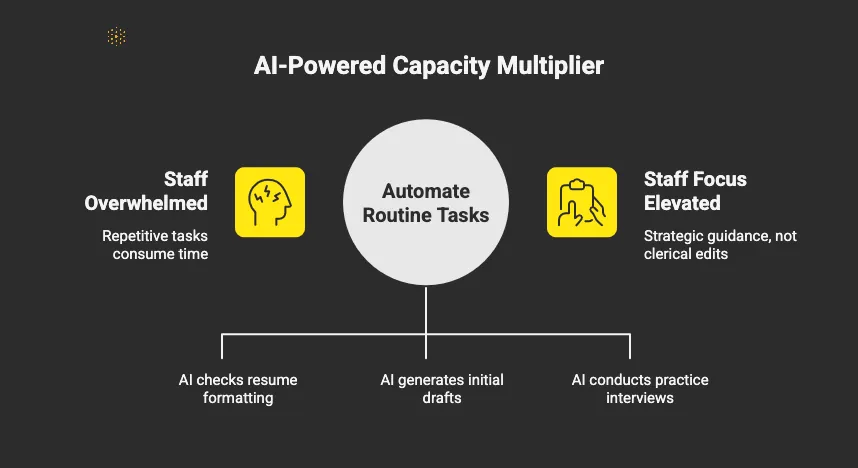
A smarter system acts as a capacity multiplier, taking over repetitive or preliminary tasks so that each staff member’s bandwidth goes much further.
Consider how much time career advisors traditionally spend on routine activities: proofreading resumes for format issues, giving the same 101 advice on cover letters, conducting basic mock interviews, answering common questions like “how do I find internships?”.
Automating these first-draft and first-touch tasks can save dozens of hours per staff member per month.
In practice, this means AI tools handle the grunt work, checking resume formatting, suggesting keyword improvements, generating initial cover letter drafts, or conducting an AI-driven mock interview, and then advisors step in for higher-level coaching.
At Tech Elevator, counselors were able to cut resume review time from weeks to a day or two, because the AI had already ensured a student’s draft met basic standards before a human ever looked at it.
Shawnee State’s team saved 40+ hours in one semester’s pilot just on mock interviews by letting students practice in an AI platform before any one-on-one meeting.
Crucially, this capacity boost isn’t about replacing staff, it’s about elevating staff to do what humans do best.
By shifting 100% of your focus from clerical edits to strategic guidance, a small team can service far more students without burnout.
In short, the AI handles the volume; your staff handles the value.
This multiplier effect makes a team of 3 perform like a team of 6, or a team of 6 like a team of 12.
Also Read: How does counselor burnout reveal a career center system that’s no longer working?
2. Engagement Multiplier: 24/7 Support, No Waiting in Line
Another game-changing benefit of a smart system is the engagement multiplier.
Traditional career services operate mostly 9-to-5 and often require students to book appointments or wait for feedback.
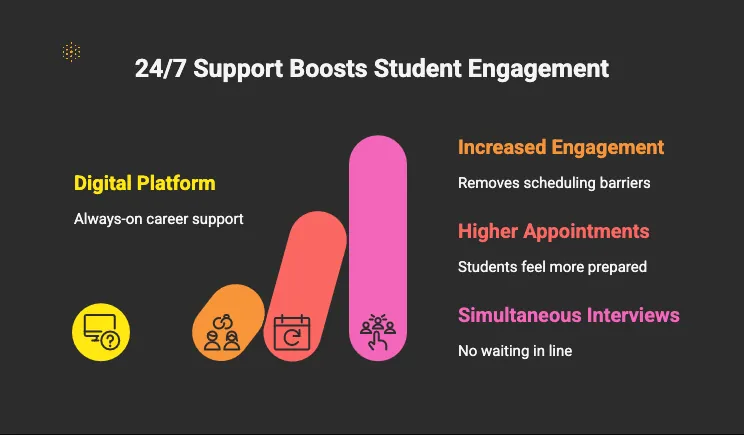
That model simply doesn’t match the rhythms of modern students. A digital platform, however, can be available 24/7, giving students immediate access to help whenever motivation strikes - be it midnight resume tweaks or a Sunday afternoon interview practice.
This “always on” support dramatically increases student engagement by removing barriers of scheduling and availability.
For example, students at Shawnee State gained round-the-clock access to career prep tools - and the data showed they used it outside business hours, since it was there when they needed it.
The result was not only more convenience, but also more students coming in for higher-value appointments (a 6% rise in appointment volume) because the easy questions were answered and students felt more prepared.
This immediacy keeps students engaged, they don’t have to email a resume and wait days for a review; they get pointers on the spot.
The engagement multiplier also means no more waiting in line for help.
Imagine being able to conduct 30 mock interviews simultaneously in a class lab session, instead of spending an entire week doing them one by one.
That’s exactly what Shawnee State achieved: “students were each in their own space… completing their mock interviews simultaneously through Hiration. Previously, these interviews would’ve been one-on-one… This approach allowed us to offer a similar experience in a fraction of the time,” said Dr. Raines.
No student had to wait or be turned away due to overbooking.
By meeting students where they are - online, on their schedule, a smarter system dramatically increases usage.
More engagement means more students building skills and confidence, which in turn means better outcomes.
Also Read: How can career centers transform support to make students job-ready?
3. Outcome Multiplier: Better Results and Proof of Value
Ultimately, the goal of scaling career services is better student outcomes - more students landing good jobs or virtual internships, and doing so faster and with greater confidence.
A smarter system can be a powerful outcome multiplier by improving the quality of support and tracking the metrics that matter.
When routine tasks are automated and engagement increases, counselors can devote attention to truly transformational interventions (like career planning, personal branding, networking connections), and students show up to interviews far more prepared.
The data bears this out:
- A recent analysis by NACE found that graduates who used their college career center services received more job offers on average than those who didn’t. Class of 2022 grads who used even one career service had 1.24 job offers on average (and each additional service used nudged that higher), versus just 1.00 offers for those who never engaged. More engagement = more offers.
- Improving the quality of career support dramatically boosts student and alumni satisfaction. Gallup surveys reveal that graduates who rated their career services experience as “very helpful” were 5.8× more likely to strongly agree their education prepared them for life after college, and 3.4× more likely to recommend their alma mater to others. The unfortunate flip side is that only 8% of grads actually both used career services and found them very helpful - meaning there is huge room to lift outcomes by making services more effective for more students. A smarter system is a key part of that effectiveness, ensuring consistent, high-quality guidance at scale.
- Tech Elevator’s career platform not only saved time; it directly led to more students getting shortlisted for interviews and offers as their resumes and interview skills improved. Students reached the interview stage 60% faster than before. And MUST Ministries achieved what can only be described as an outcomes breakthrough - a 93% jump in total job placements and a 147% increase in combined wages earned by their clients after integrating Hiration.
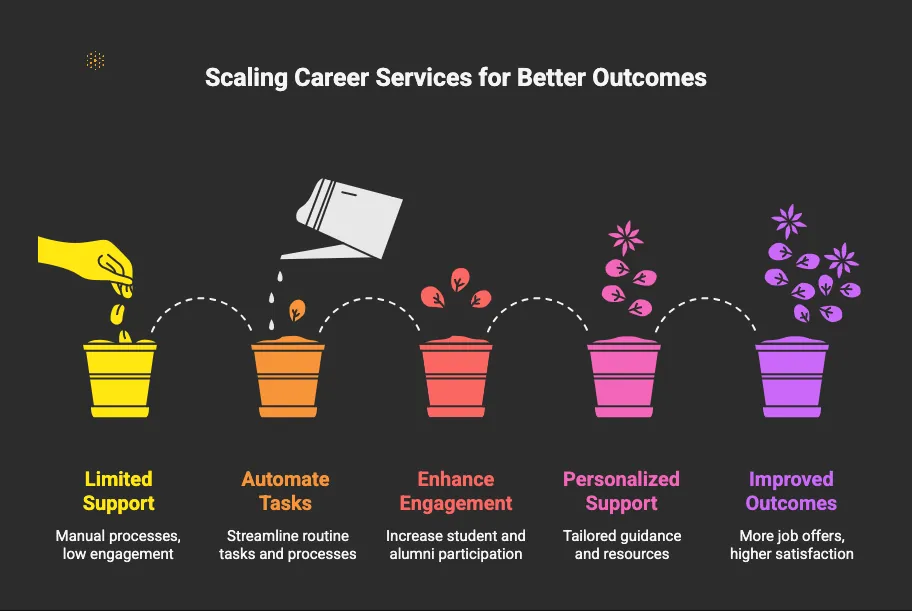
In essence, by scaling personalized support, a smarter system helps each student or job-seeker achieve stronger results.
And it provides the data to prove it.
Platforms like Hiration include dashboards and analytics (e.g. how many resumes created, improvements in resume scores, mock interview performance, etc.), which allow career centers to demonstrate ROI to administrators and funders.
In short, better outcomes justify the budget - even if you didn’t hire more staff to achieve them.
Also Read: What are the top 5 career services benchmarks every center must track?
The ROI: Calculating the Payoff of a Smarter System
It’s important to translate these improvements into the language of resource allocation - time and money.
What does “saving time” really mean for your team’s capacity and your institution’s bottom line?
Let’s do a sample calculation:
Imagine a career center with 4 full-time counselors. Each counselor currently spends, say, 15 hours a week on repetitive tasks like basic resume reviews, formatting edits, and answering FAQs via email.
If an AI-driven system takes over those 15 hours for each person, that’s 15 hours × 4 staff = 60 staff hours freed up per week.
Over the course of a school year (~40 weeks of active counseling), that’s 2,400 hours annually that can be repurposed to higher-impact work.
To put it in perspective, 2,400 hours is roughly equivalent to 1.25 full-time employees (assuming ~1,920 work hours per year is one FTE).
In other words, the existing team of 4 gains the output of an additional staff member for free. This is capacity you’ve essentially “hired” via technology.
In budget terms, if a typical counselor’s fully loaded salary is, say, $60,000, then 1.25 FTE of value equates to $75,000 in work hours.
Even if the AI platform costs a fraction of that, you’re looking at a significant return on investment (ROI) in pure labor value alone.
And this doesn’t even count the qualitative ROI of improved student outcomes (which, as noted, ties to institutional goals like retention, alumni donations, and rankings).
By investing in a smarter system, career centers essentially buy time - the most precious resource, at a discount, and convert it into better service for students.
Also Read: The Hidden Cost of Legacy Career Services: A Time Audit
Wrapping Up
Scaling career services doesn’t have to come down to hiring more staff or stretching teams thinner.
When routine work is streamlined, students get timely support, and outcomes are tracked with clarity, career centers can operate at a completely different level of efficiency and impact.
Scale also depends on whether the platform keeps becoming useful after launch through timely activation, usage visibility, and workflow alignment.
That shift often comes from having the right system in place - one that supports both students and advisors across the entire journey.
Hiration brings together career assessments, resume optimization, interview simulation, and structured counselor workflows into a single environment, making it easier to standardize support, manage cohorts, and track outcomes - all within a secure, FERPA and SOC 2-compliant setup.
For teams looking to scale without compromising quality, the focus isn’t just on doing more - it’s on building a system that makes better outcomes repeatable.
Scalable Career Services Systems — FAQs
What is the multipliers framework in career services?
It is a model that focuses on scaling impact through three areas: capacity, engagement, and outcomes, rather than increasing staffing.
How does the capacity multiplier work?
It automates repetitive tasks like resume reviews and FAQs, allowing advisors to focus on high-value coaching and strategic guidance.
What is the engagement multiplier?
It provides students with always-available support, increasing usage by removing barriers like scheduling delays and limited office hours.
How does the outcome multiplier improve results?
By improving preparation quality and increasing engagement, students perform better in applications and interviews, leading to stronger placement outcomes.
Why can't career centers scale using traditional models?
Traditional models rely heavily on one-on-one advising and manual workflows, which do not scale with growing student populations and limited staff.
How can technology improve advisor productivity?
Technology can handle first-touch interactions and basic feedback, freeing significant advisor hours that can be redirected to high-impact activities.
How can career centers calculate ROI from scalable systems?
ROI can be measured by calculating time saved, increased student engagement, and improved placement outcomes relative to the cost of implementing the system.
What is the ultimate goal of scaling career services?
To deliver consistent, high-quality support to more students while improving outcomes and maintaining sustainable workloads for staff.