How can career centers reclaim advisor time and improve service delivery?
Career centers can reclaim advisor time by auditing workflows to identify high-volume, repeatable tasks and automating them first. By redirecting effort from resume reviews, FAQs, scheduling, and reporting into higher-impact work such as advising, employer engagement, and targeted outreach, teams can expand access, reduce burnout, and improve student outcomes.
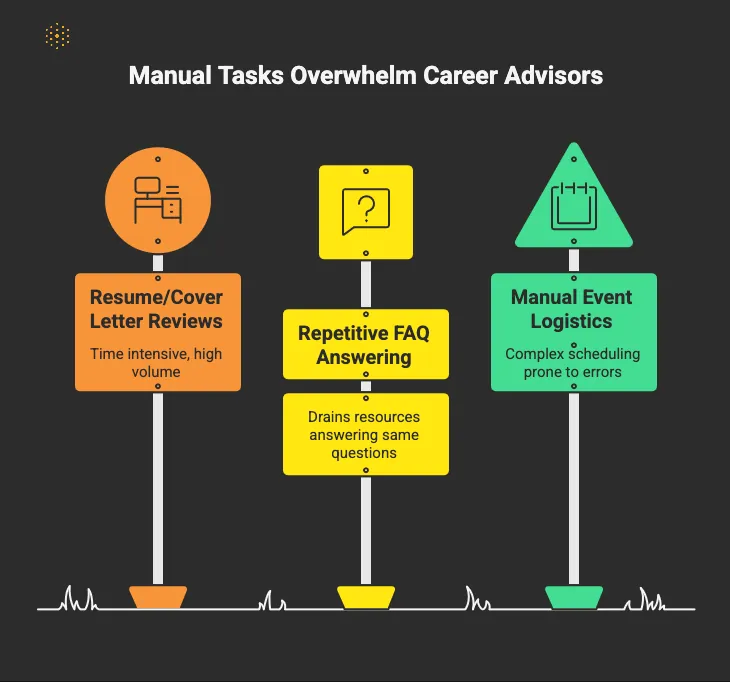
Career centers invest enormous effort in supporting students, but much of that effort is often absorbed by repetitive, low-value tasks.
Resume reviews, cover letter checks, FAQ emails, scheduling requests, event logistics, and manual reporting can quietly consume hours that could otherwise go toward deeper advising, employer engagement, and proactive student outreach.
The problem is that many offices are still operating with workflows that do not match the scale of student demand.
When advisors spend too much time on repeatable tasks, staff burnout rises, student access shrinks, and career services become harder to scale equitably.
This guide gives career center leaders a practical time-audit framework to identify where advisor hours are being lost, calculate the opportunity cost of manual work, decide which tasks to automate first, and redirect staff time toward higher-impact student support.
Career center time audit: quick calculator
Before changing tools or workflows, career centers need to understand where time is actually going. Use the framework below to estimate how many staff hours are being consumed by repeatable work.
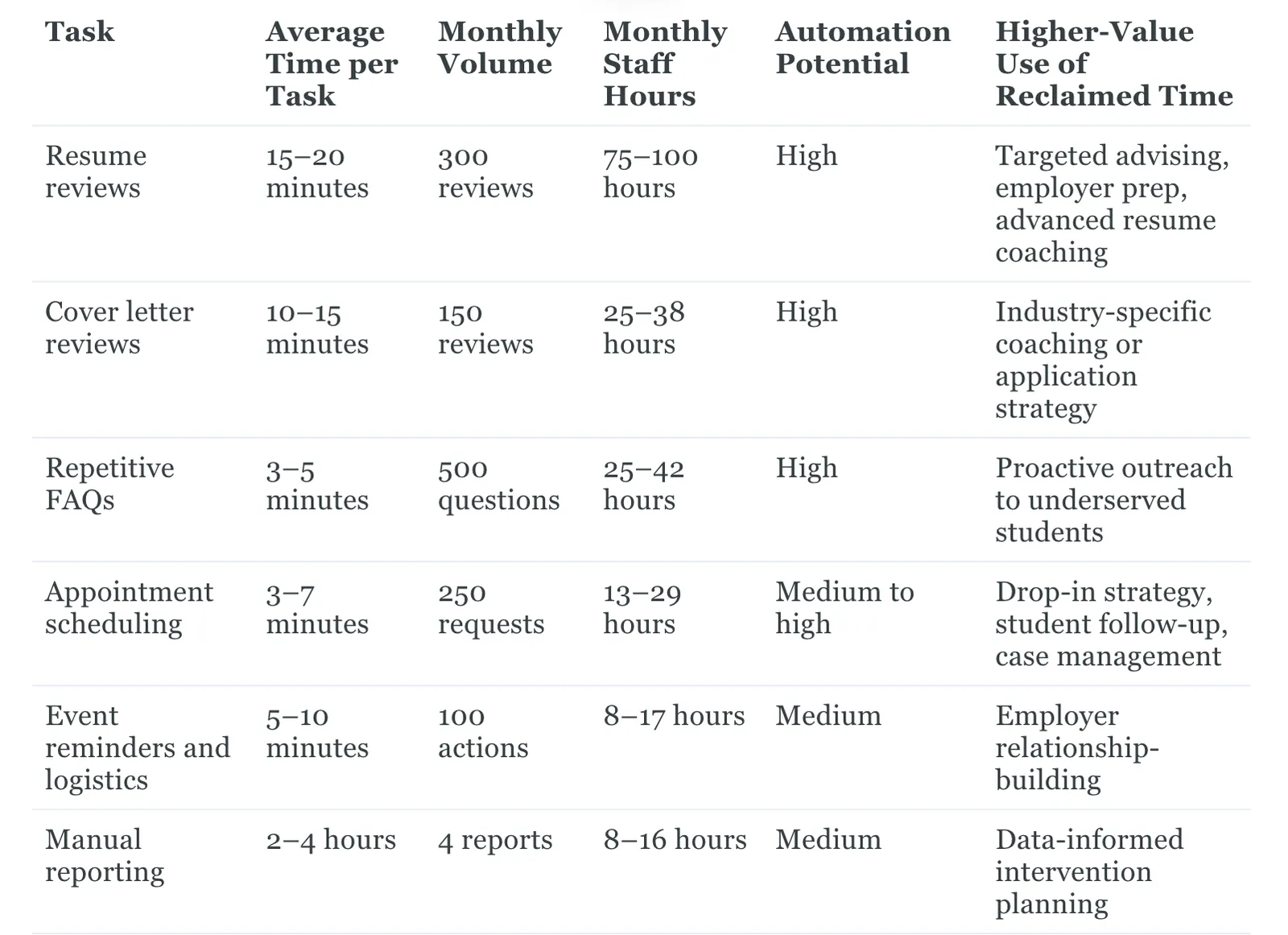
Even conservative estimates can reveal a serious capacity problem. If a team is spending 150 to 250 hours a month on repeatable tasks, that is not just an efficiency issue.
It is advisor time that could be redirected toward students who need more strategic guidance.
Where are career centers losing the most staff time?
Career advisors are often bogged down by a high volume of recurring tasks that could be automated. These tasks include:
Resume and Cover Letter Reviews
This is the most significant time sink. A counselor might spend 15-20 minutes on a single resume.
For instance, at a university with 20,000 students, even if only a quarter seek a single resume review, that’s 5,000 reviews.
At 15 minutes each, this translates to 1,250 hours of work - the equivalent of one staff member working full-time for over 31 weeks on just one basic task.
Answering Repetitive FAQs
Career services inboxes are flooded with identical questions day after day:
- Where do I find internship postings?
- How do I register for the career fair?
- What should I wear to an employer event?
- How do I book an appointment?
- Where do I upload my resume?
- Can someone review my cover letter?
A study by the UK-based Association of Graduate Careers Advisory Services (AGCAS) noted that member institutions reported over half of all student inquiries were foundational questions.
Each answer may take only a few minutes, but the total cost adds up quickly. More importantly, repetitive email support keeps staff in a reactive mode.
Instead of identifying students who need deeper help, teams spend time responding to students who are simply trying to find basic information.
Manual Event & Appointment Logistics
The process of scheduling one-on-one appointments, managing employer information sessions, and tracking attendance for workshops is often a complex web of spreadsheets, emails, and calendar invites.
This not only consumes administrative hours but is also prone to human error, leading to double bookings or missed communications.
When advisors are spending upwards of 60% of their time on the manual tasks above, the system is mathematically set up to fail the majority of students.
Manual data collection and reporting
Many career centers are under growing pressure to show outcomes, engagement, and impact. But if student activity is spread across disconnected tools, staff often spend hours pulling data manually.
That means the team may have the information somewhere, but not in a form that supports quick decision-making. Without cleaner reporting, it becomes harder to answer basic operational questions such as:
- Which students are using services?
- Which groups are under-engaged?
- Which services are driving repeat participation?
- Where are students getting stuck?
- Which advisors or programs are overloaded?
Also Read: How can universities automate career center workflows without losing the human side of advising?
How do you calculate the opportunity cost of manual work?
The true cost of manual work is not measured only in staff hours. It is measured in what the career center cannot do because those hours are already spent.
Every hour spent on a remedial task is an hour not spent on a strategic initiative that could transform student outcomes.
Let's quantify this with a conservative model:
A career center with 10 advisors, each spending just 3 hours per day on manual tasks (resume checks, FAQs, scheduling), ends up losing the equivalent of three full-time employees annually. This translates into not just lost productivity, but also significant financial implications.
| Metric | Calculation | Result |
|---|---|---|
| Daily time sink | 3 hours/advisor × 10 advisors | 30 hours/day |
| Weekly time sink | 30 hours/day × 5 days/week | 150 hours/week |
| Annual time sink (40-week academic year) | 150 hours/week × 40 weeks | 6,000 hours/year |
| Equivalent FTEs lost | 6,000 hours ÷ 2,000 hours (per FTE) | 3 FTEs |
| Direct salary cost | 6,000 hours × $25/hour | $150,000/year |
If the average salary for a career advisor is around $50,000 per year (approximately $25/hour), those 6,000 hours of administrative work cost the institution $150,000 annually in salary alone, spent on tasks that technology could handle for a fraction of the cost.
This doesn't even account for the long-term cost of lower student placement rates and reduced alumni satisfaction.
Beyond the direct financial drain, the true loss lies in what a career center could achieve with those 6,000 hours of repurposed, high-skill professional time:
- Proactive Employer Development: Instead of waiting for companies to post jobs, advisors could dedicate time to building relationships in high-growth sectors like renewable energy, AI, or biotechnology, creating exclusive opportunities for their students.
- Scalable Career Education: They could design and launch comprehensive online courses on topics like "Building a Personal Brand" or "Navigating the Tech Industry," helping thousands of students simultaneously.
- Data-Driven Student Interventions: They could analyze student data to identify which demographics are under-utilizing career services and design targeted outreach campaigns to engage them, closing equity gaps.
- Mentorship Program Expansion: Launching and managing a robust alumni-student mentorship program, a proven high-impact practice for career success.
This inefficiency also leads to staff burnout.
A report by Research Gate emphasizes that when skilled employees are bogged down by monotonous tasks, it leads to decreased job satisfaction and higher turnover rates, creating additional costs for recruitment and training.
The Impact on Student Reach & Equity
A reliance on manual processes inherently creates an inequitable system.
Support becomes a resource available only to the most proactive and privileged students, those who know how to navigate the system, book appointments early, and persistently seek help.
Students who are first-generation, from underrepresented backgrounds, or juggling part-time jobs and heavy course loads are often the ones who fall through the cracks.
They may not have the time to wait for an appointment or may be intimidated by the process. Here are some stats:
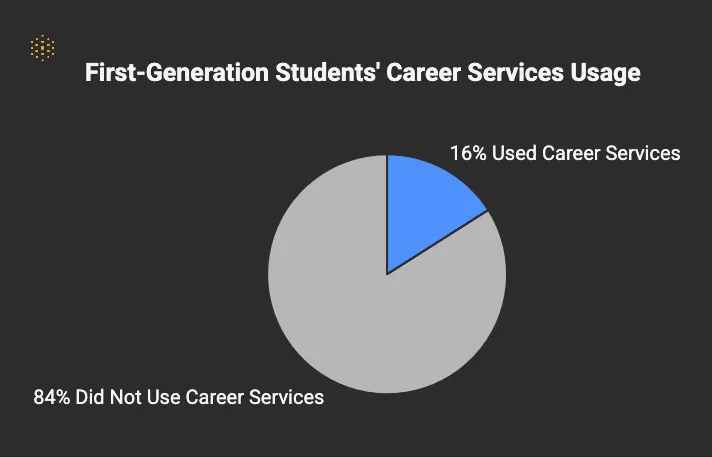
- First-Generation Students Use Career Services Less: A fact sheet from the National Association of Student Personnel Administrators (NASPA) and The Suder Foundation's First-generation Student Success initiative, using data from the U.S. Department of Education, found that only 16% of first-generation students used career services in their first year.
- Broader Lack of Engagement: The challenges faced by first-generation students are not limited to career services. They are often less likely to engage in a wide range of high-impact practices. Research published in the journal TLAR ("Breaking Down Barriers: Academic Obstacles of First-Generation Students at Research Universities") notes that these students often have competing job and family responsibilities that serve as significant obstacles to their academic success and engagement with university resources.
- The "Very Helpful" Gap: A Gallup study found that only one in six U.S. college graduates (approximately 17%) reported that their career services office was "very helpful." This indicates a massive gap in reach and impact across the entire student population, which is likely even more pronounced for those from underserved backgrounds.
Which career services tasks should be automated first?
Not every task should be automated. Career centers should prioritize automation where the work is high-volume, repeatable, and low-risk, while keeping human judgment for complex, sensitive, or developmental conversations.
Use this framework to decide what to automate first:
1. High-volume tasks
Start with tasks that happen frequently enough to create real workload pressure. Resume reviews, basic FAQs, event reminders, and appointment logistics often fall into this category.
2. Repeatable tasks
Look for work where the same steps happen again and again. If staff are giving the same first-pass feedback or answering the same questions repeatedly, the task is a strong automation candidate.
3. Low-risk tasks
Automate tasks where mistakes are easy to correct and where the student is not relying on nuanced judgment. For example, sending a reminder or checking resume formatting is different from helping a student navigate a major career crisis.
4. High student-impact tasks
Prioritize automation where faster access improves the student experience. If automation helps students get immediate resume feedback, find basic answers after hours, or prepare before an advising session, it can improve both access and readiness.
5. Strong handoff potential
The best automation does not remove advisors from the process. It creates a better handoff. A student can complete a first-pass resume review, practice interview responses, or answer intake questions before meeting an advisor, making the live conversation more focused.
What should reclaimed advisor time be used for?
The goal of automation is not to make career services less human. It is to protect human time for the work that actually requires judgment, relationship-building, and strategy.
When career centers reclaim staff hours, they can reinvest them in higher-impact areas.
Proactive student outreach
Instead of waiting for students to book appointments, advisors can identify under-engaged groups and reach out earlier. That is especially important for students who may not know how or when to use career services.
Employer development
Advisor and employer relations time can be redirected toward building stronger pipelines in high-growth or high-interest sectors. That includes targeted employer outreach, alumni connections, and industry-specific opportunities.
Scalable career education
Teams can create workshops, modules, or career courses that reach larger student groups at once. These programs can cover resume basics, interview preparation, networking, LinkedIn, industry exploration, or job search strategy.
Equity-focused interventions
If the team has better data and more time, it can identify which student groups are underusing services and design outreach accordingly. That moves the office away from a first-come, first-served model and toward more proactive support.
Mentorship and alumni programs
Mentorship programs require coordination, matching, communication, and follow-up. Reclaimed staff time can make these programs more sustainable instead of leaving them as “nice to have” initiatives.
Also Read: AI in Career Services: Benefits, Limits, and Ethical Best Practices
How does automation improve student access and equity?
When advisors are freed from the burden of resume reviews, FAQs, and scheduling logistics, they can finally shift from a reactive “first-come, first-served” model to a proactive, data-driven approach.
Research from the Pullias Center for Higher Education at USC emphasizes that proactive advising is particularly crucial for "at-promise" students.
This approach involves initiating contact early and consistently to connect students with tailored resources, which can lead to increased retention, academic confidence, and overall success.
And technology is the enabler here: automation creates a scalable, 24/7 first line of support through AI-powered resume feedback, FAQ chatbots, and automated scheduling, ensuring that every student has immediate access to foundational resources.
This allows counselors to focus their limited in-person time on students who need it most, helping close equity gaps for first-generation students and those balancing work and family responsibilities.
The National Association of Colleges and Employers (NACE) notes that AI and other digital tools can level the playing field by bridging professional network gaps and providing on-demand guidance that historically only well-connected students could access.
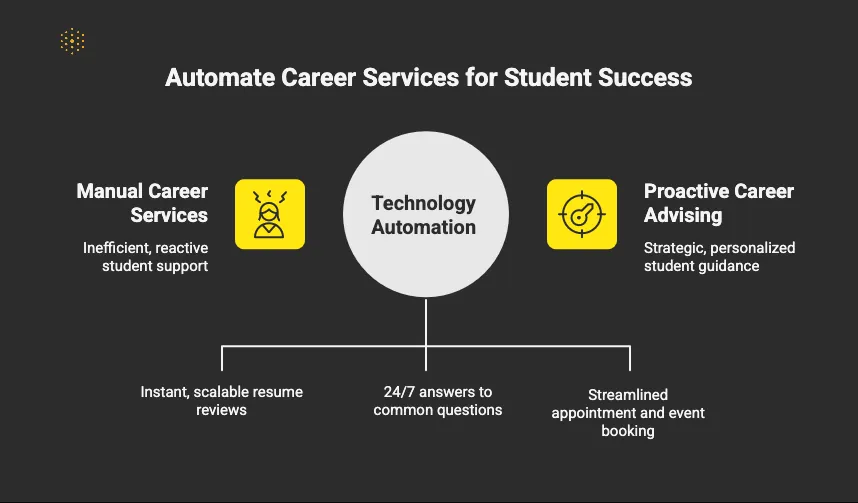
The impact of reclaiming time is staggering: in a typical career center, 6,000 advisor hours lost annually to manual tasks could instead be reinvested in initiatives like employer development, equity-driven outreach, and alumni mentorship.
Real-world results show what this looks like in practice.
Rasmussen University, serving tens of thousands of nursing students across 23 campuses, leveraged Hiration to scale resume and interview prep - freeing advisors for personalized coaching, and achieved a 93% increase in student placements (2,331 vs. 1,206) and a 147% rise in wages earned.
Similarly, Shawnee State University, with a lean team, deployed Hiration and achieved a 65% increase in student engagement in under a year, while saving 100+ of advisor hours that were redirected into high-impact employer partnerships and mentorship programs.
Together, these outcomes illustrate how turning wasted hours into proactive, equity-centered advising doesn’t just save money, it fundamentally transforms student success and institutional impact.
And if you’re exploring platforms to help scale that kind of transformation, Hiration is built for exactly this purpose - trusted by 100+ colleges to deliver optimized resumes, tailored interview prep, and 24/7 student guidance.
Book a quick demo to see the impact for yourself - we offer a free pilot with no setup fees.
Career Center Time Audit — FAQs
Why do career centers struggle with advisor capacity?
Much of advisor time is consumed by repetitive tasks such as resume reviews, FAQs, scheduling, and manual reporting, limiting time for high-impact advising.
What is a career center time audit?
A time audit is a structured process to track how advisor hours are spent and identify where time is lost to low-value, repeatable work.
Which tasks consume the most advisor time?
Resume and cover letter reviews, repetitive student inquiries, scheduling logistics, and manual data reporting are typically the largest time drains.
How do you calculate the cost of manual work?
Multiply the hours spent on repetitive tasks by staff time value to estimate both financial cost and lost opportunity for higher-impact work.
What tasks should be automated first?
Focus on high-volume, repeatable, low-risk tasks such as resume formatting checks, FAQs, appointment scheduling, and reminders.
Does automation replace career advisors?
No. Automation handles routine work, allowing advisors to focus on complex, personalized guidance and relationship-building.
How should reclaimed advisor time be used?
Reclaimed time should be reinvested in proactive outreach, employer partnerships, scalable career education, and equity-focused interventions.
How does reclaiming time improve student access?
When advisors are freed from repetitive tasks, they can support more students and shift toward proactive, targeted engagement.
What is the link between time audits and equity?
Reducing manual workload allows career centers to better reach underserved students who may not actively seek help.
What is the biggest shift career centers need to make?
The biggest shift is moving from reactive, manual workflows to structured, automated systems that protect advisor time for high-impact work.