How can advising teams build a consulting readiness framework that expands access and improves outcomes?
Advising teams can make consulting preparation more equitable by replacing isolated workshops with a structured readiness framework. Tiered learning, low-barrier entry points, guided practice, inclusive content, strategic partnerships, and technology-supported progression help more students build consulting skills while allowing advisors to deliver targeted support where it has the greatest impact.
If consulting prep mainly serves students who already understand consulting recruiting, the program is reinforcing the same insider route.
Consulting remains a high-opportunity track, but many students still encounter it through one-off workshops, limited appointments, and peer networks that often reach the same students repeatedly.
First-generation students, commuters, international students, non-business majors, and late entrants may have to decode the process on their own.
A stronger model treats consulting readiness as a structured progression, not an event series.
This guide shows how advising teams can audit access gaps, build tiered support, increase practice quality, design inclusive content, use technology, and measure whether support is reaching students who have historically had less access to structured preparation.
What Does a Tiered Consulting Readiness Framework Look Like?
Consulting prep becomes more accessible when centers unbundle it into tiers.
Foundational content should be available on demand, guided practice should be repeatable and low stakes, and high-fidelity feedback should be reserved for students who are ready for it.
That structure expands entry points without exhausting staff capacity.
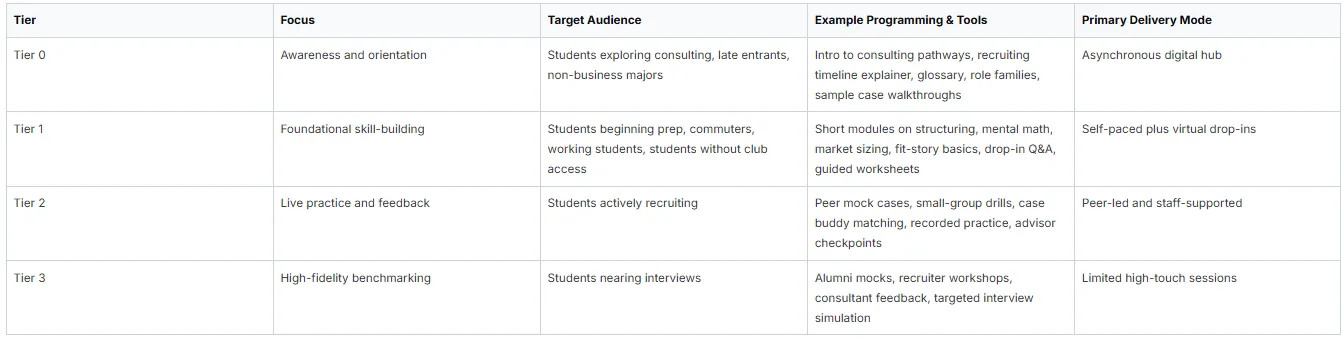
A useful design principle is simple: move students upward only when the next level of support adds a different kind of value, not just more of the same.
The same logic can also support broader tiered student support models in higher education, where self-service, group support, and high-touch advising each serve a different purpose.
How Do You Audit Your Current Consulting Prep Ecosystem for Access Gaps?
Start by treating consulting prep like a service map, not a workshop calendar. List every touchpoint students can use, then identify who uses each one, when they enter, and where they stall.
Most centers discover quickly that the problem isn't lack of content. It's uneven access to the right content at the right time.

According to NACE's overview of the value of career services, graduating seniors who used at least one career service received an average of 1.24 job offers, compared with 1.0 for students who used none.
If access to services is associated with better outcomes broadly, restricted access to consulting prep should be treated as an institutional design problem, not a student motivation problem.
What should you map first?
Begin with four categories:
- Formal center offerings such as appointments, workshops, employer events, resume reviews, and mock interviews.
- Digital assets such as case books, website pages, videos, labor market tools, and scheduling systems.
- Adjacent campus channels such as consulting clubs, honors programs, business school offices, and alumni networks.
- Unofficial channels such as faculty referrals, peer groups, and student-created prep spreadsheets.
Then sort those resources by student journey stage: awareness, initial exploration, foundational learning, live practice, and final interview prep.
Where do access problems usually show up?
In practice, the failures are usually structural:
- Discovery gaps because students don't know consulting is an option until recruiting is already underway.
- Timing gaps because workshops happen when commuter or working students can't attend.
- Format gaps because support assumes confidence with live practice from day one.
- Network gaps because realistic mock interviews depend on club membership or alumni access.
- Navigation gaps because resources sit across multiple pages and systems with no clear sequence.
Practical rule: If your most-used consulting resources are also your hardest-to-access resources, your model is rewarding confidence and prior knowledge more than readiness.
What should an audit produce?
Your audit should end with a short decision memo, not just a spreadsheet.
Name the populations least served, the journey stages with the weakest support, and the delivery formats that create the most friction.
Case interview preparation can require weeks of practice, business research, repeated drills, and multiple live cases. When students must assemble that process alone, many struggle to begin or sustain it.
Use your audit to assess whether students can easily find, sequence, and use the available support.
This career center assessment approach can help distinguish perceived support from actual access.
What Low-Barrier Programming Can Scale Foundational Knowledge?
Low-barrier programming should handle the first mile of consulting prep. It should reduce intimidation, shorten time to first action, and help students reach live practice with basic fluency.
The mistake is treating asynchronous content as a substitute for real practice. It works best as a bridge into repeated mock cases.

A stronger foundation layer should move students from awareness into action. Students need enough solo preparation to understand the case format, enough guided structure to attempt a first case, and enough live practice to build confidence under pressure.
The sequence matters because asynchronous content can start the process, but repeated speaking, structuring, and feedback build readiness.
What should sit in the foundation layer?
A workable foundational layer usually includes:
- Short concept modules on issue trees, synthesis, mental math, chart interpretation, and fit stories.
- Starter practice assets such as annotated case examples, common prompt types, and reflection sheets.
- Low-stakes office hours where students can ask basic questions without booking a full advising appointment.
- Peer entry points like first-case nights, beginner pods, or guided practice sessions for students who don't yet have a case partner.
University teams often overproduce long slide decks and underbuild structured repetition. Students don't need a polished lecture as much as they need a clear next step.
What works better than the usual workshop model?
A single "intro to case interviews" session has limited reach. A small sequence works better:
- Orientation module that explains consulting timelines and expectations.
- Skill primer focused on one concept at a time.
- Practice trigger that sends students into an actual peer drill.
- Feedback loop through reflection, advisor check-in, or recorded review.
Reading resources can start the process. They can't carry it. Students build consulting fluency by speaking, structuring, and revising in real time.
How should you adapt this for underserved groups?
For first-generation students and students entering late, remove assumptions that they know the language of consulting.
Define terms explicitly. Show examples of strong but not polished early answers. Build modules that can be completed in short bursts.
For commuters and working students, offer content in formats that can be used at odd hours.
For international students, include guidance on expectations around verbal synthesis, clarification questions, and interviewer interaction. For non-business majors, surface the business concepts they need without implying they must become finance students first.
How Can You Structure Partnerships to Increase Prep Fidelity?
Partnerships should raise the realism of practice, not just increase event count. Students need access to people who can approximate the pressure, pacing, and feedback style of actual consulting interviews.
That doesn't require endless recruiter time. It requires structured touchpoints with clear roles and manageable asks.
The challenge is especially sharp for students without established consulting networks. If access depends on knowing whom to message, how to request referrals, or which alumni are responsive, the system rewards prior knowledge.
Career centers can reduce that gap by applying a broader employer partnership framework to alumni mocks, employer-led practice, and peer support.
Which partnerships are most useful?
Three partnership types usually outperform general networking events:

What Do Effective Consulting Prep Models Have in Common?
Strong consulting prep models use staged feedback.
Students begin with independent preparation, move into peer practice, and reach alumni or employer-facing feedback only after they can use it well.
They also connect case practice with resume readiness, fit-story development, and recurring practice.
A shared mock interview rubric for career advisors can keep evaluation standards consistent across advisors, peers, alumni, and employer volunteers.
The strongest partnership model converts limited alumni and employer time into repeatable, well-scaffolded student practice.
How should you operationalize this?
Create narrow asks. An alum can commit to one mock interview each semester more easily than to "supporting consulting recruiting."
A recruiter can join a targeted virtual session for first-generation students more easily than a broad campus event with unclear outcomes.
Keep a managed roster, a standard rubric, and a short prep packet for volunteers. That's how partnerships become infrastructure rather than goodwill.
How Do You Design Inclusive Content and Accommodations?
Inclusive consulting prep should be designed for variation from the start.
Students differ in schedule flexibility, familiarity with professional norms, language confidence, disability-related access needs, and social capital. That means access is not only about offering the resource.
It is also about how easily students can find it, use it, and understand the next step.
What should inclusive consulting content include?
Build one centralized consulting hub, then create targeted support tracks within it. Those might include:
- First-generation students with plain-language guides, alumni stories, and explanations of networking norms.
- International students with support on fit interviews, communication expectations, and employer research.
- Commuter and working students with asynchronous modules, virtual practice options, and shorter practice blocks.
- Students with disabilities with accessible media formats, clear accommodation processes, and scheduling flexibility.
- Non-business majors with a starter path on business fundamentals and transferable strengths.
A centralized consulting hub can support multiple student groups through targeted frameworks, accessible formats, and intentional information architecture.
What does accommodation look like in operational terms?
The U.S. Department of Labor found that 63% of American Job Centers were not fully accessible to people with disabilities, even though almost all were physically accessible.
The lesson for campuses is clear. Physical or nominal availability isn't enough.
Use a practical checklist:
- Caption and transcribe videos so students can use content in different settings and formats.
- Offer virtual and in-person options for live events whenever possible.
- Publish clear sequences so students know what to do first, second, and third.
- Reduce navigation friction by avoiding scattered links across club pages, employer pages, and advising pages.
Consulting readiness support should also align with broader career services support for students with disabilities, especially when accessibility gaps appear across advising, events, and digital resources.
What Technology Can Systematize and Scale Accessible Prep?
Technology should act as the operating layer for accessible consulting prep.
It should centralize content, route students into the right level of support, support practice outside business hours, and give staff usable visibility into engagement patterns. If the platform only stores resources, it won't fix the access problem.

NACE argues that career services should function as a community-building hub, with labor-market insights, skill-building courses, and curated resources embedded into the website experience.
That's a useful benchmark for consulting prep because students often need one place to move from awareness to skill-building to live practice without guessing where the next resource lives.
What should the tech layer actually do?
Look for systems that support five functions:

Where does technology help most?
It helps most at the points where student effort and staff capacity usually collide. A student who works evenings can still complete a module, submit a recorded response, or schedule peer practice after hours.
An advisor can then spend appointment time on synthesis, performance issues, or interview strategy instead of repeating foundational explanations.
For interview-specific scale, an AI mock interview workflow for student readiness can help students complete baseline practice before staff, alumni, or employer-facing coaching.
What should you avoid?
Don't let technology become a dumping ground for links. If students enter a portal and see twenty unrelated resources, you've digitized confusion.
Use clear frameworks, consistent naming, and simple progression rules.
Teams evaluating systems may find this higher ed career center tech stack guide useful when deciding whether a platform can support both scalability and student usability.
How Should You Measure the Impact of Accessible Consulting Prep?
Measure access first, progression second, and outcomes third. If you jump straight to placement data, you won't know whether the system widened participation.
Good reporting shows who engaged, who advanced through the prep journey, and whether underserved students gained more consistent access to meaningful support.
A practical measurement set looks like this:
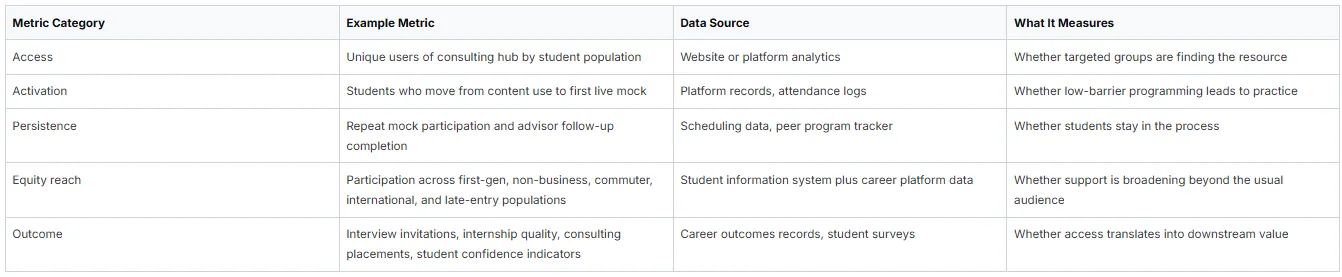
Don't present aggregate participation as proof of equity. A crowded workshop can still leave the same students underrepresented.
According to NACE's article on designing the future of career services, the field is moving toward labor-market insights, skill-building resources, and more community-centered delivery. Accessible consulting prep fits that direction when measurement reflects system design, not just event attendance.
The reporting question to ask every term is straightforward: Which student groups now have a viable path into consulting preparation that they lacked before?
Wrapping Up
A strong consulting readiness framework gives students lower-friction entry points, staged practice, inclusive content, intentional partner support, and a clear view of what comes next.
Hiration supports this work through a full-stack career readiness suite that spans the student journey, including Career Assessments, AI-powered Resume Optimization, Interview Simulation, LinkedIn and cover letter support, and a dedicated Counselor Module for managing cohorts, workflows, and analytics within a secure, FERPA and SOC 2-compliant platform.
For advising teams, the next step is to make consulting preparation easier to find, easier to begin, and easier to track, so readiness does not depend on prior knowledge, club membership, or informal networks.
Consulting Readiness Framework — FAQs
What is a consulting readiness framework?
A consulting readiness framework is a structured advising model that moves students through progressive stages of learning, practice, feedback, and interview preparation instead of relying on isolated events.
Why should consulting preparation be tiered?
Tiered support allows students to build foundational knowledge independently, develop skills through guided practice, and receive high-touch coaching only when they are ready for more advanced feedback.
How can career centers identify access gaps in consulting preparation?
Advising teams should map every consulting resource, identify who uses each service, analyze where students disengage, and review whether underserved populations have clear entry points throughout the preparation journey.
What belongs in the foundational consulting preparation layer?
A strong foundation includes introductory modules, case interview basics, mental math practice, issue tree instruction, sample cases, beginner practice sessions, and low-pressure office hours.
How can advising teams make consulting preparation more inclusive?
Centers can reduce barriers by providing plain-language guidance, asynchronous resources, accessible formats, virtual practice opportunities, targeted pathways for different student populations, and clear preparation sequences.
What role should alumni and employers play?
Alumni and employers are most effective when they support advanced mock interviews, realistic feedback, networking opportunities, and consulting-specific coaching within a structured advising framework.
How can technology improve consulting readiness programs?
Technology can centralize learning resources, deliver self-paced practice, route students into appropriate support levels, automate communication, and provide advisors with visibility into student progression.
What metrics should career centers use to evaluate consulting readiness?
Useful metrics include student participation, progression through readiness stages, practice completion, engagement across student populations, advising referrals, mock interview performance, and recruiting outcomes.
Why is progression more important than participation?
Attendance alone does not demonstrate readiness. Career centers should measure whether students move from awareness to guided practice, advanced coaching, and successful consulting interview preparation.
What makes a consulting readiness framework sustainable?
Sustainable programs combine standardized learning pathways, advisor workflows, scalable technology, structured partnerships, inclusive design, and consistent measurement so consulting preparation becomes an integrated career service rather than a collection of disconnected activities.