What should career centers look for in an AI resume review platform?
Career centers should look for AI resume review platforms that go beyond formatting checks and deliver role-specific, bullet-level feedback with consistent scoring. The right system should improve review quality, reduce repetitive workload, support team workflows, provide performance analytics, and meet higher-ed privacy standards while still keeping counselors central to decision-making.
If your career center is evaluating an AI resume review platform, the real question is not whether it can generate a score or rewrite a bullet. You need to understand how it arrives at its feedback.
Does it identify missing evidence, ask the student for context, and help them communicate what they actually did? Or does it simply polish incomplete content without verifying the experience behind it?
Institutional resume review also requires consistency across majors and cohorts, job-specific guidance, counselor oversight, and visibility into student progress.
The platform should help students improve independently without removing the reflection and critical thinking involved in building a credible resume.
This guide explains what career centers should evaluate, which tasks AI can handle, where counselors should stay involved, and how Hiration connects evidence-based feedback with NACE competencies, job alignment, and career-team operations.
What Should Career Centers Evaluate First?
Career centers should assess six areas before comparing individual product features: feedback depth, career-readiness alignment, student action, counselor control, administrative visibility, and institutional fit. The table below turns these areas into proof points your team can request during a demonstration or pilot.
| Evaluation area | What the platform should support | Evidence to request |
|---|---|---|
| Feedback depth | Structure, ATS compatibility, skills gaps, bullet quality and job-description alignment | Sample reviews from students across different majors and experience levels |
| Career-readiness alignment | Analysis of whether a resume demonstrates relevant competencies, not just keywords | Competency results and supporting evidence drawn from the resume |
| Student action | Contextual prompts that require students to supply missing evidence before AI helps reframe their content | An example showing the original bullet, questions asked, student inputs, and final revised bullet |
| Counselor control | Configurable standards, manual comments and routes for counselor intervention | A demonstration of scoring controls and the counselor review experience |
| Administrative visibility | Cohort activity, performance signals, students needing help and follow-up actions | A live view of the administrative dashboard and reporting options |
| Institutional fit | Clear privacy, security, accessibility and integration documentation | Relevant institutional documentation and implementation requirements |
Why Does Manual Resume Review Break at Scale in Career Services?
Manual resume review works well in small volumes. It becomes much harder to sustain when student demand rises and teams need to deliver both quality and speed.
Most career centers run into the same pressures. Counselors spend time repeating the same core feedback across resume after resume. Students often submit documents with different goals, backgrounds, and target roles, which means the review process cannot be fully standardized.
Review quality may also vary depending on counselor experience, workload, or familiarity with a specific field.
That creates a difficult tradeoff. Career centers can try to move faster, but that may reduce the depth and quality of feedback. They can try to personalize every review, but that can quickly overwhelm staff capacity.
AI resume review helps solve that tension. It can handle repetitive analysis, apply consistent review parameters, and surface improvement areas quickly, allowing counselors to focus more of their time on judgment, coaching, and student context.
AI Readiness Self-Assessment for Career Teams
AI resume review only works at scale when the team behind it has clear standards, governance, staff confidence, and visibility. Use this 7-10 minute assessment to see where your approach stands, what is missing, and which operating area to fix first.
- 7-10 minutes
- 6 operating areas
- 3 readiness levels
What Should an AI Resume Review Platform Actually Do?
Not every AI resume review tool is built for career centers. A strong platform should do more than scan for keywords or provide generic feedback. It should support both student outcomes and team operations.
Here is what career centers should look for.
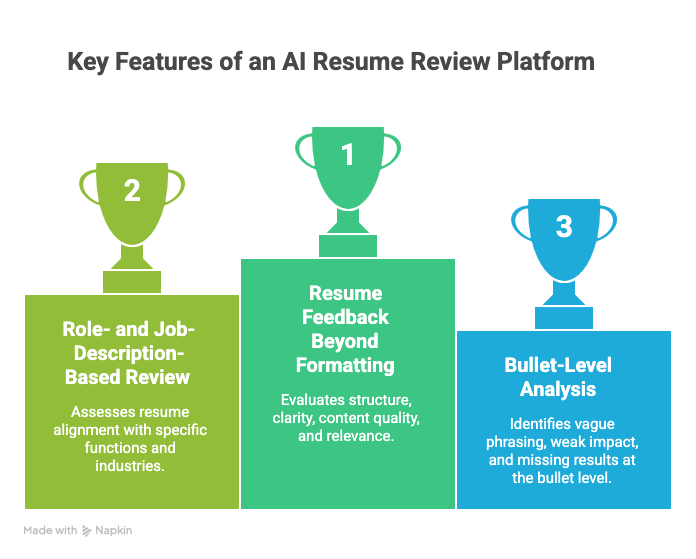
1. Resume feedback that goes beyond formatting
A strong platform should evaluate more than surface presentation. It should help students improve structure, clarity, content quality, and relevance to the kinds of roles they are targeting.
2. Role- and job-description-based review
Students are not applying to the same kinds of jobs. A useful platform should help reviewers assess how well a resume aligns with specific functions, industries, and sample job descriptions.
3. Bullet-level analysis
The most valuable resume feedback often happens at the bullet level. Career centers need a system that can help identify vague phrasing, weak impact, missing results, and opportunities to improve relevance.
4. Evidence-based improvement that keeps students involved
An AI resume review platform should not invent achievements or polish incomplete bullets without understanding what the student actually did. When essential details are missing, it should ask contextual questions about the student’s responsibilities, actions, methods, tools, and results before suggesting a revision. This keeps the student involved in constructing the evidence while AI helps organize it into clearer, more complete language.
5. Standardized scoring and review consistency
Different reviewers should not produce wildly different standards for the same student. A platform should support more consistent evaluation so career centers can improve quality across the team.
6. Workflow support for managers and reviewers
Career centers need more than document review. They also need reviewer assignment, student grouping, submission tracking, notification systems, and visibility into workload.
7. Reporting and performance analytics
A useful platform should help managers understand turnaround time, review activity, student progress, and operational bottlenecks.
8. Privacy readiness for higher ed
Student data handling matters. Career centers need a vendor that can speak clearly about data privacy, deletion workflows, and compliance expectations in higher education.
How Does Hiration Help Career Centers Scale Resume Review?
Hiration’s AI Resume Review platform is designed to help career centers improve both review quality and operational efficiency. Instead of treating resume feedback as a one-off manual task, it gives teams a more structured and scalable way to support students.
How Does Hiration Improve Resume Feedback Quality?
50+ parameter review with configurable scoring
Hiration provides a real-time resume review score based on more than 50 parameters. Its five-part critique covers structural quality, skills gaps, bullet-level strength, achievement quantification, resume length, power verbs, overused language, and other content signals. Career centers can also configure the scoring rubric around their institutional standards instead of relying entirely on a fixed review model.
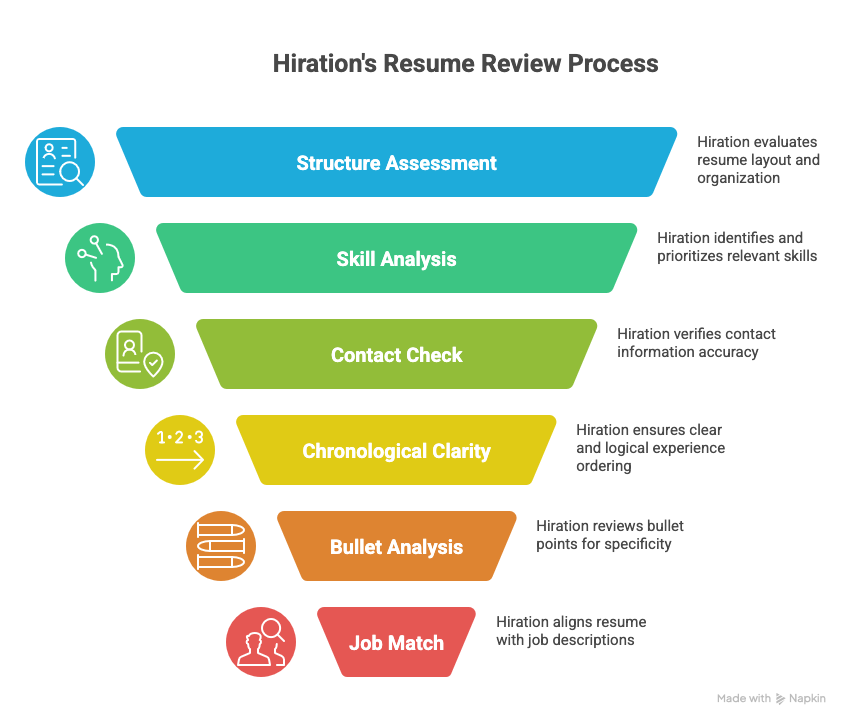
Structure assessment
Hiration evaluates the overall structure of a resume, including layout choices, resume length, section usage, and how effectively skills and experience are presented. That helps students improve readability while giving counselors a faster starting point for deeper conversations.
Skill-level analysis
Hiration’s skill analysis goes beyond identifying skills in isolation. When the NACE Skill Analysis panel is enabled, it evaluates whether a resume demonstrates the eight NACE career readiness competencies and separates them into “Demonstrated” and “Not clearly shown.” Student-facing feedback can also include evidence quoted from the resume, giving counselors a clearer way to connect document feedback with career-readiness development.
Contact information checks
Small issues can create unnecessary friction in the job search. Hiration checks whether core contact information is present and professionally presented, including phone number, email address, and LinkedIn profile.
Reverse-chronological clarity
A resume should make a student’s experience easy to follow. Hiration helps ensure that the career narrative is clear, logically ordered, and easier for reviewers and recruiters to understand quickly.
ATS compatibility review
Hiration reviews whether a resume uses recruiter- and ATS-readable structure, including standard section headings, appropriate layout, clear formatting, and the absence of elements that may disrupt parsing. Students receive a more specific explanation of structural risks, while counselors can reserve appointments for decisions that require context rather than basic formatting corrections.
Bullet-level analysis
Hiration does not simply polish a weak bullet or introduce details the student has not provided. It first evaluates the bullet through the WHO framework: what the student did, how they did it, and the outcome or measurable impact. When essential evidence is missing, the platform asks contextual questions about the student’s actual responsibilities, methods, tools, decisions, and results. It then uses the student’s responses to help reframe the bullet into clearer, more complete, STAR-aligned language. This keeps the student responsible for the underlying evidence while AI helps structure and communicate it more effectively.
Job match analysis
Students can paste a target job description to receive an overall match score and a breakdown of skills already present or missing from the resume. They can add skills they can substantiate under relevant experiences, develop those experiences into stronger STAR-aligned bullets, and create separate resume versions tailored to different job descriptions.
Where Should AI Assist in Resume Review, and Where Should Counselors Stay Involved?
AI can speed up resume review, improve consistency, and surface issues that are easy to miss at scale. It is especially strong at handling repetitive analysis, identifying structural problems, and flagging opportunities to improve alignment with a target role.
Counselors still play the more important role in interpretation and coaching. They understand student context, motivation, identity, and readiness in ways software cannot. They are also better positioned to guide students through decisions about how to present experiences, how to tell a stronger story, and how to prioritize changes based on the student’s real goals.
That is why the strongest model for career centers is not AI instead of counselors. It is AI supporting counselors, so teams can spend less time on repetitive edits and more time on high-value advising.
For resume review specifically, career centers should define this division of responsibility before introducing the platform to students.
| AI-supported first review | Student responsibility | Counselor role |
|---|---|---|
| Identify structural and ATS compatibility issues | Correct basic formatting and organization problems | Review legitimate exceptions or institution-specific requirements |
| Identify missing elements within resume bullets | Provide accurate context, methods and outcomes | Decide which experiences best support the student’s career narrative |
| Compare the resume with a target job description | Select only skills and evidence the student can substantiate | Coach the student on relevance, positioning and application strategy |
| Identify competencies that are demonstrated or not clearly shown | Review the evidence and strengthen incomplete examples | Connect resume evidence with broader career-readiness development |
| Apply the institution’s configured scoring criteria | Complete an initial revision before requesting help | Intervene when the student remains below the expected standard |
Also Read: AI in Career Services: Benefits, Limits, and Ethical Best Practices
How Does Hiration Support Career Center Operations?
A resume review platform should not stop at student-facing feedback. Career centers also need tools that help teams manage delivery across larger student populations.
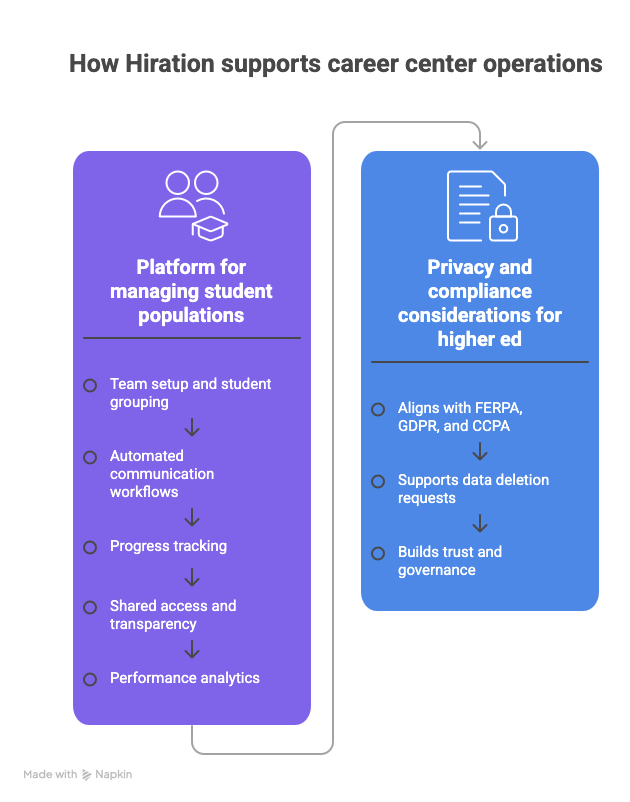
Team setup and student grouping
Hiration allows managers to set up teams and assign reviewers to specific student groups. Cohorts can be organized around criteria such as field of study, graduation year, or other segmentation needs.
Each cohort can also have its own parameters, assigned reviewers, and additional settings, allowing teams to apply different review expectations across programs or student groups.
Automated communication workflows
Once students are added, automated email workflows help bring them onto the platform and keep the process moving. Reviewers are notified when resumes are submitted, which supports a steadier workflow without extra administrative chasing.
Progress tracking
Admins can see resume submissions, scores, reviewer assignments, and student activity in one place. They can also group students who fall below a defined performance threshold, making it easier to distinguish students progressing independently from those who may need counselor intervention.
Targeted student outreach
After identifying a low-scoring student or group, admins can email those students directly from the platform. This closes the gap between reporting and intervention: the team can see who may need support and act without exporting a list or waiting for the student to book an appointment.
Shared access and transparency
Students can send a completed resume to their assigned counselor for manual review. Counselors can mark comments, return the resume, and help the student finalize it, allowing AI feedback and human review to operate inside the same review process.
Performance analytics
Hiration helps admins track career center metrics such as student sign-ups, resumes created, resumes downloaded, students below a defined score, and product adoption by cohort or group. These signals help teams distinguish access from actual resume-preparation activity and identify where additional outreach may be needed.
Also Read: Can One Tool Replace Five? Consolidating Career Services Tech Stack
What Privacy and Compliance Evidence Should Career Centers Request?
Privacy is a core concern for universities evaluating AI tools. Hiration approaches AI Resume Review with a focus on responsible data handling and higher-ed expectations. The platform aligns with FERPA, GDPR, and CCPA requirements and supports requests related to data deletion.
For career centers, that matters because AI adoption is not just about capabilities. It is also about trust, governance, and choosing tools that can operate responsibly in an educational environment.
Career centers can also request Hiration’s SOC 2, VAPT, and VPAT-related materials as part of their institutional review. Regardless of vendor, universities should ask how resume data is stored, who can access it, how deletion requests are handled, and which privacy, security, and accessibility documentation is available.
What Should Career Centers Ask Before Choosing an AI Resume Review Platform?
Before adopting any AI resume review solution, career centers should ask a few practical questions:
- Does the platform evaluate resume content, structure, ATS compatibility, and bullet quality rather than producing only a general score?
- Can it assess whether students demonstrate career-readiness competencies, including evidence from the resume?
- Does its bullet analysis identify what the student did, how they did it, and the resulting impact?
- Can students receive contextual improvement guidance without the system inventing unsupported experience or results?
- Can the career center configure the scoring rubric around its own resume standards?
- Can counselors manually review resumes, add comments, and return them to students?
- Does job-description analysis distinguish between skills already present and skills the student can genuinely substantiate?
- Can managers identify students below a defined threshold and contact them directly from the platform?
- Can the platform report on resume creation, downloads, scores, and adoption by cohort?
- Is the privacy, security, accessibility, and data-deletion approach clear enough for institutional review?
Those questions help separate lightweight tools from platforms that can actually support career services operations.
During a pilot, compare the platform’s feedback with your advisors’ existing standards across resumes from different majors and experience levels. Track whether students revise their resumes, whether common issues decline, which students still require counselor intervention, and whether the administrative data makes targeted follow-up easier.
Conclusion
AI resume review works best when it is part of a larger career readiness system, not a disconnected point solution.
Career centers need tools that help students improve specific documents, but they also need a broader way to support exploration, preparation, and progress across the full journey.
Hiration supports that bigger picture with a full-stack career readiness suite that includes Career Assessments, AI-powered Resume Optimization, Interview Simulation, and a dedicated Counselor Module for managing cohorts, workflows, and analytics.
All of it sits within a secure, FERPA and SOC 2-compliant platform built to help career teams scale support without losing the human guidance that makes it valuable.
As student needs grow and expectations around career outcomes rise, platforms that connect readiness, feedback, and team operations can make career services more consistent, efficient, and impactful.
Book a walkthrough to see how Hiration combines AI resume review, NACE competency analysis, WHO-based bullet feedback, job-specific tailoring, counselor review, and cohort-level visibility in one career readiness platform.
AI Resume Review for Career Centers — FAQs
Why is resume review difficult to scale in career centers?
Resume review requires personalized feedback across different roles and student backgrounds. As volume increases, maintaining both speed and quality becomes difficult without overloading counselors.
How does AI improve resume review workflows?
AI can handle repetitive analysis, apply consistent review standards, and quickly identify improvement areas, allowing counselors to focus more on coaching and student-specific guidance.
What kind of feedback should an AI resume tool provide?
A strong tool should provide structural feedback, role-specific insights, and detailed bullet-level analysis to improve clarity, impact, and alignment with target job roles.
Why is job-description-based review important?
Students apply to different roles, so feedback must be tailored. Job-based review helps ensure resumes align with specific industry expectations and hiring criteria.
How does AI help maintain consistency across reviewers?
AI applies standardized scoring and evaluation criteria, reducing variation between reviewers and ensuring more consistent feedback quality across the team.
What operational features should career centers look for?
Platforms should support reviewer assignment, student grouping, submission tracking, notifications, and workload visibility to help teams manage large-scale review processes efficiently.
What role do counselors play when using AI resume review?
Counselors interpret AI feedback, provide context, guide decision-making, and help students refine their narratives, making their role more strategic rather than repetitive.
How should career centers evaluate AI resume review platforms?
Centers should assess feedback depth, role alignment, consistency, workflow support, analytics, and privacy standards to determine whether the platform can support both student outcomes and operations.
Why is privacy important when using AI in resume review?
Career centers handle sensitive student data, so platforms must meet higher-ed privacy expectations, including compliance with regulations like FERPA and clear data handling practices.
What is the ideal role of AI in career services?
The ideal role of AI is to support, not replace, counselors by improving efficiency, consistency, and scale while keeping human judgment central to student guidance.