Career readiness is still treated as optional at many institutions - something students engage with if they choose to visit the career center.
The result is uneven outcomes: some students graduate with strong, demonstrable skills, while others leave without ever translating their academic work into employable value.
When graduates struggle to articulate skills or meet employer expectations, it impacts placement rates, employer relationships, and how the institution’s value is perceived in the market.
The disconnect is well documented, and it signals that fragmented, opt-in models are no longer sufficient at scale.
This guide breaks down how career centers can move from isolated services to a structured, curriculum-integrated approach.
It covers how to define competency progression across four years, audit curricular and co-curricular touchpoints, and build a system to introduce, practice, and measure career readiness in a way that is consistent, scalable, and institution-wide.
What is a career readiness curriculum map?
A career readiness curriculum map is a strategic, multi-year framework that embeds career development milestones into the student lifecycle. It moves beyond optional services by identifying specific curricular and co-curricular touchpoints where competencies are introduced, practiced, and mastered. This institutional tool makes career readiness a shared responsibility between academic affairs and student services, ensuring all students have structured opportunities to develop and articulate their professional value.

A curriculum map positions career development as a core part of the educational mission, not something optional or add-on.
And the need for this shift is clear.
There’s a disconnect: according to the National Association of Colleges and Employers, 79.5% of seniors believe they’re proficient in professionalism, but only 42.5% of employers agree.
That gap highlights a deeper issue - traditional, opt-in models aren’t enough to build skills consistently across the student body.
A curriculum map solves for this by creating a structured, visible pathway where career readiness is introduced, reinforced, and measured over time.
It allows institutions to scale impact beyond what the career center alone can handle.
Making this shift isn’t easy, as explored in our guide to common career services challenges - but it’s essential for delivering equitable, institution-wide outcomes.
How do you map readiness outcomes across a four-year student journey?
Mapping readiness outcomes involves defining a tiered structure for each core competency, detailing what it looks like at different stages of a student's development. This is crucial for creating a sequenced, multi-year pathway. Instead of a generic checklist of the NACE career readiness competencies, the framework must define observable behaviors that progress from introductory to mastery levels across four years.
This developmental arc transforms abstract skills into a concrete, scaffolded learning process.
For example, "Critical Thinking" for a first-year student might mean identifying an argument in a text, while for a senior it means independently designing and executing a research project.
The map makes this progression explicit.
This tiered approach is exemplified by programs at the University of Wisconsin, where embedding career readiness into courses led to a 32% increase in graduate employability indices at participating institutions.
The table below offers a template for this developmental mapping.
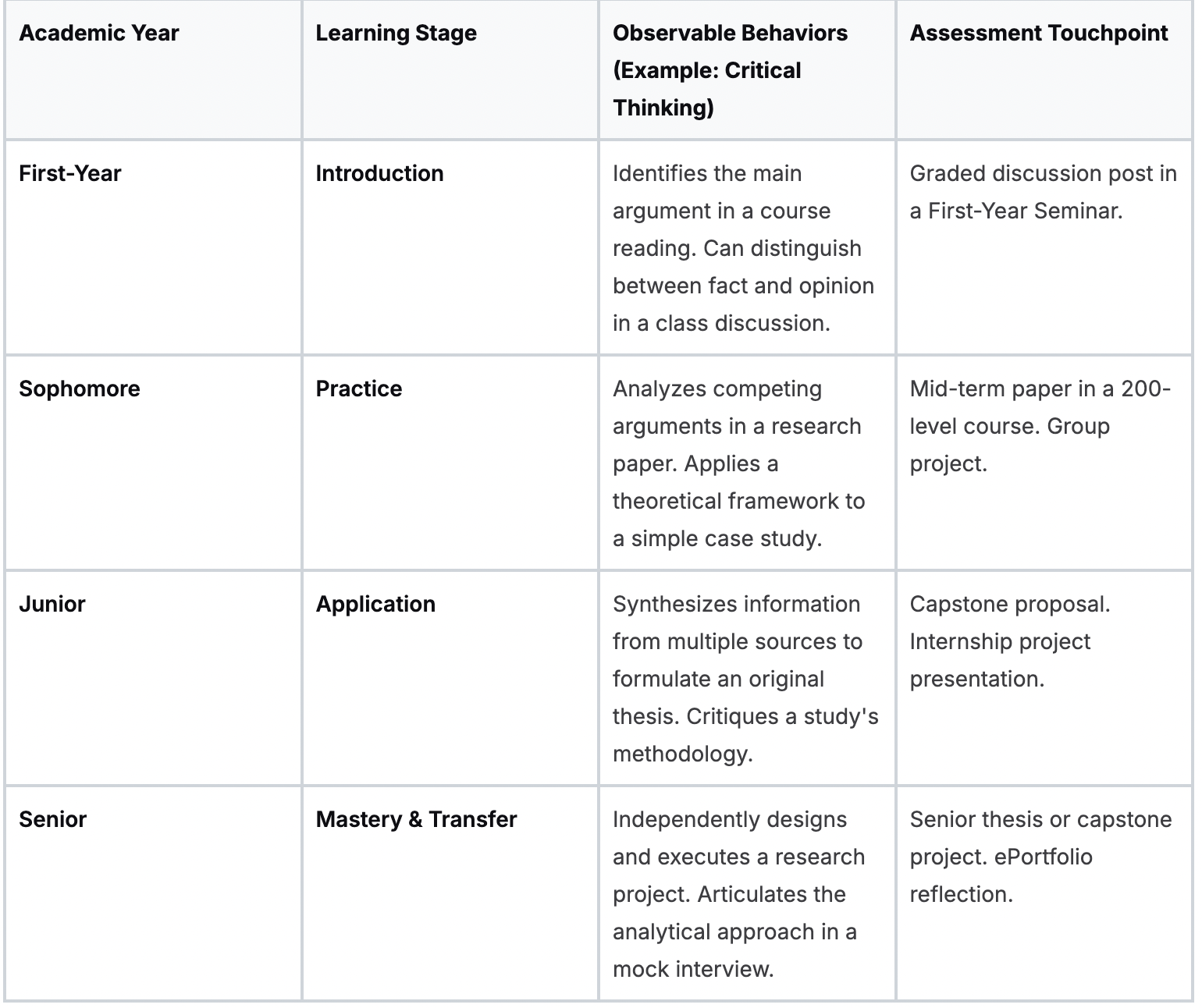
This developmental framework ensures students don't just become aware of competencies; they can actively demonstrate them and articulate their value to employers.
By integrating career assignments into the curriculum, institutions can build and assess these skills systematically.

Where do you find curricular and co-curricular touchpoints for the map?
You find touchpoints by conducting a comprehensive audit of both academic syllabi and co-curricular programs to identify where career competencies are already being taught, even implicitly. The goal is to make this existing work visible and connect it to your competency framework. This audit is your foundational data set and a critical tool for achieving faculty and staff buy-in.
The process involves two parallel tracks:
- Curricular Audit: A systematic review of syllabi, course catalogs, and departmental learning outcomes to find assignments, projects, and activities that align with your competency framework. A group presentation in a history course, for example, is a direct touchpoint for teamwork and communication.
- Co-curricular Audit: A catalog of learning opportunities outside the classroom, such as student government roles, undergraduate research, study abroad, and on-campus employment. A student organization treasurer role is a touchpoint for financial management and ethical leadership.
This audit makes implicit learning explicit, providing the raw material for your map.
For instance, The College of New Jersey's English department proactively mapped course activities to career competencies to demonstrate the major's value.
This faculty-led initiative illustrates how a departmental audit can create powerful connections between academic learning and career preparation, providing a model for other disciplines.
Also Read: How can career centers align their annual program calendar with hiring cycles to improve student outcomes?
How are competencies introduced, practiced, and measured?
Competencies are scaffolded using a three-stage model - Introduction, Practice, Mastery - and measured through a mix of direct and indirect assessments at each stage. This structure ensures a developmental progression, building student skill and confidence systematically. Each touchpoint identified in your audit is categorized into one of these stages to form a coherent learning pathway.
The three stages are:
- Introduction: Foundational, often first-year experiences where students are first exposed to a competency. A first-year seminar requiring students to summarize a guest lecture is an introductory touchpoint for critical thinking.
- Practice: Mid-level experiences where students apply competencies in more complex, guided situations. A sophomore-level course where students analyze competing arguments in a research paper is a practice touchpoint.
- Mastery: Advanced, typically junior or senior-level opportunities where students demonstrate a competency with independence. A senior capstone project or a significant internship role is where mastery is demonstrated and assessed.
Measurement requires a mixed-methods approach, combining direct evidence (e.g., scored resumes, mock interview recordings, internship performance reviews) with indirect evidence (e.g., self-assessment surveys, reflective essays).
For example, a student might report high confidence in their communication skills (indirect), but a recorded mock interview (direct) could reveal a need for more structured answers.
Tracking key career center metrics like internship participation rates and rubric-scored resume quality provides quantifiable proof of the map's impact.
Technology is essential to view analytics from these various data points without creating an unsustainable administrative burden.
Also Read: How Do You Turn Faculty & Alumni into a Career Readiness Network?
Wrapping Up
Building a career readiness curriculum map is ultimately about shifting from fragmented support to a system that delivers consistent, measurable outcomes for every student.
When competencies are embedded across the curriculum and reinforced through structured touchpoints, career development stops being an add-on - and becomes part of how the institution delivers value.
The challenge, however, is operational. Mapping competencies, tracking progression, and measuring outcomes across departments can quickly become complex without the right infrastructure in place.
This is where having a unified system can make the difference.
Hiration brings together career assessments, AI-powered resume optimization, interview simulation, and centralized counselor workflows into a single environment.
With built-in analytics and compliance standards like FERPA and SOC 2, it becomes easier to manage cohorts, track skill development, and scale career readiness efforts without adding administrative burden.
For institutions looking to move from intent to execution, the focus isn’t just on designing the map - it’s on enabling it to run consistently across the entire student lifecycle.