How can career centers manage large caseloads without burning out advisors?
Managing large caseloads sustainably requires replacing reactive, first-come-first-served advising with a data-informed triage system that segments students by need and matches intervention intensity accordingly. By implementing tiered support models, themed scheduling, structured templates, and integrated infrastructure, career centers can protect senior advisor time, reduce redundant work, and shift from volume-based metrics to outcome-based verification. Sustainable caseload management depends on system design, not individual productivity.
The conventional wisdom on managing large caseloads - better time management, misses the systemic issue.
The default first-come, first-served advising model misallocates a career center’s most limited resource: advisor expertise.
It disproportionately serves confident, proactive students while those who are uncertain or overwhelmed remain underserved.
The result is predictable: advisor burnout and uneven student outcomes.
The issue is not effort, but an operational model built for reaction rather than prioritization.
Sustainable caseload management requires replacing reactive queues with a data-informed triage system that segments students by need and matches intervention intensity accordingly.
This guide outlines how career centers can make that shift at scale, moving from constant firefighting to strategic, evidence-based engagement.
How can career centers systematically triage student needs at scale?
Career centers can triage student needs by replacing the reactive, first-come, first-served queue with a proactive, tiered intervention framework. This system segments students based on data points - such as class year, major, and engagement analytics, rather than self-reported urgency. This allows advisors to match intervention intensity to actual student need, ensuring high-touch support is reserved for the most complex cases.
This data-driven approach allows your team to move from putting out fires to strategically engaging the right students at the right time.
For example, the career center at Georgia Tech uses analytics from its student engagement platform to identify and support students who show high potential but are less likely to seek services independently.
This decision model visualizes that exact shift - moving away from a reactive, one-size-fits-all queue toward a more strategic, proactive triage system.
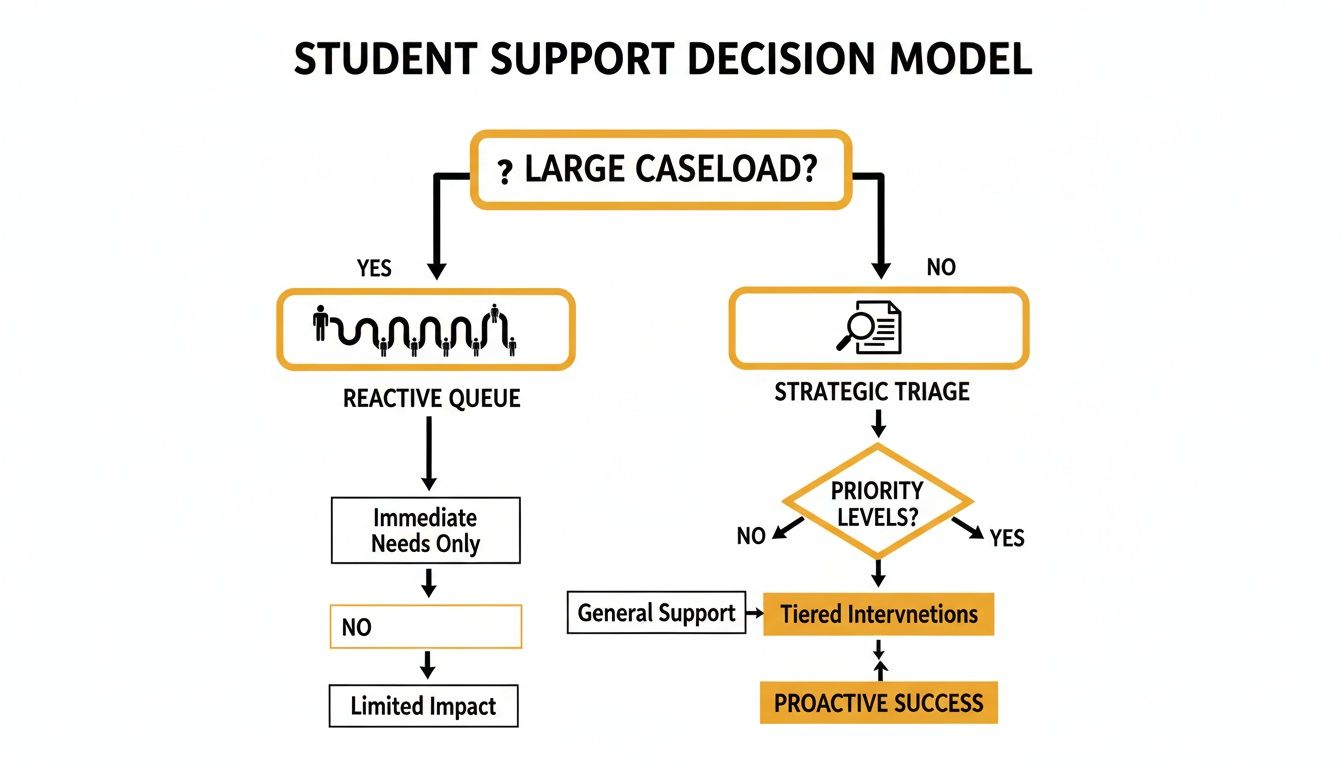
A practical triage framework maps student profiles to specific advisor actions and, crucially, a method to verify that the intervention worked.
This transforms advising into an evidence-based practice.
Student Caseload Triage Framework
This framework maps student segments to appropriate intervention levels, advisor actions, and verifiable outcomes, enabling a scalable and evidence-based support model:
| Intervention Tier | Student Profile | Advisor Action | Verification Method |
|---|---|---|---|
| Tier 1 (Low-Touch) | First-year students; students in majors with clear career paths; students exploring majors. |
Automated email campaigns with links to self-service resources
(e.g., resume builders, career exploration tools). Targeted workshops on foundational topics. Nudges to complete online career assessments. |
Platform analytics (e.g., click-through rates, resource usage). Workshop attendance records. Assessment completion rates. |
| Tier 2 (Moderate-Touch) | Juniors not engaged with career services; seniors with low application numbers; students changing majors. |
Proactive outreach from a peer advisor or intern. Invitation to small-group coaching sessions focused on specific skills (e.g., networking, interview prep). Required completion of a career milestone before meeting 1:1 with an advisor. |
Number of students who book a follow-up appointment after outreach. Completion of assigned career homework (e.g., updated resume). |
| Tier 3 (High-Touch) | At-risk seniors nearing graduation with no job offers; students on academic probation; first-generation or low-income students with low engagement. |
Mandated 1:1 advising sessions. Personalized action plan with bi-weekly check-ins. Direct introductions to alumni mentors or partner employers. Intensive support from a dedicated career coach. |
Number of job applications submitted post-intervention. Documented mock interviews completed. Confirmed internship or job offers. |
This structured approach frees up senior advisors to focus on complex cases in Tier 3, while technology and trained junior staff effectively handle the needs of students in Tiers 1 and 2.
How can advisors shift from reactive firefighting to proactive engagement?
Advisors can shift from reactive to proactive engagement by replacing fragmented, one-off appointments with structured scheduling and cohort-based support. A highly effective method is implementing “Themed Days,” where advisors dedicate entire days to specific activities like high-need student appointments, resume workshops, or employer outreach. This significantly reduces context-switching, a primary driver of cognitive load and advisor burnout.
The University of California, Berkeley's Career Center implements this strategy by organizing advising "sprints" focused on specific industries, creating focused, high-impact engagement that serves many students at once.
This strategy fits perfectly within a broader, more structured approach, such as an advisor-led job search framework.
How can structured templates reduce redundant advisor work?
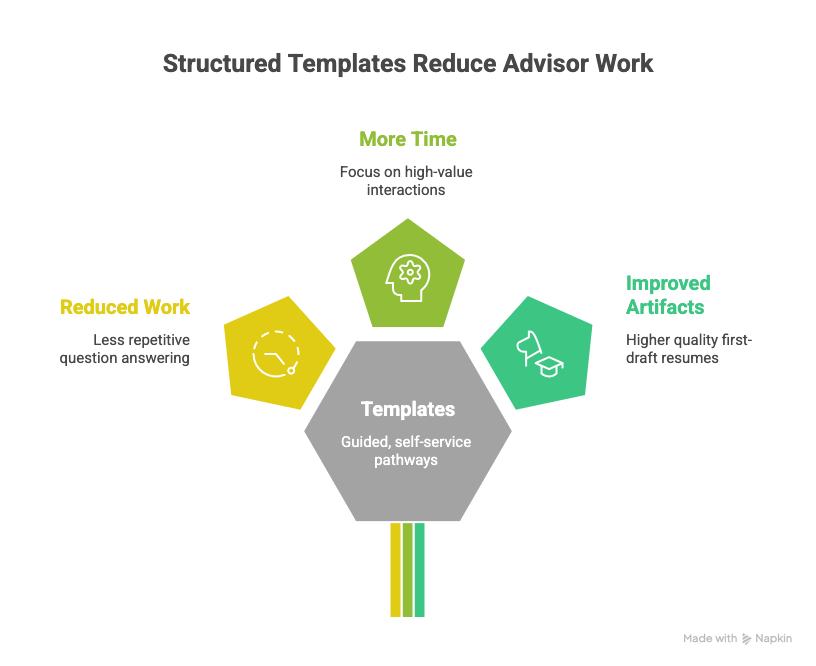
Structured templates and communication playbooks reduce redundant work by creating guided, self-service pathways that handle foundational student questions at scale. Instead of answering the same basic resume formatting or career exploration questions repeatedly, advisors can deploy automated sequences of self-assessments, prompts, and curated resources. This reserves advisor time for complex, high-value interactions.
Arizona State University excels at this, using scalable tools to deliver consistent, templated career education to its massive student body.
Verification of this strategy's effectiveness is not based on student satisfaction but on the quality of student-produced artifacts.
A career center can verify this works by measuring the quality of first-draft resumes from students who used a guided template versus those who did not.
A sharp decrease in appointments booked for basic formatting issues provides a clear signal of saved advisor time. Institutions can use a library of effective resume templates as the foundation for these playbooks.
What are the primary warning signs of systemic advisor overload?
Systemic overload is often caused by institutional failure modes, not individual time management. A key warning sign is "tech layering" - the adoption of fragmented, single-purpose tools for resumes, mock interviews, and scheduling.
According to research from EDUCAUSE, such fragmentation forces staff into duplicative administrative work, increasing burnout.
Another sign is a focus on vanity metrics, such as the sheer number of appointments, over outcome metrics like verified skill improvement.
This incentivizes high-volume, low-impact meetings, leading to advisor exhaustion.
Verification methods include tracking staff turnover rates, conducting anonymous advisor workload surveys, and analyzing the hidden costs of legacy workflows compared to the investment in integrated systems.
How can institutions build a sustainable system for caseload management?
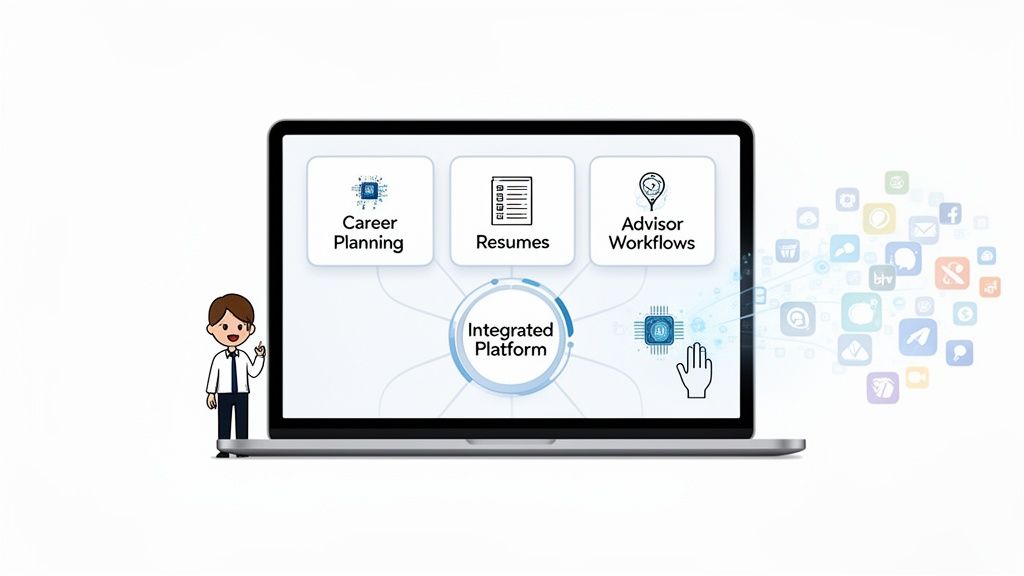
A sustainable system requires moving beyond individual tactics to a technology-enabled, integrated infrastructure.
Fragmented tools create data silos and administrative friction, which directly contributes to advisor workload and prevents longitudinal tracking of student development.
An integrated system is the only way to effectively monitor a student's progress over time and automatically capture evidence of their career readiness.
Wrapping Up
Sustainable caseload management is a system design problem, not a productivity one.
Career centers that scale impact do so by intentionally allocating advisor expertise: high-touch support for complex cases, structured workflows and technology for foundational needs.
This reduces burnout, improves consistency, and makes outcomes measurable.
Replacing fragmented tools and reactive appointments with integrated infrastructure allows teams to track progress over time and verify what works.
Hiration enables this shift by unifying career planning, ATS-aligned resumes, scalable interview practice, and FERPA-compliant counselor workflows, freeing advisors for high-impact coaching.
The result is a model built to scale expertise, protect advisor capacity, and deliver more equitable student outcomes.
Managing Large Advising Caseloads — FAQs
Why does the first-come, first-served advising model lead to burnout?
It misallocates advisor expertise by prioritizing confident, proactive students while high-need students remain underserved, creating reactive workloads and uneven outcomes.
What is a triage model in career services?
A triage model segments students by data indicators such as engagement and class year, matching them to appropriate tiers of intervention rather than relying on self-reported urgency.
How do themed advising days reduce advisor burnout?
Themed days group similar activities together, reducing context switching and cognitive load while allowing advisors to serve multiple students efficiently.
How do structured templates save advisor time?
Templates and guided workflows handle foundational questions at scale, improving first-draft quality and reducing repetitive formatting or exploratory appointments.
What are warning signs of systemic advisor overload?
Indicators include fragmented tech stacks, focus on appointment volume over outcomes, duplicated administrative work, rising staff turnover, and persistent context switching.
How can centers verify that a triage system is working?
Verification comes from tracking shifts in advisor time allocation toward high-value cases, improved artifact quality, reduced low-complexity appointments, and measurable workload stabilization.
What makes caseload management sustainable long term?
Sustainability depends on integrated infrastructure that connects triage, workflows, analytics, and longitudinal tracking, ensuring expertise is allocated strategically rather than reactively.