How can career services support adult learners with practical, scalable strategies that respect their time and experience?
Career services can improve adult learner outcomes by redesigning support for real constraints: offering asynchronous and flexible access, coaching horizontal pivots through transferable skills, building project-based portfolio proof, teaching time-efficient job search systems, and using asset-framed advising rooted in local labor market data—so adult learners convert education into measurable career mobility.
Adult learners bring a wealth of life experience to your campus, but they also bring a highly specific set of logistical and professional challenges.
As Career Services Professionals (CSPs), you know that handing a 35-year-old parent the same resume template you give to a 19-year-old sophomore simply does not work.
To genuinely support this growing demographic, we need to rethink our approach from the ground up.
Here is an actionable, data-backed guide on effective career strategies specifically tailored for adult learners.
How do we address the unique barriers adult learners face?
Adult learners navigate intense work-study conflicts and heavy caregiving duties that traditional students rarely face. They juggle full-time employment alongside parenting, leaving them with highly restricted schedules. Traditional 9-to-5 career center hours and generic entry-level advice completely fail to accommodate their complex, fragile logistical realities.
To put this into perspective, according to a 2025 report by Jobs for the Future (JFF), 46% of students aged 30 or older work full-time, and more than 60% have dependents.
Furthermore, a 2025 systematic review published in MDPI identified "work-study conflict" as a persistent, major barrier for 21.6% of all adult learners.
CSPs must advocate for asynchronous career resources, weekend advising hours, and on-demand virtual support to meet these students where they actually are.
Also Read: How to Build Scalable Peer Mentor Programs That Drive Student Outcomes?
How can we facilitate effective career pivots for adults?
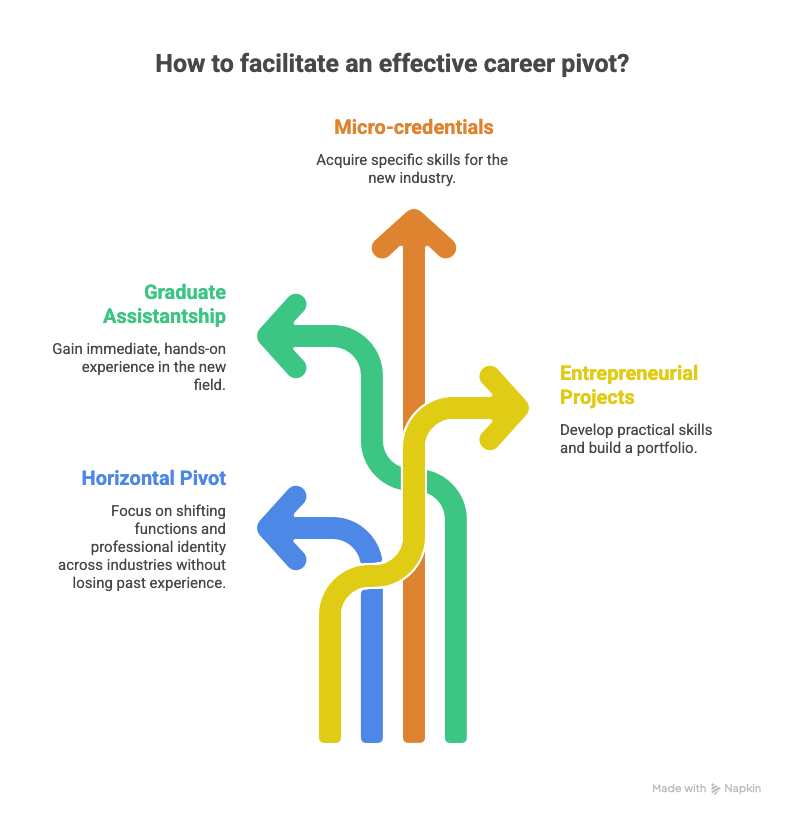
Guide adult learners toward "horizontal pivots" rather than starting from scratch. Help them identify transferable skills from their past careers and apply them to new industries. Encourage them to pursue graduate assistantships, micro-credentials, or entrepreneurial campus projects that provide immediate, hands-on experience in their new target field.
A horizontal pivot focuses on shifting functions and professional identity across industries without losing the value of past experience.
For example, according to a 2026 student account from the MSU Broad College of Business, a student successfully transitioned from a legal career in Brazil to the marketing industry by launching her own app and securing a graduate assistantship in digital marketing.
Coach your adult learners to reframe their narratives.
Help them translate past competencies like turning legal analysis into marketing data insights, so they enter their new field at a level that respects their prior professional tenure.
Also Read: 8 Plug-and-Play Career Assignments to Embed in Any Course
Why is project-based portfolio proof essential for hiring?
Employers increasingly demand visible proof of competency over bullet points on a resume. Project-based portfolios allow adult learners to showcase tangible solutions, consulting work, and applied 21st-century skills. This authentic assessment method proves they can execute complex, real-world tasks immediately upon hire, bypassing entry-level skepticism.
The Education Design Lab notes that employers want to see students positioned as "consultants, not interns," equipped with industry-recognized micro-credentials and a portfolio of work-based experiences.
According to a 2025 paper published on SSRN by Manuel B. Garcia, digital portfolios serve as an authentic project-based learning assessment that is vastly superior to traditional exams for showcasing longitudinal academic growth and technical capability.
Guide your adult learners to build digital homes for their capstone projects, freelance deliverables, and case studies so they can tangibly prove their value to hiring managers.
Also Read: Workshop Scripts Advisors Can Use to Create Verifiable Student Outcomes
What are time-efficient job search systems for busy adults?
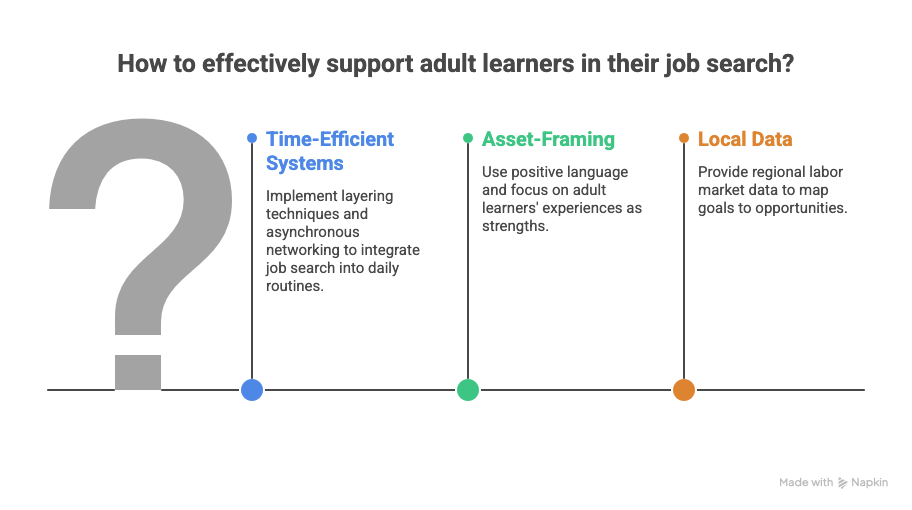
Implement "layering" techniques and asynchronous networking systems. Teach adult learners to integrate skill-building and industry research into their existing daily routines, like commutes. Guide them to use automated job alerts, targeted LinkedIn outreach during off-hours, and virtual employer speaker series instead of time-consuming, traditional career fairs.
Adult learners cannot afford to treat a job search as a second full-time job.
According to career pivot insights published by Steering Point, "layering in learning" is a vital survival tactic - this means listening to industry podcasts during a commute or dedicating strictly time-boxed weekend hours to maintain work-life balance.
Additionally, a 2024 Urban Institute report indicates that providing flexible access to employer speaker series and virtual mock interviews significantly broadens professional networks for students lacking inherent social capital.
Also Read: What Recruiters Really Want: A Data-Backed Playbook for Career Services
How should advisors adapt their conversation strategies?
Drop the deficit language and adopt an asset-framing approach. Speak to adult learners as experienced professionals rather than inexperienced students. Validate their life experience, focus on how their unique backgrounds provide a competitive edge, and map their goals directly to real-time, local labor market data.
Terminology shapes reality.
According to a comprehensive research brief by ERIC, using terms like "low-skill" or "at-risk" focuses entirely on vulnerabilities and fails to recognize adult learners as successful, resilient problem-solvers.
Frame their experiences as assets.
Moreover, according to a 2025 Gatsby Education report, high-quality career guidance for adults must be underpinned by quality-assured, regional labor market data.
Treat your advising sessions like a strategic peer-to-peer consulting meeting, mapping their rich histories directly to the most viable local economic opportunities.
Also Read: How Can Career Advisors Make Students More Visible on LinkedIn?
Wrapping Up
Supporting adult learners is not about adding more services. It is about redesigning your systems to match their time constraints, experience, and career goals.
When guidance becomes flexible, skills-first, and proof-driven, adult learners engage more and transition into stronger, more stable roles.
That shift requires scalable infrastructure.
Career teams are increasingly adopting platforms that deliver asynchronous support, personalized resume and interview feedback, and portfolio-ready outputs without adding to staff workload.
Hiration’s full-stack career readiness suite brings these elements together, from career assessments to AI-powered resume and interview modules, along with a dedicated counselor workspace for managing cohorts and outcomes within a secure, FERPA and SOC 2-compliant environment.
When adult learners are supported in ways that respect their reality, they convert education into real, measurable career mobility.
Supporting Adult Learners in Career Services — FAQs
What makes adult learners’ career barriers different from traditional students?
Adult learners often balance full-time work, caregiving, and fixed schedules, which makes standard 9-to-5 hours and generic entry-level guidance ineffective. The barrier is usually logistical and time-based, not motivation or capability.
What changes should career centers make first to improve access for adult learners?
Prioritize flexible delivery: asynchronous resources, virtual advising, written follow-ups, and appointment options outside traditional hours. These changes reduce friction and make career support compatible with adult learners’ routines.
How can advisors support effective career pivots for adults without forcing a “restart”?
Coach horizontal pivots by identifying transferable skills, reframing prior experience into a new industry narrative, and recommending fast proof-builders like micro-credentials, assistantships, or applied campus projects that create relevant experience quickly.
Why is project-based portfolio proof especially important for adult learners?
Portfolios reduce employer skepticism by showing tangible work—case studies, capstones, consulting-style deliverables, and applied projects—so adult learners can prove competency beyond resume bullets and translate experience into visible outcomes.
What are time-efficient job search systems that work for busy adults?
Teach “layering” and time-boxing: automated job alerts, short scheduled outreach blocks, commute-friendly learning, and virtual employer events. The goal is a sustainable system that does not require a second full-time job.
How should advisors adapt their conversation strategy with adult learners?
Use asset-framing and a peer-to-peer tone. Treat adult learners as experienced professionals, validate their existing competencies, and connect their goals to real-time labor market data rather than deficit language or generic exploration prompts.
What kinds of “proof” should adult learners build while still in school?
Focus on portfolio-ready artifacts: a targeted resume rewrite, a LinkedIn profile aligned to a new role, a capstone or case study write-up, a micro-credential badge, and a short set of STAR stories tied to role requirements.
How can career services scale adult learner support without increasing staff workload?
Standardize repeatable frameworks (pivot mapping, portfolio templates, time-boxed job search plans) and use systems that deliver asynchronous guidance and track progress across cohorts, so adult learners get consistent support even with limited staff capacity.