How can career services teams meaningfully evaluate the 8 NACE Career Readiness Competencies?
Career services teams can evaluate the NACE competencies by translating them into observable behaviors, assessing evidence through structured reflection and behavioral examples, and scoring readiness using standardized, multi-level frameworks rather than self-reported confidence or buzzwords.
Career readiness isn’t a vocabulary problem. It’s a translation problem.
Most students can name the NACE competencies. Far fewer can explain what they actually look like in action, or prove them to an employer.
That gap is where confidence breaks down, advising gets fuzzy, and recruiters stop listening. Skills don’t fail students. Vague language does.
This guide helps Career Services Professionals translate the NACE competencies into student-friendly language, assess real readiness (not buzzwords), and move students from awareness to impact - making career readiness visible, measurable, and credible.
What are the 8 competencies in student-friendly language?
The eight NACE competencies are the building blocks of professional success: Career & Self-Development, Communication, Critical Thinking, Equity & Inclusion, Leadership, Professionalism, Teamwork, and Technology. Think of these as the "language of work" that translates a student’s classroom theories into the specific, high-value actions that recruiters and hiring managers are looking for.
To get students to buy in, you have to stop using "HR-speak." According to SUNY Westchester Community College, translating these into "Sample Behaviors" helps students see themselves in the definitions.
| Competency | Student-Friendly “Translation” |
|---|---|
| Communication | Explaining your ideas so people actually get it, and listening so you get theirs. |
| Critical Thinking | Connecting the dots to solve a problem without needing a manual. |
| Equity & Inclusion | Working effectively with everyone, regardless of where they come from or what they believe. |
| Professionalism | Showing up, owning your mistakes, and being the person people can count on. |
| Career & Self-Development | Being the CEO of your own growth and knowing how to ask for what you need. |
| Teamwork | Playing your part in a group to hit a goal, even when personalities clash. |
| Leadership | Influencing others to get things done, even if you don’t have “Manager” in your title. |
| Technology | Using digital tools ethically and efficiently to work smarter, not harder. |
Also Read: How to give resume feedback in 5 minutes?
How can you evaluate a student’s competency level?
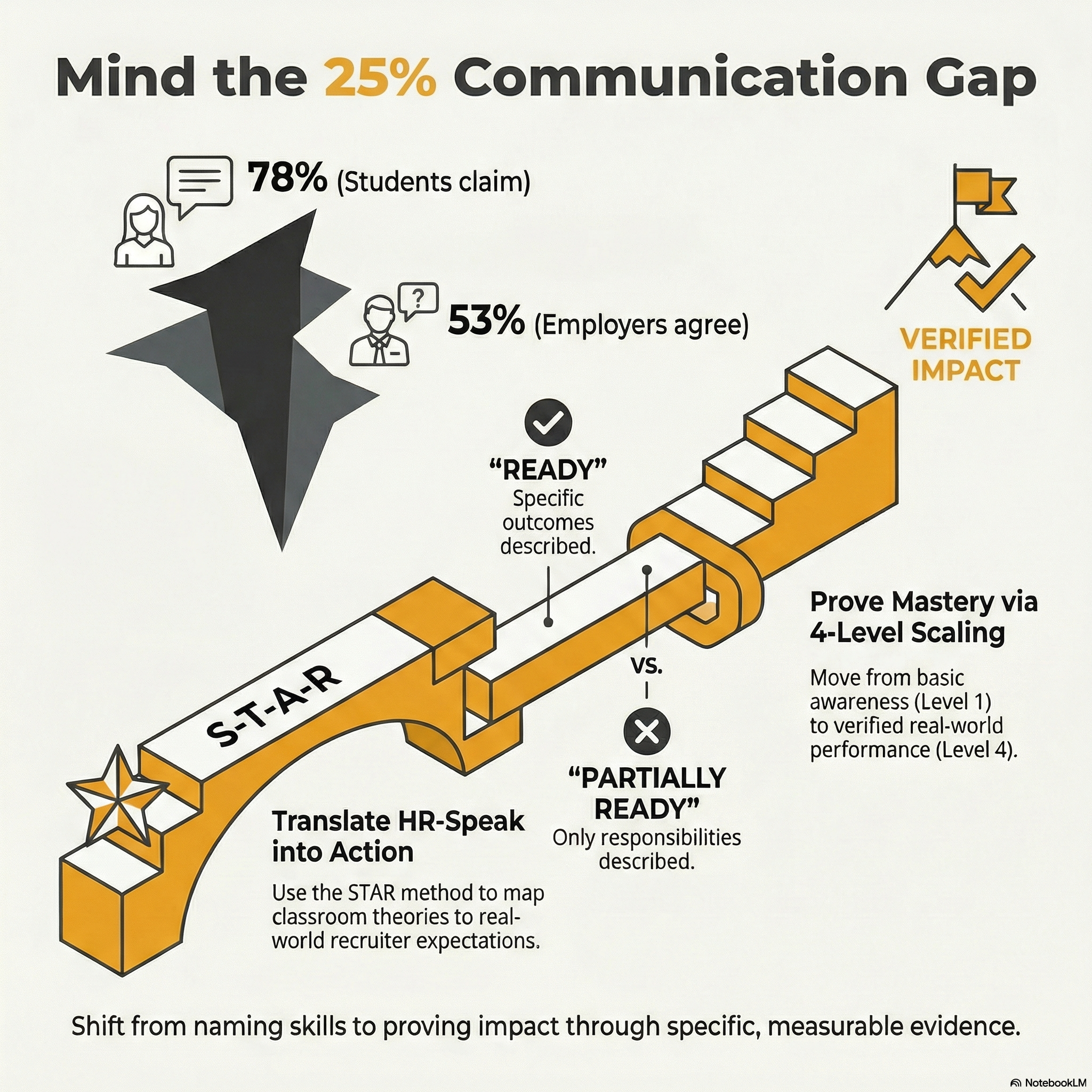
Advisors should use a mix of self-assessment tools, behavioral interviewing, and e-portfolio reviews to gauge proficiency. By asking students to map their experiences to the STAR (Situation, Task, Action, Result) method, you can determine if they can articulate their skills or if they are simply reciting a list of buzzwords.
Generic assessments don't work anymore. According to Rice University, using specialized tools like the Career Launch NACE Career Readiness Inventory allows students to get feedback on experiential learning specifically tied to employer-valued skills.
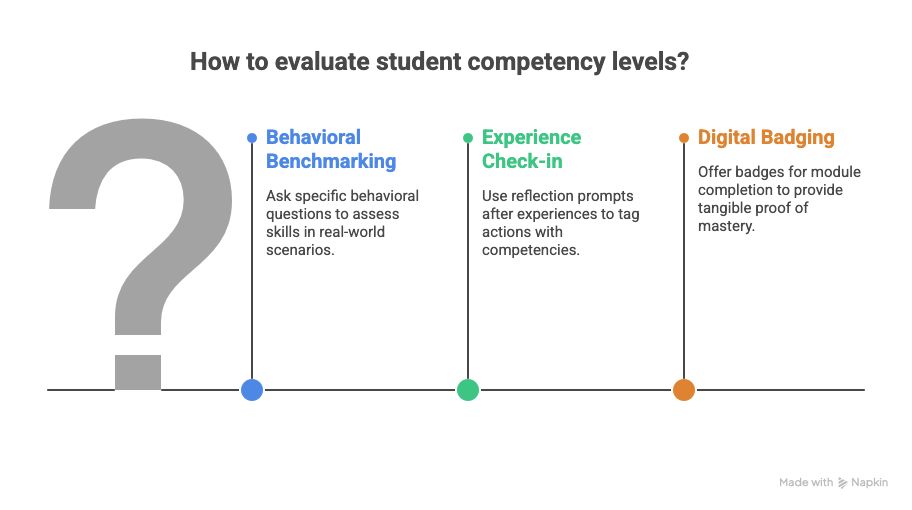
Three Proven Methods for CSPs:
- Behavioral Benchmarking: During appointments, don't ask "Are you a good communicator?" Ask: "Tell me about a time you had to explain a complex topic to someone who was totally confused."
- The "Experience Check-in": Following the lead of Florida State University, use short, structured reflection prompts after internships or campus jobs to help students "tag" their actions with specific competencies.
- Digital Badging: According to Case Western University, offering "stackable" digital badges for specific modules (like Networking or Interviewing) provides tangible proof of mastery that students can share on LinkedIn.
Also Read: How to build career readiness for student athletes?
What are the indicators of "Ready" vs. "Partial Readiness"?
"Readiness" is the ability to provide a specific, high-impact example of a skill in action, whereas "Partial Readiness" is merely acknowledging the skill's importance. A ready student can describe the impact of their actions on an organization, while a partially ready student describes their responsibilities without clear outcomes.
The "Proficiency Chasm" is real. According to NACE’s 2025 Perception Gap research, 78.1% of students believe they are proficient in Communication, but only 53.5% of employers agree - a 24.6% gap.
| Competency | Partial Readiness (The “What”) | Full Readiness (The “How” + Impact) |
|---|---|---|
| Communication | I write good reports and emails for my club. | I synthesized a 50-page research report into a 3-slide executive summary that secured $1,500 in funding from the Student Gov, according to UConn Career Services source. |
| Critical Thinking | I know how to use Excel and look at data. | I analyzed 6 months of club spending in Excel and found a way to cut costs by 15% by renegotiating vendor contracts. |
| Teamwork | I worked on a group project for my marketing class. | I managed a 4-person team, resolved a conflict over deadlines by implementing a Trello board, and we finished the project 2 days early. |
| Equity & Inclusion | I am inclusive and have friends from different backgrounds. | I audited our student club’s recruitment process, identifying 3 barriers for neurodivergent students and implementing accessible meeting formats, according to Michigan State source. |
| Professionalism | I always show up to my shift on time. | I created a shift-handoff checklist that reduced communication errors by 20% for the incoming morning crew, ensuring 100% task completion. |
| Leadership | I was the president of the Chess Club last year. | I delegated tasks to 5 committee members and grew club membership by 30% through a targeted social media campaign and local outreach, according to Yale OCS source. |
| Technology | I am proficient in using AI and social media. | I utilized Generative AI to draft initial email templates for alumni outreach, saving the team 5 hours of manual writing per week while maintaining brand voice, according to USC source. |
| Career & Self-Development | I go to career fairs and update my resume. | I identified a gap in my data visualization skills, completed a 10-week certification in Tableau, and used it to create a real-time dashboard for my internship supervisor, according to Stanford source. |
Also Read: How to build a skills first goal setting workshop?
How can you close the most common competency gaps?
Close the gap by embedding career readiness directly into the curriculum and campus jobs rather than treating it as an "extra" activity. Advisors should facilitate "reflection-in-action," where students are prompted to name the competency they are using while they are performing a task, ensuring the skill becomes part of their professional identity.
The widest gap is in Leadership and Professionalism, where the perception difference between students and employers approaches 30%, according to NACE.
- The Professionalism Gap: Students mistake "politeness" for professionalism. According to USF Career Services, CSPs can close this by directing students to "Business Etiquette for Gen Z" pathways via LinkedIn Learning.
- The Leadership Gap: Many students think they need to be "President" of a club to lead. Teach them about "Micro-Leadership" - taking initiative on a single task. According to UConn, campus jobs (Work+) are the best labs for this; students learn to manage up by asking for guidance before a task stalls.
Also Read: What are some activities career centers can use to build student professionalism?
What is a simple roadmap for scoring student readiness?
To build an effective scoring system, you must move beyond binary "Pass/Fail" thinking. According to the NACE Quick Poll from September, while 83.3% of colleges are implementing competencies, only 24.4% have a formal assessment plan in place.
The following roadmap utilizes the official 4-point scale from the NACE Competency Assessment Tool to help you standardize how you measure and verify student progress.
| Readiness Level | Definition & Performance Descriptor | Evidence / Artifact Required | Institutional Strategy (Adoption Stat) |
|---|---|---|---|
| Level 1: Emerging Knowledge | Student can identify the competency and understands its basic value in the workplace. | Self-reflection essay or “Defining the Skill” worksheet. | 57% of schools integrate this level into First-Year Experience programs. |
| Level 2: Understanding | Student can describe how the competency applies to their specific major or career field. | Completed STAR story draft for a specific job description. | 79% of institutions use 1-on-1 advisor appointments to verify this level of understanding. |
| Level 3: Early Application | Student has demonstrated the skill in a controlled setting (classroom, simulation, or club). | Evaluated project, case study, or “Career Ready” digital badge. | 22% of colleges now use Badging or Passport programs to certify these applications. |
| Level 4: Advanced Application | Student has successfully applied the skill in a professional environment with measurable impact. | Supervisor evaluation from an internship or on-campus job. | 48% of schools assess this via Internships, and 38% via On-Campus Jobs. |
Advisors should use this 4-level scale to facilitate "360-degree feedback," comparing a student's self-assessment against an observer's rating (like a faculty member or supervisor).
By moving a student through these levels - from simply knowing what "Professionalism" is (Level 1) to receiving a high supervisor rating in a real-world internship (Level 4), you provide the "proof" that 65% of employers are now looking for in their move toward skills-based hiring.
Also Read: How does a 4-week job search plan help advisors coach students more effectively in 2026?
Wrapping Up
Career readiness becomes real only when students can show it - clearly, consistently, and in ways employers recognize.
That requires more than one-off workshops or standalone assessments. It requires a system that connects competencies to evidence, reflection to articulation, and advising to outcomes.
This is where many career centers are rethinking their stack.
Instead of juggling disconnected tools, Hiration brings career assessments, AI-driven resume and interview practice, and counselor-led cohort management into a single, FERPA- and SOC 2-aligned system.
When readiness is tracked across the full student journey, and supported by workflows and analytics, career teams can focus less on administration and more on what matters most: helping students prove they’re ready.
NACE Career Readiness — FAQs
What are the 8 NACE Career Readiness Competencies?
The eight competencies are Career & Self-Development, Communication, Critical Thinking, Equity & Inclusion, Leadership, Professionalism, Teamwork, and Technology.
Why do students struggle to demonstrate career readiness?
Most students understand the competency labels but lack the language and structure to explain how their experiences demonstrate those skills in action.
How can advisors assess readiness beyond self-reporting?
Advisors can use behavioral questions, experiential reflections, portfolio reviews, and supervisor feedback to evaluate whether students can provide evidence-based examples.
What is the difference between readiness and partial readiness?
A ready student can describe specific actions and outcomes tied to a competency, while a partially ready student can only describe responsibilities or intentions.
Which competencies show the largest employer perception gaps?
Leadership and Professionalism consistently show the widest gaps between student self-perception and employer evaluation.
How can career centers standardize competency evaluation?
Standardization requires a shared scoring rubric, a multi-level proficiency scale, and alignment across advisors, faculty, and supervisors.
Why is a multi-level scoring model important?
Multi-level scoring captures growth over time and allows advisors to distinguish awareness, practice, proficiency, and verified performance.