How should career advisors evaluate mock interviews in 2026?
Career advisors should evaluate mock interviews using a structured, rubric-based framework aligned with employer competencies such as problem-solving, teamwork, communication, and adaptability. Scoring responses based on evidence, decision-making clarity, and outcomes ensures feedback reflects real hiring standards rather than subjective impressions.
Modern interview coaching for US college students has moved past "be yourself" advice.
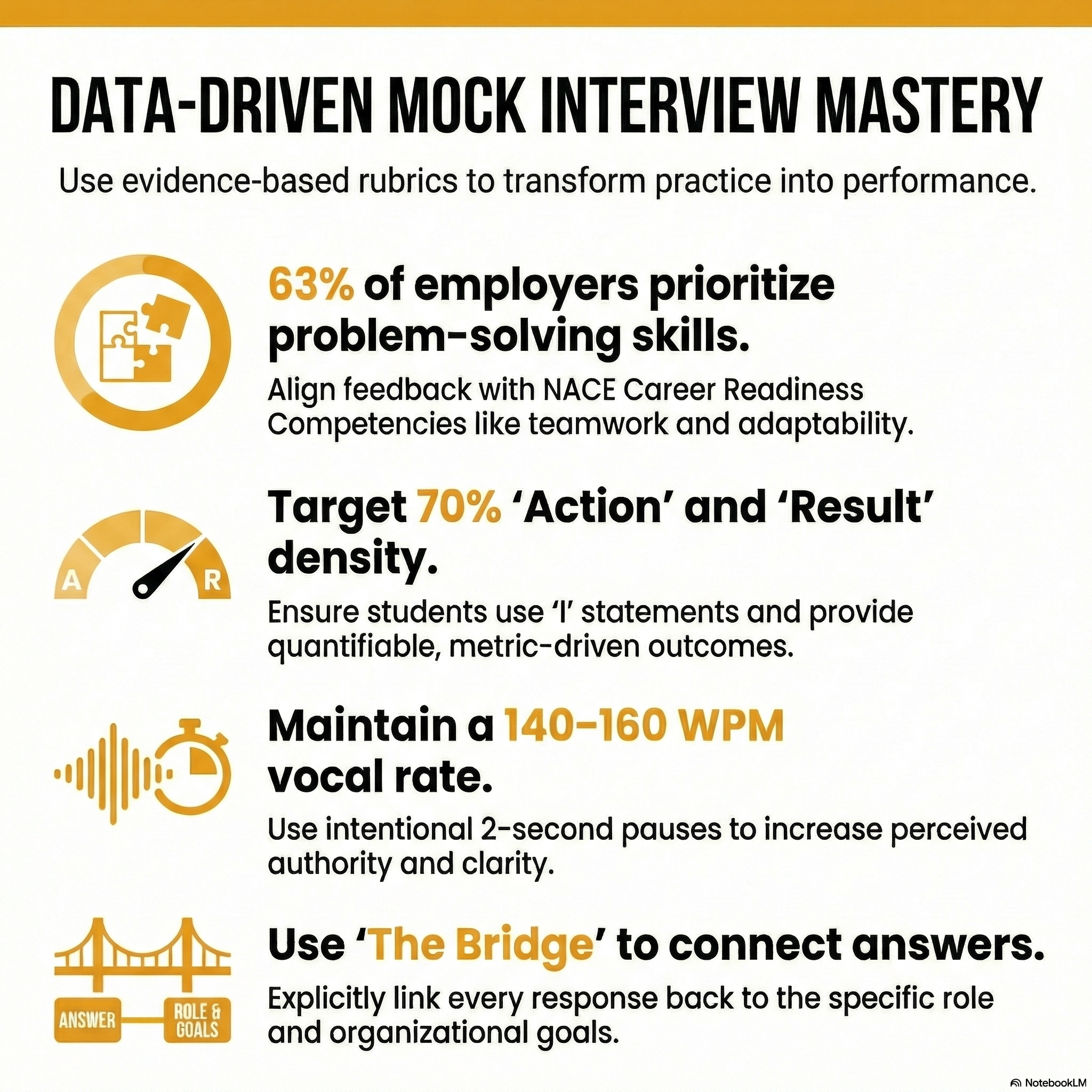
With 63% of employers prioritizing problem-solving and 57% seeking teamwork evidence according to the NACE Job Outlook 2025 report, your feedback must be data-driven.
A rubric-based approach transforms subjective impressions into actionable career development for your students.
Here is an evidence-based framework to evaluate and elevate student interview performance.
Which behavioral categories must a mock interview rubric include to meet employer standards?
A robust mock interview rubric must align with the competencies employers actually assess, not generic interview advice. At a foundational level, this means scoring problem-solving, communication, and adaptability - core elements of the NACE Career Readiness Competencies - based on whether students can demonstrate them through specific, evidence-based examples rather than abstract claims.
This competency-driven approach is becoming even more critical as employers place greater emphasis on human-centered skills in an AI-enabled workplace.
According to SHRM, traits such as emotional intelligence, collaboration, curiosity, ethical judgment, and critical thinking - which cannot be automated, are increasingly used to predict long-term performance and leadership potential, shifting interview evaluation away from surface polish toward structured assessment of how candidates think, adapt, and work with others.
To ensure your rubric is actionable, use a 1-5 scoring scale across categories that capture both competency execution and human skill expression:
- Leadership/Initiative: Does the student demonstrate ownership and impact, not just participation? Are they able to articulate decisions made, influence exercised, or outcomes driven?
- Analytical Thinking: Can the student explain how they evaluated options, weighed trade-offs, and applied logic to reach a decision - rather than narrating events?
- Adaptability: Does the response show learning agility, comfort with ambiguity, and the ability to adjust approach based on feedback or changing conditions?
When these categories are scored consistently, the mock interview moves from subjective impression-building to evidence-based competency evaluation, the same standard employers now expect in real hiring decisions.
Also Read: What are the top 5 career services benchmarks every center must track?
How should CSPs objectively score a student's STAR response during a mock interview?
Score a STAR response based on the "Action" and "Result" density. Effective responses dedicate 60-70% of the time to these two areas. A high score requires quantifiable results or specific qualitative feedback the student received. Use a scale that penalizes vague "we-focused" descriptions and rewards students who connect actions to organizational goals.
STAR Scoring Rubric Example:
- Situation/Task (10%): Was it brief and relevant?
- Action (60%): Did they use "I" instead of "we"? Did they mention specific tools or methodologies?
- Result (30%): Did they provide a number? According to MIT Career Advising, a high-impact result should answer: "How was the organization better because of your work?"
Also Read: How to build a skills first goal setting workshop?
What specific criteria should be used to evaluate an interviewee's voice, tone, and posture?
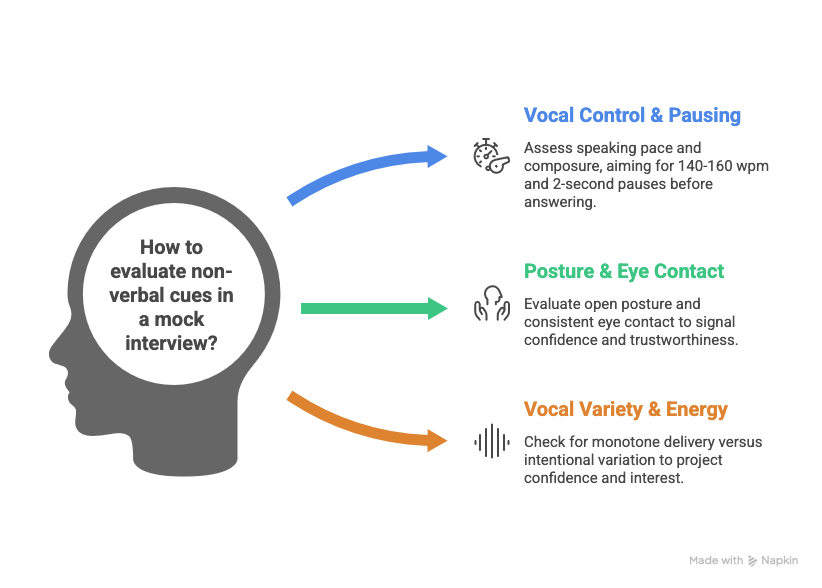
Evaluate non-verbal cues including eye contact, vocal variety, and open posture. According to research in the Journal of Business and Psychology, non-verbal behaviors significantly predict interview outcomes. Score students on their "immediacy behaviors" - nodding, leaning in, and maintaining a steady pace to ensure they project confidence and professional warmth throughout the session.
Here's what to check:
- Vocal Control & Pausing: Evaluate speaking pace and composure together. The ideal vocal rate is 140-160 words per minute; use a stopwatch during mock sessions to flag rushed delivery driven by anxiety. Students should also demonstrate controlled pausing - maintaining eye contact and pausing for roughly two seconds before answering increases perceived authority and clarity, as highlighted by Stanford Graduate School of Business.
- Posture & Eye Contact: Assess whether the student maintains an open posture (hands visible, shoulders relaxed) while sustaining natural, consistent eye contact. Closed body language, such as crossed arms, looking away, or excessive downward glances, has been associated with lower hireability ratings, while open posture and steady eye contact signal confidence, engagement, and trustworthiness, according to Caldwell & Burger’s personality/interview research.
- Vocal Variety & Energy: Check for monotone delivery versus intentional variation in tone, emphasis, and volume. A lack of vocal variety can make strong answers feel flat or rehearsed, while controlled energy helps students project confidence, interest, and professional presence throughout the interview.
Also Read: What are some good icebreakers for career coaching sessions?
Which follow-up questions should advisors ask to probe deeper during a mock interview?
Advisors should ask "probing" questions that force students to elaborate on their decision-making process or internal reflections. Instead of accepting a surface-level story, ask about alternatives they considered or specific technical hurdles. This mimics real-world recruiter behavior and helps students prepare for aggressive "deep-dive" interview styles commonly found in tech and finance.
The Oxford University Careers Service suggests using follow-up questions to test the authenticity of a student's answer.
High-Impact Probing Questions:
- "You mentioned a 'successful' outcome - what specific metric did you use to define that success?"
- "What was the biggest risk you took in that situation, and how did you mitigate it?"
- "If your supervisor gave you feedback on that project, what was the one thing they said you could improve?"
Also Read: How can career services close the equity gap for FGLI students?
What are the most frequent interview mistakes, and how can advisors guide students to correct them?
The most common interview mistakes include rambling answers, over-rehearsed responses, and insufficient employer research - gaps that directly affect hiring outcomes. In fact, according to interview stats from RecruitBPM, 47% of hiring managers would not hire a candidate who demonstrated little knowledge of the company, making poor preparation an immediate disqualifier rather than a minor flaw.
These issues typically reflect unclear thinking and weak structure, not a lack of experience.
Advisors can correct these patterns by teaching structured response control, starting with “the pause,” where students take a few seconds to organize their thoughts before answering, and reinforcing the “Bridge” technique, which trains students to explicitly connect each response back to the role, employer, or job description.
Effective coaching must move students from passive storytelling to active value-proposition communication, ensuring every answer explains not just what happened, but why it mattered to the organization.
| Mistake | Correction Strategy |
|---|---|
| The “We” Trap | Pause the mock session and ask: “If you were removed from that team, what part of the project would have failed?” Use the answer to rewrite the Action step with clear individual ownership. |
| Surface-Level Research | Coach students to identify a company’s specific competitor challenge and reference it directly in their “Why us?” answer to demonstrate informed motivation and strategic thinking. |
| The Perfectionist Fail | Teach the Oxford method: identify a real skill gap (e.g., “I struggled with public speaking”) and explain the active management system in place (e.g., joining Toastmasters and presenting weekly). |
Also Read: How career centers can support seniors without jobs before graduation?
Wrapping Up
Modern interview coaching can no longer rely on intuition, generic advice, or one-off mock sessions.
As employer expectations shift toward competency-based and human-skill-driven hiring, career services teams need interview feedback that is structured, repeatable, and defensible.
A well-designed mock interview rubric transforms interviews from subjective practice runs into measurable learning experiences - helping students understand what strong performance actually looks like, why certain answers land, and how to improve with intention.
When advisors anchor coaching in clear criteria, evidence-based scoring, and targeted follow-ups, students move beyond “sounding prepared” to demonstrating real workplace readiness.
For career centers looking to extend this kind of structured support without stretching advisor capacity, Hiration can serve as an enablement layer rather than a replacement.
Its full-stack career readiness suite supports assessment, resume optimization, and interview practice through AI-powered modules, alongside a dedicated counselor module for managing cohorts, workflows, and insights - all within a secure, FERPA- and SOC 2-compliant platform.
Mock Interview Rubric — FAQs
Why is a rubric-based mock interview approach necessary?
A rubric-based approach removes subjectivity from interview feedback and aligns coaching with how employers actually evaluate candidates. It ensures consistency across advisors and helps students understand what strong performance looks like in measurable terms.
Which competencies should a mock interview rubric assess?
A strong rubric should assess competencies such as problem-solving, communication, leadership, adaptability, and analytical thinking. These map directly to the NACE Career Readiness Competencies and current employer expectations.
How should advisors score STAR interview responses?
STAR responses should be scored by weighting Actions and Results most heavily. High-quality answers focus on individual contribution, decision-making, tools used, and clear outcomes rather than vague descriptions or team-only narratives.
What non-verbal behaviors should be evaluated in mock interviews?
Advisors should evaluate vocal pace, tone variation, eye contact, posture, and pausing. These immediacy behaviors influence perceived confidence, clarity, and professionalism during interviews.
What follow-up questions improve mock interview depth?
Probing questions that explore decision-making, risks, feedback received, or alternative approaches help test authenticity and prepare students for real recruiter deep-dive interviews.
What are the most common mock interview mistakes students make?
Common mistakes include rambling answers, vague outcomes, over-rehearsed responses, and weak employer research. Advisors can correct these by reinforcing structured responses, intentional pauses, and explicit role alignment.