How can career centers build a messaging playbook using student personas?
Career centers can build an effective messaging playbook by identifying key student personas using institutional data, tailoring tone and content to each group’s psychological barriers, and validating outreach through measurable engagement and student actions.
Career services messaging breaks down at the very first assumption: that there is a single “student” audience.
Generic email blasts about resume workshops are designed for a non-existent average, rendering them irrelevant to students with distinct anxieties and communication styles.
This one-size-fits-all strategy is why engagement remains low and why career services are often perceived as misaligned with student realities.
An effective messaging playbook isn't about creating more content; it's a strategic shift from broadcasting to targeted, persona-driven intervention that acknowledges the multiple, unique journeys from student to professional.
What student personas should career centers prioritize?
Prioritize personas based on institutional data and high-stakes needs, not just demographics. Focus on segments whose career navigation is most complex: the Pragmatic Procrastinator (overwhelmed by process), the Ambitious Achiever (fears missing a competitive edge), First-Generation/Low-Income students (face navigational uncertainty), and International Students (grapple with sponsorship anxiety).
These personas move beyond simple segmentation by capturing the core psychological barriers to engagement.
They should be built by cross-referencing Student Information System (SIS) data with engagement metrics from platforms like Handshake.
A 2024 NSSE report indicates that students who perceive support services as relevant are 40% more likely to utilize them.
For example, the University of California, Berkeley's Career Center analyzes first-destination survey data by college to spot trends, which provides a quantitative foundation for developing and validating such personas.
Also Read: How to Build Scalable Peer Mentor Programs That Drive Student Outcomes?

How can a career center verify persona accuracy?
Verify personas by testing them against student behavior and advisor observations. Run A/B tests with persona-specific messages and track engagement lifts. For an FGLI persona anxious about finances, an email highlighting paid micro-internships should significantly outperform a generic “internship opportunities” message. A measurable lift in click-through and appointment bookings validates the persona's core motivation.
Another verification method involves sharing draft personas with frontline advisors and asking: “Does this reflect the students you met this week?”
This feedback loop, used by institutions like the University of Richmond, ensures personas mirror on-the-ground realities.
Finally, review student-produced artifacts. Do resumes from your “Ambitious Achiever” persona consistently show leadership roles?
These patterns in student work can confirm or challenge a persona's defined characteristics.
Clemson University's Center for Career and Professional Development uses this integrated data approach to tailor outreach, making their communication more effective.
Also Read: Advisor Self-Assessment Toolkit for Strategic, AI-Ready Career Centers
How should messaging tone differ for each persona?
Messaging must be tuned to the specific psychological frequency of each persona. For the ‘Pragmatic Procrastinator,’ the tone must be urgent but simple, providing a clear, low-effort next step. For the ‘Ambitious Achiever,’ the tone should be exclusive and challenging, offering a competitive edge. This is not just about word choice; it’s about aligning the entire message with the student’s internal narrative.
FGLI students often require a supportive and demystifying tone that builds trust and clarifies the unwritten rules of career development.
For international students, the tone must be direct and pragmatic, openly acknowledging their unique hurdles like visa sponsorship.
The University of Texas at Austin's career center, for example, customizes its weekly newsletters by college and major.
This simple segmentation makes their outreach exponentially more relevant because the tone and content align with the specific academic and career context of the recipients.
Also Read: Career Coaching Session Agenda Template for Scaling Student Support

Persona-Driven Messaging & Verification Framework
The following framework maps distinct messaging approaches to verifiable student actions.
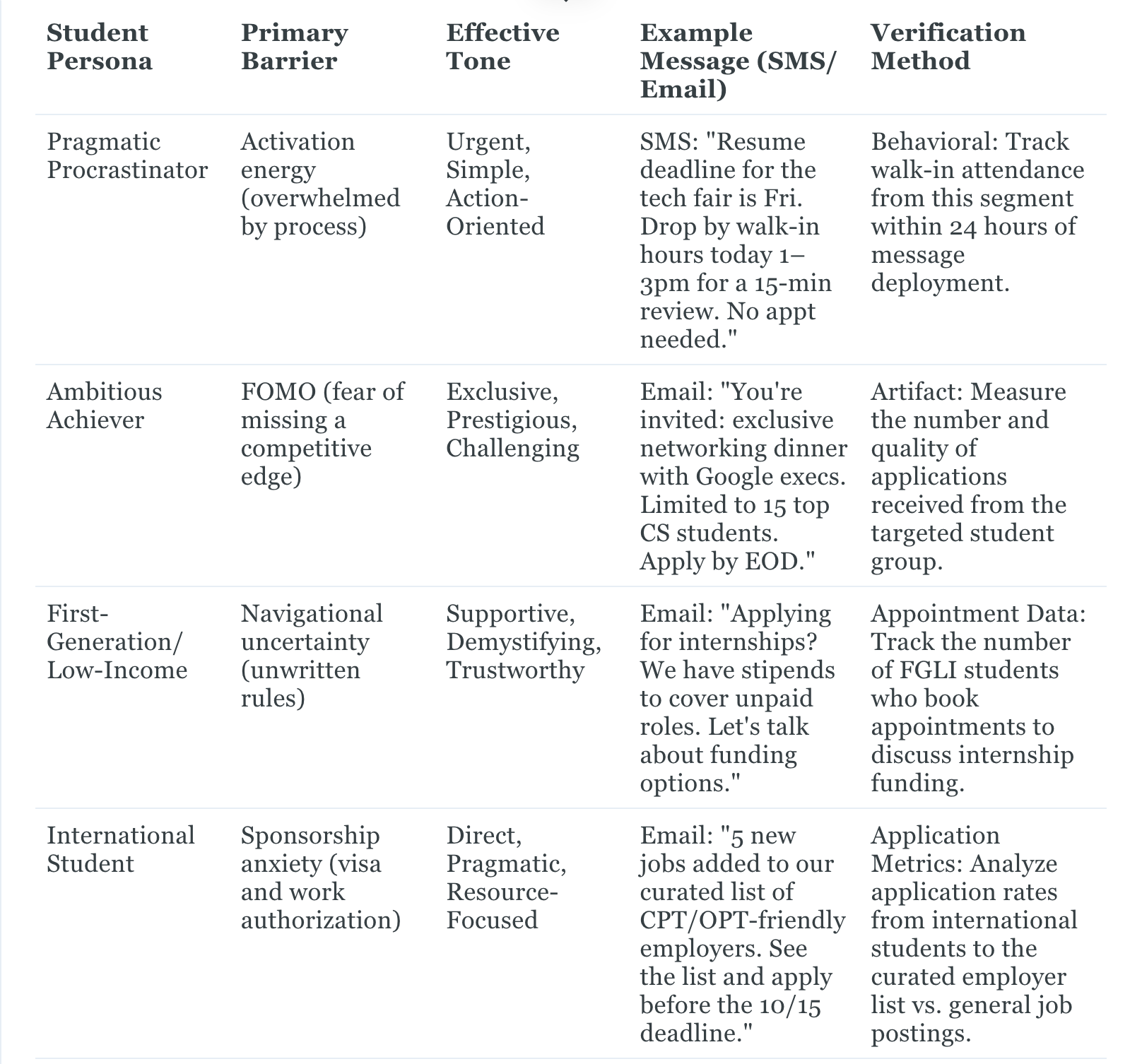
This moves from abstract personas to concrete outreach tactics that can be measured.
Also Read: 8 Plug-and-Play Career Assignments to Embed in Any Course
How can advisor scripts be personalized for difficult conversations?
Advisor scripts for difficult conversations must shift from a solution-first to an inquiry-first model grounded in the student’s persona. Instead of offering generic reassurance, the script should validate the student's specific anxiety and reframe their setback as actionable data. This is a move from comforting to coaching.
For instance, at Wake Forest University's Office of Personal and Career Development, advisors use a narrative coaching model to help students integrate setbacks into their career goals.
For an Ambitious Achiever devastated by a rejection, avoid saying, "It's competitive; don't take it personally."
Instead, try: "Let's treat this outcome like a data point. What can we learn from the application process that gives us an edge next time?"
This reframes the student as a strategist analyzing intelligence. This approach, also used by Stanford University's Life Design Lab, focuses on prototyping small actions to reduce the friction of getting started.
How do you verify script effectiveness?
Verify script effectiveness by tracking post-appointment actions. The proof isn't just in how students feel, but what they do.
- Post-Appointment Surveys: Ask targeted questions like, "What is the one clear, actionable next step you will take this week?" The specificity of their answers is your primary metric for clarity.
- Artifact Analysis: Did an advisor work with an overwhelmed student on a small resume tweak? Verify that an updated resume was uploaded to the career services platform within 48 hours. This is tangible proof of action.
- Behavioral Follow-Up: Did the Ambitious Achiever schedule a follow-up to analyze their interview performance? Did the Procrastinator attend the walk-in hours they committed to?
Also Read: Workshop Scripts Advisors Can Use to Create Verifiable Student Outcomes
How must messaging adapt for international students?
Messaging for international students fails if it does not directly address their primary barrier: work authorization. To be effective, communications must move beyond generic cultural advice to provide tactical, sponsorship-focused intelligence. This begins with segmenting students by their specific status - F-1 CPT, F-1 OPT, STEM OPT - as rules and timelines vary significantly.

Proactively curate and share lists of sponsor-friendly employers using public resources like the USCIS H-1B Employer Data Hub.
This transforms the career center from a source of general advice into a provider of critical, timely intelligence.
Northeastern University's career office excels here, running workshops specifically on navigating the sponsorship conversation during interviews.
How do you verify this approach works?
Verification requires tracking specific metrics tied to sponsorship-seeking behaviors.
First, track attendance at sponsorship-specific workshops; high attendance validates that your messaging has correctly identified their pain point.
Second, measure application rates from international students to roles on your curated lists of sponsor-friendly companies via a platform like Handshake.
Finally, analyze the application-to-interview ratio for this group versus those applying to the general job pool.
A higher conversion rate for the vetted group provides powerful evidence of impact.
Also Read: How to Train New Advisors at Scale and Standardize Support?
Where do scaled personalization efforts typically fail?
Scaled personalization efforts typically fail due to institutional realities: siloed data, fragmented tools, and advisor bandwidth limitations. Career centers often possess rich demographic data in the SIS and separate engagement data in other platforms, but these systems rarely integrate. This data disconnect leads to incomplete personas and irrelevant messaging.
This is a systems problem. For example, a student logging into a resume builder three times a week might be flagged as “disengaged” for not attending workshops, leading to mismatched outreach.
This integration challenge is well-documented; EDUCAUSE has documented that integrating disparate campus technologies remains a top institutional challenge, directly crippling effective student outreach.
The consequences are significant, especially as a recent NAFSA report flagged a 17% decline in new international student enrollment for Fall 2025.
The most sophisticated messaging playbook will fail if the underlying data is fragmented and advisors lack integrated tools to act on insights efficiently, which is why building scalable systems for career services is crucial.
How does persona-based messaging connect to career readiness?
Connecting targeted outreach to tangible improvements in career readiness and employment outcomes is the end goal. A collection of disconnected tools, a resume builder here, an interview platform there - creates a fragmented student experience and makes it impossible to track progress from an initial email nudge to a verified skill.
Without a unified system, a career center cannot know if a message about resumes led to a student creating a high-quality, ATS-ready document.
This gap makes demonstrating impact nearly impossible.
This is where a unified career readiness infrastructure provides a longitudinal record of each student’s progress.
When career exploration, resume development, and interview preparation are brought into a single, FERPA- and SOC-2-compliant platform like Hiration, career centers gain the ability to connect advisor actions to verifiable student outcomes.
By integrating ethical, human-in-the-loop AI across the student journey, from career fit-gap analysis to scalable mock interviews, institutions can move beyond fragmented engagement tactics to a holistic, evidence-based system that measurably improves placement rates.
Student Persona Messaging — FAQs
Why does generic career services messaging fail to engage students?
Generic messaging fails because it assumes a single student audience, ignoring different motivations, anxieties, and decision-making styles across student groups.
Which student personas should career centers prioritize?
Career centers should prioritize personas such as the Pragmatic Procrastinator, Ambitious Achiever, FGLI students, and International Students, based on institutional data and support needs.
How can career centers verify that their personas are accurate?
Personas can be validated through A/B testing of messaging, advisor feedback, and analyzing student behaviors such as engagement, appointment bookings, and artifact quality.
How should messaging tone vary across student personas?
Messaging tone should align with each persona’s psychological drivers, such as urgency for procrastinators, exclusivity for achievers, clarity for FGLI students, and practical guidance for international students.
How can advisor scripts be personalized for difficult student conversations?
Advisors can personalize scripts by using inquiry-first coaching that validates student concerns and reframes setbacks into actionable next steps based on the student’s persona.
How do career centers measure messaging and script effectiveness?
Effectiveness can be measured through post-appointment actions such as resume updates, follow-up bookings, and workshop attendance rather than satisfaction alone.
How should messaging be adapted for international students?
Messaging for international students should address work authorization, visa timelines, and sponsorship strategies directly with practical, data-driven guidance.
Why do scaled personalization efforts often fail in career services?
Personalization fails due to fragmented systems, siloed data, and limited advisor bandwidth, preventing consistent, data-informed outreach at scale.
How does persona-based messaging improve career readiness outcomes?
Persona-based messaging increases relevance, drives engagement, and connects outreach to measurable skill development and employment outcomes.