How can career centers prevent liberal arts underemployment after graduation?
Liberal arts underemployment can be prevented by intervening early with intentional career design, skill-stacking, and clear first-job targeting. By guiding students to pair liberal arts strengths with market-aligned skills, internships, and outcome-based narratives before senior year, career teams can help ensure the first post-grad role sets long-term direction rather than limiting future mobility.
Liberal arts underemployment doesn’t usually happen because students lack ability.
It happens because the first year after graduation quietly locks in trajectories.
Too many humanities and social science graduates accept roles that don’t require a degree, not because they aimed low, but because no one helped them aim early.
By the time graduation arrives, the window for shaping a “college-level” first job has already narrowed, and the cost of that miss compounds fast.
This guide breaks down how career teams can shift that trajectory earlier.
It shows how to help students avoid the undermatch, pair liberal arts strengths with targeted skill stacking, and graduate with a career plan that translates academic value into market outcomes - so the first job sets direction instead of damage
How can you prevent liberal arts underemployment in the first post-grad year?
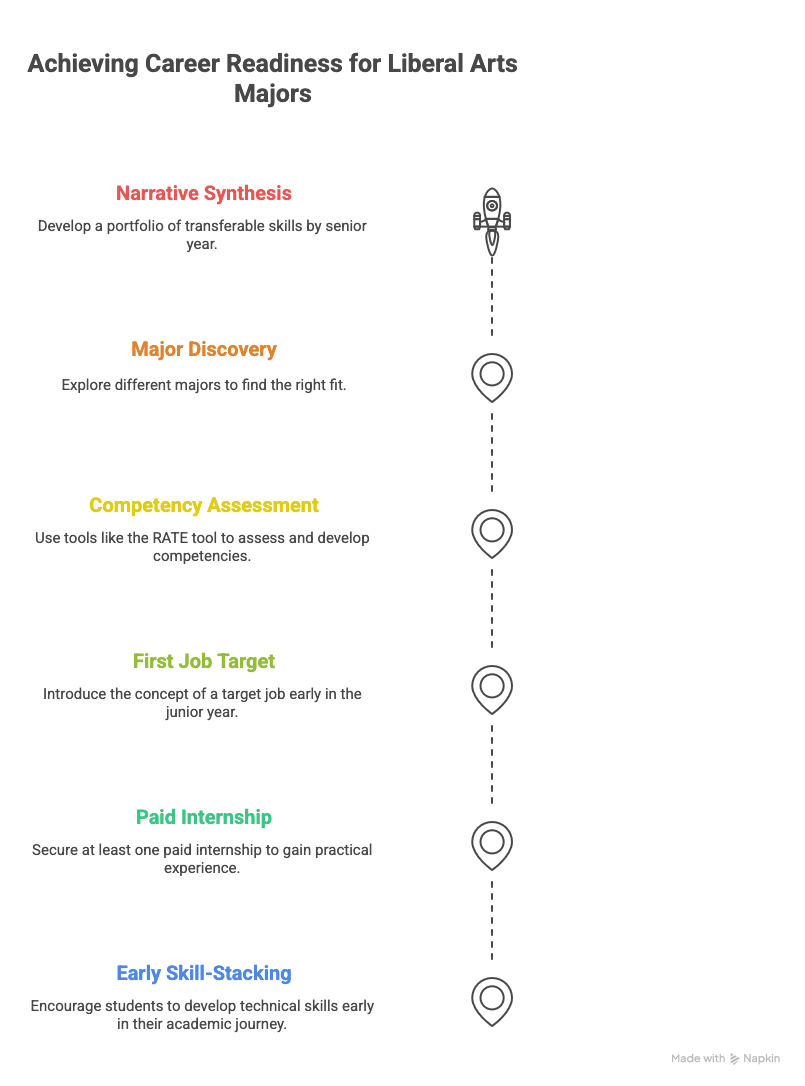
You can prevent this by shifting your students' focus from "finding a job" to "avoiding the undermatch" through early technical skill-stacking. By encouraging them to secure at least one paid internship, you increase their odds of securing a college-level role by 40%, according to NACE’s 2024 Student Survey.
The "scarring effect" of a poor first job is particularly aggressive for humanities students. Data from the St. Louis Fed (2025) shows that graduates in college-level jobs earn 88% more than those with only a high school diploma, while underemployed graduates earn only 25% more.
To combat this, you should introduce the "First Job Target" early in their junior year. Don't let them wait for graduation to see what "sticks."
Instead, guide them to use tools like the University of Minnesota’s RATE tool, which helps students self-assess their competency development. According to NACE (2025), 77% of students who used this tool felt significantly better prepared to explain their ROI to recruiters.
Also Read: How does counselor burnout reveal a career center system that’s no longer working?
How can you guide students to build a high-ROI sample career plan for liberal arts majors?
You can guide them by implementing a "Four-Phase Readiness" framework that integrates professional milestones directly into their academic timeline. This plan must move them from broad "Major Discovery" in their freshman year to "Narrative Synthesis" in their senior year, ensuring they graduate with a documented portfolio of transferable skills.
A sample career plan isn't just a list of tasks; it’s a strategy to close the "translation gap" between the classroom and the boardroom.
According to Lightcast’s 2024 Digital Skills Outlook, 32% of job skills have changed since 2021. Your students need a plan that accounts for this volatility.
The Sample Career Plan Blueprint
| Academic Year | Phase | Your Actionable Milestone |
|---|---|---|
| Freshman | Discovery | Conduct 3 informational interviews with alumni in non-linear career paths. |
| Sophomore | Skill-Stacking | Complete one technical micro-credential (e.g., SEO, Excel, or SQL). |
| Junior | High-Impact | Secure a paid internship. According to NACE (2024), paid interns receive 1.14 job offers on average. |
| Senior | Synthesis | Convert the CV into a competency-based resume mapped to NACE Career Readiness Competencies. |
Also Read: What are some good DEI outreach strategies for career centers?
Which "Skill-Stacking" credentials offer the highest marketability for your students?
You should promote "Liberal Arts + 1" credentials, focusing on digital fluency and AI-driven research skills to complement their critical thinking. According to the AAC&U (2025), 81% of employers are more likely to hire graduates who pair a broad liberal arts foundation with specific technical certifications.
The goal isn't to turn a History major into a Software Engineer. It's to make them a History major who understands Data Analytics.
- The ROI of "Hybridity": According to Strada, graduates who add just one technical skill to their liberal arts base can increase their starting salary by an average of $6,000 to $11,000.
- Real-World Example: Bryant University integrates business applications into liberal arts paths. Their Class of 2024 saw a median starting salary of $76,000, a 6% increase from the previous year, according to Bryant’s 2025 ROI Report.
Also Read: How to boost student attendance at career fairs?
How do you help students translate academic artifacts into employer-ready language?
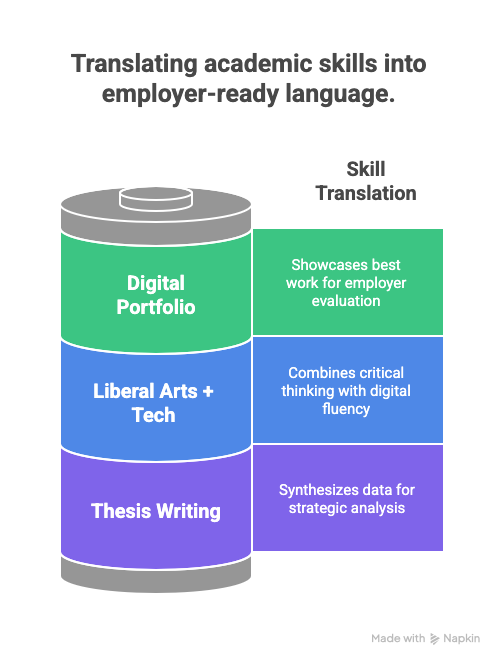
You can help them by replacing academic jargon with "Outcome-Based" descriptors on their resumes and LinkedIn profiles. Instead of "wrote a thesis," guide them to say "Synthesized 50+ data sources to deliver a strategic analysis," which directly maps to the Critical Thinking competency highly valued by recruiters.
Liberal arts students often have the skills but lack the vocabulary. You must coach them to be "multilingual" - able to speak both the language of their discipline and the language of the market.
- Competency Mapping: Use NACE’s Career Readiness Competencies as a rubric.
- Actionable Advice: Have students build a "Digital Portfolio" of their best work. According to AAC&U research, 83% of employers find portfolios more useful than a transcript alone in evaluating a candidate’s potential.
- The College Example: Middlebury College uses industry-specific "Career Communities" to help students translate their liberal arts experience into specialized industry narratives.
Also Read: What are the top 5 career services benchmarks every center must track?
The Bottom Line
The long-term ROI of a liberal arts degree is a "slow burn" that eventually outperforms many specialized degrees.
According to Georgetown CEW (2024), the 40-year Net Present Value for many liberal arts colleges exceeds $1.9 million.
Your job is to ensure they survive the first 24 months with a college-level role so they can reach that long-term payoff.
Making this shift - from last-minute placement to early, intentional career design, requires more than good frameworks.
It requires the right support system behind your team.
Hiration is built to make that work more manageable. Its ethical, AI-driven career suite supports students across every stage of growth, from self-assessment and exploration to resumes, interviews, and job matching, so career teams can deliver more personalized guidance at scale without losing the human core of their work.
For institutions rethinking how to engage liberal arts students earlier and more consistently, the right infrastructure can turn these strategies from one-off initiatives into sustainable practice.
Liberal Arts Underemployment — FAQ
Why does liberal arts underemployment happen so early after graduation?
Underemployment often begins with the first post-grad job. Students accept roles that do not require a degree because career targeting and skill translation were delayed, narrowing options by the time graduation arrives.
What is the “undermatch” problem for liberal arts graduates?
Undermatch occurs when graduates take roles that do not align with their education level or long-term potential. These early mismatches can lock in lower trajectories and slow wage growth for years.
When should career teams intervene to prevent underemployment?
Intervention should begin by junior year, when students can still shape internships, skill development, and first-job targets instead of reacting late in senior year.
What does “skill-stacking” mean for liberal arts students?
Skill-stacking pairs liberal arts strengths with one market-aligned technical or digital skill, such as data analysis, research tools, or AI literacy, to increase employability without abandoning the major.
How can students translate academic work into employer language?
Students should replace academic phrasing with outcome-based descriptors that highlight analysis, synthesis, communication, and impact, making classroom work legible to recruiters.
Why are internships critical for liberal arts career outcomes?
Paid internships reduce the risk of underemployment by providing professional signals, applied experience, and clearer first-job pathways that align with college-level roles.
What role should career centers play in first-job planning?
Career centers should help students define a clear “first job target,” align skills and experiences to that role, and ensure graduates leave with a coherent narrative and market-ready materials.