How can career centers effectively support students with interdisciplinary majors?
Career centers can support interdisciplinary majors by shifting from major-to-job mapping to skills-based coaching, building employer partnerships in hybrid industries, embedding experiential learning into advising, and tracking nuanced outcomes like career alignment and internship conversion. This approach helps students translate diverse coursework into a coherent professional narrative employers understand.
The modern job market no longer fits neatly into traditional academic silos.
As students increasingly build their own majors to match their unique interests, Career Service Professionals (CSPs) face a distinct challenge.
Standard career playbooks simply do not work for students who blend data analytics, sociology, and graphic design into a single degree.
If you want to drive real outcomes for these students, you have to throw out the old major-to-career crosswalks and adopt a highly customized, data-driven approach.
Here are actionable advice to elevate your career services for interdisciplinary majors.
Why are interdisciplinary majors a unique challenge for career centers?
Interdisciplinary students often struggle because they lack a single, linear career track. Unlike nursing or accounting majors, these students blend fields like biology and sociology, making traditional major-to-job mapping useless. CSPs must help them articulate their customized skill sets to employers who increasingly prioritize adaptability over specific degrees.
The sheer volume of these students is growing rapidly. There were over 110,000 interdisciplinary degrees awarded in 2021, according to Data USA.
When a student builds a custom degree, they inherently bypass established corporate recruiting pipelines.
However, employers actually want the exact skills these students possess.
According to Research.com, over 90% of employers identify transferable, adaptable abilities as critical hiring priorities.
Furthermore, their data reveals that 36% of interdisciplinary studies graduates enter management positions, where cross-functional thinking is mandatory.
How can we build effective employer pipelines for these blended majors?
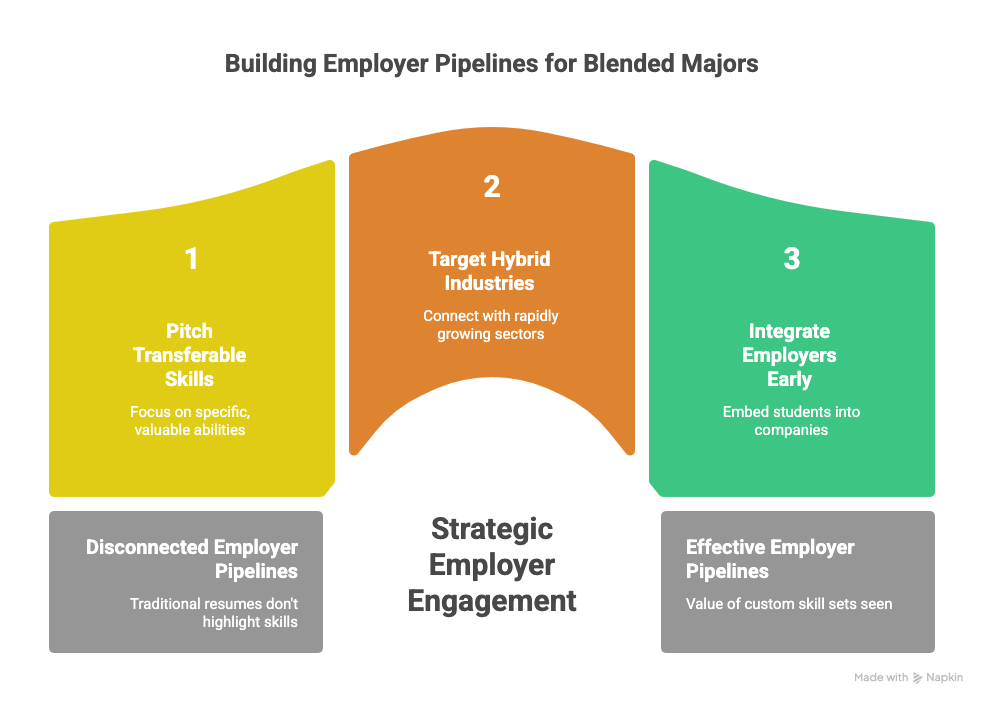
You need to pitch the specific, transferable skills these students possess rather than their degree titles. Focus your employer relations on rapidly growing, hybrid industries like data science, corporate sustainability, and healthcare administration, where hiring managers actively seek candidates who can connect the dots across different business functions.
Build relationships with employers in sectors experiencing massive growth that inherently require a multidisciplinary approach.
For example, data science relies on statistics, programming, and domain expertise.
According to the U.S. Bureau of Labor Statistics, data science roles will see a massive 36% employment growth from 2023 to 2033.
To bridge the gap between employers and non-traditional majors, integrate employers directly into the student's curriculum early on.
The University of Cincinnati tackles this effectively through robust cooperative education (co-op) models.
By allowing interdisciplinary students to embed themselves into companies globally for full-time or project-based work, the university forces employers to see the value of a custom skill set in action, bypassing the traditional resume screen.
Which advising frameworks actually work for custom-designed degrees?
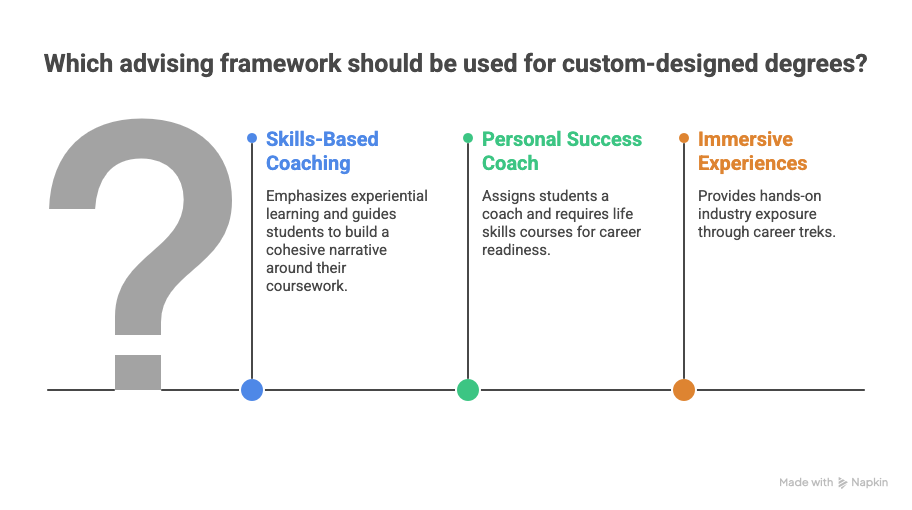
Ditch the traditional major-to-career handouts. Instead, transition to a skills-based coaching model that emphasizes experiential learning. You must guide these students to build a cohesive narrative around their diverse coursework through mandatory internships, structured career communities, and early, hands-on industry exposure that proves their real-world value.
Stop asking these students, "What job title do you want?" and start asking, "What complex problems do you want to solve?"
Look to High Point University, which assigns students a personal Success Coach and requires Life Skills courses to build baseline career readiness before they even pick a career path.
You can also implement immersive, short-term experiences.
St. John’s University utilizes "career treks" to physically bring students into various company headquarters.
For an interdisciplinary student who cannot conceptualize where their hybrid degree fits, standing inside a corporate office and talking to cross-functional teams is far more valuable than a standard advising appointment.
What outcome metrics prove the ROI of interdisciplinary programs?
Standard placement rates do not tell the whole story for these students. You must track nuanced data like career alignment, internship-to-hire conversion rates, and the specific resources that led to job offers. This granular data proves the value of custom degrees to prospective students, parents, and skeptical faculty.
While the National Association of Colleges and Employers (NACE) sets a baseline 65% knowledge rate target for First Destination Surveys, you should aim higher to validate these non-traditional paths.
Valparaiso University achieved an impressive 84.3% knowledge rate by aggressively combining standard survey data with social media scraping and direct input from faculty.
Go beyond basic employment status. Follow the lead of Carnegie Mellon University (CMU).
They added custom, non-standard questions to their First Destination Survey.
They track "Career Alignment" (asking graduates if their current role is completely, well, somewhat, or barely aligned with their career interests) and ask for the "Most Important Resource" that secured the position (e.g., faculty referral, Handshake, internship conversion).
Finally, track and promote the financial ROI. According to Data USA, the average salary for employees with an interdisciplinary degree sat at over $85,000 in 2021, proving these hybrid paths are highly lucrative.

Wrapping Up
By helping students translate hybrid coursework into clear professional narratives, building employer partnerships in multidisciplinary fields, and tracking nuanced outcome metrics, career centers can turn these unconventional degrees into powerful career advantages.
Hiration supports this shift by giving career centers a full-stack career readiness infrastructure.
From career assessments to AI-powered resume optimization and interview simulation, along with a dedicated counselor module for managing cohorts, workflows, and analytics, the platform helps teams deliver structured support at scale within a secure, FERPA- and SOC 2-compliant environment.
With the right systems and strategies in place, interdisciplinary degrees can move from being difficult to place to becoming some of the most adaptable and future-ready pathways in higher education.
Career Services for Interdisciplinary Majors — FAQs
Why are interdisciplinary majors challenging for traditional career advising?
Interdisciplinary students combine multiple academic fields, making it difficult to map their degrees to traditional career pipelines. Advisors must help them translate diverse coursework into clear skills and professional narratives.
What approach works best when advising interdisciplinary students?
A skills-first advising approach works best. Instead of focusing on degree titles, advisors should help students identify transferable competencies and demonstrate how those skills solve real-world problems.
How can career centers build employer pipelines for interdisciplinary majors?
Career centers should focus employer outreach on multidisciplinary industries such as data science, sustainability, healthcare administration, and product development where cross-functional thinking is highly valued.
Why is experiential learning especially important for interdisciplinary students?
Internships, co-ops, and project-based experiences allow students to demonstrate how their blended skill sets apply in real-world environments, making their value clearer to employers.
How can advisors help students articulate their interdisciplinary background?
Advisors should guide students to build a coherent narrative that explains the problems they want to solve, the skills they bring from different disciplines, and how those capabilities create value for employers.
What outcome metrics should career centers track for interdisciplinary programs?
Effective metrics include career alignment, internship-to-hire conversion rates, employer engagement, and the resources that directly contributed to student job offers.
Why are traditional placement metrics insufficient for interdisciplinary majors?
Because interdisciplinary graduates often pursue unconventional roles across industries, basic placement statistics fail to capture the quality of outcomes or how well roles align with their blended expertise.
How can career centers scale support for interdisciplinary students?
Centers can scale support by implementing structured advising frameworks, integrating experiential opportunities into academic programs, and using systems that track skills development, engagement, and career outcomes across cohorts.