How should career centers design intake questionnaires to improve advising outcomes?
Career centers should design intake questionnaires as diagnostic tools that capture student goals, readiness, urgency, and confidence before the first session. By using structured questions, scaled responses, and triage logic, advisors can segment students, prioritize support, and shift sessions from basic discovery to high-impact coaching.
Career centers are expected to deliver personalized, high-impact advising at scale, but most intake forms make that nearly impossible.
They collect basic information, yet fail to surface the context advisors actually need to guide students effectively.
As a result, valuable session time is spent on repetitive discovery instead of meaningful coaching, limiting both depth and reach.
This gap is not just operational, it affects how effectively career centers can support outcomes, allocate resources, and demonstrate impact.
When advisors lack upfront clarity on a student’s goals, readiness, and challenges, the entire advising model becomes reactive.
This guide outlines how to redesign the intake questionnaire into a diagnostic tool that enables segmentation, prioritization, and more strategic advising from the very first interaction.
What Questions Should Advisors Ask in a First Session Intake Questionnaire?
A first-session intake questionnaire should do more than gather demographic details. It should surface a student’s motivations, anxieties, and immediate priorities so advisors have meaningful context before the conversation begins. That shifts the first appointment from a routine fact-finding exercise to a focused, high-impact strategy session. The most effective questions are built to move beyond one-word responses and prompt students to share the personal and professional story behind where they are right now.

The primary goal is to capture a multidimensional snapshot of the student’s current state.
This allows advisors to bypass repetitive discovery and immediately move into meaningful coaching.
The questions themselves set the tone - shifting the interaction from intake to strategy. For more on setting the right tone, see these icebreakers for career coaching sessions.
Framing Goal-Setting Questions
Understanding a student's long-term aspirations is critical for effective coaching.
However, generic questions like "What is your career goal?" often yield unhelpful, surface-level responses.
Instead, questions should prompt reflection and narrative. This approach aligns with advising philosophies at institutions like Duke University, where understanding a student's story is central to the coaching process.
Example Goal-Setting Questions
- "Describe the work environment or company culture where you believe you would thrive. What specific elements of that environment appeal to you?"
- "Imagine it's two years post-graduation. What would a successful and fulfilling professional life look like for you then?"
- "What specific, tangible outcomes would make these coaching sessions a success from your perspective?"
These questions shift the focus from job titles to underlying values and motivations, providing a much richer dataset for the advisor.
Assessing Experience and Self-Perceived Skills
The questionnaire must capture not only a student's experiences but also their self-assessment of those experiences.
This is not a resume-building exercise; it is a diagnostic tool to understand their ability to articulate their own value proposition.
A student's self-perception of their skills is a powerful leading indicator of career readiness.
This section should prompt them to connect past activities - internships, projects, leadership roles to their future goals.
It reveals how effectively they can construct their professional narrative.
Experience and Skills Assessment Questions
- "Of all your experiences (internships, projects, volunteer work), which one felt most meaningful to you, and why?"
- "In which skills or knowledge areas do you feel most confident? Conversely, where do you see the biggest gaps you'd like to address?"
- "Describe a significant challenge you overcame during a project or internship. What was the key takeaway from that experience?"
This line of questioning reveals the "so what?" behind their resume line items. It provides advisors a window into the student's metacognitive abilities - a critical component of career readiness.
Also Read: How Can Career Centers Build a Skills-First Goal-Setting Worksheet?
How Can Questionnaires Assess Career Readiness?
A strategic intake questionnaire must differentiate between a first-year student exploring majors and a senior facing an imminent application deadline. This requires moving beyond simple data collection to implement a dynamic triage system. The objective is to use targeted questions to generate quantifiable signals of a student's preparedness, enabling the career center to segment students and allocate resources more effectively.
Using Scaled Questions to Quantify Readiness
To accurately gauge a student's readiness level, advisors must move beyond binary yes/no questions.
Likert scales and multiple-choice scenarios provide a more nuanced, objective baseline.
This data allows advisors to tailor conversations and prioritize their time. For example, the question "Do you have a resume?" is diagnostically useless.
A more effective approach frames readiness on a continuum:
Which statement best describes your current resume?
- A) I have not started one. (Readiness Level: 1)
- B) I have a rough draft that needs significant work. (Readiness Level: 2)
- C) I have a solid draft that a peer has reviewed. (Readiness Level: 3)
- D) I have a finalized version I am actively using for applications. (Readiness Level: 4)
This single question segments students into four distinct groups. The student at Level 1 can be automatically directed to a resume-building workshop, while the student at Level 4 may be ready for an advanced session on Applicant Tracking Systems (ATS) optimization.
For a deeper dive, see this comprehensive career readiness assessment guide.
What Questions Signal Urgency, Barriers, and Confidence?
An effective intake questionnaire must uncover the internal factors that often derail a student's career progress, such as imposter syndrome, networking anxiety, or low self-confidence. Students rarely volunteer this information. Well-designed questions can surface these mindset challenges and signal a student's urgency level before the first appointment. This requires using indirect, psychometric-style prompts rather than direct and potentially alienating questions.

Designing Questions to Signal Urgency
Urgency is a critical metric, almost always tied to external deadlines and active job-seeking behaviors.
An intake form must surface these time-sensitive triggers to enable a proactive response from the advising team. Questions should reveal a student's application velocity and commitment level.
Example Urgency-Signaling Questions:
- "How many job or internship applications have you submitted in the past 30 days?" (0, 1-5, 6-10, 11+)
- "Are you currently preparing for any upcoming interviews or career fairs?" (Yes/No, with optional date field)
- "Are you managing any active job offers or decision deadlines?" (Yes/No, with option to provide details)
A student with 10+ applications and an offer deadline represents a high-priority case. This data point can trigger an automated notification to an advisor, as seen in the tiered support systems at institutions like the University of Michigan's Career Center.
Using Scales and Scenarios to Measure Confidence
Confidence is a key predictor of job search success. A simple 1-to-10 scale is an effective tool for quantifying a student's self-assessed readiness for specific career milestones.
These ratings provide a baseline metric that can be tracked over time.
Sample Confidence-Scaling Questions:
- On a scale of 1-10, how prepared do you feel to reach out to alumni on LinkedIn for an informational interview? (1 = Not at all prepared; 10 = Completely prepared)
- Rate your confidence in your ability to articulate your skills and value to an employer during an interview. (1 = Very low confidence; 10 = Very high confidence)
Situational judgment questions offer another indirect method for uncovering mindset barriers.
Presenting a realistic scenario and asking for a response can reveal thought processes and avoidance behaviors more effectively than a direct question.
Scenario: You attend a virtual career fair and see a recruiter from your dream company is available for a one-on-one chat. What is your most likely next step?
- A) Immediately join the queue to speak with them.
- B) Spend 15-20 minutes researching and preparing questions first.
- C) Observe other students' interactions before deciding whether to join.
- D) Decide not to join because I don't feel prepared enough.
This single question can flag potential perfectionism (B), social anxiety (C), or a significant confidence gap (D), allowing for a more holistic intervention.
This aligns with the integrated well-being and life design model pioneered by Stanford University's CareerEd initiative.
When supporting students, it is also useful to consider frameworks for assisting diverse populations, such as neurodivergent students.
Intake Questionnaire Triage Framework
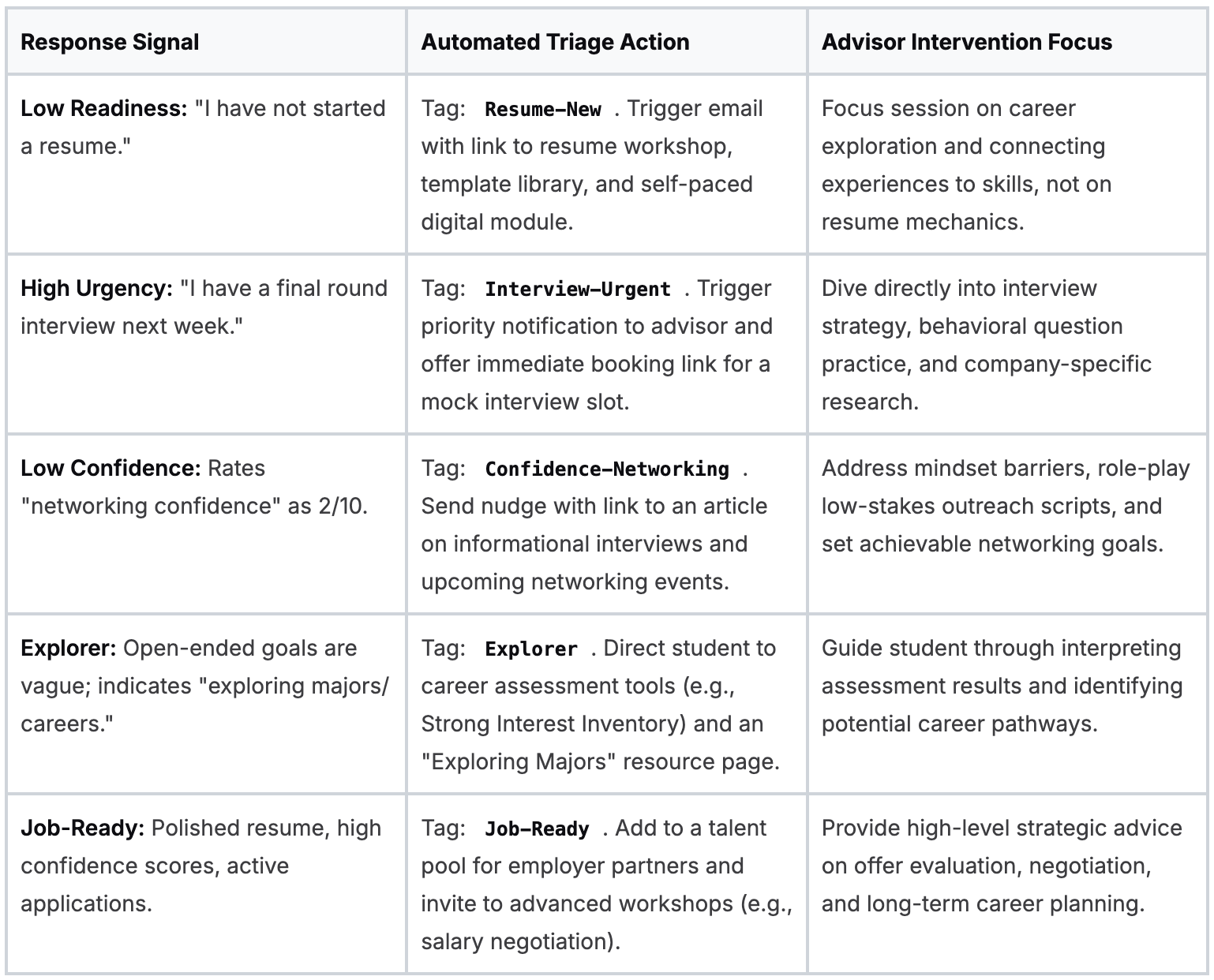
This triage model, powered by branching logic within the digital form, automates the initial sorting process.
It allows institutions like Arizona State University to manage large student populations by ensuring high-need students receive immediate attention while others are guided to relevant self-service resources.
Wrapping Up
Designing a strong intake questionnaire is not just about asking better questions - it’s about building a system that can scale personalized support across a diverse student population.
When done right, it enables advisors to move faster, focus on high-impact conversations, and ensure every student receives guidance that is both timely and relevant.
To support this shift, Hiration brings together the full career readiness journey in one place - from career assessments to AI-powered resume optimization and interview simulation.
Alongside this, dedicated counselor tools help manage cohorts, workflows, and analytics within a secure, FERPA and SOC 2-compliant environment.
As career centers continue to evolve, the ability to combine structured intake, intelligent triage, and integrated tools will play a key role in delivering consistent, scalable outcomes for students.
Career Coaching Intake Questionnaire — FAQs
What is the purpose of an intake questionnaire in career advising?
An intake questionnaire collects structured insights on student goals, readiness, and challenges before the first session, allowing advisors to move directly into strategic coaching rather than basic discovery.
What types of questions should be included?
Effective questionnaires include goal-setting prompts, experience and skills reflection, readiness assessments, urgency signals, and confidence scales to capture a complete picture of the student.
How can questionnaires measure career readiness?
Career readiness can be measured using scaled or multiple-choice questions that place students along a continuum, such as resume development stage or interview preparedness.
Why are scaled questions more effective than yes/no questions?
Scaled questions provide nuanced data that helps segment students into different readiness levels, making it easier to tailor advising and allocate resources efficiently.
How can intake forms identify urgency?
Questions about application volume, upcoming interviews, and offer deadlines help identify students with immediate needs who may require priority support.
How do questionnaires uncover hidden barriers like anxiety or low confidence?
Indirect questions, such as confidence scales or situational scenarios, reveal mindset barriers more effectively than direct questions, helping advisors address underlying challenges.
What is a triage-based intake system?
A triage system uses questionnaire responses to automatically segment students into different support levels, directing them to workshops, self-service tools, or one-on-one advising as needed.
How does a strong intake system improve advising outcomes?
By providing upfront clarity, intake systems reduce repetitive conversations, increase session quality, and help career centers scale personalized support across large student populations.