How can career centers scale group advising without sacrificing student outcomes?
Career centers can scale effectively by using a triage model that routes foundational, high-volume needs into interactive group sessions while reserving one-on-one time for complex advising. By focusing on artifact-producing workshops, peer feedback loops, and tiered follow-up systems, group advising becomes a scalable engine that improves outcomes and frees staff for high-impact coaching.
Most career centers are overloaded with one-on-one appointments that could easily be handled at scale.
The real question isn’t whether to use group advising - it’s when and how to use it so it actually works.
When designed with a triage mindset, group advising becomes a high-impact, scalable layer of support that handles foundational career tasks while freeing senior advisors to focus on complex, high-stakes coaching.
Here’s how to structure group advising sessions that drive real outcomes, not just attendance.
When is group advising actually effective?
Group advising works best when applied to high-volume, low-complexity topics and peer-driven experiential learning. By using a triage model, career centers can handle foundational queries in group settings, which reserves intensive, one-on-one professional advising hours for complex career narrative development and high-stakes negotiation strategies.
You cannot scale your impact if your senior advisors are acting as basic grammar checkers.
Shifting to a needs-based system allows professional staff to drastically increase their hours spent on high-value, Tier 3 activities.
Take Point Loma Nazarene University (PLNU) as a real-world example.
According to a report by the National Association of Colleges and Employers (NACE), PLNU successfully shifted from primarily one-on-one appointments to small-group formats and integrated career competencies directly into first-year courses and senior seminars.
The result was a much more efficient use of staff time and a massive boost in peer learning.
Furthermore, EAB recommends approaching this through the lens of Population Health Management, which involves looking at campus-wide data to proactively target students with rising risk instead of just waiting for them to walk through your doors.
Also Read: How to Support Adult Learners in Career Services?
What are the best formats for group advising?
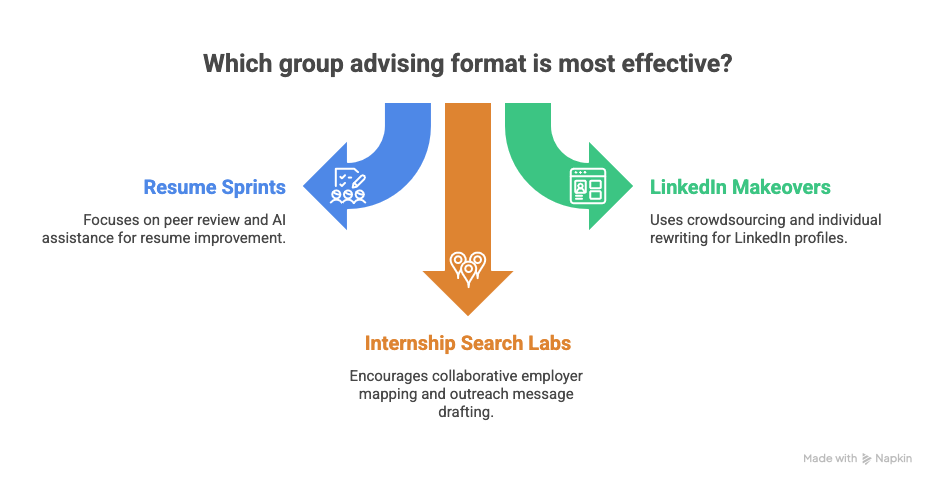
The most effective group advising formats are interactive, artifact-producing sprint workshops focusing on resumes, LinkedIn optimization, and internship searches. Instead of passively listening to a presentation, students actively build, critique, and refine their career documents in real-time alongside their peers and an advisor coach.
If students leave a group session without a tangible, improved asset, the session failed.
You want to implement "sprint workshops" and peer labs.
According to NACE's 2026 insights on post-linear career services, centers should replace gatekeeping competency tests with iterative, coach-guided feedback loops.
- Resume Sprints: Group students into pods of three. Give them a calibrated rubric and let them peer-review first drafts. According to the 2025 NACE Career Services Benchmarks Report, 59.3% of career services staff now use AI as an assistive tool. Encourage students to use AI for the initial pass on grammar and formatting, then use the group session to hone the actual impact of their bullet points.
- LinkedIn Makeovers: Project a real, entry-level LinkedIn profile on the screen and crowdsource improvements. Then, give students 15 focused minutes to rewrite their headlines and summaries on their own devices.
- Internship Search Labs: Move away from generic job board tours. At Duke University, they group drop-in advising and application review appointments to handle high-volume needs collaboratively. Model this by having students map out three target employers during the session and draft networking outreach messages together.
Which facilitation techniques drive student engagement?
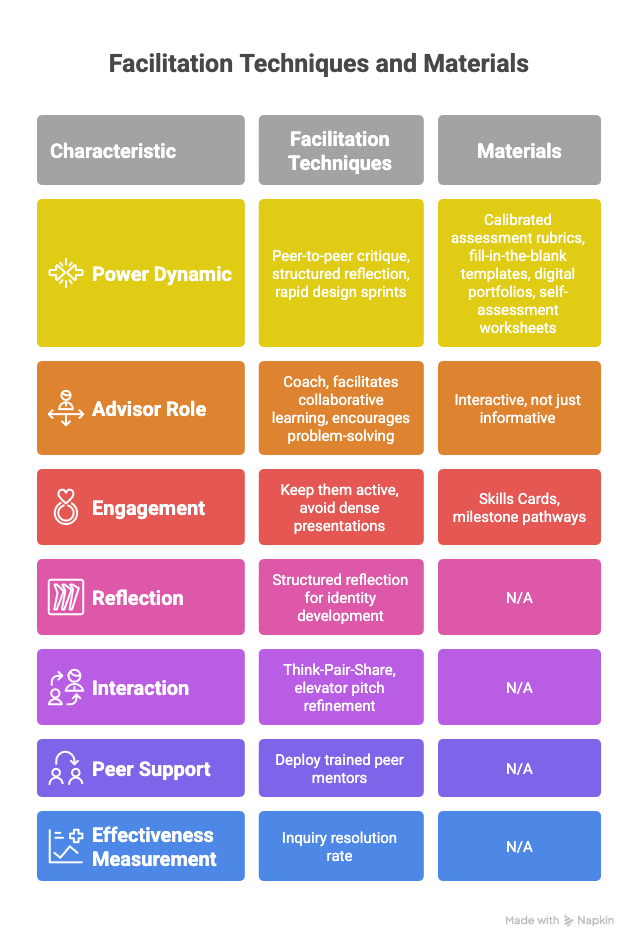
Effective facilitation flips the traditional power dynamic by using peer-to-peer critique, structured reflection, and rapid design sprints. Rather than talking at students, the career advisor acts as a coach who facilitates collaborative learning, encourages active problem-solving, and guides iterative feedback loops among the participants.
Engagement drops the second you turn on a dense 40-slide presentation. Keep them active.
According to NACE, embedding structured reflection into experiences is crucial for identity development. Ask questions like, “What did I try? What changed? What did I learn about the kind of problems I want to solve?”
Use the "Think-Pair-Share" method to get students talking.
Have them draft an elevator pitch, pitch it to the person next to them, and refine it based on immediate feedback. You should also deploy trained peer mentors within these groups.
Tracking your "inquiry resolution rate", the percentage of issues fully resolved by peer mentors without staff escalation is the best way to prove the effectiveness of peer-led group facilitation.

What materials are needed for a successful session?
Skip the heavy slide decks and equip students with actionable, plug-and-play tools. You must provide calibrated assessment rubrics, fill-in-the-blank templates, digital portfolios for artifact aggregation, and self-assessment worksheets that allow students to continuously track their individual growth across key career competency areas.
Your materials need to be interactive, not just informative.
For example, Queen's University uses a physical deck of "Skills Cards" that allows students to analyze any experience via a card sort activity to identify their key competencies.
They map these outcomes directly to degree-level expectations.
Provide clear milestone pathways (e.g., discover, explore, build, launch) printed out for the tables.
When students have rubrics and templates in hand, they spend less cognitive energy figuring out formatting rules and more energy crafting their unique career narratives.
How do I follow up individually without burning out?
Follow up strategically by employing a tiered support system that reserves individual concierge advising for complex, high-stakes needs. Track workshop outcomes via scheduling platforms, leverage peer mentors for routine inquiries, and automate your initial check-ins through your university's career management system to maintain scale.
You simply cannot meet one-on-one with every single student who attends a group workshop. Instead, shift your metrics from tracking volume (number of appointments) to tracking value (type of appointments).
The primary indicator of a successful group advising model is a measurable increase in senior advisor hours spent on high-value, complex coaching.
You can also send an automated post-session survey using Handshake, Symplicity, or your CRM. Ask students to rate their confidence level regarding the topic.
Only invite students who score low or indicate they have complex, targeted needs like navigating a specific disability accommodation or negotiating a difficult job offer to book a "concierge" one-on-one appointment.
Wrapping Up
Scaling group advising is about creating a system where every session produces measurable progress and frees your team to focus on high-impact work.
When your workshops generate stronger artifacts, clearer career narratives, and better-prepared students, your one-on-one time naturally shifts toward the conversations that matter most.
That is where the right infrastructure becomes critical.
Hiration supports this model by giving students structured, AI-powered support for resumes, interviews, and LinkedIn work between sessions, while giving your team the tools to manage cohorts, track outcomes, and identify who actually needs deeper intervention.
The result is a career center that operates with both scale and precision, without adding strain to your staff.
Group Advising Models for Career Services — FAQs
When is group advising more effective than one-on-one advising?
Group advising works best for high-volume, low-complexity topics such as resume basics, LinkedIn optimization, and internship search strategies, allowing one-on-one sessions to focus on advanced coaching and complex career decisions.
What is a triage model in career services advising?
A triage model routes students based on need level, sending foundational questions to scalable group sessions while reserving senior advisor time for complex cases such as career pivots, negotiations, and specialized support.
What types of group advising formats drive the best outcomes?
The most effective formats are interactive, artifact-producing sessions such as resume sprints, LinkedIn makeovers, and internship search labs where students actively build and improve career materials during the session.
How do you keep students engaged during group advising sessions?
Engagement increases when sessions use peer critique, structured reflection, and short design sprints rather than lectures, positioning the advisor as a coach who facilitates active participation and iterative improvement.
What materials should every group advising session include?
Provide practical tools such as rubrics, templates, self-assessment worksheets, and milestone pathways so students can immediately apply what they learn and leave with improved career artifacts.
How can peer mentors be used effectively in group advising?
Peer mentors can handle routine questions, facilitate peer feedback, and increase inquiry resolution rates without staff escalation, helping extend capacity while improving student relatability and engagement.
How should career centers follow up after group advising sessions?
Use tiered follow-up systems with automated check-ins and confidence surveys, inviting only students with complex needs or low confidence to book one-on-one sessions, which keeps support scalable without overwhelming staff.
What is the key success metric for a scalable group advising model?
A strong model shows a shift in advisor time toward high-value, complex coaching, while students leave group sessions with tangible progress such as improved resumes, LinkedIn profiles, or targeted job search plans.