If you work in a university career center, you already know the math doesn't work in your favor. You are likely managing an impossible student-to-advisor ratio.
You simply cannot be everywhere at once.
To scale your impact, you need force multipliers.
By deputizing your faculty and alumni, you transform your career center from a standalone office into an institution-wide ecosystem.
Here is exactly how top-tier career services professionals (CSPs) are building these engines, backed by the latest data and real-world program structures.
How can faculty actively drive career readiness in the classroom?
Faculty drive career readiness by seamlessly integrating professional development into their existing curriculum. Instead of adding extra work, they embed NACE competencies into syllabi, host alumni guest speakers, and assign career-focused projects like resume building. This approach democratizes access to career preparation for all students.
You cannot rely on students opting into career services. You have to meet them where they already are: the classroom.
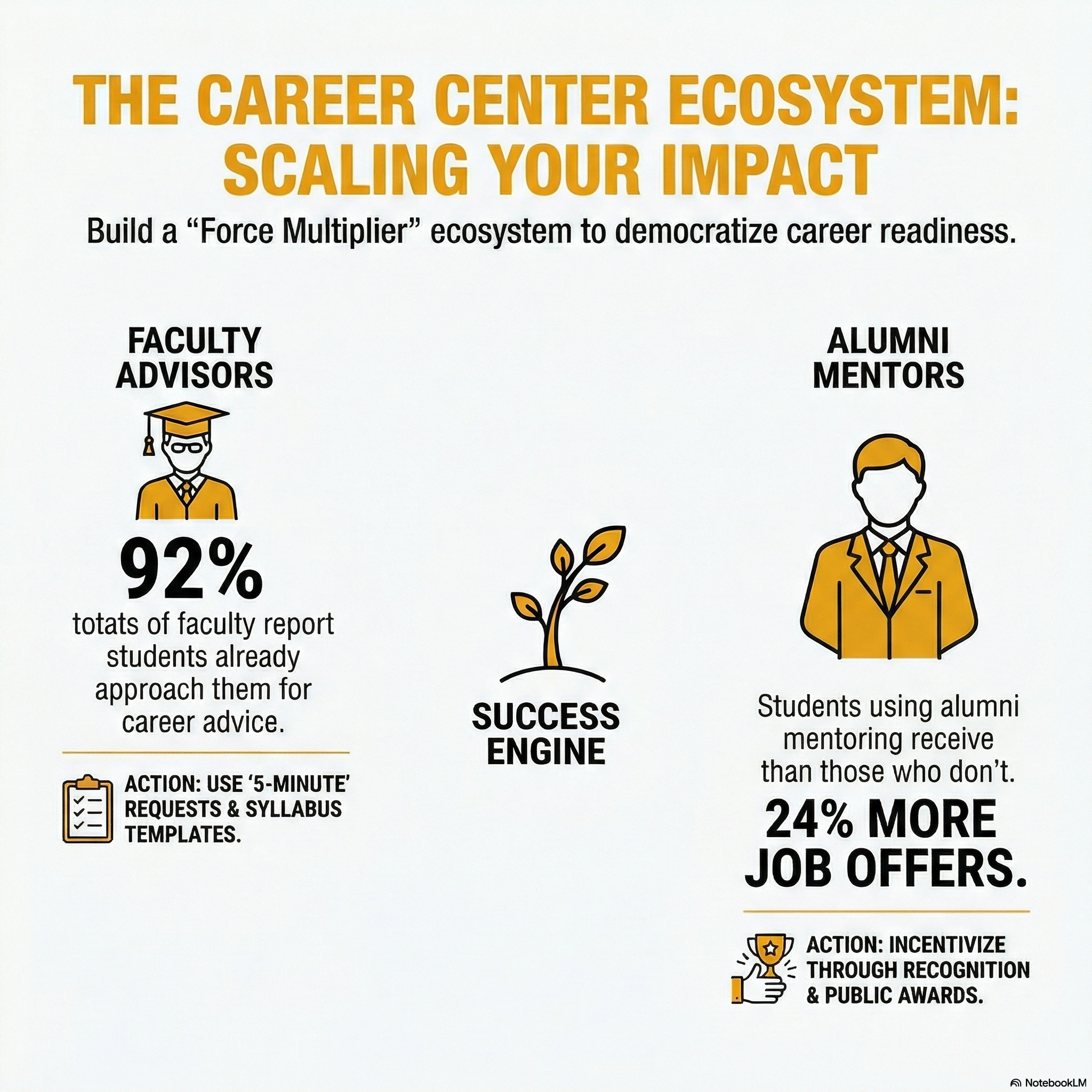
According to a 2024 report by the National Association of Colleges and Employers (NACE), a staggering 92% of faculty report that students ask them for career advice.
Furthermore, 63% of faculty said alumni reached out to them for career guidance. Faculty are already doing the work; they just need your framework.
Some institutions are already doing this.
For example, Elon University’s Student Professional Development Center's "Faculty Career Champions" bridge the gap by integrating career-related assignments directly into courses and partnering with CSPs to invite employers into the classroom.
And Oregon State University’s Career Development Center runs a 6-week cohort-based program that trains faculty to view career readiness through an inclusive lens, specifically identifying barriers for first-generation and low-income students.
Also Read: Why Your Faculty Partnerships Fail to Scale (& How to Fix It)
What are the most effective alumni engagement models for career services?
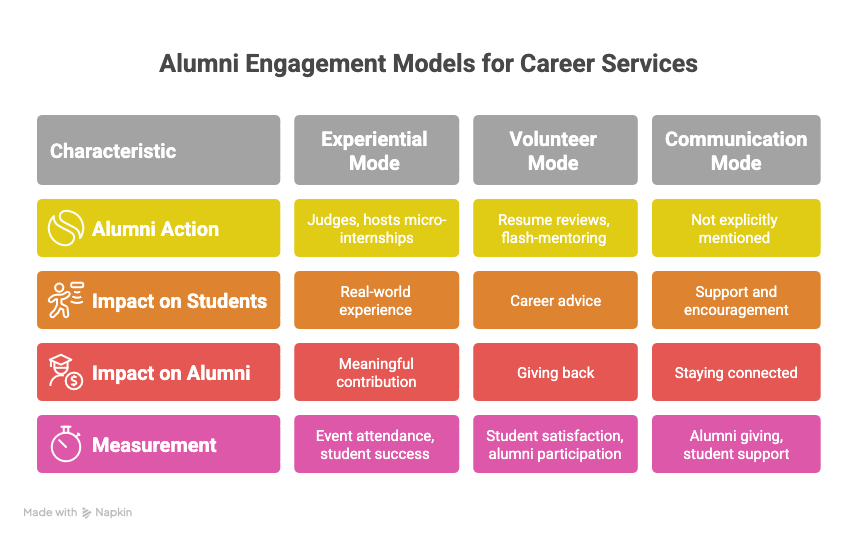
The best alumni engagement models shift from passive networking to active, experiential learning. Top institutions use structured micro-mentoring, industry-specific advisory boards, and alumni-in-residence programs. By categorizing engagement into volunteer, experiential, and communication modes, career centers can precisely track and scale meaningful student-alumni interactions.
According to NACE, graduating seniors who use at least one career service (like alumni mentoring) receive an average of 1.24 job offers compared to just 1.0 for those who don't.
This is the "Engagement-to-Offer Multiplier." Furthermore, students who feel supported in their careers are 2.5x more likely to donate as alumni later on.
According to CASE Insights on Alumni Engagement, successful institutions measure impact not just by event attendance, but by breaking engagement down into actionable modes.
- Experiential Mode: Alumni acting as judges for student pitch competitions or hosting micro-internships.
- Volunteer Mode: Alumni providing 1-on-1 resume reviews or participating in flash-mentoring sessions.
Also Read: How can faculty integrate career readiness into coursework without adding extra workload?
How should I structure outreach to recruit faculty and alumni?
Structure your outreach around specific, low-friction requests that highlight the immediate impact on students. Avoid vague calls for involvement. Instead, use templates that ask for a precise commitment like a short syllabus review or a single classroom visit, while providing all necessary resources upfront to eliminate guesswork.
Mass emails with broad subject lines like "Partner with Career Services" go straight to the trash.
Busy professionals need to know exactly what you want, how long it will take, and what they need to do.
Here are some Faculty and Alumni Outreach Templates you can customize:
Subject: Quick resource: Adding NACE competencies to your [Course Name] syllabus
Hi Professor [Name],
I noticed you’re teaching [Course Name] this fall. Many students mention how much your class helps them think critically.
To help them articulate this to employers, I’ve put together a 1-page guide on tying your existing assignments to NACE Career Readiness Competencies. It takes about 5 minutes to review, and I’ve included a plug-and-play paragraph you can drop directly into your syllabus.
Would you be open to taking a look?
Alumni Outreach Template:
Subject: 15 minutes to help a current [Major] student?
Hi [Name],
Congratulations on your recent promotion at [Company]! Our current [Major] students are highly interested in your career path.
We are running a "Flash Mentoring" week next month. Would you be willing to hop on a single, 15-minute Zoom call with a graduating senior to review their resume? We handle all the scheduling and provide a feedback rubric so no preparation is required on your end.
Also Read: How Can Career Centers Support Seniors Without Jobs Before Graduation?
How do I incentivize faculty and alumni to participate?
Incentivize participation through public recognition, plug-and-play resources, and student-driven awards. While stipends help, the most powerful motivators are intrinsic. Provide faculty with ready-made assignment templates to save them time, and leverage student nominations to publicly honor faculty and alumni, boosting their professional profiles and institutional loyalty.
While HigherEd suggests faculty desire funding or course releases to integrate career prep, budgets are tight. You have to win on convenience and recognition.
Actionable Strategies:
- Student-Led Nominations: According to Weber State University, their Career Champions are directly nominated by students. Nothing motivates a professor more than knowing a student felt impacted enough to nominate them for an award.
- Zero-Friction Resources: According to the UC Davis Career Center, they offer asynchronous Canvas modules filled with course assignment templates, syllabi samples, and PPT slides. You incentivize faculty by saving them prep time.
Also Read: How can career centers prove ROI and institutional value to deans and senior leadership?
How do I build a sustainable governance structure for these programs?
Build sustainability by establishing a centralized leadership team within career services while decentralizing execution across academic departments. Define clear eligibility criteria, mandate specific training cohorts, and track engagement using standardized metrics. This ensures quality control while allowing the program to scale organically across the entire institution.
A program without structure becomes a massive administrative burden. You need a hub-and-spoke model.
According to a NACE Quick Poll, 82.1% of career readiness competency initiatives are led by the Career Services Director, but execution happens at the department level.
Structural Best Practices:
- Formalize the Commitment: NC State’s Career Development Center for instance, mandates employees to attend training and formally commit to being a Career Champion for the entire academic year. This weeds out passive participants.
- Measure and Report: Embed First-Destination Survey (FDS) touchpoints into the academic milestones your new faculty champions oversee. Track the "Applicant-to-Hire Ratio" for students who interacted with alumni mentors and present this ROI to your Dean or Provost.
Wrapping Up
Scaling career readiness across an institution requires systems that make collaboration easy, measurable, and repeatable.
When faculty, alumni, and advisors are aligned with clear frameworks and resources, you turn isolated efforts into a coordinated engine that drives real outcomes.
Hiration’s career readiness suite can support this by helping students create assessed artifacts, practice interviews, and refine applications, while your team manages cohorts, tracks engagement, and reports outcomes in one secure, FERPA- and SOC 2-compliant platform.
The goal is a sustainable ecosystem where every classroom, alumni interaction, and advising touchpoint contributes to measurable career outcomes.