How can career centers create a case interview rubric that improves coaching consistency?
Career centers can improve case interview coaching by using a standardized rubric built around observable behaviors rather than advisor impressions. Effective rubrics define core competencies, establish behavioral scoring anchors, support calibration across advisors, and generate readiness data that can be tracked over time. This creates more consistent feedback, clearer student development plans, and stronger readiness decisions across consulting and other case-based interview formats.
Case interview prep can look organized from the outside and still feel inconsistent inside the advising room.
One advisor may tell a student their structure is “almost there.”
Another may watch the same mock and say the student is interview-ready.
A third may focus on math, while another focuses on communication.
The student leaves with mixed signals, and the career center has no clear way to compare readiness across advisors, cohorts, or recruiting cycles.
That gap becomes harder to manage as case-style interviews move beyond consulting into product, finance, operations, healthcare, and public sector roles.
This guide breaks down how career centers can design a case interview rubric that improves advisor consistency, supports role-specific coaching, and turns mock interview feedback into usable readiness data.
Why Does a Standardized Rubric Outperform Ad-Hoc Feedback?
At 4:00 p.m., one advisor marks a student as ready for final-round consulting interviews. At 4:30 p.m., another advisor watches the same recording and says the student still lacks judgment and executive communication.
If both advisors are using personal instincts, the student gets mixed signals, and the career center cannot defend its coaching decisions to employers, faculty partners, or its own staff.
A standardized rubric outperforms ad-hoc feedback because it turns case coaching into an assessment system instead of a series of individual opinions.

Product managers, finance analysts, operations candidates, and policy students may all face problem-solving interviews, but the signals of strong performance differ by function.
Without a common rubric architecture, advisors tend to over-reward polish, underweight reasoning, and apply inconsistent standards across schools or units.
The operational value is straightforward.
A rubric lets directors calibrate staff, compare outcomes across workshops and appointments, and identify where coaching actually changes student performance.
It also makes it easier to train peer coaches, graduate assistants, and employer-facing teams who do not all come from consulting backgrounds.
Career centers that already use structured hiring logic will recognize the advantage.
Define the behaviors, set anchors, train raters, and check whether different evaluators score the same performance in roughly the same way.
What ad-hoc feedback usually gets wrong
Ad-hoc feedback often sounds practical but breaks down the moment a student meets a second advisor or enters a different program.
- “Be more structured” often means different things to different raters. One advisor means sharper problem framing. Another means clearer signposting. A third means using a consulting-style issue tree, which may not even fit a product or finance case.
- “Drive the case more” can refer to pacing, prioritization, hypothesis formation, or confidence in handling ambiguity. Without a scoring anchor, the student cannot tell which behavior to change.
- “Your math was shaky” may reflect poor setup, careless arithmetic, weak interpretation, or failure to connect the calculation to the decision.
Those comments do not scale well across repeated practice, shared notes, or institutional reporting.
Practical rule: If two trained advisors cannot identify the same behavior and assign roughly the same score, the center has coaching preferences, not an assessment standard.
Standardization also improves fairness.
Students who know the hidden norms of consulting recruiting already decode vague feedback better than first-generation students, career changers, and students testing cases for non-consulting roles.
A rubric reduces that gap by making expectations explicit.
There is a trade-off. Standardization takes time to build, and poorly designed rubrics can become too rigid or too consulting-specific.
The answer is not to abandon structure.
It is to build a flexible rubric with clear scoring anchors, then train advisors to apply it consistently across role families.
The payoff is larger than cleaner notes after a mock interview. A standardized system gives institutions usable evidence on readiness, coaching quality, and where students need targeted support.
What Key Competencies Should a Case Interview Rubric Measure?
Two advisors watch the same mock case. One says the student was “good on structure but weak on executive presence.”
The other says the student “needed stronger business judgment.” Neither comment is wrong, but neither gives the center a stable scoring record or the student a clear next step.
A useful rubric fixes that by measuring behaviors that can be observed, taught, and compared across raters.
A strong starting point is to separate case performance into observable dimensions: problem structuring, quantitative analysis, judgment, creativity, synthesis, communication, and case leadership.
For career center use, two additions usually improve coaching quality and rater consistency: chart interpretation and coachability.
Communication should also be scored directly rather than buried inside leadership, because advisors often score speaking style too loosely unless the category is defined.
Which competencies belong in the core rubric
A practical Case Interview Rubric for Career Advisors should score these eight areas:
- Problem structuring The student clarifies the objective, identifies the decision to be made, and builds an approach that fits the case instead of forcing a memorized framework.
- Judgment and prioritization The student forms an initial view, identifies the highest-value questions, and adjusts the direction of the analysis when new evidence changes the picture.
- Quantitative analysis This covers setup, arithmetic accuracy, use of units, and whether the student can explain what the result means for the decision.
- Chart interpretation This deserves its own category. Many students can describe a graph, but fewer can identify the one insight that should change the recommendation.
- Creativity and option generation Strong performance here means producing relevant ideas tied to the business context, not listing generic growth tactics.
- Synthesis and recommendation The student answers the question directly, leads with the conclusion, and supports it with the strongest evidence and risks.
- Communication and case leadership This includes signposting, pacing, listening, transitions, and the ability to guide the conversation in a way that helps the interviewer follow the analysis.
- Coachability In repeated mocks, this shows whether the student incorporates prior feedback, responds constructively to prompts, and improves on specific behaviors over time.
These categories work because they separate errors that often get blended together in advising notes.
A weak recommendation may come from poor prioritization, not poor communication. A messy calculation may reflect weak setup, not weak math fluency.
If the rubric collapses those distinctions, advisors cannot diagnose patterns accurately and students cannot improve efficiently.
How to keep the competencies observable
Each competency needs to be grounded in visible or audible behavior. “Good business sense” is too vague to score reliably.
“Identified the profit decline as the decision driver, tested revenue before cost, and revised the hypothesis after seeing segment data” is scoreable.
That standard matters even more when the rubric is used across staff with different levels of case experience.
Newer advisors can evaluate whether a student clarified the objective, used units correctly, or ended with a direct recommendation. They do not need to infer polish or confidence from a general impression.
Score what the student did. Do not let confidence, speaking speed, or familiarity with consulting language stand in for analytical performance.
This is also where non-consulting adaptation starts.
Product case interviews may weight prioritization, user reasoning, and trade-off logic more heavily. Finance interviews may put more weight on numerical interpretation and recommendation quality.
The underlying competencies can stay consistent if the behavioral examples change by role family.
How to map case skills to campus-wide readiness language
Career centers often need a rubric that serves two audiences at once.
Advisors need case-specific criteria. Institutional leaders need language that aligns with broader student outcomes and assessment reporting.
A crosswalk solves that problem.
Problem structuring and synthesis map cleanly to critical thinking. Communication and case leadership connect to oral communication and professionalism. Coachability supports career and self-development.
Centers that already report through campus assessment frameworks can translate case performance into familiar terms by using a career readiness competencies guide as a reference point.
That alignment does more than satisfy reporting needs.
It makes the rubric easier to defend when employers, faculty partners, and institutional assessment teams ask why case coaching belongs in a career center's broader readiness strategy.
How Should Career Centers Design Effective Scoring Scales and Anchors?
Career centers should use a scoring scale that advisors can apply consistently under time pressure, then define each score with behavioral anchors.
A 3-point scale is usually easier for campus implementation, while a 5-point scale can work for advanced programs with trained raters.
The anchor matters more than the number of points.

Many teams start with too much precision. They build five or seven score levels before they have shared definitions. That usually creates fake accuracy.
Advisors begin splitting hairs between adjacent scores, and the notes become less reliable, not more.
When to use a 3-point scale and when to use a 5-point scale
Use 3 points when:
- Multiple staff members score cases and you need faster norming.
- Peer coaches or graduate assistants participate and you want simpler calibration.
- Students need clear developmental guidance instead of subtle distinctions.
Use 5 points when:
- A specialized consulting team runs the program with repeated rater training.
- The center needs more differentiation among highly prepared students.
- Recorded cases are reviewed asynchronously and staff can spend more time on scoring notes.
A center that can't maintain scoring consistency on three levels won't improve by moving to five.
Sample Behavioral Anchors for Problem Structuring
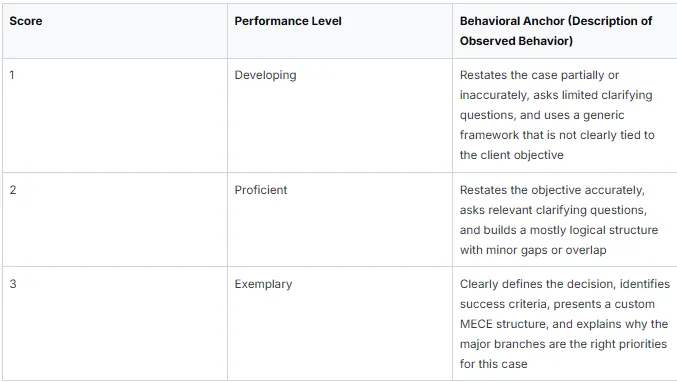
How anchors reduce subjectivity
Behavioral anchors should describe what the advisor observed, not what the advisor felt.
That means replacing labels like “smart,” “executive presence,” or “not strategic enough” with evidence such as:
Observed sequencing such as whether the student clarified the objective before structuring.
Observed reasoning such as whether the student offered a hypothesis and tested it.
Observed analytical grounding such as whether the student explained assumptions, checked whether the numbers were plausible, and connected the calculation back to the decision.
Advisors do not need students to memorize industry trivia. They do need students to show range-based reasoning, explain assumptions clearly, and notice when an answer does not make business sense.
For teams building adjacent assessment tools, it can help to compare design choices with other coaching artifacts such as a resume review rubric for career centers.
How Can a Rubric Be Adapted for Non-Consulting Roles?
A case rubric should be adapted by separating cross-role problem-solving skills from job-family-specific criteria.
Keep the core dimensions stable, then add one or two role-relevant measures such as stakeholder tradeoffs, implementation realism, user empathy, or domain judgment.
That keeps the system scalable without forcing every case into a consulting template.

Many case coaching systems assume that all case interviews reward the same behaviors. That does not match employer demand on most campuses.
Product management may value customer reasoning and prioritization.
Finance may care more about analytical rigor and assumption quality.
Public sector roles may place more weight on tradeoffs, implementation constraints, and stakeholder impact.
This is where many generic case rubrics fall short: employers outside consulting may value judgment, stakeholder tradeoffs, implementation realism, or user reasoning more than a standard profitability framework.
A two-layer model that scales
Use a core layer for all case-based assessment:
- Problem framing
- Evidence use
- Quantitative reasoning
- Communication
- Recommendation quality
Then add a role layer based on the target pathway.
For example:
- Product management Add user empathy and prioritization logic.
- Finance Add assumption discipline and sensitivity to financial tradeoffs.
- Operations Add process realism and implementation feasibility.
- Public sector or nonprofit Add stakeholder complexity and policy or mission alignment.
What role adaptation looks like in practice
A student interviewing for consulting and a student interviewing for product may receive the same market-entry case.
The consulting candidate might be scored more heavily on issue-tree quality and hypothesis progression. The product candidate might be scored more heavily on customer segmentation, tradeoff reasoning, and practical rollout decisions.
That's a better fit for mixed-population institutions because it avoids creating dozens of separate rubrics while still honoring employer differences.
If the rubric rewards only polished framework delivery, students heading into non-consulting roles can look weaker than they are. The assessment should match the job family, not the advisor's favorite case-prep style.
What Is the Process for Piloting the Rubric and Training Advisors?
Pilot the rubric with a small advisor group, score the same sample cases independently, compare differences, revise the anchors, and train all raters before launch.
The critical step is norming.
A rubric only becomes fair when advisors use the same score for the same observed behavior.

Most rubric failures aren't design failures. They are rollout failures.
The form looks fine on paper, but advisors interpret categories differently, skip fields under time pressure, or revert to old habits during busy recruiting periods.
A practical 30 60 90 day rollout
First 30 days
- Form a working group with one lead advisor, one employer-facing staff member, and one data or operations partner if available.
- Draft the rubric with six to eight competencies and behavioral anchors.
- Select sample recordings from mock sessions or staff role plays.
Next 30 days
- Run norming sessions where all advisors score the same recorded case independently.
- Compare score spreads and identify categories with the most disagreement.
- Revise anchors where terms like “strong” or “clear” are too vague.
Final 30 days
- Pilot live use in a limited program such as consulting club mock interviews or a business school cohort.
- Collect advisor and student feedback on clarity, time burden, and usefulness.
- Launch center-wide with a short scoring guide and example completed rubrics.
How to run a norming session that actually works
A useful norming session is concrete and short.
Ask each advisor to score one recorded mock case alone.
Then discuss only the categories with notable disagreement. Don't debate whether the student was “good.” Debate what behavior was observed and which anchor fits best.
For teams building broader staff capability, this can sit alongside a more formal advisor onboarding and support process, especially when new staff, graduate assistants, or peer educators will use the rubric.
How Do You Integrate the Rubric into Counseling Workflows and Technology?
Integrate the rubric at the appointment, documentation, and reporting levels.
Attach it to mock case sessions, store completed scores in a shared system, review progress across repeat appointments, and use aggregate trends to guide programming. If the rubric lives only in a PDF, staff won't use it consistently.
The operational rule is simple. Make the rubric part of the advising workflow already in place.
Don't ask advisors to complete a separate process after the meeting.
The scoring form should sit inside the appointment record or the post-session documentation flow, with space for both numeric ratings and short evidence notes.
A workable setup usually includes:
- Pre-session tagging so students identify target role family before the mock.
- During-session scoring on the core dimensions.
- Post-session notes with two strengths, two development priorities, and the next practice task.
- Longitudinal tracking so a second advisor can see prior scores and repeated patterns.
What to collect and what to avoid
Collect rubric data that supports coaching decisions:
- Competency-level scores
- Advisor comments tied to observable behavior
- Target role or industry
- Session type such as live mock, recorded review, or workshop assessment
Avoid building a data model so detailed that advisors stop completing it. A light, reliable form beats an extensive form that only half the team uses.
Wrapping Up
A strong case interview rubric gives career centers a shared coaching standard, clearer advisor notes, and a better way to track student readiness across repeated practice.
Hiration supports that work through a full-stack career readiness suite that spans the student journey, including Career Assessments, AI-powered Resume Optimization, Interview Simulation, LinkedIn and cover letter support, and a dedicated Counselor Module for managing cohorts, workflows, and analytics within a secure, FERPA and SOC 2-compliant platform.
For career centers scaling case prep beyond one-off mock interviews, the next step is to make feedback consistent, visible, and easier to act on.
That shift turns case prep from a staff-dependent service into a structured readiness pathway students can improve through over time.
Case Interview Rubrics for Career Advisors — FAQs
Why is a standardized case interview rubric important?
A standardized rubric reduces advisor subjectivity, creates consistent readiness standards, improves coaching quality, and allows student performance to be compared across advisors and cohorts.
What problems do ad-hoc case interview evaluations create?
Ad-hoc evaluations often produce inconsistent feedback, unclear improvement priorities, advisor disagreement, and limited ability to track readiness over time.
What competencies should a case interview rubric measure?
Core competencies typically include problem structuring, judgment and prioritization, quantitative analysis, chart interpretation, creativity, synthesis, communication, case leadership, and coachability.
Why are behavioral anchors important?
Behavioral anchors define observable actions for each score level, making evaluation more reliable and helping students understand exactly what needs improvement.
Should career centers use a 3-point or 5-point scale?
A 3-point scale is often easier to calibrate across multiple advisors, while a 5-point scale can provide more differentiation when raters receive extensive training.
How can rubrics support non-consulting case interviews?
Career centers can keep core problem-solving competencies consistent while adding role-specific dimensions such as user empathy, stakeholder trade-offs, implementation realism, or financial reasoning.
What is rubric norming?
Norming is the process of having multiple advisors score the same case, compare results, discuss differences, and refine scoring interpretations to improve consistency.
How should advisors score case interview performance?
Advisors should evaluate observable behaviors such as objective clarification, hypothesis development, analytical reasoning, communication structure, and recommendation quality rather than confidence or presentation style alone.
How can career centers integrate rubric data into advising workflows?
Rubrics should be embedded directly into appointment records, mock interview documentation, readiness reviews, and longitudinal student tracking systems.
What is the biggest strategic benefit of a case interview rubric?
A well-designed rubric transforms case coaching from a staff-dependent activity into a repeatable assessment system that supports readiness decisions, advisor calibration, and measurable student development.