How can career centers help small employers build stronger internship programs?
Career centers can improve small employer internships by moving from passive job posting to active employer enablement. Strong systems assess employer readiness, require clear supervision and project scope, provide lightweight learning agreements and onboarding templates, set compliance guardrails, and use student feedback and conversion metrics to decide which opportunities are worth promoting.
Small employers often want interns, but many lack the structure to support them well.
Without clear project scope, trained supervision, onboarding, and basic compliance confidence, promising opportunities can quickly become confusing for students and risky for institutions.
For career centers, the challenge is not just finding more internship hosts. It is helping under-resourced employers become reliable learning partners.
This guide covers how to assess small employer readiness, set simple internship guardrails, provide plug-and-play templates, and decide which opportunities are worth promoting to students.
Why do small businesses struggle to launch successful internship programs?
Small employers often fail to launch workable programs because they lack dedicated HR infrastructure, suffer from extreme bandwidth constraints, and struggle to translate vague business needs into structured learning outcomes. Without formal templates, they fear legal non-compliance under the Fair Labor Standards Act (FLSA) and struggle to provide consistent, professional supervision.
While the desire to tap into early talent is strong, the execution frequently falters on basic mechanics.
According to a NACE Quick Poll cited by Southern Illinois University Edwardsville, 80% of responding employers indicated that internships provide the best return on investment (ROI) as a recruiting strategy.
Yet, small businesses routinely miss out on this ROI due to deep-seated structural barriers:
- The "Polished Worker" Fallacy: Small business owners frequently conflate an intern with a budget-friendly, fully autonomous contractor. They expect the student to fix their social media or build an entire database on day one with zero direction, ignoring the educational nature of a true internship.
- The Unpaid Inequity Trap: Because cash flow is tight, smaller organizations often default to unpaid roles. However, according to the NACE Position Statement on Unpaid Internships, unpaid internships reside largely with smaller for-profit companies and nonprofits, which inadvertently worsens equity gaps and severely limits the applicant pool.
- The Shadow of FLSA Fact Sheet #71: Small employers hear legal horror stories regarding the Department of Labor's primary beneficiary test. Lacking compliance officers, they often paralyze themselves with fear over legal exposure or, conversely, unknowingly violate labor laws by replacing regular staff with unpaid student labor.
Also Read: How should career centers build a clear policy for paid vs unpaid internships?
How can career centers evaluate if a small employer is actually ready for an intern?
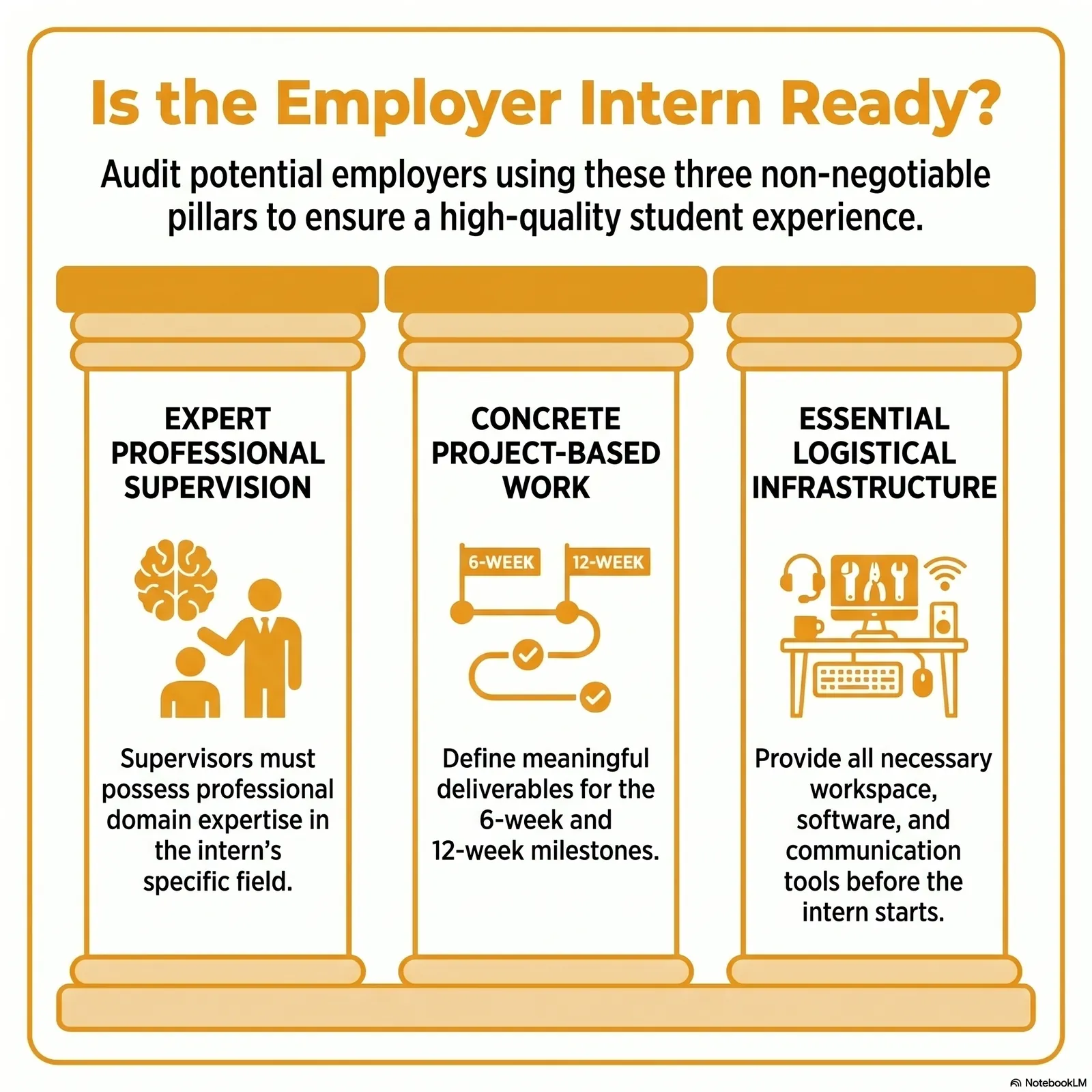
Career services practitioners can assess readiness by auditing three core pillars: professional supervision, work scope, and basic logistical infrastructure. An employer is ready only if they can commit a dedicated mentor with domain expertise, outline clear project-based work, and provide the mandatory physical or virtual tools needed for the intern to succeed.
Do not let an unequipped employer post a vague role that will result in a poor student experience.
Instead, put them through a rapid readiness audit. According to the University of Minnesota (UMN) College of Liberal Arts Internship Toolkit for Employers, a high-quality experience requires a strict baseline of employer commitment.
Train your employer relations team to look for these three pillars before approving a new host:
1. Professional Supervision Expertise
The host must designate a specific staff member to act as the supervisor. This person cannot just be an administrator who checks timesheets; they must possess professional expertise in the field where the intern is working.
If a startup wants a marketing intern but has no one on staff who understands marketing, they fail the readiness check.
2. Concrete Work Scope vs. Administrative Busywork
Ask the employer: “What specific project will be completed at the 6-week and 12-week marks?” If they cannot answer beyond “helping out around the office,” they are not ready.
The work must be meaningful, analytical, or creative rather than purely administrative.
3. Logistical and Technical Equipment
According to the UMN CLA audit framework, employers must verify that they have adequate workspace and equipment, including a computer, necessary software licenses, a secure corporate email account, and a desk, before the student arrives.
If the role is remote, they must demonstrate a documented system for daily digital communication and asynchronous accountability.
Also Read: Designing Micro-Internships: A 5-Step Guide for Career Centers
How do you build a lightweight internship framework without overwhelming small business owners?
To keep things simple, career centers should steer small employers away from complex corporate manuals and instead focus on a minimal framework: a structured Learning Agreement, fixed hours, and micro-onboarding. Grounding the role in NACE's core career readiness competencies provides a turnkey structure that defines clear learning outcomes immediately.
The secret to supporting small employers is stripping away corporate jargon. They do not need a 40-page internship handbook; they need a single-page blueprint.
Define Scope via NACE Competencies
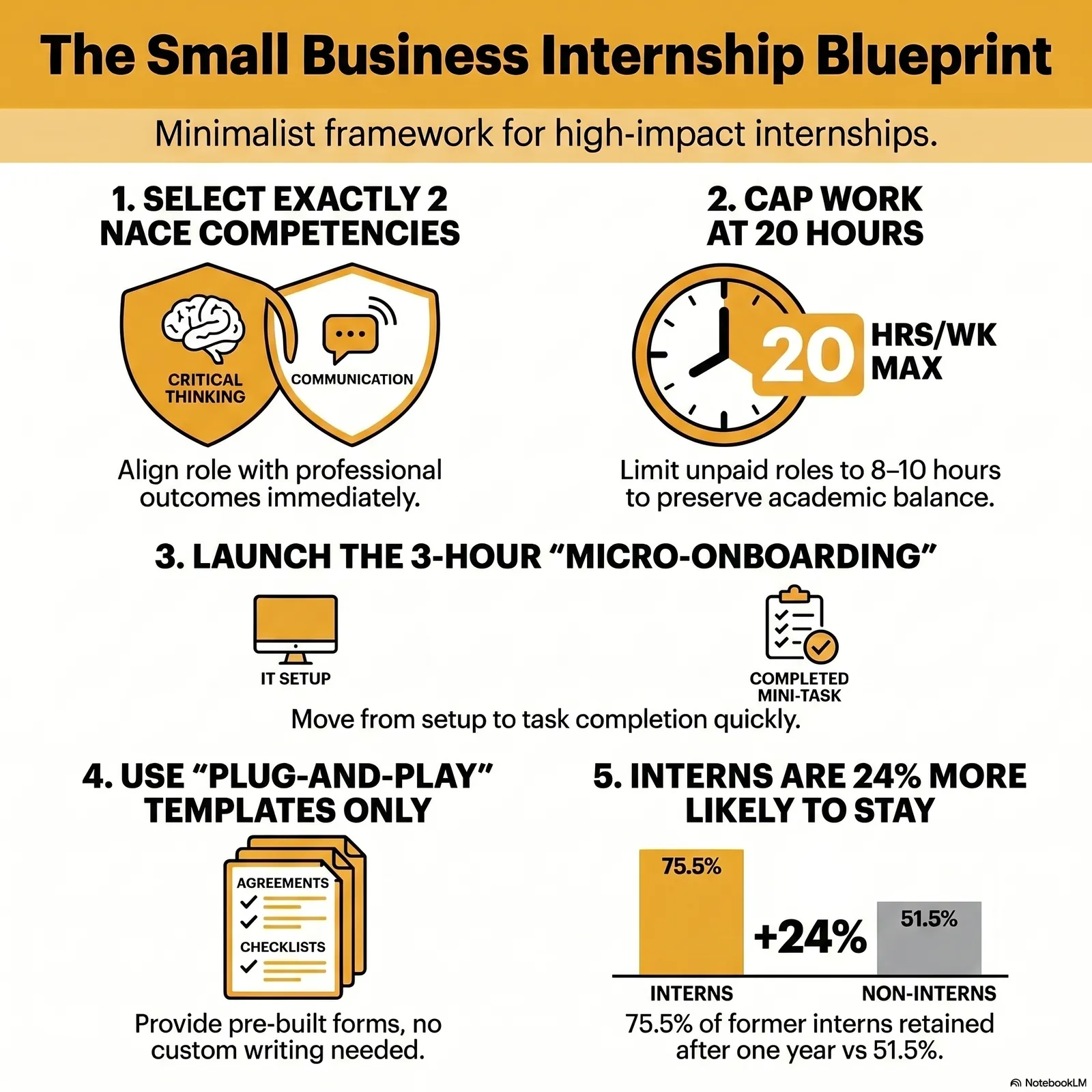
Instead of letting employers invent goals from scratch, hand them the NACE Career Readiness Competencies (e.g., Critical Thinking, Communication, Technology). Instruct the employer to pick exactly two competencies that this internship will actively develop.
This immediately aligns the business needs with measurable academic and professional outcomes.
Impose Rigid Hour Limits
To prevent small businesses from overwhelming students, set explicit guardrails on working hours. According to the Western Oregon University (WOU) Internship Toolkit, career centers should recommend that students work no more than 20 hours per week while attending classes full-time to preserve academic balance.
For unpaid positions, WOU explicitly notes that students may only be able to dedicate 8 to 10 hours per week, as a heavy unpaid workload directly compromises their academic performance and financial stability.
The "Micro-Onboarding" Schedule
Small employers frequently fail at onboarding because they think it requires a week of lectures. Teach them the "Day One, Hour One" rule:
- Hour 1: IT setup, tool access, and team introductions.
- Hour 2: A 30-minute deep dive into the core project assignment.
- Hour 3: The first mini-task (e.g., auditing a single webpage or pulling a specific data report) so the student contributes on their very first day.
What specific templates and checklists can career services provide to first-time hosts?
Career services should equip first-time hosts with a plug-and-play toolkit containing an Internship Learning Agreement, a first-week orientation checklist, and standardized evaluation forms. These lean documents streamline the management process, ensuring small employers can deliver high-impact training and consistent feedback without drowning in administrative paperwork or HR bottlenecks.
Do not ask a small business owner to write an evaluation form or an orientation plan. If you do, they will simply skip it.
According to the Minneapolis Saint Paul Economic Development (Greater MSP) Internship Toolkit, which leverages the nationally recognized UMN Career Readiness Initiative, offering structured, pre-built templates is the fastest way to scale employer capabilities.
Your center should host a self-service digital toolkit containing the following downloadable documents:
| Template Name | What It Solves | Key Component to Include |
|---|---|---|
| The 1-Page Learning Agreement | Prevents scope creep, clarifies expectations, and helps align the internship with learning outcomes | Student and supervisor signatures agreeing to three specific learning objectives, expected responsibilities, and success indicators |
| The "First 5 Days" Orientation Checklist | Reduces supervisor uncertainty and helps interns become productive more quickly | A step-by-step onboarding checklist covering workspace setup, technology access, introductions, project overview, and a scheduled weekly 1-on-1 check-in |
| The Mid-Point Evaluation (Likert Scale) | Identifies performance concerns, supervision issues, or student dissatisfaction before the internship ends | A simple 1-to-5 rating scale focused on communication, initiative, professionalism, learning progress, and goal achievement, supplemented by a brief action-planning section |
By productizing these resources, your career center provides immediate operational infrastructure to the employer, standardizing the student experience regardless of company size.
Also Read: How Career Centers Can Build Fair Internship Stipend Programs
When should a career center approve a small business internship for student promotion?
Career centers should approve and promote an internship only when it meets strict gatekeeping criteria: guaranteed FLSA compliance, clear alignment with academic learning goals, and a dedicated supervisor. Tracking long-term program quality relies on evaluating post-internship conversion rates, supervisor feedback, and formal exit interviews with the participating students.
Your institution's reputation is tied to the safety and quality of the experiences you promote. Therefore, your career center must act as a strict gatekeeper while tracking development metrics over time.
The Promotion Threshold
Do not publish a role on your university job board unless the employer signs off on your institution's core site expectations.
If an employer refuses to assign a dedicated professional mentor or insists on an unpaid model that fails the FLSA primary beneficiary test, decline the posting.
Tracking Long-Term Performance Metrics
Once a small employer is cleared to hire, transition them into your assessment loop. According to NACE employer benchmarks published by Walsh College, the average conversion rate of interns to full-time hires sits at 63.1%.
Furthermore, data from the NACE 2023 Internship & Co-op Report demonstrates that former interns are retained at much higher rates: 75.5% are still with the organization after their first year, compared to just 51.5% of non-intern hires.
Use these benchmarks to demonstrate value to your small business partners. Send an automated survey 30 days post-internship to track:
- The Conversion Metric: Did the small employer offer the student an extended internship, part-time work, or a full-time role?
- The Student Exit Insight: Conduct a mandatory 5-minute checkout with the returning student. If a student notes that an employer used them for low-level manual labor without mentorship, flag the employer profile in your CRM for a mandatory remediation review before allowing them to post again.
By shifting from passive job-board hosting to active, template-driven consultation, your career center can systematically transform under-resourced local businesses into premier experiential learning hubs for your students.
Also Read: How can career centers build a scalable first-year internship strategy that improves outcomes?
Wrapping Up
When small employer internships are structured well, they can expand access to practical experience without lowering the quality bar for students.
The real work is building the systems behind those opportunities: readiness checks, learning agreements, onboarding templates, supervisor expectations, and feedback loops that make small employers easier to support over time.
Hiration can support that broader career readiness journey with Career Assessments, AI-powered Resume Optimization, Interview Simulation, LinkedIn optimization, and more, along with a dedicated Counselor Module to manage cohorts, workflows, and analytics within a secure, FERPA and SOC 2-compliant platform.
The goal is simple: help more students move from opportunity to readiness with the right structure behind them.
Small Employer Internships — FAQs
Why do small employers struggle to run internships?
Small employers often lack HR infrastructure, supervisor bandwidth, compliance confidence, onboarding systems, and the ability to turn vague business needs into structured learning experiences.
How should career centers assess employer readiness?
Career centers should review whether the employer has a qualified supervisor, clear project scope, basic equipment, communication systems, and a realistic plan for student support.
What makes a small employer internship high quality?
A high-quality internship includes meaningful work, professional supervision, clear learning outcomes, reasonable hours, onboarding support, and alignment with academic or career goals.
What should career centers reject or pause?
Centers should pause roles with vague duties, no qualified mentor, excessive unpaid hours, administrative busywork, poor compliance fit, or no structured student support.
How can small employers keep internship design simple?
They can use a one-page learning agreement, two selected career readiness competencies, fixed hour limits, and a simple first-day onboarding plan.
What templates should career services provide?
Career services should provide a learning agreement, first-week orientation checklist, midpoint evaluation, final evaluation, supervisor guide, and student exit feedback form.
Why are hour limits important?
Clear hour limits protect academic balance, reduce exploitation risk, and help small employers design internships around realistic student capacity.
When should a small employer internship be promoted to students?
It should be promoted only after the employer confirms compliance, supervision, project scope, learning goals, onboarding expectations, and student support capacity.
How should career centers track internship quality?
They should track student exit feedback, supervisor evaluations, conversion opportunities, compliance issues, repeat employer quality, and post-internship outcomes.
What is the biggest strategic shift career centers need?
Career centers should move from simply approving internship postings toward actively helping small employers become reliable, structured experiential learning partners.