Career centers are increasingly expected to demonstrate real impact, yet many assessments still focus on activity metrics like appointment counts and workshop attendance rather than student outcomes.
This creates a disconnect when leadership is trying to evaluate how career services contribute to institutional priorities such as student success, retention, and employment outcomes.
To make a stronger case for resources and strategic influence, career centers need assessment approaches that capture what truly matters: skills developed, engagement patterns, and the role career services play in helping students transition into the workforce.
This guide explores five modern career center assessment strategies that help universities measure meaningful impact, translate operational data into institutional value, and communicate that story clearly to campus leadership.
1. Define Your Goals and Key Metrics
Before you can measure success, you need to define what it looks like.
A clear strategic plan with specific, measurable, achievable, relevant, and time-bound (SMART) goals is the bedrock of any effective assessment.
A great example is Florida State University's Career Center.
Their publicly available strategic plan outlines clear strategic priorities, from promoting student career preparedness to increasing employment opportunities.
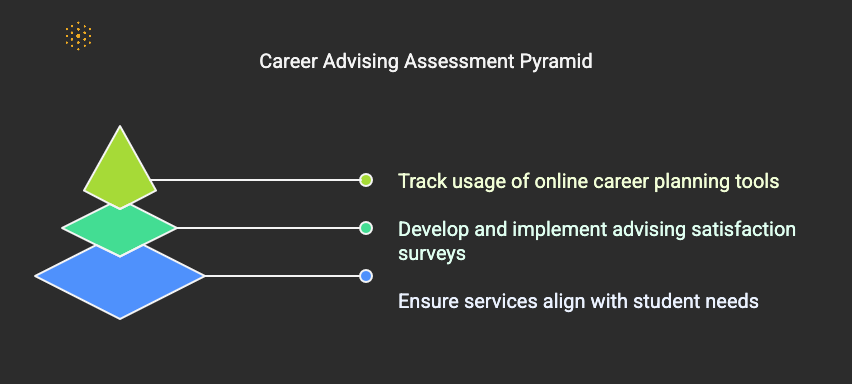
For each priority, they identify desired outcomes and specific assessment methods. For instance, to assess their career advising, they plan to:
- Develop and implement satisfaction surveys for advising appointments.
- Track the usage of online career planning tools.
- Conduct needs assessments to ensure their services align with student needs.
To get started on your own plan, you could run a one-hour "Goal-Mapping" session with your team.
On a whiteboard, create two columns: "Our Services" and "Desired Student Outcomes."
List your top five services (like resume reviews or mock interviews) and for each one, ask: "If this service is successful, what can a student do afterward that they couldn't do before?"
This shifts your focus from tracking appointments to defining measurable student skills, which form the foundation of great goals.
Also Read: Career Center Strategic Plan: 4 Priorities Universities Must Focus On
2. Track Engagement to Understand Your Reach
To understand your impact, it's critical to benchmark your reach against national data.
For example, The National Association of Colleges and Employers (NACE) reports that while the 61% of students who use career services achieve better employment outcomes, a significant portion of students are never engaged.
This raises the key question: How does your own center's engagement compare, and who are you missing?
To answer this, you can track every engagement point systematically.
For instance, if you use a chatbot on your website, you can analyze its data to track what questions are asked most frequently and at what times of the year. This passive data is invaluable for understanding student needs at scale.
Using this data allows you to ask specific, powerful questions: "Based on our chatbot logs, should we run more resume workshops in October?" or "Which majors have the lowest rates of mock interview participation?"
By tracking this information by class year, college, and major, you can identify service gaps and pivot your outreach strategy.
Instead of sending a generic campus-wide email, you can now partner with a specific department to deliver a targeted program right where the data shows it's needed most.
Also Read: 5 ways to build strong employer partnerships for career treks

3. Focus on Learning and Development Outcomes
While student satisfaction is important, a deeper level of assessment looks at what students are learning and how they are developing.
This aligns with the NACE Career Readiness Competencies, which include skills like critical thinking, communication, and professionalism.
Valdosta State University's Career Services Assessment Plan provides a strong framework for this.
They assess not just satisfaction with workshops, but also the learning outcomes by surveying students on their understanding of the content.
You can apply this same principle to any of your programs.
For your next resume writing workshop, try defining a key learning outcome beforehand, such as, “Students will be able to identify the key components of an effective resume.”
You could then measure this with a simple pre- and post-workshop quiz or by having students critique sample resumes to see if they can apply what they learned.
Also Read: How Can Career Centers Demonstrate Institutional ROI?
4. Tell Your Story with a Compelling Annual Report
All the data you collect is only as good as your ability to communicate it.
A visually engaging and easy-to-digest annual report is a powerful tool for showcasing your center's accomplishments to university leadership, faculty, and prospective students.
Take a look at the annual reports from California State University, Long Beach's Career Development Center and Baylor University's Career Center.
These reports go beyond just numbers by including infographics, student testimonials, and success stories:
If a full report seems overwhelming, you could start small.
Try creating a one-page infographic summarizing your key achievements for the semester using a free tool like Canva. A powerful visual can often be just as effective as a multi-page document.
Also Read: 6 ways to supercharge your career center administration
5. Use Data to Drive Improvement
The ultimate purpose of assessment is not just to prove your worth, but to improve your services. The data you collect should inform your decisions and help you better serve your students.
The University of Alabama's Career Center, in their annual report, not only highlights their successes but also uses the data to inform their future direction.
A great way to put this into practice is to schedule a regular "data dive" with your team.
At the end of each semester, set aside time to review your assessment data together and ask critical questions:
- What are the most and least used services? Why?
- Are we reaching a diverse range of students? If not, what can we do differently?
- What feedback are we receiving from students and employers?
- What is one thing we can change next semester based on this data?
By embracing a data-informed approach to assessment, you can not only demonstrate the incredible value of your career center but also ensure that you are continually evolving to meet the needs of the students you serve.
Also Read: 7 Career Center Annual Report Examples for University Leaders

Final Thoughts
Proving the value of a career center increasingly depends on the ability to connect everyday activities to measurable student outcomes.
When assessment is tied to engagement patterns, learning outcomes, and post-graduation success, it becomes much easier to show leadership how career services contribute to institutional priorities like retention, employability, and student confidence.
But effective assessment also depends on having the right systems in place to capture meaningful data across the student journey.
As career services teams support thousands of students with limited staff, technology can play an important role in scaling guidance while generating the insights needed for institutional reporting.
Hiration is designed with this in mind.
The suite spans the full career readiness journey, from career assessments to AI-powered tools for resume optimization, interview simulation, and other job-search preparation modules.
A dedicated counselor module also helps teams manage cohorts, track engagement, and analyze outcomes through centralized workflows and analytics, all within a secure platform built to meet FERPA and SOC 2 compliance standards.
When assessment, technology, and advising work together, career centers can move beyond activity tracking to something far more powerful: a clear, data-backed narrative of student success.