Should you check the "I consent to AI review of my application" box? Almost always, yes. That checkbox is a disclosure, not a verdict on you. It tells you the employer uses automated tools somewhere in screening, and in most cases you have to agree to be considered at all. Declining rarely helps. On a lot of systems it leaves your application with no score in a stack of thousands, so a human never digs it out. The place you can actually move the needle is the resume itself. Give the software something clean to read and you have done the useful thing.
What that consent line actually is
You are filling out an application, you get near the submit button, and there it is. A little box or a Yes/No toggle. Something like "I consent to the use of artificial intelligence and automated tools to review and assess my application." Sometimes it is phrased as a heads-up rather than a request. Sometimes it is flipped into an opt-out: "Check here if you do not want your application reviewed by AI." Same idea, different packaging.
People freeze on it. The reaction is usually some version of "wait, so a robot decides, and I'm signing off on that?" And under a brutal job market, that hesitation turns into a real fear that ticking the box hands your fate to a black box, while leaving it blank gets you quietly trashed.
Here is the calmer read. The line is mostly paperwork. It started showing up on applications around 2024 and spread fast through 2025 and 2026, and the reason is boring: new disclosure and consent rules in several places, plus the hiring-software vendors turning on a compliance default so their customers stay on the right side of those rules. It is the hiring equivalent of a cookie banner. Annoying, everywhere now, and far less sinister than it feels in the moment.
That does not mean it is meaningless. It is worth understanding what you are agreeing to, what your options really are, and where the box does and does not matter. So let's take it apart.
Notice versus consent: they are not the same box
The first thing to sort out is which of two things you are actually looking at, because they carry different weight.
A notice is informational. "This employer uses automated technology to help review applications." You are not being asked to do anything. It is a disclosure the company is obligated (or advised) to make, and you read it and move on. No decision required.
An affirmative consent is a request you have to answer. You tick the box, or you pick Yes, and only then does the form let you submit. Decline, and often the application simply will not go through. A third variant is the opt-out, where the default is that AI reviews you and the box is your chance to say no. Watch the wording on those, because an unchecked opt-out box means you are consenting by default.
Why does the distinction matter to you? Because a notice is nothing to lose sleep over, and an affirmative consent is usually a gate. If it is a gate, the practical question is not "is this fair" but "what happens to my application on each path." We'll get to that. The short version is that the paths are lopsided, and not in the direction most people assume.
Why employers put it there in the first place
The instinct is to read the box as a trap. It is not. In most cases it is there for reasons that have nothing to do with filtering you out and everything to do with the company protecting itself.
Employers add the consent line mainly to comply with disclosure and transparency rules, and to create a paper trail showing they told you. If a jurisdiction says "you must inform candidates when you use automated tools," the cleanest way to prove you did is a checkbox with a timestamp. The hiring platforms then bake this in as a default so their thousands of customers are covered without each one having to think about it. That is why the same stiff wording turns up across totally unrelated companies. It is vendor language, not a hint about that specific employer's culture.
There is a smaller, more cynical reading that occasionally holds: a consent question can double as a filter of convenience, a way to thin a stack. Someone who declines is easy to set aside. That happens, but it is the exception, and even then the mechanism is passive (your application ends up unscored and ignored) rather than a triggered "reject" button. Treat the box as compliance first. Assume malice only if you have a specific reason to.
What the "AI review" is usually doing at this stage
The word "AI" on an application form makes it sound like a machine is rendering judgment on your worth. Most of the time, at the point where you meet this checkbox, the automated part is far more mundane than that.
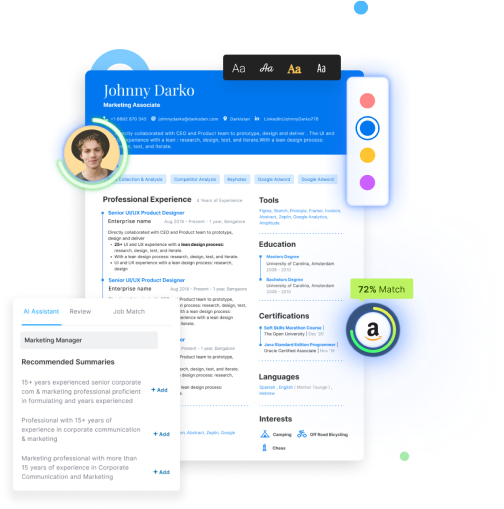
At the application stage, the software is mostly parsing, searching, and sorting. It reads your resume into structured fields, matches your experience against the job's requirements, and produces a relevance ranking so a recruiter can start at the top of a very tall pile. On many systems that ranking shows up as a score or a match percentage next to your name. That is the thing you are consenting to: being read, matched, and ranked by software before a person sees you.
This is the part worth internalizing, because it is where most of the fear is misplaced. Ranking is not the same as rejecting. The system is trying to order the queue, not empty it. It is also why spraying hundreds of applications through AI auto-apply bots tends to backfire: volume without relevance just sinks you lower in that same ranking. There is a stubborn myth that these tools bin most resumes on contact, and it does not hold up to how recruiters actually use them, a point worth reading in full in our piece on the ATS auto-reject myth. The tool that scores you is usually the same tool the recruiter uses to find you.
Two other things this checkbox is not, so you can stop conflating them. It is not an AI screening call, where a chatbot or voice bot actually interviews you and asks knockout questions. And it is not the same conversation as algorithmic bias in hiring, which is a real and separate concern about how those ranking models can skew. The consent box is upstream of both. It is just the moment the software gets permission to read you. If you want the broader map of how automation shows up across the whole hiring process, our job seeker's guide to AI in hiring is a good companion read.
The real question: does checking or declining change your odds?
Here is the honest answer, and it is not the reassuring one. Declining almost never helps, and it frequently hurts.
Play it out. If it is an affirmative-consent gate and you refuse, the form usually will not submit, so you are not in the running at all. If it is an opt-out and you take it, you often stay in the applicant pool but without a relevance score attached to your name. That sounds harmless until you picture the recruiter's screen: a list of a few thousand applicants, sortable by match, and yours sitting there marked "not available." When someone is trying to work through that volume, the unscored applications are the ones that never get opened. You did not get rejected. You got skipped, which functionally looks the same to you.
The counterargument people cling to is that opting out forces a human to read you, and a human is fairer than a machine. In a low-volume role, maybe. For anything that draws hundreds of applicants, the human never gets there. There is no world where a recruiter hand-reads the "no score" pile before working the ranked one.
And the version where you check Yes? You get read and ranked. You might still be sorted low. But at least you are sorted, which means you are in the queue a recruiter is actually working through. Between "in the ranked stack, possibly low" and "in the unranked stack, probably never opened," the first is plainly better. It is a lopsided trade, and it tilts toward consenting.
One caveat, and it is the reason this is not a blanket rule: in a few jurisdictions you have a right to request human review or an alternative process, and there declining does not automatically dead-end you. That is real, it is narrow, and it depends entirely on where the job is. Which brings us to your rights.
The AI is going to read your resume anyway. Is it clean enough to read? Run it through a free AI resume review and see exactly how the software parses your experience, section by section, before a recruiter ever does. Get a free resume review →
What rights you actually have (and where)
This is the part that changes month to month, so read it as a map of a moving landscape, not a rulebook. None of this is legal advice, your rights depend heavily on where the job is based and where you are, and the specifics keep shifting. With that said, here is roughly where things stand as of August 2026.
In the European Union, two separate rules are worth knowing. The older one is GDPR, and its Article 22 gives you a right not to be subject to a decision based solely on automated processing when that decision carries a legal or similarly significant effect. Tucked into that same right is the ability to ask for a human to step in, to put your side of it, and to challenge the result. The newer one is the EU AI Act. Its transparency obligations kicked in around August 2026, but the heavier duties aimed at high-risk employment AI got shoved back to late 2027 when the bloc slimmed down its own timeline. Read plainly: in Europe you first get told, and the stricter oversight is still coming down the pipe.
In the United States there is no single federal rule covering this, so what you get is a patchwork that changes as you cross a state or even a city line. New York City is the one that has actually been biting for a while. Since 2023 its bias-audit law has required employers using automated hiring tools to run an independent audit each year, post a public summary, give candidates advance notice, and offer a stated way to request an alternative. Illinois is the interesting split-screen. It has demanded notice and consent before AI analyzes a recorded video interview since all the way back in 2020, and then in January 2026 its Human Rights Act picked up a second layer that bars AI which discriminates in hiring and requires notice when AI is in the mix, though the exact wording of that notice is still being drafted.
The rest is mostly future tense, which is the part people miss. Colorado's much-hyped AI law got torn up and rewritten, and its start slid to 2027, so right now it does nothing. California finalized its automated-decision rules, but employers do not have to comply until January 2027. Connecticut passed a transparency law in 2026 whose real teeth land later still. See the theme? A lot of what gets cited online as your "AI hiring rights" is dated ahead of today. That is the single biggest reason you cannot treat a headline about some state's new law as protection you actually have this week.
The practical takeaway from all of that: in a handful of places you genuinely can ask for a human to look at your application, and you should know that if the job is based there. Nearly everywhere else, the "right" you have is to be told AI is being used, which is precisely the notice you are reading on the form. Being informed is not the same as being able to opt out without cost. Do not assume a rule you read about for one state protects you in another.
What to actually do when you hit the box
Strip away the anxiety and the move is simple. Check it, and get on with the application.
The energy you were about to spend agonizing over the consent line is better spent on the one thing in this whole process you fully control, which is the document the software is about to read. If the AI is going to parse and rank your resume no matter what you tick, then make the resume it reads a clean one. That is where the payoff sits. Not in the checkbox.
Clean, in this context, has a specific meaning. A single-column layout the parser can follow top to bottom. Real text, not text baked into an image or a graphic. Standard section headings the software recognizes. Job titles, dates, and companies in obvious places. Keywords that honestly reflect what you did and match the language of the posting, because the matching step is looking for exactly that. If you want the full walkthrough, our guide on how to test whether your resume is ATS-friendly shows you how to check all of this yourself in a few minutes.
What clean does not mean is gaming the parser. There is a persistent bit of advice floating around that you should paste the job description in white or one-point font so the AI "sees" the keywords and a human does not. Skip it. Modern systems read your resume as plain text and show recruiters that plain text, so the concealed block is right there in the open, and it reads as exactly what it is. We took that trick apart in detail in our post on the white-text resume hack. Match the job honestly instead. It works better and it does not blow up in your face.
The parsing problem is the real enemy, not the checkbox
Ask people who apply to a lot of jobs what actually enrages them about these systems, and it is almost never the consent box. It is the moment right after, when they upload a perfectly good resume, the system's auto-fill mangles it, and they end up retyping their entire work history into a form because the parser put their job titles in the company field and dropped half their dates.
That mess is the tell. If a mainstream ATS cannot cleanly parse your resume during auto-fill, the same parser is going to struggle when it reads you for ranking, and that is a problem the consent box has nothing to do with. So when the auto-fill comes out garbled, resist the urge to just patch the form and move on. Take it as a signal that your resume's structure is fighting the software, and go fix the resume. A layout that auto-fills cleanly is a layout that ranks cleanly.
This is why the parse test beats the panic. You cannot control the employer's algorithm or the law in their state. You can control how legible your resume is to a machine, and that single fix pays off on every application you send, checkbox or no checkbox.
Should the checkbox worry you at all?
Mostly, no. And it helps to be clear about why not.
The consent line is becoming standard equipment on applications. When you see it, the useful information it gives you is simply that this employer uses AI somewhere in its funnel, which, for any large company in 2026, was already a safe assumption. Nothing about the box reveals a new threat; it just confirms the weather you were already standing in. Seeing it on more and more forms is not a sign that hiring got more hostile, only that disclosure rules finally caught up with what companies were already doing.
What the box is not is a decision about you. Ticking it does not lower your odds, and it does not put you in a worse pile than the applicant who ticked it a minute earlier. It is disclosure, not a scorecard. The scorecard, such as it is, comes later, from how well your resume matches the role, and that you can influence.
If you want the wide-angle version of where this box sits in the whole process, our walkthrough of how hiring actually works, apply to offer, shows exactly which stage this is and what happens on either side of it. Zoom out and the checkbox shrinks to what it is: one small, mostly clerical step near the front door.
The edge cases where declining is defensible
None of this is an argument that you must consent, or that objecting is silly. There are situations where declining is a reasonable stand, and it is worth naming them honestly instead of pretending consent is always costless.
If the job is based somewhere that guarantees you a human-review alternative, and you would rather a person read you from the start, exercising that right costs you little. If you are applying to a role where being a data point that trains someone's model genuinely bothers you on principle, that is a legitimate line to hold, as long as you go in knowing it may cost you the opportunity. And if a posting leans so hard on opaque automated scoring that you would not want to work there anyway, treating the box as a filter on them is a defensible way to think about it. Just be honest with yourself that in a tight market, "I only want jobs that review me by hand" is a stance that shrinks your options, and you should choose it on purpose rather than by accident. For most people, most of the time, the math points the other way.
The bottom line
The "I consent to AI review of my application" checkbox looks like a fork in the road, and it mostly is not. It is a disclosure that hiring software is in the mix, dressed up as a decision. In the overwhelming majority of cases you have to consent to be considered, and declining leaves you either out of the running or sitting unscored where no human will find you.
So check the box, then go win the part you actually control. A resume the software can read cleanly, keywords that honestly match the job, a layout that does not fight the parser. Know your rights if you happen to be applying somewhere that grants them, and do not assume those rights follow you across a border or a state line. The box is not the battle. Your resume is.
Frequently Asked Questions Should I check the box that says I consent to AI reviewing my application?Yes. Tick it and submit. It is nearly always a gate you must pass to be considered, and declining tends to leave your application either dead on arrival or floating in the pool with no score attached, where a recruiter grinding through thousands of names never digs it out. Checking the box gets you read and ranked. That is the pile you want to be in. Will I get auto-rejected if I say no to AI review?Not by a triggered "reject" button, usually. What happens instead is quieter. On a consent gate, the form often will not submit, so you never enter the running. On an opt-out, you stay in the pool but without a relevance score, so the recruiter sorting by match never gets down to you. The outcome looks a lot like rejection even though nothing formally rejected you. Why do so many job applications suddenly ask this?Blame the lawyers, not the recruiter. Disclosure and consent rules landed across several states and countries between 2024 and 2026, and the hiring platforms reacted by flipping on a compliance default for every customer at once. That is why you see the same stiff sentence on applications from companies with nothing else in common. It is vendor boilerplate driven by law. It tells you nothing about that particular employer. Is the AI going to reject my resume the moment I upload it?Almost certainly not. At the application stage the software is mostly parsing your resume into fields, matching it to the job, and ranking it so a recruiter can start at the top of the pile. Ranking low is not the same as being rejected. The tool that scores you is generally the same one the recruiter uses to find you. Do I have a right to a human reviewing my application instead?Sometimes. It hinges completely on where the job sits. A handful of places, New York City among them, require an alternative process or a route to human review. In the EU, GDPR Article 22 lets you contest a decision made solely by automation when it significantly affects you. But most jurisdictions only make the employer tell you AI is in use, which is precisely the notice you are already reading on the form. A rule you saw for one state does not follow the job across a border. Is this checkbox the same as an AI interview?No. The consent box is about software reading and ranking your written application. An AI interview is a separate thing, where a chatbot or voice bot actually conducts a screening conversation and asks you questions. They show up at different points and call for different tactics. Our guide on handling an AI screening call covers the chatbot version, and our piece on the one-way video interview covers the recorded kind. Can I trick the AI by hiding keywords in white text?Don't. Systems read your resume as plain text and show recruiters that same plain text, so a buried block of keywords is fully visible to the human on the other end and reads as a stunt. It is more likely to cost you the role than win it. We break down why in our post on the white-text resume hack. Match the job honestly and the ranking takes care of itself. Does opting out delete my application from the system?Usually not, which surprises people. On a lot of platforms, opting out keeps you in the applicant queue and simply removes the relevance score from your record. You are technically still in there. Just unranked, which in a pool of a few thousand is close to invisible. Behavior does differ from one vendor to the next, so treat this as a pattern rather than a guarantee, but "still in the pile, just unscored" is the version you run into most. Is it a red flag that a company uses AI to review applications?Not on its own. For any large employer in 2026, some automation in the funnel was already a given, and the checkbox just confirms it. What matters more is whether their process feels opaque or dehumanizing overall. If a role leans entirely on scoring you would never see explained, that is worth weighing, but the mere presence of a consent line is not a warning sign. Is any of this legal advice I can rely on?No. This is general information about a fast-moving area, and the laws around automated hiring differ by country, state, and city and keep changing. Several of the rules mentioned here are dated ahead of today or were recently reworked. If your situation actually turns on your legal rights, check the current rules for the specific place the job is based, or talk to someone qualified there.