Do you have to explain a medical gap on your resume?
No. Your resume owes an employer honest dates and a truthful work history, not the reason you were away. You can leave the gap unexplained, add a neutral line like "Career Break, 2023–2024," or write one short, non-medical sentence noting the leave is resolved and you're available. Naming the illness is a personal choice, never a requirement. In the US an employer generally can't even ask about a medical condition before making a job offer. Pick the lightest option that lets a reader move on.
There's a particular kind of dread that comes with updating a resume after a health crisis. You're staring at a blank stretch between two jobs, and the timeline feels like it's about to narrate the worst year of your life to a stranger. It isn't. A gap is a fact on a page. It is not a confession, and you are not on the stand.
This piece is about the resume specifically. It's the one document where you have the most control and owe the least explanation. The one honest sentence some people add to a cover letter is a separate call, and the "so, what happened here?" conversation lives in the interview, which we'll get to. First, the page itself. What goes on it, what stays off it, and how to lay it out so a reader sees your work before they count the months.
The short version: your resume owes dates, not a diagnosis
Two things belong on a resume and are non-negotiable: your employment dates have to be accurate, and the work history you list has to be true. That's the whole contract. Nothing in it requires a reason for time off.
People tie themselves in knots here because the gap feels like a question the resume is asking on the employer's behalf. It isn't, really. A recruiter scanning your history wants to account for the time, confirm you can do the job, and see that you're available now. The specific cause of a break rarely factors into any of that. A blank between two dated roles reads as ordinary far more often than people fear, because most careers have one by now.
If it helps to think about the deeper question of whether a gap hurts you at all, we wrote a whole recruiter's-eye piece on whether employers actually care about career gaps. Short answer, the gap is rarely the thing that sinks a candidacy. This post assumes the gap is already there, and you just need to know what to type into that space.
Three ways to handle it, side by side
There are really only three moves, and all three are honest. The trick is matching the move to your situation instead of reaching for the one that feels safest in the moment.
Say nothing. Let the dates stand and let the gap be blank. This works when the break is short, or old, or already accounted for by everything around it. A four-month space from early 2024 does not need a caption. Adding one often does more harm than the silence would have.
Label it, neutrally. Drop a plain entry into your timeline where a job would go: Career Break, 2023–2024. That's it. No reason, no story. A neutral label with dates tells a reader the time is accounted for and there's nothing to chase, which is usually all they wanted to know. "Personal Leave" and "Family and Health Leave" do the same job if the wording sits better with you.
Add one honest, non-medical line. When the break is long and recent enough that a reader will wonder, a single forward-looking sentence can settle the question before it's asked: Took a planned medical leave; fully resolved and available for full-time work. Notice what that line does and doesn't do. It's accurate, and it looks forward, toward the job rather than the past. What it never does is name a condition.
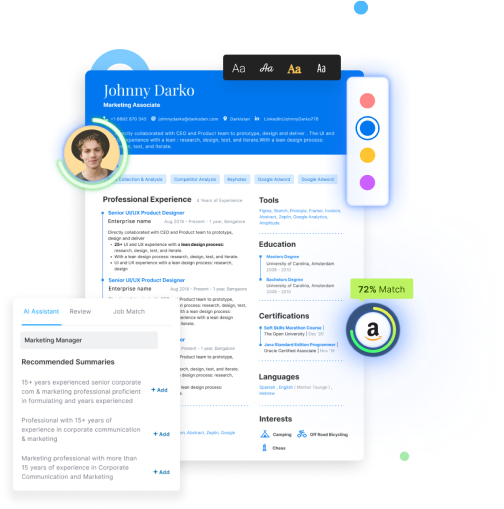
It helps to picture how these look in the actual block of your work history. Option one is two roles stacked with a visible space between the end date of one and the start of the next, and a reader's eye slides over it faster than you'd think. Option two puts a line where a job title would go, something like "Career Break, 2023–2024," sitting in the same left-aligned column as your positions so it reads as a deliberate entry instead of a missing one. Option three is that same entry with a short clause hanging off it. None of the three changes the architecture of the resume. They only change how much the blank space is allowed to say.
Most people land on option one or two. Option three earns its place only in the narrow cases we'll get to below.
What you never have to put on a resume
Here's the part worth reading twice. You are never obligated to put your diagnosis, your prognosis, your treatment, or the reason for your leave on a resume. Not the word, and not even a hint of it. Whether to disclose a health condition is your decision and yours alone, and choosing privacy is not the same as hiding something.
The general legal backdrop supports that instinct, and this is a good moment for a clear caveat: what follows is general information, not legal advice, and your own situation deserves a professional who knows the specifics. With that said, in the US the Americans with Disabilities Act generally prohibits an employer from asking disability-related questions or requiring a medical exam before it makes you a conditional job offer. An employer can ask if you're able to do the job and how you'd approach it. It generally cannot ask what's wrong with you. The ADA's employment rules generally reach employers with 15 or more staff. When a form or a screen can't ask the question, a resume certainly doesn't have to answer it.
So the "why" is optional in the strongest sense. Some people share a sliver of it for their own comfort. Many share nothing. Both are completely normal, and neither is a strategic mistake.
Vague, but honest: the line that actually works
If you do decide to write something, aim for a phrase that's neutral, true, and pointed forward. Those three qualities are what separate a line that reassures from a line that raises eyebrows.
Neutral means the line names a category and nothing more. "Health matter," "medical leave," "personal leave," any of those. Keep it accurate too, since the dates around it are checkable and you never want the wording fighting the facts. Then let the sentence land on the job ahead instead of the time behind you. A working template: [Neutral reason]; now resolved and available. Fill it in and you get lines like Full-time medical leave, 2023–2024; resolved and ready for full-time work, or the even shorter Career Break for a health matter (resolved). Both say enough without saying too much.
What you're avoiding is the apology and the backstory. No "unfortunately," no "had to step away due to a serious," no reassurances about how it won't happen again. A person who's fine doesn't over-explain, and the tone of the line does as much work as the words. Calm and short reads as calm and short.
Never invent a job, never move a date
There's a tempting shortcut that turns a small problem into a large one: filling the gap with a job that didn't happen, or nudging your real dates to make the space disappear. Skip both.
Omitting a reason isn't lying. Inventing a role that never existed is a different thing entirely, and the distinction matters, because employment history is one of the most routinely checked facts in hiring. Background screens and employment verifications exist specifically to confirm titles and dates, and payroll-fed databases like The Work Number can surface the actual months you clocked in somewhere. A fabricated job or a doctored date doesn't read as a rounding error when it's found. It reads as a reason not to trust anything else on the page, and it usually ends the process on the spot. We broke down exactly what these checks do and don't surface in this guide to what a background check actually shows.
The honest version costs you nothing you'd actually want to keep. A true blank on your timeline is defensible forever, while a clever fiction becomes a small landmine you carry into every future conversation about the role.
How much is enough
Almost always: a label, one line, or nothing. That's the whole range.
The instinct to over-explain is human, and it backfires anyway. Picture a recruiter with forty resumes to clear before lunch. On yours they hit three careful sentences about a health condition sitting where a job should be, and the first thing that fires isn't sympathy, it's "why did this need three sentences." The detail you offered as reassurance reads as a flag instead. Space is the tell: the more room the gap takes up on the page, the more important it starts to look. One tidy line, or a clean blank, says the opposite. This is handled, now let's talk about the work.
Think of the gap as a footnote, not a headline. Here's a test that works: read your own resume top to bottom at the pace a recruiter actually reads, the quick skim of a few seconds, and notice where your attention lands. If it snags on the empty stretch instead of your most recent title, the layout is pointing at the wrong thing, and the fix is to make the recent work louder rather than the gap quieter.
Where the gap sits on the page
Layout does quiet work here. You can play a gap down without hiding it, and the difference between those two things is the whole game.
Keep an honest reverse-chronological order. That's still what most recruiters and applicant tracking systems expect, and trying to dodge it usually costs you more than the gap does. Lead the page with a strong summary and your most recent relevant work, so a reader meets your skills before they start counting months. If you're coming back into a slightly different lane, leaning on transferable skills up top puts the focus where you want it. The format to steer clear of is the pure "functional" or skills-only layout that drops dates entirely. Recruiters read those as a sign you're hiding something, and the software behind the first screen tends to parse them badly.
One more small lever: year-only dates. Listing "2023" and "2024" instead of the exact months can quietly shrink a seven-month gap into nothing, and that's not dishonest, since you're just being less granular. It has a limit, though. Year-only dates won't hide a long gap, and a reader who sees "2019" next to "2021" may fill the blank year with their own worst guess, so treat it as a way to soften a short gap, not a cloak for a big one. If your timeline feels cluttered by the whole thing, it's often easier to rebuild it cleanly in a resume builder than to keep nudging a document that's fighting you. For the general mechanics of dates and formatting around any gap, this career-gap resume walkthrough covers the nuts and bolts.
When a line of context helps, and when silence is fine
The one-line option isn't a default. It's a tool for a specific shape of gap, and using it in the wrong place just draws a circle around something a reader would've skated past.
A line earns its place when the gap is long, recent, and obvious enough that a reader will stop and wonder no matter what you do. A two-year blank ending last month is going to raise the question in someone's head. A neutral label there gets ahead of it and reads as steady rather than evasive. The same logic covers a caregiving break, which is common enough now that a plain Family Caregiving, 2022–2024 reads as completely unremarkable. If that's closer to your situation, the caregiver resume guide goes deeper on framing the skills that period built.
Silence wins the rest of the time. Short gaps, gaps from years ago, gaps that later dates already explain. Adding a caption to a quiet, old, three-month break is like footnoting a sentence nobody questioned. When in doubt about a small gap, leave it. The blank is doing less damage than the explanation would.
If the reason is mental health
Every rule above holds, without an asterisk. A break for depression, anxiety, burnout, or a hospitalization is a health matter, and a resume treats it exactly like any other. You owe no detail. A neutral label is the standard move, and "Career Break" or "Health Leave" covers it fully.
One honest observation, offered as a choice and not a rule: a lot of people reach for the plain word "health" rather than "mental health," and that's usually because the stigma still runs heavier for the second phrase than it should. Making that call for your own protection is completely legitimate, and so is being more open if that's who you are and the field welcomes it. There's no correct answer here, only the one you can defend without your stomach dropping. What a recruiter is actually reading for, in every version of this, is one plain thing: do you seem steady and ready to do the work. The diagnosis was never the thing being evaluated.
The reassurance that does the real work: you're back now
Here's the reframe that takes the pressure off the gap entirely. The quiet question behind a recruiter's eyes is less "what happened to them" and much more "are they back, and can they be counted on now." Answer that second one well, and the first mostly dissolves on its own.
You answer it by looking current. Maybe that's a Google Data Analytics certificate you finished in the spring, or two months of contract work you took on to knock the rust off, or a volunteer project that leaned on the exact skills a job posting lists. Any one of those settles a reader more than a paragraph about the past ever could, because it's evidence instead of a promise. A gap that ends in "and here's what I've been sharpening lately" stops looking like a hole and starts to read like a runway.
On the page, that usually lives in a short "Recent Professional Development" block sitting near the top, above or beside your work history, so it's among the first things a skimming eye lands on. You don't need a stack of entries there. One recent, dated, relevant item pulls most of the weight, because it drags attention into the present tense, which is exactly where you want the whole conversation to sit.
That's the whole psychology of a return. Nobody on a hiring panel is grading your recovery; they're checking whether the person in front of them can do the role in front of them, and "resolved and current" answers that more convincingly than a backstory ever could.
The interview is a different room
Keep the two jobs separate. The resume's only task is to get you into the room. Whatever brief context you choose to share out loud belongs in the conversation, not on the page, and it can stay just as light there.
If the gap comes up in an interview, one calm sentence handles it: I took some time out for a health matter, it's fully resolved, and I'm glad to be back. Then pivot to the work. You still don't owe a diagnosis in that room either. You control how much you share, and "resolved, and here's why I'm a fit" is a complete answer. We put together a fuller script for that exact moment in our guide to explaining career gaps during an interview, and if you're deciding whether to add a sentence to your application letter, the cover-letter gap post covers that call. If you want the wider map of how a recruiter moves a candidate from resume to offer, our pillar on how hiring actually works lays out where each stage weighs what.
A word if you're still in the thick of it
If you're reading this mid-treatment, or in the shaky early weeks of a return, the resume is not the emergency it feels like tonight. It's a fixable document. You can label a gap in ten minutes once the fear stops running the edit, and none of the choices above are permanent.
You also don't have to do it alone. There are genuinely free, no-strings resources built for exactly this: Cancer and Careers runs a free resume-review service for people with a cancer diagnosis, and places like Memorial Sloan Kettering and the National Coalition for Cancer Survivorship keep return-to-work guidance that's practical rather than preachy. Career counselors and, in some cases, an oncology social worker can help you rehearse the interview line until it stops catching in your throat. Use them.
The gap on your resume is going to look enormous to you and ordinary to almost everyone reading it. That mismatch is the whole thing. Give a reader an accurate timeline, a calm label if you want one, and clear evidence that you're ready now, and you've done everything the page is actually asking of you.
Frequently Asked Questions
Do I legally have to disclose a medical condition on my resume?
Nothing requires it. A caveat before anything else, though: this is general information, not legal advice. With that said, in the US an employer usually can't even ask about a specific medical condition until it has made you a conditional offer, and a resume comes long before that point, so it certainly doesn't have to volunteer one. Sharing is your call. If your circumstances are thorny, an employment lawyer who knows your state is the right person to ask.
What's the safest way to label a health gap?
A neutral entry with dates, sitting in your timeline right where a job would go: "Career Break, 2023–2024." That's the whole thing. "Personal Leave" and "Health Leave" do the same work if either reads better to you. A label like this accounts for the months, and accounting for the months is the one thing most readers are checking for.
Should I just leave the gap blank instead?
Often that's the better move. A break that's short, or years old, or already boxed in by the dates around it needs no caption at all. Over-explaining costs you more than the silence does. Save a written line for the gaps that are long, recent, and big enough to make someone pause on their own.
Can I write "medical leave" without naming the illness?
Yes, and that's exactly the move. "Medical leave" or "health matter" points at a category rather than a condition, and adding "resolved and available" turns the sentence toward the future. The diagnosis, the prognosis, the course of treatment: none of it is owed to anyone reading a resume. A category plus a forward turn is genuinely enough.
Is it okay to use year-only dates to shrink the gap?
For a short gap, sure. Writing "2023" and "2024" instead of the exact months isn't a lie, and it can make a five-month break more or less disappear. There's a ceiling on the trick. It won't paper over a long absence, and a reader who clocks a whole year missing between two entries may imagine something worse than what really happened. Soften a small gap with it, don't disguise a big one.
What if the gap is because of my mental health?
Treat it like any other health matter, because that is what it is. A neutral "Career Break" line covers it and you owe no further detail. Plenty of people go with the plain word "health" over "mental health," usually because the stigma still lands harder on the second phrase, and that's a fair personal decision rather than a rule. A recruiter is reading for readiness, not a diagnosis.
Won't a background check expose my gap anyway?
It can confirm your titles and your dates, which is precisely why you keep both honest and never invent a job to plug the hole. A true gap, even an unexplained one, holds up under any scrutiny. What gets people caught is the fabricated role or the shifted date. Our background-check guide walks through what actually surfaces.
How do I explain the gap if they ask in the interview?
Keep it to one calm sentence: "I stepped away for a health matter, it's resolved, and I'm glad to be back." Then turn the conversation toward the role. No diagnosis is owed in that room either. Our interview-gap guide has a fuller script if you want to rehearse it.
Does a health gap actually hurt my chances?
Far less than the 3am version of your brain insists. What raises eyebrows is an unexplained gap sitting next to skills that have gone stale, not a labeled break that ends in something recent and relevant. The gap on its own is rarely the dealbreaker. We got into the recruiter's actual read in do employers care about career gaps.
I've been out for years. Is a one-line label really enough?
For the resume, yes. The thing that carries a multi-year return isn't the label, it's the proof that you're current now: a certificate finished last quarter, a bit of contract work, a course, volunteering that flexed the target skills. Put a neutral label together with one recent signal like that, and the length of the break quietly stops being the headline.