Which summer programs should career centers prioritize in 2026—and why do they matter?
Focus on five: a June Job Sprint for unplaced grads, virtual employer treks, a micro-internship Skill-Up challenge, pre-arrival career communities to cut melt, and alumni coffee-chat sprints. These strengthen outcomes in the 3–6 month post-grad window, sustain engagement, and support retention.
Summer looks calm on campus, but it is a turning point for many students.
Recent graduates are still looking for work, continuing students may have no internships lined up, incoming freshmen can lose momentum and fail to enroll.
All of this affects outcomes, retention, and how students feel about your support.
The research is consistent - many graduates secure jobs in the 3-6 month window after commencement and students who feel supported over the summer are more confident in the value of their degree.
This makes summer programming essential, not optional.
Students need structure, community, and simple ways to stay connected to your center when they are off-campus.
This guide shares 5 programs your team can launch right away - focused, practical, and designed to meet real needs in summer 2026.
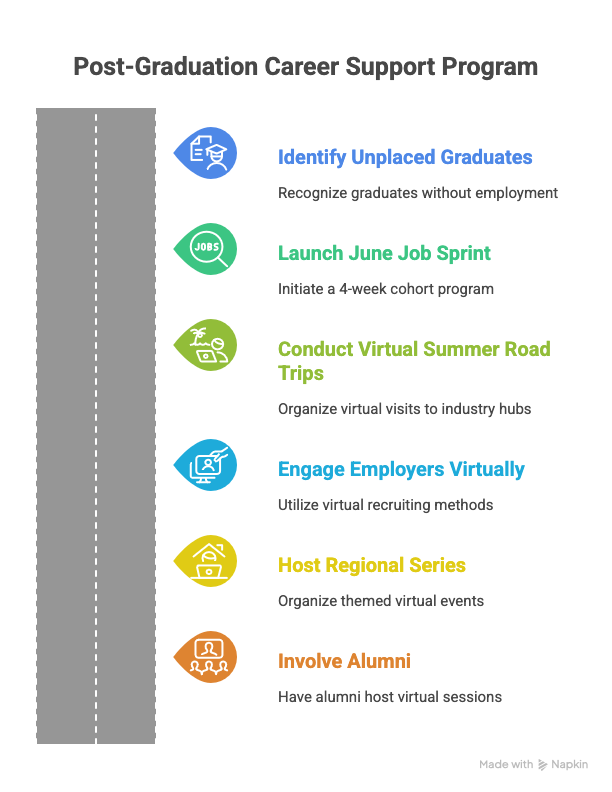
1. How do we program for the "Unplaced" Class of 2025 after commencement?
Launch a "June Job Sprint" specifically for recent graduates who have not secured employment. Instead of generic counseling, structure this as a 4-week cohort-based program. This creates accountability and community for anxious graduates, directly protecting your First Destination Survey (FDS) metrics before the six-month clock runs out.
According to the NACE First Destination Survey, while many graduates secure employment early, a significant portion of outcomes are finalized in the critical 3-6 month window post-graduation.
Graduates often lose access to campus support structures just when they need them most.
According to Strada Education Network, alumni who felt their institution was helpful in their career preparation are far more likely to believe their degree was worth the cost.
By extending active programming into June, you directly influence this perception.
Also Read: What are the top 5 career services benchmarks every center must track?
2. How can we offer employer site visits when campus is empty?
Organize "Virtual Summer Road Trips" (Industry Treks). Since students are geographically dispersed, physical bus tours are logistically difficult. Virtual treks allow you to program "visits" to hubs like NYC, SF, or Austin without travel costs, engaging students who are home for the summer.
Virtual recruiting has normalized remote engagement, and employers are often more willing to host a 1-hour virtual panel in July than a half-day physical tour in October.
According to NACE’s Recruiting Benchmarks, virtual engagement remains a staple for employers, with over 80% of employers utilizing virtual recruiting methods to supplement physical presence.
This efficiency makes them highly receptive to summer virtual visits.
Actionable Strategy:
- The Regional Series: Host "West Coast Wednesdays" or "Finance Fridays."
- The Alum Hook: Have an alumnus at the target company host the Zoom session on their phone, walking through the office (if allowed) or showing their "Day in the Life."
Also Read: How to boost student attendance at career fairs?
3. What programming works for students with zero summer plans?
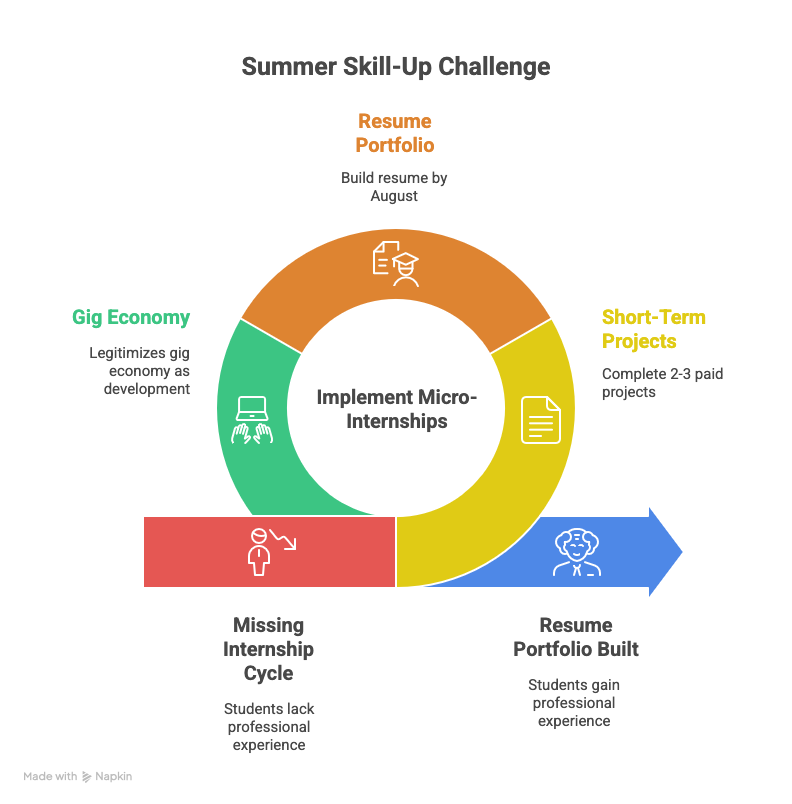
Implement a "Summer Skill-Up Challenge" utilizing Micro-Internships. Rather than shaming students for missing the traditional internship cycle, create a program where they complete 2-3 short-term, paid professional projects (Micro-Internships) facilitated by your center to build a resume portfolio by August.
The "internship or bust" mentality leaves many students behind, particularly first-generation students who may need to work non-professional jobs for income.
You need a program that legitimizes the "gig economy" as professional development.
Parker Dewey, the pioneer of Micro-Internships, reports that 98% of students who complete a micro-internship are retained by the employer if hired full-time, and 80% of these projects are completed by students from underrepresented populations.
Also Read: How can career centers prepare students for AI-driven interviews?
4. How do we program for incoming freshmen to stop "Summer Melt"?
Launch a "Pre-Arrival Career Community" in July. Move beyond the standard orientation table. Invite incoming freshmen to join major-specific virtual communities (e.g., "Future Engineers 2029") moderated by your student ambassadors. This connects career identity to their enrollment before classes start.
"Summer Melt" - where deposited students fail to matriculate, is a retention crisis.
By introducing career programming in the summer, you validate their investment in college.
According to the Harvard Center for Education Policy Research, summer melt rates can range from 10% to 40%, often due to a lack of connection or support during the transition.
Connecting a student's current excitement to their future career is a proven retention strategy.
For instance, Georgia State University utilized AI chatbots to answer summer questions, reducing melt by 21%.
Career centers can emulate this by having student ambassadors manage a "Summer Career Questions" text line or chat.
Also Read: How can career centers close the equity gap for FGLI students?
5. How can we use alumni for programming when they are busy?
Create "Summer Coffee Chat" Sprints. Alumni are often less swamped in July than during Q4/Q1. Facilitate a program where alumni commit to just one month of mentorship availability. Match students for informational interviews specifically during the summer downtime when the stakes are lower.
"Flash mentoring" or "sprints" respect the professional's time while giving students practice in networking.
Networking remains the primary driver of employment. According to LinkedIn, "applicants who are referred by a current employee are 9x more likely to get hired."
Facilitating these warm introductions during the summer removes the friction of cold outreach.
Actionable Strategy:
- The "Summer 50" Drive: Recruit 50 alumni who agree to take three 20-minute calls in July.
- The Script: Provide students with the exact email template and questions to ask. Do not send them in cold.
Also Read: How can career centers support international students through interviews?
Wrapping Up
Summer programming works best when students have support they can rely on, not just for a workshop or a single event, but throughout every step of their career journey.
That’s where the right support can make a real difference.
Hiration offers a full career-readiness suite that helps students plan their path, find real opportunities, build stronger application materials, and practice interviews with meaningful feedback.
Counselors also get a unified workspace to manage cohorts, track progress, and keep guidance consistent, even when students are away from campus.
For career centers working to strengthen outcomes in every season, including the summer months, Hiration make it easier to scale support, build confidence, and measure what matters most to your institution and your students.
Summer Career Programs — FAQ
Why run a June Job Sprint for unplaced graduates?
A structured 4-week cohort supports anxious grads in the 3–6 month post-grad window, strengthening FDS outcomes while maintaining alumni confidence in institutional support.
What makes virtual employer treks effective?
Students are dispersed and employers maintain strong virtual recruiting. One-hour Zoom panels or alum-led walkthroughs offer high-value access without travel logistics.
How do micro-internships support students with no summer plans?
Short paid projects build a portfolio by August and legitimize gig-style experience. These projects often convert to stronger employer relationships and future hiring.
How can career centers reduce summer melt?
Pre-arrival major-specific career communities in July create belonging early. Ambassador-moderated chats keep incoming students connected and increase matriculation odds.
How can alumni be engaged when they’re busy?
Run a short July “Coffee Chat Sprint.” Alumni commit to a few 20-minute calls, and students receive scripts and questions to ensure smooth, low-friction interactions.
Which metrics prove summer program impact?
Cohort participation, micro-internship completions, virtual trek attendance, melt reduction, and the ratio of alumni chats to interviews or offers.
How can programs stay equitable for FGLI students?
Provide paid micro-projects, virtual options, structured templates, and summer chat/text support so students with work or family obligations can still participate fully.
What formats work best in July and August?
Four-week sprints, weekly virtual treks, curated project lists, and moderated community chats. Predictable, bite-sized formats outperform one-off large events.