How can career services teams systematically identify and close student skill gaps in 2026?
Career services teams can close student skill gaps by shifting from degree-based advising to structured skill-gap audits, mapping academic experience to market-validated competencies, and embedding targeted upskilling pathways that align with employer expectations.
The traditional "degree-plus-GPA" model of career services is officially in the rearview mirror.
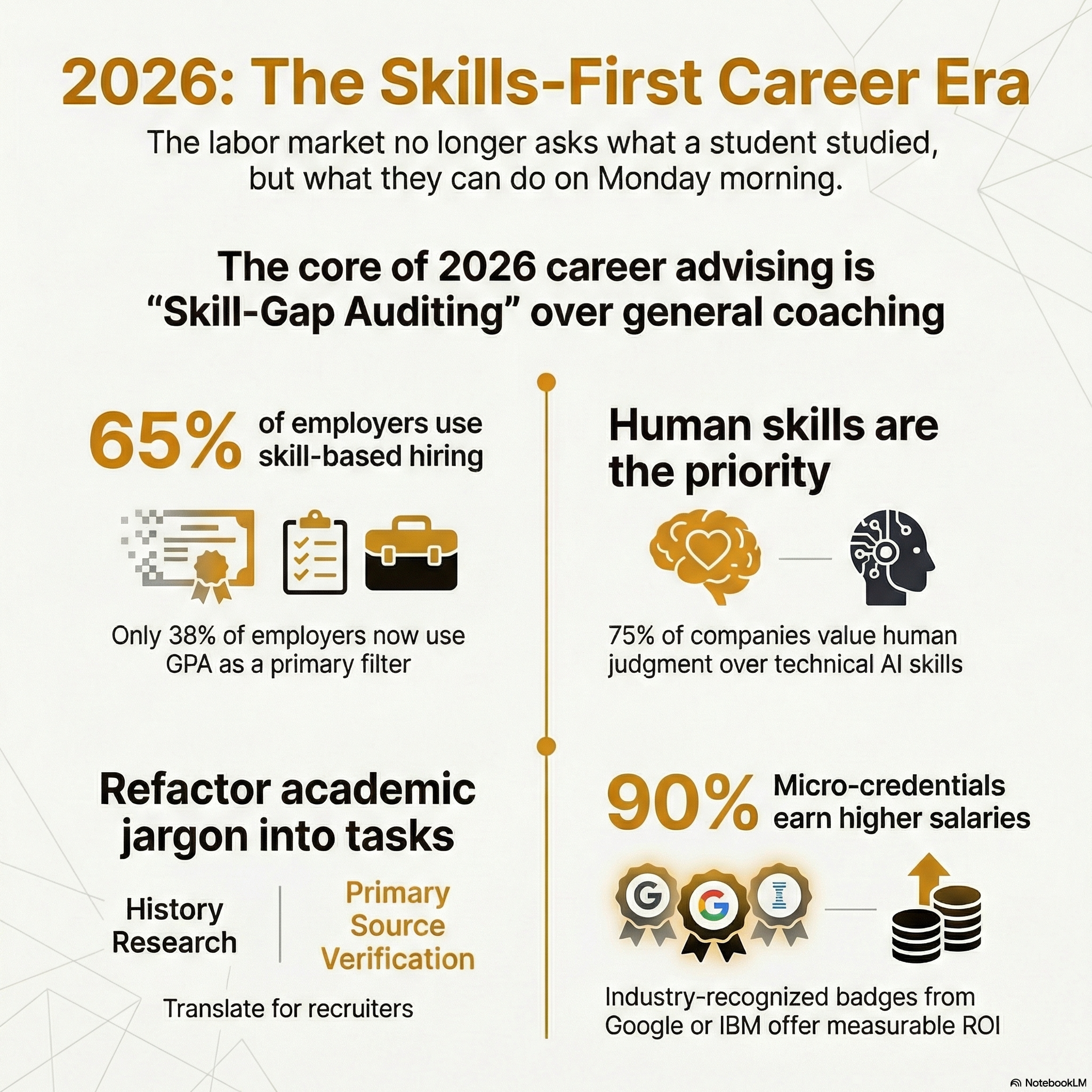
As we move through 2026, the labor market is no longer just asking what a student studied, it’s asking what they can do on Monday morning.
For Career Service Practitioners (CSPs), the challenge has shifted from general coaching to high-precision skill-gap auditing.
According to NACE’s Job Outlook 2025 Spring Update, only 38% of employers now use GPA as a primary filter, while 65% have pivoted to skill-based hiring practices.
Here is your actionable guide to identifying and closing those gaps.
How can advisors spot hidden skill gaps in resumes and student interviews?
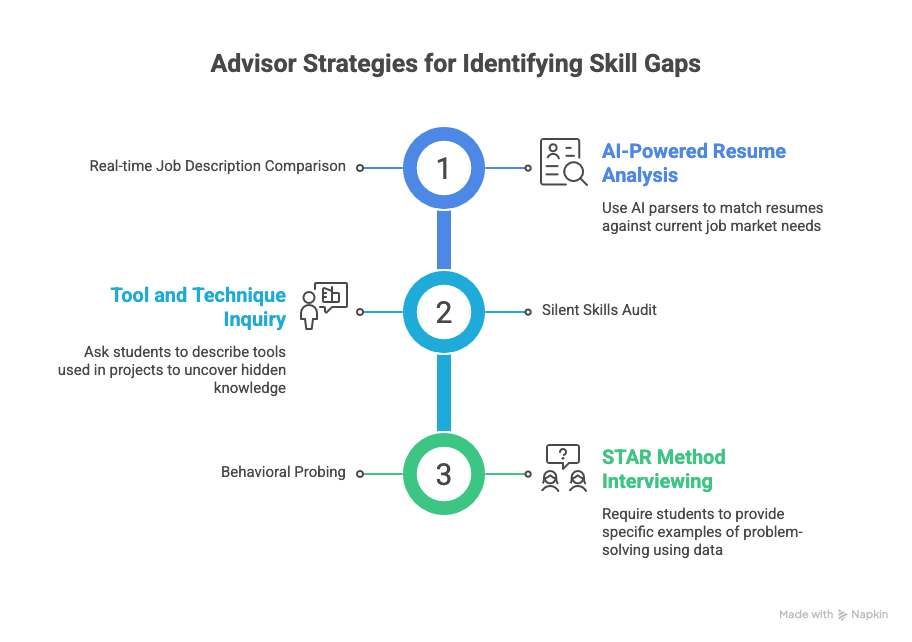
Advisors can identify skill gaps by moving beyond keyword matching to "contextual auditing." Use AI-powered parsers to compare resumes against real-time job descriptions, and employ behavioral interviewing techniques that require students to prove competency through the STAR method. This shift reveals whether a student possesses the skill or just the terminology.
- The "Silent Skills" Audit: When reviewing a resume, ask the student to describe the tools used in their projects. If a Marketing student lists "Content Creation" but can’t explain Campaign Automation or Audience Psychographics, you’ve found a gap.
- Behavioral Probing: According to Recruit CRM, 2026 recruiters are prioritizing "Human Problem-Solving." During appointments, don't ask if they can solve problems; ask for a specific instance where they used data to pivot a strategy.
Also Read: What are some good icebreakers for career coaching sessions?
Which industry-specific skills should CSPs prioritize in 2026?
In 2026, industry-specific skills are defined by "AI-plus" integration and "Human-Centric" resilience. Advisors must prioritize technical fluency in sectoral AI tools, like health data analytics or ESG reporting, while doubling down on "Human Skills" that AI cannot replicate, such as ethical judgment and complex empathy. According to LinkedIn’s 2026 Labor Market Report, 75% of companies globally agree that human skills are now more important than technical skills because they provide the necessary "human-in-the-loop" oversight for automated systems.
The following tables break down the non-negotiable skills for the current year based on reports from LinkedIn, Lightcast, Taggd, and other reputable sources.
Technology & Digital Infrastructure
| Skill Category | Priority Skills (2026) |
|---|---|
| Artificial Intelligence |
|
| Cybersecurity |
|
| Data & Cloud |
|
| Software Dev |
|
Healthcare & Life Sciences
| Skill Category | Priority Skills (2026) |
|---|---|
| HealthTech |
|
| Biotech |
|
| Patient Care |
|
Liberal Arts, Media & Public Service
| Skill Category | Priority Skills (2026) |
|---|---|
| Media & PR |
|
| Public Policy |
|
| Education |
|
| Social Services |
|
Finance & Professional Services
| Skill Category | Priority Skills (2026) |
|---|---|
| FinTech |
|
| Banking |
|
| Operations |
|
Sustainability & Energy
| Skill Category | Priority Skills (2026) |
|---|---|
| Green Tech |
|
| Environment |
|
Also Read: How to Give Resume Feedback in 5 Minutes?
What are the most effective techniques for mapping academic skills to modern job roles?
To bridge the syllabus-to-salary gap, advisors must move from "titling" roles to "deconstructing" tasks. The most effective techniques in 2026 involve stripping away academic jargon and replacing it with the specific behavioral indicators and market-validated taxonomies that recruiters use.
Actionable Techniques for Advisors
- Outcome Refactoring: Instead of listing "Course: History 101," guide students to list the project deliverable. A "History Research Paper" is refactored into "Archival Research & Primary Source Verification," which mirrors the technical requirements for a Compliance Officer or Research Analyst.
- Taxonomy Crosswalking: Use industry-standard frameworks like O*NET or Lightcast to find the "market synonyms" for academic achievements. For example, a student’s ability to manage a group project isn't just "teamwork"; it is "Cross-Functional Coordination" and "Conflict Mitigation."
- Sub-Competency Drill-Down: Use the Skills and Competencies Taxonomy (SCT) to break down broad labels into specific sub-skills. According to the Government of Canada (ESDC), a vague skill like "Communication" is only useful when mapped to specific components like "Interpreting non-verbal cues" or "Adapting styles for diverse audiences".
- The "Policy Analyst" Mapping Model: Follow the model used by the Canada School of Public Service (CSPS), which breaks down "Strategic Thinking" into granular, observable actions. This allows a Liberal Arts student to prove they possess "Technical" analytical depth.
This level of specificity is critical because, when you help a student "refactor" their degree, you aren't just editing a resume, you are providing the "market translation" that exponentially increases their hiring confidence.
Also Read: How to Build and Use a Standard Resume Critique Rubric?
How can you integrate micro-credentials into a student’s career path?
Integrate micro-credentials by identifying "credit-bearing" certificates that align with the student's primary major to bridge specific technical gaps. Advisors should prioritize industry-recognized badges (like Google, IBM, or Salesforce) because these offer a measurable ROI. Research shows that 90% of employers are willing to pay higher salaries to candidates who hold these specific, validated skills.
Micro-credentials are no longer "extra credit"; they are the new currency.
- Skill-Gap Mapping: Compare a student’s major requirements against high-growth job descriptions.
- Credit-Bearing Pathways: Map industry certificates to existing elective credits. Instead of "extra credit," allow a 30-hour certification to substitute for a 1-unit independent study or a technical elective.
- Timing & Placement: Introduce basic literacy badges (digital fluency) in freshman year and high-ROI technical badges (Cybersecurity, Data Science) during junior/senior year to maximize recruitment impact.
Leading universities are proactively bridging the skills gap by embedding high-stakes sectoral competencies directly into their student pathways. According to Georgia State University, their "College to Career" explorer uses real-time data to map diverse degree backgrounds to specific industry roles, while Allegheny College has successfully launched 28 stackable micro-credentials in AI Strategy and Digital Content specifically for Liberal Arts majors. Additionally, Arizona State University has integrated Green Tech and Sustainability certifications into its core business and engineering curricula to meet the 105% growth in renewable energy roles.
How can advisors build scalable, personalized upskilling plans for diverse student populations?
Build scalable plans by moving from generic advice to "Career Lattices" supported by real-time labor market data. Use a 4-year integration plan - similar to the University of Texas's Leadership Network, that embeds experiential learning and competency tracking into every semester. This ensures that even under-resourced students gain the "experience" required for entry-level roles without needing unpaid internships.
Scalability requires institutional alignment. According to NACE, while 83% of colleges are implementing competencies, only 31% do so institution-wide.
Advisors should push for "Career-Across-the-Curriculum," where faculty embed one market-ready skill into every syllabus.
- Implement "In-Reach" Experiential Learning: Instead of relying on external internships, convert on-campus student employment into skill-building labs. Map every campus job (from the mailroom to the gym) to NACE Competencies, requiring students to track and reflect on these skills as part of their employment.
- The 4-Year Competency Roadmap: Adopt a tiered integration model like the University of Texas’s University Leadership Network (ULN). In this model, students complete 10 hours of experiential learning per week, with Year 2 focusing on Communication and Year 4 focusing on Professionalism and Leadership.
- Automated SMART Goal Setting: Use digital career platforms to help students set "Specific, Measurable, Achievable, Relevant, and Time-bound" goals. According to MBA.com, this structure is vital for accountability; for example, "Earn a Google Data Analytics Certificate by March" is 40% more likely to be completed than "Learn Data".
Also Read: How can career centers close the equity gap for FGLI students?
Wrapping Up
Students do not fail because they lack potential. They fail because their skills are not expressed in the language employers can verify quickly - on a resume, in a behavioral story, and in the first 10 minutes of an interview.
The advantage now goes to career centers that can run repeatable skill-gap audits, turn findings into an upskilling plan, and track progress at scale without turning advising into an assembly line.
To operationalize this type of approach, Hiration supports career teams with a full-stack career readiness suite.
In addition to career assessments, AI-powered resume optimization, and interview simulation, the platform can analyze student profiles against real job descriptions to surface concrete skill gaps tied to specific roles.
Counselors can manage cohorts, workflows, and outcomes through a dedicated module, all within a secure, FERPA- and SOC 2-aligned environment.
Closing Student Skill Gaps — FAQs
What is a skill-gap audit in career advising?
A skill-gap audit evaluates whether students can demonstrate job-relevant competencies in context, rather than simply listing keywords or coursework.
Why is GPA no longer a reliable indicator of readiness?
Employers increasingly prioritize demonstrable skills and applied experience over academic metrics, reducing the weight of GPA in hiring decisions.
How can advisors translate academic work into employer language?
Advisors can refactor academic outputs into outcome-based skills using industry taxonomies and competency frameworks recruiters recognize.
Are micro-credentials necessary for all students?
Micro-credentials are most effective when used to close specific technical gaps aligned with a student’s target role or industry.
How can career centers scale personalized upskilling?
Scaling requires structured competency roadmaps, embedded experiential learning, and systems that track skill development across cohorts.
Does focusing on skills reduce holistic advising?
No. Skills-based advising enhances clarity and confidence while preserving individualized coaching and career exploration.