What do recruiters really want in 2026, and how should career centers coach students differently?
Recruiters now prioritize scannable resumes, skills-based LinkedIn visibility, quantified interview answers, and proof of real-world impact over GPA or generic applications. Career centers can improve outcomes by coaching students around recruiter behavior, using data-backed advising, and building repeatable systems that turn career readiness into measurable evidence.
As a Career Service Practitioner (CSP), you’re the bridge between academic theory and the ruthless 2026 hiring reality.
While students often fixate on their GPA or finding the "perfect" template, recruiters are scanning for something else entirely: proof of impact and behavioral readiness.
The 2026 hiring landscape is leaning harder into "skills-first" hiring, and if we don’t pivot our advising to match this data-backed reality, our students will keep sending resumes into the "black hole."
Here is what the latest research tells us about what actually moves the needle for a 2026 recruiter.
How should I advise students on resume formatting in 2026?
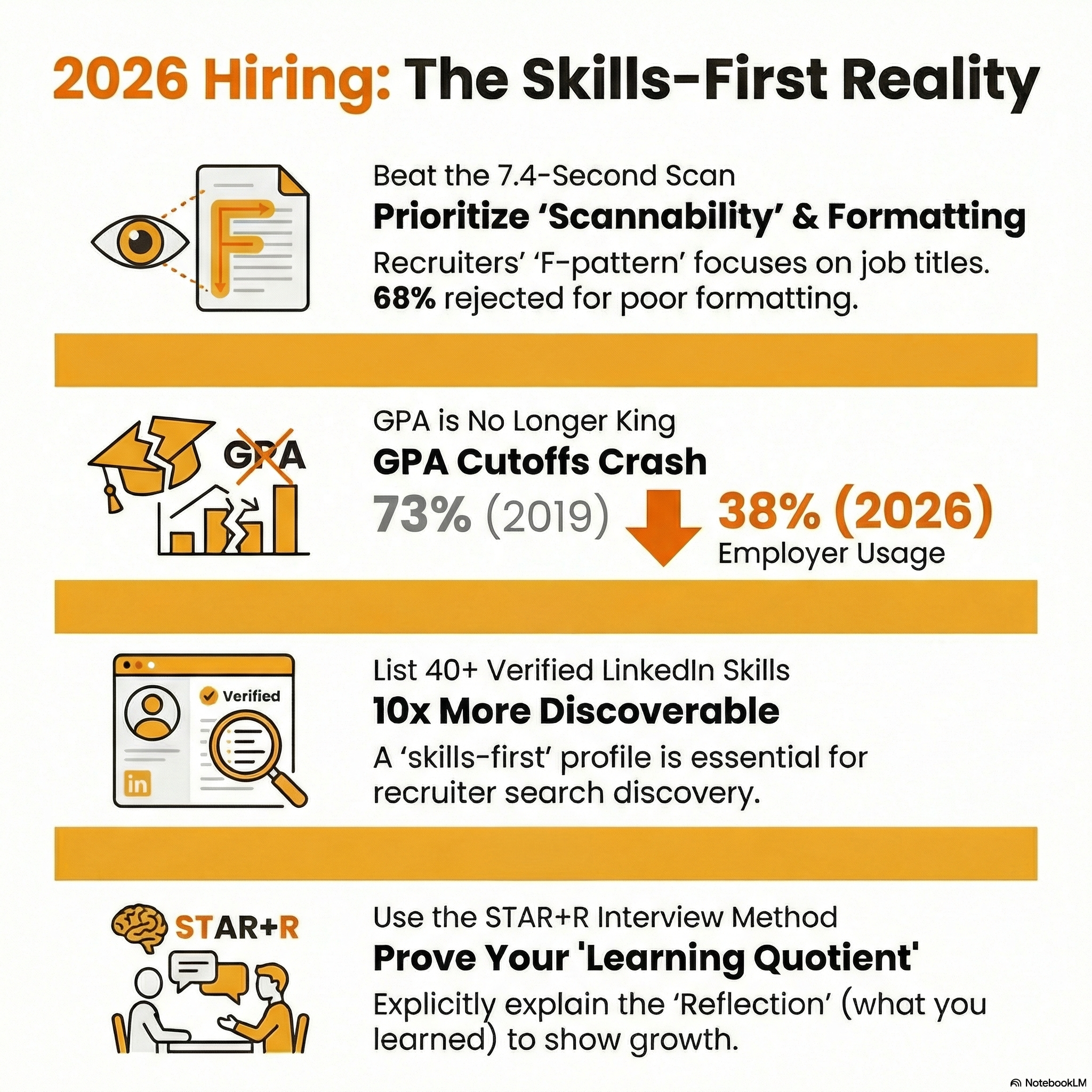
Recruiters prioritize "scannability" over aesthetics, spending just 7.4 seconds on an initial review. Advisors must steer students toward a single-column, reverse-chronological layout that highlights impact via the X-Y-Z formula. This ensures that the most relevant keywords and measurable results hit the recruiter’s "F-pattern" eye path immediately.
According to The Ladders’ Eye-Tracking Study, recruiters focus almost exclusively on job titles and company names on the left-hand side of the page.
If a student uses a "creative" double-column layout, they risk their best content being ignored during the initial 7.4-second scan.
To win, students need to adopt the Google X-Y-Z Formula: "Accomplished [X] as measured by [Y], by doing [Z]".
Furthermore, Jobvite’s 2024 Recruiter Nation Report notes that 83% of recruiters prioritize tailored resumes, yet 68% of hiring managers will reject a candidate for poor formatting alone.
For your students, this means "one-size-fits-all" is a death sentence.
Also Read: Resume Triage Framework for Career Services: Advisor Checklist
What do recruiters check first on a student’s LinkedIn profile?
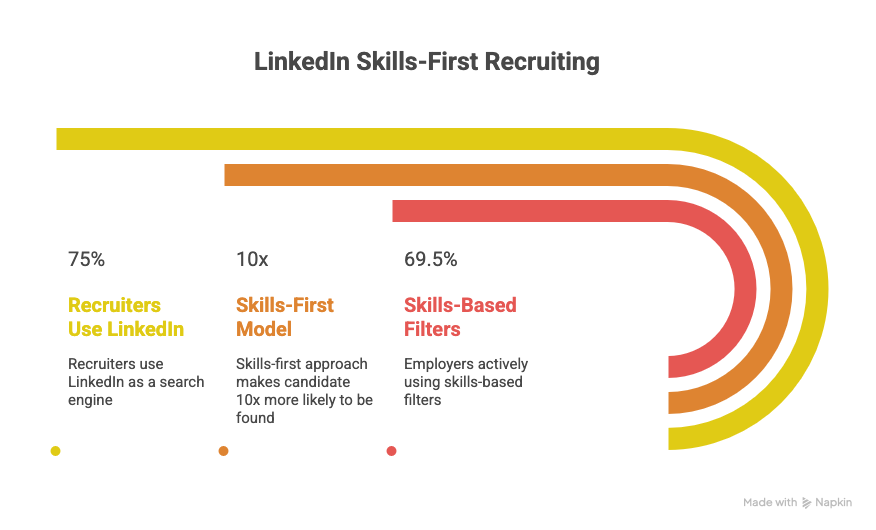
Recruiters use LinkedIn as a search engine, prioritizing the "Skills" section and mutual connections to filter candidates before even clicking "See more" on a summary. Since 75% of recruiters now use a "skills-first" model, a profile without at least 40+ verified skills is essentially invisible to their search algorithms.
According to LinkedIn’s Future of Recruiting 2025 Report, a "skills-first" approach makes a candidate 10x more likely to be found by recruiters.
When coaching, emphasize that recruiters don't "read" profiles, they filter them.
NACE’s Job Outlook 2026 reveals that 69.5% of employers are actively using these skills-based filters to find "durable skills" like adaptability.
If a student’s LinkedIn doesn't align with the specific technical stack or soft skills listed in the job description, they won't even appear in the search results of LinkedIn Recruiters.
Also Read: How Can Career Advisors Make Students More Visible on LinkedIn?
Which interview behaviors act as immediate disqualifiers?
While technical skill gets the interview, "soft" dealbreakers like a lack of eye contact or failing to provide a "Reflection" in their answers end the process. Recruiters are now looking for the "STAR+R" method, where students explicitly explain what they learned from a situation, proving a high "Learning Quotient" (LQ).
According to a RecruitBPM, 67% of interviewers will reject a candidate for failing to make eye contact, and 47% of interview failures are linked to insufficient company research.
Beyond etiquette, the structure of the answer is king.
NACE’s Job Outlook 2026 data shows that 87% of employers apply skills-based assessments during the interview.
If a student can’t quantify their impact (e.g., "Increased social engagement by 20%"), they are viewed as "unprepared" by 66% of managers, according to Deloitte.
Also Read: How should career advisors evaluate mock interviews in 2026?
What is the biggest misconception students have about the 2026 job market?
The most dangerous myth is that a high GPA is a student’s primary "selling point." In reality, the "GPA Cutoff" is dead; only 38% of employers still use it. Recruiters now prioritize "experiential proof" (internships, co-ops, and projects) over academic statistics, viewing degrees as a baseline rather than a differentiator.
The data is startling: NACE’s Job Outlook 2026 shows GPA cutoff usage has crashed from 73% in 2019 to just 38.1% today.
Students often spend hours obsessing over a 3.8 vs. a 3.9 when they should be obsessing over a portfolio.
Plus, many students still believe their major dictates their career path. In practice, most employers are far more flexible.
Around 60.9% report that they hire across majors as long as the candidate demonstrates the required skills.
There is also a growing belief that AI-generated resumes make the job search faster and easier. Recruiters are seeing the opposite effect.
According to NACE, over half say that mass AI applications make the process harder to evaluate, not easier, because they blur genuine candidate signals.
Finally, many students assume that applying to more roles automatically improves their chances. In reality, outcomes are driven by precision, not volume.
Targeted applications, especially those supported by referrals, are 4x more likely to convert into interviews and offers than large volumes of generic submissions.
Also Read: NACE Competencies Guide: How to Measure and Prove Student Readiness
How can I communicate these insights to students effectively?
To break through student "advice fatigue," CSPs should use "anomalous data" - stats that directly contradict their existing beliefs, to force a mindset shift. By showing students the "7-second scan" heatmaps or the "GPA crash" stats, you move from being a "nagging advisor" to a "strategic intelligence officer."
According to the American Psychological Association (APA), the most effective way to correct a misconception is to present credible, "perceptually obvious" data that challenges the student’s worldview.
Actionable CSP Tactics:
- The "Recruiter View" Demo: Show students the back-end of LinkedIn Recruiter. When they see how profiles are filtered by "Skills" and "Location," they stop treating LinkedIn like a social network and start treating it like a database.
- Reverse Mock Interviews: Have the student "hire" you. Intentionally make the mistakes like lack of eye contact, vague answers, and let them experience how quickly a recruiter loses interest.
Also Read: How can career centers identify and close career readiness gaps in students at scale?
Wrapping Up
The gap between what students believe and what recruiters actually reward is structural.
If career services continue to coach for an outdated hiring model, students will keep optimizing the wrong signals and missing opportunities that were within reach.
The shift to a skills-first, evidence-driven hiring market requires a parallel shift in how career centers operate: from advising in theory to building proof, from templates to targeted narratives, from one-time feedback to repeatable systems that compound over time.
That is where the right infrastructure starts to matter.
Hiration operationalizes this model through a full-stack career readiness suite that spans the entire journey - from career assessments to AI-powered resume optimization, interview simulation, and LinkedIn preparation, paired with a dedicated counselor module to manage cohorts, workflows, and outcomes, all within a secure, FERPA- and SOC 2-compliant environment.
This makes it possible to turn advising into a continuous, measurable process rather than a series of one-off interventions.
What Recruiters Really Want in 2026 — FAQs
How should career advisors coach students on resume formatting in 2026?
Advisors should prioritize scannability over design by recommending single-column, reverse-chronological resumes with measurable impact statements, so recruiters can quickly identify titles, results, and relevant keywords in the first scan.
Why do recruiters reject “good” resumes so quickly?
Recruiters often reject resumes when formatting is hard to scan, the content is not tailored to the role, or achievements are vague. A resume can look polished but still fail if it does not show clear impact and job-specific relevance.
What do recruiters check first on a student’s LinkedIn profile?
Recruiters usually filter by skills, keywords, and location before reading the full profile, which means students need strong skills alignment, complete sections, and job-relevant language to show up in recruiter searches.
Which interview behaviors act as immediate disqualifiers?
Common disqualifiers include weak eye contact, vague or unstructured answers, poor company research, and failure to explain measurable outcomes or lessons learned from past experiences.
What is the biggest misconception students have about the 2026 job market?
Many students still believe GPA or application volume is the main driver of success, but recruiters increasingly reward demonstrated skills, relevant projects, targeted applications, and evidence of real-world readiness.
How should career centers explain “skills-first hiring” to students?
Career centers should show students that employers now search and assess for skills, behaviors, and impact evidence first, so resumes, LinkedIn profiles, and interview answers must all reflect the same skill-based narrative.
What is the best way to break through student advice fatigue?
Use data points that challenge student assumptions, such as recruiter scan time or declining GPA cutoffs, and pair those stats with practical demonstrations so students can see how recruiters actually evaluate candidates.
How can career centers turn recruiter insights into repeatable student outcomes?
Career centers can build repeatable outcomes by standardizing advising around recruiter behavior, using structured resume and interview frameworks, and tracking progress across resumes, LinkedIn, and mock interviews over time.