If your career center supports students across a main campus, satellite locations, and regional campuses, providing the same list of services everywhere is rarely the most practical model.
Some support needs to be available where students study. Other services can be shared across the institution, while many can be delivered virtually without requiring students to travel to the main campus.
The challenge is deciding which services belong in each layer and making sure students can move between them without having to figure out the university's internal structure themselves.
This guide explains how career centers can decide what should exist locally, what should be centralized, what can be virtual, and how students and employers should move between those layers.
What should comparable career support mean across multiple campuses?
Comparable career support means students can reach the services they need regardless of where they study. It does not mean every campus needs an identical career center.
A smaller regional campus may not need its own industry specialists, employer-relations team, interview program, and full calendar of career events.
It does need a clear way for students to access those services when they need them. The service-design question is therefore not:
How do we recreate the main-campus career center at every location?
It is:
What needs to be close to the student, what can be shared across campuses, and what can students access virtually?
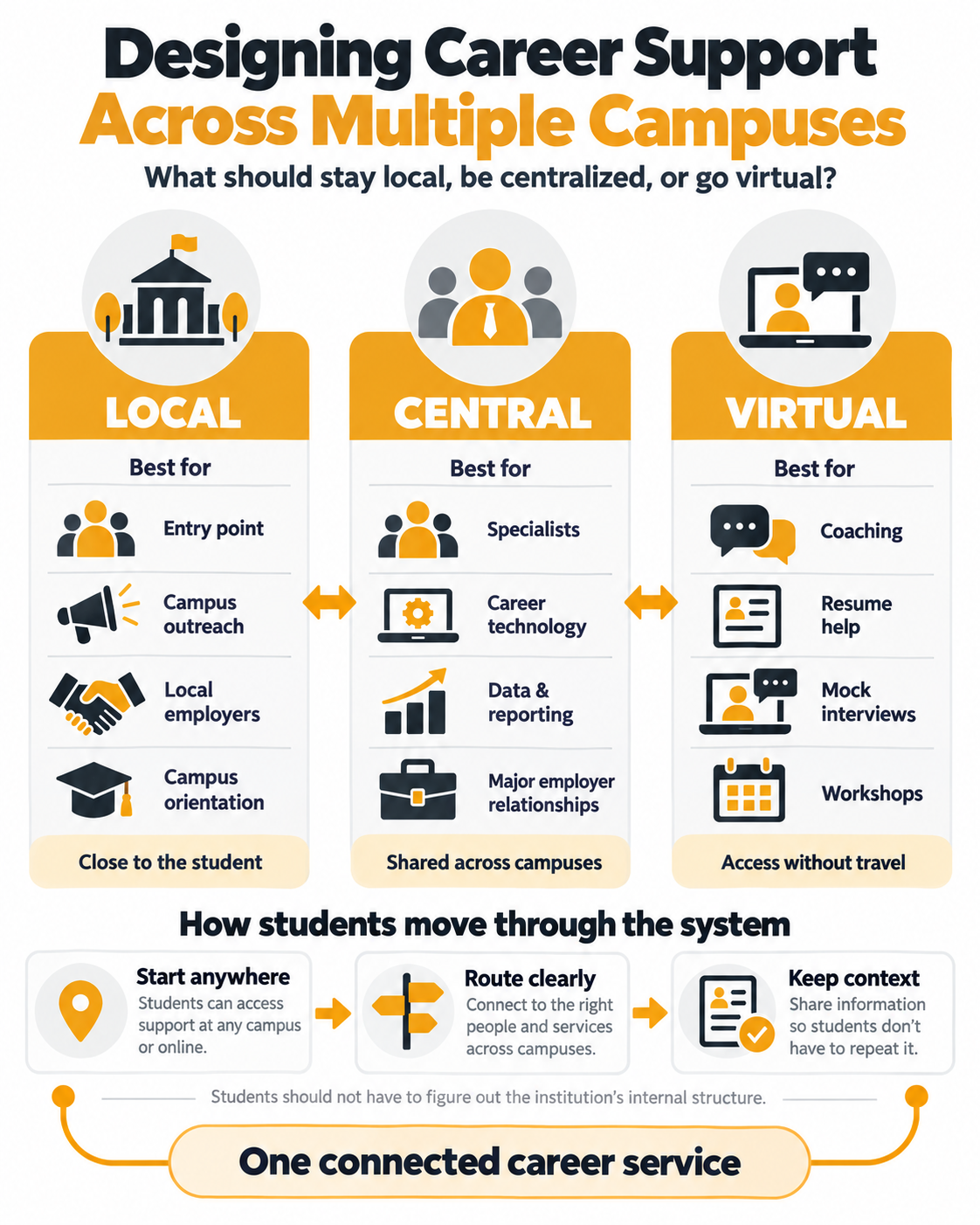
A useful starting point is to map services across three layers.
| Skill Area | Employer-Facing Translation | Possible Evidence |
|---|---|---|
| Research and analysis | Gather, evaluate, and interpret information from different sources | Research project, policy brief, market analysis |
| Communication | Explain complex ideas clearly to different audiences | Presentation, writing sample, campaign, report |
| Data and technology | Use tools or data to investigate problems and support decisions | Dashboard, analysis, prototype, technical project |
| Synthesis | Connect information from different disciplines to form a recommendation or solution | Capstone, case study, consulting project |
| Collaboration | Work with people who bring different expertise or perspectives | Team project, internship, employer-sponsored project |
| Problem-solving | Apply knowledge from more than one field to a practical challenge | Portfolio project, research project, applied coursework |
The exact split will vary by institution, but the objective remains the same: students should not lose access to meaningful career support simply because their program is based away from the main campus.
Institutions already use different versions of this model. Arizona State University, for example, lists Career Services locations at its Downtown Phoenix, Polytechnic, Tempe, and West campuses rather than directing every student to a single physical office.
Penn State combines individual Commonwealth Campus career offices with broader university resources and regional employer-engagement roles.
These examples do not establish one model every institution should follow. They show why multi-campus career support can be designed as a combination of local and shared services rather than as one central office serving every location.
Which career services need to exist locally?
Keep a service local when it depends heavily on campus context, physical presence, local relationships, or knowing the student population at that location.
Every satellite campus does not need every career-services specialty represented in person. It does, however, need enough local presence that career support does not feel like a service located somewhere else.
A recognizable career-services entry point
Students should know where career questions start on their campus.
That might be:
- a dedicated career-services professional
- a career coordinator with several responsibilities
- an embedded staff member
- a designated student-success professional connected to the central career team
The important part is not the job title. It is that students have a clear local entry point rather than being told to search the main-campus website and work out who to contact.
Campus-specific student outreach
Students at different locations may have different academic calendars, commuting patterns, programs, employer interests, and times when they are physically on campus.
Career communications should therefore have a local layer.
A regional campus should be able to decide when students need reminders, which programs should be promoted heavily, which employers are relevant, and where career programming fits into its own campus activity.
Relationships with the surrounding employer community
Employer relationships are one area where geography can matter substantially.
A regional campus may sit near employers that rarely recruit from the main campus but offer relevant internships, part-time work, apprenticeships, experiential learning, or graduate opportunities to students nearby.
The local career presence should be able to identify and develop those connections rather than relying entirely on institution-wide employer outreach.
Navigation and initial triage
Students should also be able to get basic questions answered locally:
- Which career service do I need?
- Where should I start?
- Who handles this industry?
- How do I get resume feedback?
- Which recruiting events apply to me?
- Can I meet with a specialist from another campus?
The local layer does not need to solve every problem. It needs to prevent the student from becoming the routing mechanism.
Which career services should be centralized across the institution?
Centralize services when expertise, infrastructure, data, or scale creates more value than duplicating the same capability at every campus.
A multi-campus institution can give students broader access by sharing expensive or specialized capabilities instead of restricting them to whichever staff happen to work at their location.
Specialist career expertise
An institution may have advisors with deeper knowledge of:
- consulting
- technology
- healthcare
- government
- graduate school
- international careers
- entrepreneurship
- particular recruiting processes
Those specialists do not necessarily need to be duplicated at every campus.
They can serve students institution-wide if regional students have a clear path to reach them.
Institution-wide career technology
Career platforms, resume tools, interview preparation, career exploration resources, job platforms, appointment systems, and shared resource libraries generally work better as institution-wide infrastructure.
Students should not receive a substantially different technology stack simply because they attend a different campus.
The central career team can manage the infrastructure while local teams determine how and when students use it.
Major employer relationships
Large employers may recruit from the institution as a whole rather than from individual campuses.
A central team can coordinate those relationships, manage recruiting activity, maintain employer records, and prevent different campuses from independently contacting the same organization without knowing what other conversations are already happening.
Local teams can then add campus-specific context where useful.
Data, reporting, and shared standards
Multi-campus delivery becomes difficult to evaluate if every location records activity differently.
Core definitions such as appointments, workshops, employer interactions, referrals, student engagement, and service usage should therefore be shared.
That allows the institution to compare access without forcing every campus to deliver services in exactly the same way.
Ohio State provides an example of coordination across a decentralized environment. Its University Career Services Committee includes professionals from Columbus and regional campuses and is designed to facilitate collaboration and coordination among career-services professionals across the university.
The relevant lesson is not that every institution needs the same committee. It is that distributed delivery still requires a shared layer connecting the separate parts of the system.
Which career services can be delivered virtually?
Use virtual delivery when students need access to expertise or preparation, but the service does not depend on the advisor and student being in the same physical location.
Virtual access is particularly useful in a multi-campus institution because it changes the question from:
Which advisor is located on this campus?
to:
Which advisor or resource is best suited to this student's need?
Services that can often work across campuses virtually include:
- career coaching appointments
- resume and cover-letter reviews
- mock interviews
- LinkedIn support
- career exploration
- industry-specific advising
- job-search support
- employer information sessions
- alumni panels
- workshops
- follow-up appointments after an in-person meeting
The University of Cincinnati, for example, directs students at UC Clermont and UC Blue Ash to their respective college career centers, while other university resources support students through the broader career-services environment.
Cincinnati also provides one-on-one virtual career coaching and virtual career events for distance learners through its Career Studio.
Virtual access should therefore complement the local layer rather than replace it.
A regional student might begin with a local career contact, meet virtually with a specialist based elsewhere, use institution-wide preparation tools between appointments, and return to the local team when a campus-specific or local-employer question arises.
That is one connected service rather than four separate offerings.
How should students move between local, central, and virtual career support?
Students should enter through whichever layer is easiest for them, then be routed to the right support without having to restart the process. The institution's structure should remain largely invisible to the student.
A student should not need to know which office owns a service before asking for it. A simple model can work like this:
| Student need | Starting point | Next step | Service layer |
|---|---|---|---|
| Unsure where to start | Local career contact | Initial guidance | Local |
| Basic resume questions | Local contact or online resource | Self-service support | Local/virtual |
| Complex resume for a specific industry | Local contact | Specialist referral | Central/virtual |
| Interview preparation | Career platform or advisor | Practice + specialist support | Virtual/shared |
| Local internship search | Local career contact | Relevant local employers | Local |
| National employer recruiting | Any career contact | Central recruiting team | Central |
| Industry-specific career questions | Any entry point | Specialist advisor | Central/virtual |
| Major career fair | Local promotion | Institution-wide event | Central |
| Follow-up after referral | Same student record | Local or specialist advisor | Shared |
Three details are particularly important.
Students should not have to repeat their situation
If a student speaks to someone at a regional campus and is referred to a central specialist, the relevant context should move with the referral.
Otherwise, the student experiences the institution as separate offices rather than one career service.
Referrals should have a clear destination
"Contact the main career center" is not a referral.
The student should know:
- who or what they are being referred to
- why
- how to access it
- what happens next
The local team should not disappear after every referral
A student may need specialist support temporarily while still relying on their local campus for other career needs.
Referral should connect layers, not permanently transfer ownership of the student from one campus to another.
How should career centers decide where programs and events should live?
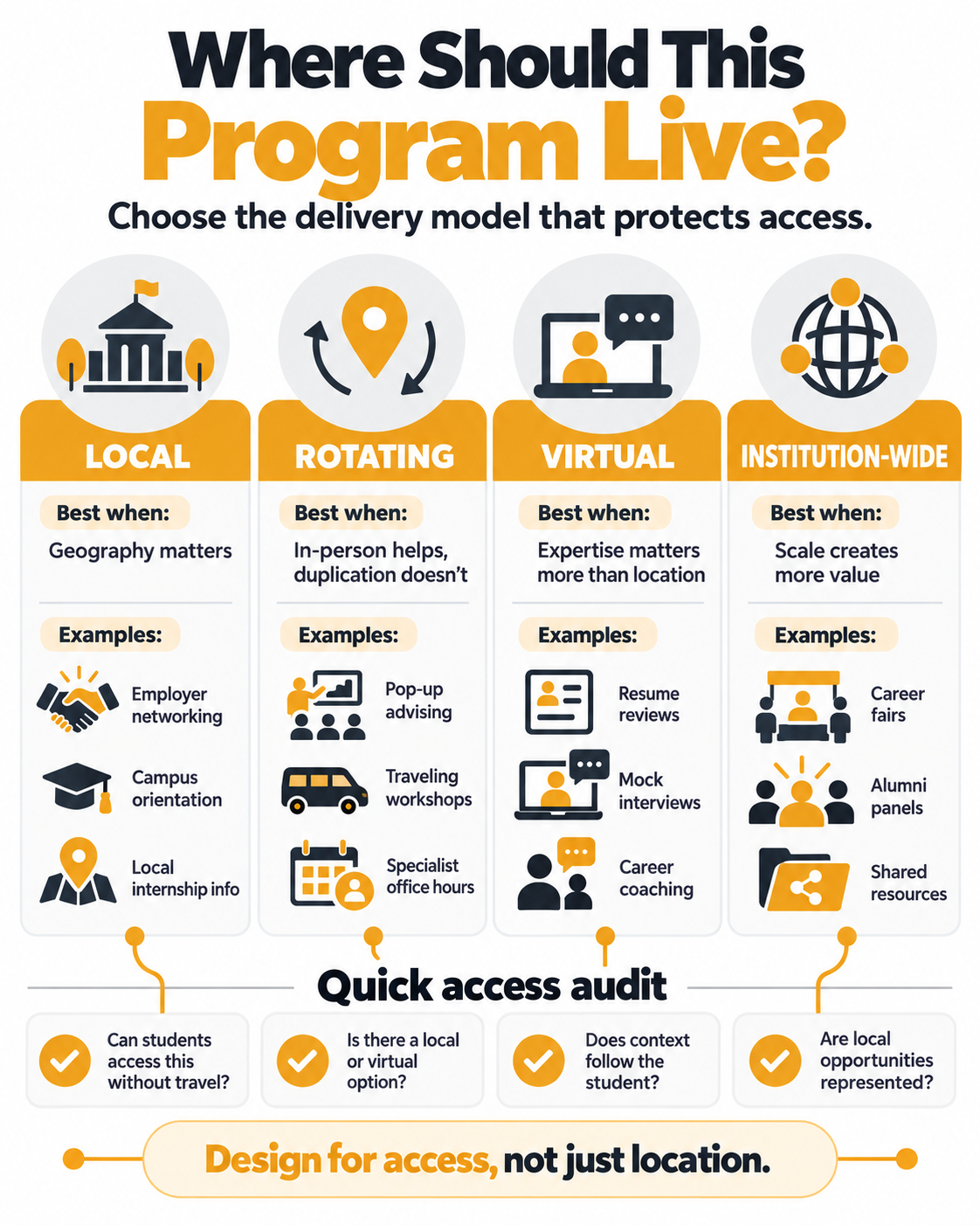
Choose the delivery location based on what the program requires, not on where the central career office happens to be located. Some programs gain value from being local. Others become more useful when students from every campus can participate together.
Career teams can use four default categories.
| Type of program | Best default | Why |
|---|---|---|
| Local employer networking | Local | Employer geography matters |
| Regional hiring event | Local | Connects students with nearby opportunities |
| Basic resume workshop | Virtual/shared | Content can be delivered consistently |
| Industry specialist session | Virtual/shared | Expertise matters more than location |
| Major career fair | Institution-wide | Scale benefits employers and students |
| Local internship information session | Local | Opportunities may be campus-specific |
| Alumni panel | Virtual/institution-wide | Broadens participation |
| Drop-in career questions | Local + virtual | Gives students multiple entry points |
| Mock interviews | Virtual/shared | Easier to scale expertise |
| Campus-specific career orientation | Local | Should reflect the local student experience |
A useful test is to ask:
Would moving this program to the main campus make it materially harder for students at another campus to participate?
If the answer is yes, the program needs either a local version, a rotating model, or a viable virtual option.
A second test is:
Would repeating this program separately at every campus add meaningful local value?
If the answer is no, it may be better delivered once and made accessible institution-wide.
How should employer relationships move between local and central teams?
Local teams should be able to develop geographically relevant employer relationships while central teams coordinate institution-wide relationships and prevent duplication.
The objective is not to divide employers rigidly between campuses.
It is to make sure the institution can benefit from both local knowledge and central coordination.
A practical split might look like this:
Local campuses can lead on:
- employers concentrated around that campus
- local small and midsize businesses
- regional healthcare systems
- school districts
- municipal and state agencies
- local nonprofits
- employers connected to campus-specific academic programs
- regional internship and experiential-learning opportunities
Central employer relations can lead on:
- national employers
- employers recruiting across several campuses
- institution-wide partnerships
- major recruiting events
- shared employer records
- broader employer communications
Both layers need shared visibility
Suppose a regional campus develops a strong relationship with a local employer that later wants to recruit students across the university.
That relationship should be able to move into the institution-wide layer without the regional team losing visibility into it.
The reverse should also work.
If a national employer tells the central team that it wants candidates near one specific location, the relevant regional campus should be brought into the relationship.
Penn State's employer-engagement structure provides a useful real-world example of this type of geographic coordination. Its Commonwealth Campus employer-engagement operation includes Eastern and Western Region Employer Engagement Specialists alongside individual campus career offices.
The service-design principle is simple: employers should not have to understand the university's internal campus structure any more than students should.
How can career centers stop the main campus from becoming the default for every service?
Audit where students are being asked to travel, who receives opportunities first, and whether regional-campus students have a realistic alternative when a service is centered on the main campus.
Centralization can happen unintentionally.
A university may technically serve every campus while still designing most career activity around the main one.
Warning signs include:
- most in-person career events happen at the main campus
- regional students are regularly referred there for routine services
- specialist appointments are difficult to access remotely
- the main career website gives little campus-specific guidance
- career emails focus heavily on main-campus events
- employers primarily interact with the main campus
- local staff cannot see central career activity
- central staff cannot see what students have already done locally
- regional campuses receive programs only when someone from the main campus is available to travel
- regional students have career technology but little guidance on when to use it
Career teams can review each major service using a simple access audit.
| Question | What to check |
|---|---|
| Can the student access this without travelling to the main campus? | Local or virtual alternative |
| Does the student know where to start? | Clear campus-specific entry point |
| Can a local staff member connect the student directly? | Referral path |
| Does previous context follow the student? | Shared records |
| Can regional students participate in institution-wide programs? | Scheduling and virtual access |
| Are local opportunities represented? | Regional employer coverage |
| Can employers reach the appropriate campus easily? | Employer routing |
| Can leadership compare usage across campuses? | Campus-level reporting |
This moves the conversation away from whether a service technically exists and toward whether students at each campus can realistically use it.
Wrapping Up
Supporting students across multiple campuses does not require recreating the same career center at every location.
The stronger model is to decide what students need locally, what can be shared centrally, and what can be delivered virtually, then make it easy for students and employers to move between those layers without having to understand the institution’s internal structure.
For career centers, that means creating clear local entry points, shared specialist support, coordinated employer relationships, and consistent access to career resources across campuses.
Hiration can support this model by giving students institution-wide access to resume, interview, LinkedIn, cover letter, and career-preparation tools while giving career teams visibility into student activity and progress through the Counselor Module.
Book a walkthrough to see how Hiration can support career services across multiple campuses.