How do you write a motivation letter that actually influences hiring decisions?
A strong motivation letter explains intent, values, and long-term alignment rather than repeating experience already listed on a resume. When structured around mission fit, personal drivers, and future contribution, it becomes a differentiator for internships, academic programs, non-profits, and purpose-driven roles where “why” matters as much as “what.”
Most applicants treat the motivation letter as an afterthought - or worse, recycle a generic cover letter and change the heading. That’s a costly mistake.
In roles where values, intent, and long-term alignment matter, the motivation letter often carries more weight than the resume itself.
It’s the one place where recruiters evaluate why you want the opportunity, not just whether you can do the work. And when written correctly, it becomes a differentiator - not filler.
This guide breaks down what a motivation letter actually is, how it differs from a cover letter, and how to structure one that sounds human, intentional, and mission-aligned.
What is a motivation letter and do I really need one?
A motivation letter is a personalized document that explains your "why" - why you want the role and why you are the best fit. Unlike a resume that lists facts, this letter tells your professional story.
A motivation letter leans more into your aspirations, values, and passion for the organization’s mission. It is particularly critical for internship applications, career changers, or roles where "cultural fit" is a top priority.
As you tailor your resume to a specific job, use your motivation letter as the bridge that aligns your professional drive with the organization's immediate pain points.
What is the difference between a motivation letter and a cover letter?
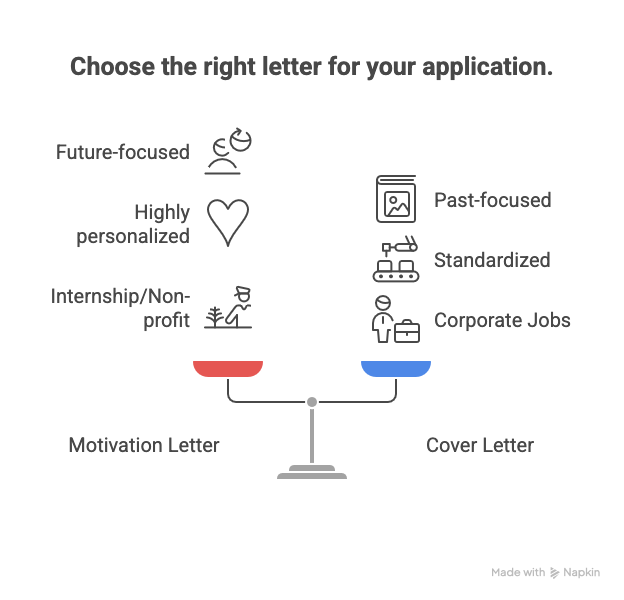
A motivation letter focuses on your future goals, passion, and reasons for wanting a specific role, while a cover letter typically highlights how your past experience matches the job description. Motivation letters are more personal and are frequently required for internships, academic programs, or non-profit roles.
While a cover letter is written for standard corporate job applications to link your skills to job requirements, a motivation letter is written when you're applying for internships, non-profit roles, or academic programs where your personal drive and alignment with organizational values are the primary factors for selection.
Understanding the CV vs resume difference is helpful here, as a motivation letter often accompanies a CV in more academic or international settings where long-form detail is preferred.
How do I structure my motivation letter for maximum impact?
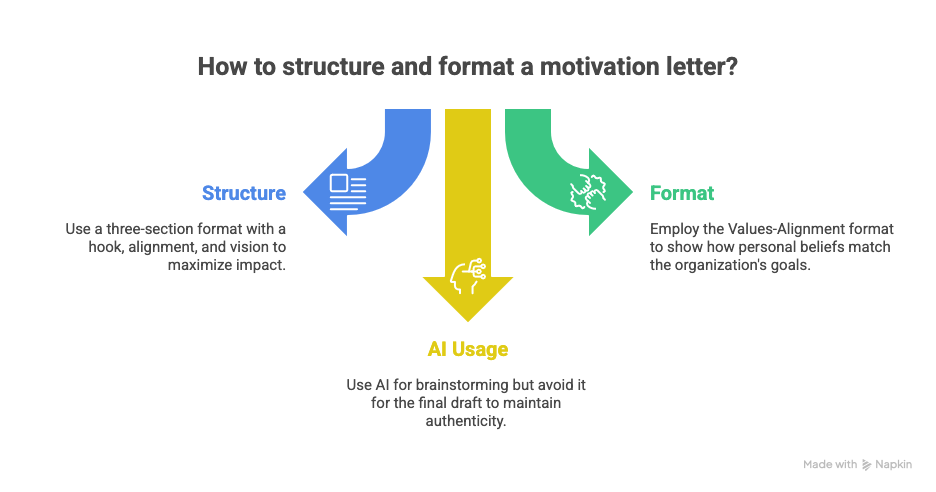
Structure your motivation letter into three main sections: a personal introduction, a values-aligned body, and a goal-oriented conclusion. Keep the document to one page (300-400 words) to respect the reader’s time.
According to research by Tilburg University, successful letters are concise, using only 3 to 4 paragraphs to deliver a high-impact narrative.
Follow this proven outline:
- The Hook (Intro): Introduce yourself and clearly state your excitement for the specific mission.
- The Alignment (Body): Connect your personal values to the organization's goals. Instead of just listing tasks, explain why their work matters to you.
- The Vision (Conclusion): Explain how this opportunity fits into your career trajectory and what you plan to contribute.
What is the best format to use for a motivation letter?
The "Values-Alignment" format is the most effective approach for motivation letters. This involves researching the organization’s core principles and explicitly stating how your personal beliefs mirror them.
According to the United Career Coalition, hiring managers at mission-driven organizations like the UN prioritize candidates who demonstrate a deep understanding of the mandate and culture.
For example, don't just say you want an internship; explain how your academic background in environmental science aligns with the company's recent sustainability initiative.
When describing your contributions, use resume action words and power verbs to make your passion feel proactive rather than passive. This format shifts the focus from "what I want" to "how we can achieve this mission together."
Should I use AI to write my motivation letter?
Use AI as a brainstorming partner to outline your thoughts or check your grammar, but never let it write the final draft. Authenticity is the "gold standard" for motivation letters.
A 2025 survey by Oxford University Careers Service found that 50% of recruiters explicitly do not want to see AI-generated applications, as they lack the unique human voice required for a personal document.
While AI can show you how to write a cover letter with examples, it cannot feel your genuine enthusiasm. If a hiring manager detects a bot-written letter, it signals a lack of effort and poor communication skills.
Use your own words to describe your "why" - it’s the only part of your application that AI cannot replicate.
What is a good sample of a motivation letter?
Given below is a sample for a college student applying for a sustainability internship, demonstrating how to lead with a "mission-first" approach rather than just listing skills:
Subject: Motivation for Sustainability Internship
Dear [Hiring Manager’s Name],
I am writing to express my motivation to apply for the Sustainability Internship at [Organization Name]. Over the past two years, I have become increasingly drawn to work that addresses environmental challenges at the community level, particularly initiatives that combine ecological science with public participation. Your organization’s focus on long-term urban sustainability strongly resonates with the kind of impact I hope to spend my career pursuing.
My interest in sustainability began during my undergraduate studies in Environmental Science, but it deepened when I saw how small, coordinated actions could shift behavior at scale. Leading a student initiative focused on reducing plastic waste made me realize that environmental progress is not only about policy or data - it is about engaging people in change they can see and believe in. This experience clarified my motivation to work with organizations that treat sustainability as both a scientific and social responsibility.
I am particularly motivated to join [Organization Name] because your work reflects the type of values-driven approach I admire: measurable impact, long-term commitment, and community-centered solutions. Rather than viewing this internship as a short-term role, I see it as a formative step in building a career focused on sustainable systems and responsible consulting. I am eager to learn from practitioners who are actively shaping how cities respond to climate challenges.
Thank you for considering my application and for the work your team continues to do in advancing sustainable urban development. I would welcome the opportunity to further explore how my goals and values align with your mission.
Warm regards,
[Your Full Name]
Also Read: How to write a letter of interest?
Wrapping Up
Writing a motivation letter requires clarity of intent, alignment with the role, and consistency with the rest of your application.
That process becomes easier when your resume, cover letter, and motivation letter are built to work together - not in isolation.
For students and job seekers who want help structuring that thinking, without outsourcing their voice, Hiration can help.
Not to replace judgment, but to help align resumes, motivation letters, and interviews into a single, consistent story.
Because when your application documents reinforce each other, intent becomes easier to see and harder to ignore.
Motivation Letter FAQs
What is a motivation letter?
A motivation letter explains why you want a specific role or program and how your values, goals, and intent align with the organization’s mission. It focuses on purpose rather than past tasks.
Is a motivation letter different from a cover letter?
Yes. A cover letter connects past experience to job requirements, while a motivation letter focuses on future goals, personal drive, and mission alignment. Motivation letters are common in internships, academia, and non-profit roles.
When is a motivation letter required?
Motivation letters are typically required for internships, academic programs, scholarships, non-profits, and roles where cultural or values alignment is a primary selection factor.
How long should a motivation letter be?
A motivation letter should be one page, typically 300–400 words, structured into a clear introduction, values-aligned body, and goal-oriented conclusion.
What is the best structure for a motivation letter?
The most effective structure includes a personal hook, a section connecting your values to the organization’s mission, and a conclusion explaining how the role fits into your long-term goals.
Should I use AI to write my motivation letter?
AI can help with brainstorming or grammar checks, but the final letter should always be written in your own voice. Authenticity is critical, and generic AI-written letters are easily detected.
What makes a motivation letter stand out?
Clear intent, genuine alignment with the organization’s mission, and a forward-looking perspective on contribution make a motivation letter compelling rather than repetitive.