If your career center is comparing Interviewstream with Hiration, you are probably trying to answer a practical question: do you need an interview management platform, or a broader student-readiness system?
Interviewstream is useful to evaluate when your team is focused on digital interviews, scheduling, hiring events, interview building, AI-generated summaries, confidence scoring, and recruiting workflows.
Hiration is worth comparing when your priority is helping students prepare more completely through role-based, resume-based, job-description-based, assigned, admission, and conversational interview practice, along with resumes, CVs, cover letters, LinkedIn, career exploration, job search, counselor review, cohort tracking, and readiness reporting.
This comparison will help career centers understand where Interviewstream fits, where Hiration fits, and which platform better matches the student preparation workflow their team needs to support.
Hiration vs Interviewstream at a glance
| Comparison area | Interviewstream | Hiration |
|---|---|---|
| Interview creation | Interview builder, structured interviews, question libraries, on-demand interviews, and live interview workflows | Role-based, resume-based, job-description-based, assigned, admission, category-driven, and conversational interview creation |
| Assignment workflow | Interview assignments and reviewer workflows for education users | Assign interviews to students or cohorts, use Start Interview via Code, preserve incomplete attempts, and guide students to the right practice |
| Review model | Reviewer feedback, interview insights, AI summaries, and recruiting-focused review workflows | AI review, counselor review, self or peer review where configured, AI-only or AI plus manual review, and institution-defined evaluation |
| Counselor control | Education-facing admin tools, but broader public positioning is recruiting-led | Counselor-defined expectations, custom questions, leniency settings, think time, retakes, proctoring controls, cohort settings, and reviewer assignment |
| Feedback depth | Practice recordings, self-review, reviewer feedback, and AI-generated summaries | Answer evaluation, speech analysis, posture feedback, eye contact, screen position, filler words, pace, pitch, and downloadable improvement reports |
| Dynamic interview practice | Not the main public positioning | Conversational interviews with voice-based follow-ups, context-aware questioning, and case-style practice |
| Career-center operations | Interview reports, admin access, and interview management workflows | Student management, cohorts, assigned activities, score-based grouping, outreach, reporting, resume and interview review, and engagement nudges |
What is the main difference between Hiration and Interviewstream?
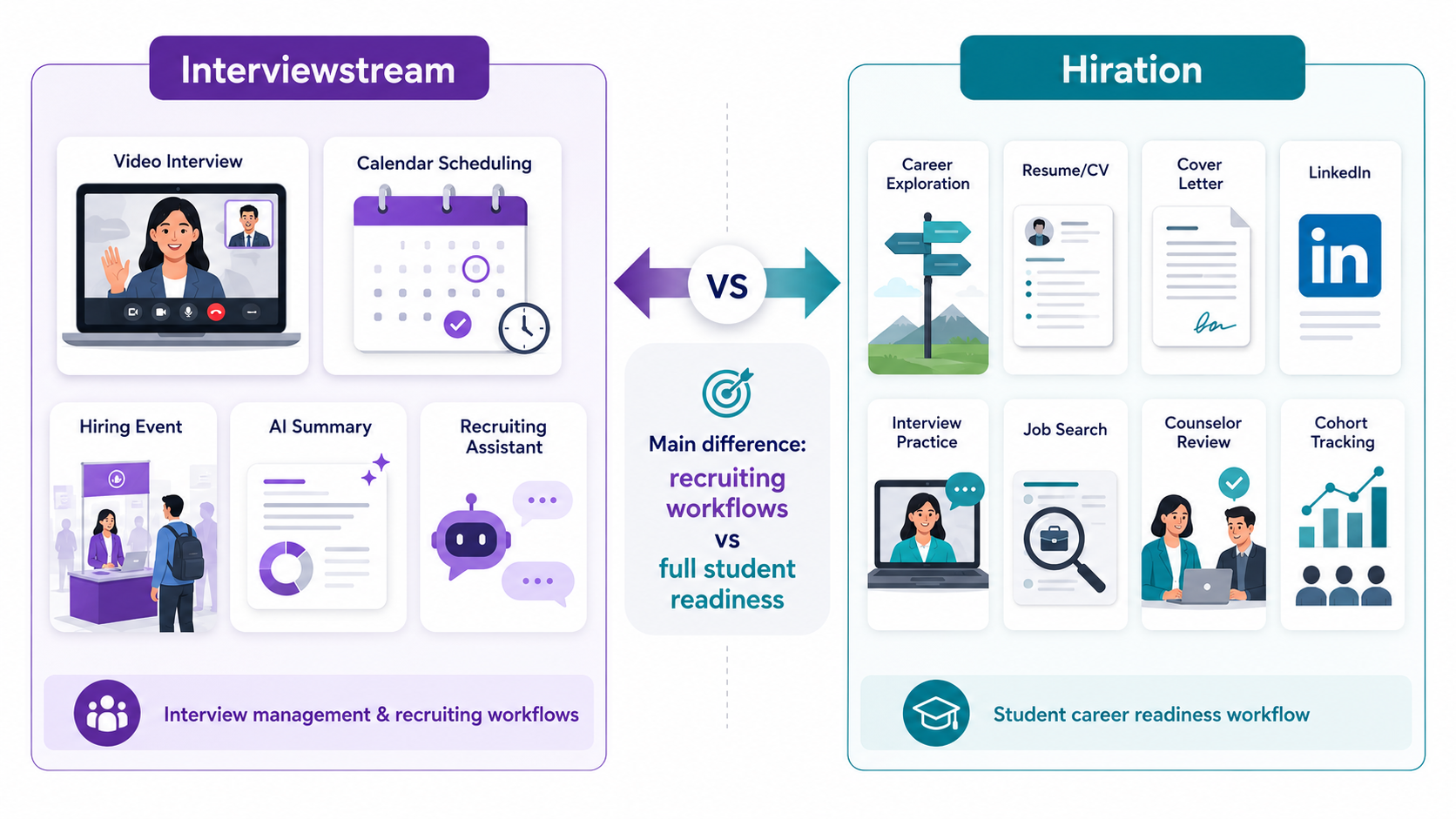
The main difference is the center of gravity.
Interviewstream is organized around the interview process itself: creating interviews, scheduling interviews, managing hiring events, reviewing candidate responses, summarizing interviews with AI, and helping recruiting teams move faster.
That is useful when the primary workflow is recruitment.
Hiration is organized around student readiness. Interview practice is one part of a larger workflow where students also need to build resumes, tailor applications, improve LinkedIn profiles, write cover letters, explore career paths, prepare for job-specific interviews, track opportunities, and receive counselor feedback.
That distinction matters for career centers.
A student may complete a mock interview, but the interview is rarely the only issue. Weak answers often come from unclear experience, weak resume bullets, poor role targeting, limited confidence, or a lack of practice connecting skills to employer expectations.
Hiration is built to support those connected needs.
Interviewstream helps organizations manage interviews more efficiently. Hiration helps career centers help students become more prepared before, during, and after the interview.
How do Hiration and Interviewstream approach AI differently?
Interviewstream’s newer AI capabilities are closely tied to hiring and recruiting productivity. Its AI Interview Summary generates interview summaries, and its AI Confidence Score helps users understand how closely the AI-generated summary reflects the original candidate response.
Its AI Recruiting Assistant is positioned around recruiter productivity, including support for interview questions, job descriptions, social posts, emails, and related recruiting content.
That makes sense for a platform rooted in hiring workflows. The AI layer helps recruiting teams reduce manual work, review interviews faster, and manage candidate information more efficiently.
Hiration’s AI is aimed at student development and career-center control.
The platform is designed to help students practice, reflect, improve, and act without turning AI into an uncontrolled writing or scoring layer. Students still provide their own experience, evidence, judgment, and responses. AI provides structure, feedback, prompts, and scalable support.
Career centers can define expectations, control resources, and decide how review workflows should operate.
For example, Hiration can support students by:
- Evaluating interview answers for relevance, structure, depth, and missed information
- Reviewing speech delivery, filler words, pace, pitch variation, eye contact, posture, and screen position
- Generating interviews based on a role, resume, job description, admission context, or assigned career-center activity
- Allowing counselors to define interview expectations so the AI evaluates students against institutional standards
- Connecting interview feedback with resume, cover letter, LinkedIn, and job-search workflows
The difference is not simply “which platform has AI.”
The more important question is what the AI is designed to improve. Interviewstream’s AI is increasingly tied to hiring efficiency and interview review.
Hiration’s AI is tied to student preparation, career-readiness development, and counselor-controlled support. That is also why Hiration’s model aligns well with the broader AI guardrails career centers need in student preparation.
Which platform offers stronger student interview preparation?
Hiration becomes the clearer fit when the priority is student interview preparation, because the platform is designed around practice, feedback, improvement, and career-center assignment, not only interview recording.
Students can start interview practice in several ways. They can generate a mock interview from a job title and years of experience, paste a job description to create a tailored interview round, practice resume-based interview questions, use role-based interview tracks, complete category-driven interview practice where configured, complete admission interview practice, or take an interview assigned by the career center.
This matters because students are not preparing for one generic interview. A student applying for a software internship, a healthcare role, a graduate program, or an employer event may need a different preparation path.
Hiration also supports Start Interview via Code, which gives career teams a simple way to direct students to the right interview. A student can enter a code, view the interview summary, start the attempt, or continue an incomplete attempt. This is useful for classes, workshops, assignments, targeted interview practice, career center campaigns, and employer-prep events.
The review layer is also more detailed than basic completion tracking. After recording, students can receive an overall score and AI evaluation across answer quality, speech delivery, and non-verbal communication. The downloadable report can show what went well, what needs improvement, and what a stronger answer could have looked like based on the student’s actual response.
Hiration also analyzes posture, eye contact, screen position, speaking pace, pitch variation, filler words, and related delivery signals.
For career centers, the important part is control. Counselors can define interview expectations and guide how the AI evaluates student responses.
That means an interview can be assessed against institution-defined expectations, a sample answer, or custom criteria rather than only generic interview standards.
Career teams can also create different interview types, choose AI-only review or AI plus manual review, enable or disable proctoring, set leniency levels, configure retakes and think time, assign interviews to cohorts, and browse or customize questions across 180+ profiles.
Interviewstream also supports interview practice in higher-ed contexts, including interview assignments, student recordings, reviewer feedback, administrative access, question libraries, and reporting.
Its broader public positioning, however, is more centered on digital interviewing, scheduling, hiring events, interview building, AI summaries, and recruiting productivity across multiple sectors.
For a career center, the distinction is practical. Hiration connects interview practice to the surrounding readiness actions students usually need.
A student can explore career paths, build a resume, create a CV, review resume quality, check ATS compatibility, improve weak bullets, generate a cover letter, optimize LinkedIn, practice interviews, complete assigned interviews, use interview codes, review feedback, discover jobs, track opportunities, and submit work to a counselor.
How does Hiration support conversational interview practice?
Hiration also supports conversational interviews, which adds another layer beyond static question-and-answer practice.
Instead of only showing pre-written questions, the conversational interview experience creates a voice-based, back-and-forth interview where the AI listens to the student’s answer, understands the context, and asks follow-up questions based on what the student said.
This can make practice feel closer to a real interview, especially when students need to handle probing questions, clarify weak answers, or practice deeper reasoning.
The system can support standard conversational interviews and case-style interviews. It can be used for behavioral questions, technical skill assessment, experience-based discussions, problem-solving scenarios, cultural-fit practice, business cases, structured problem solving, and strategic thinking exercises.
This matters for career centers because many students can prepare a first answer, but struggle when an interviewer asks a follow-up. A more dynamic interview experience helps students practice the flow of a real conversation, not only isolated responses.
For Hiration, this strengthens the comparison because interview preparation is not limited to recorded mock interviews. It can include role-based practice, resume-based practice, job-description-based practice, assigned interviews, admission interviews, Start Interview via Code, and conversational interviews inside the same broader readiness environment.
How do counselor and reviewer workflows compare?
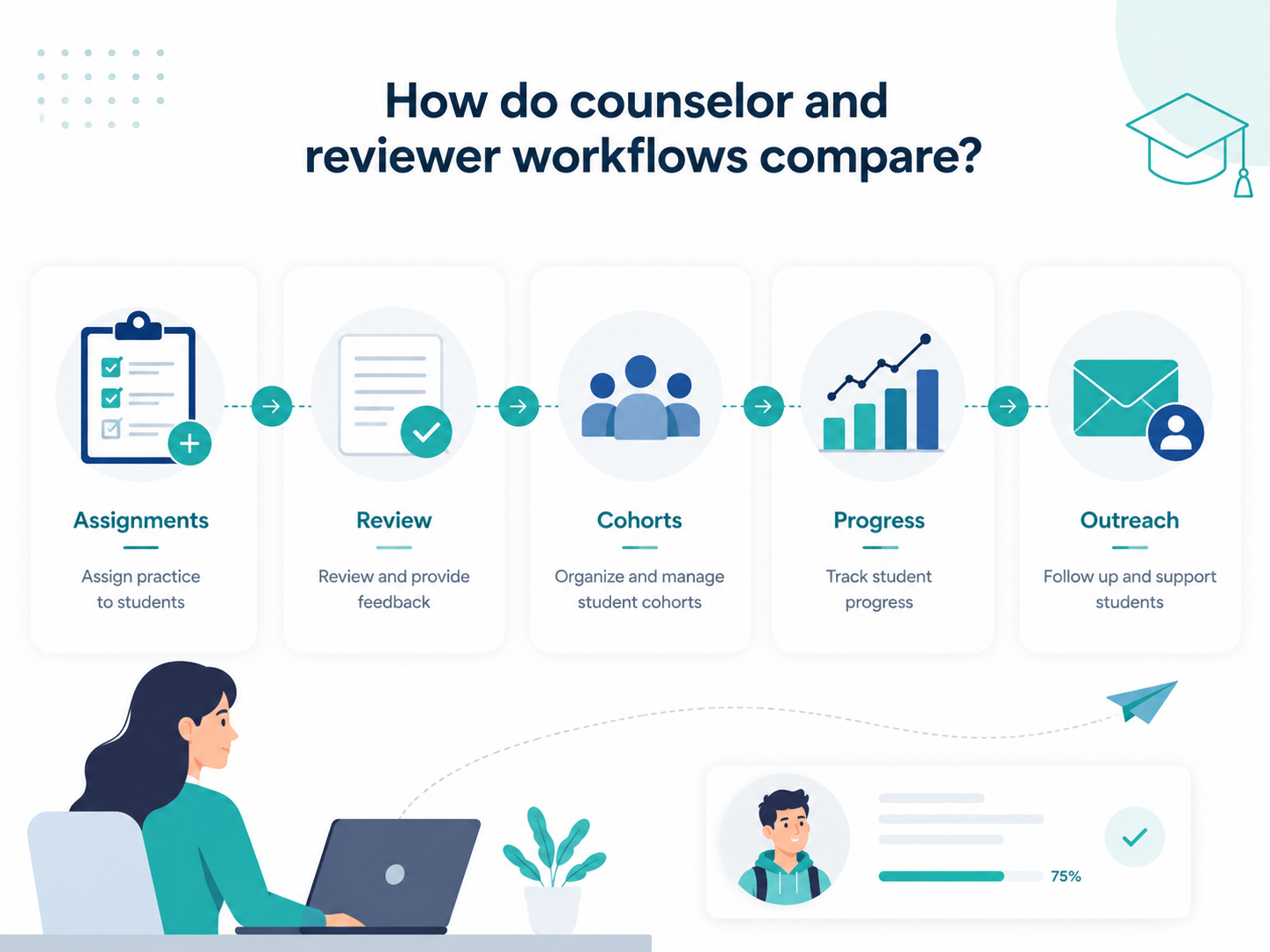
Career centers do not only need students to practice interviews. They need a way to create the right interview experiences, assign them to the right students, manage reviewers, track completion, identify students who need support, and follow up before classes, workshops, placement cycles, internship deadlines, or employer-facing events.
Interviewstream supports education-facing workflows such as interview assignments, recorded student responses, reviewer feedback, administrative access, question libraries, and interview reports. It also has broader interview-management capabilities, including scheduling, interview building, hiring-event support, interview insights, and AI-generated summaries.
Hiration is built more directly around the career-center operating model.
Career teams can create and manage tailored interview experiences, assign interviews to all students or specific cohorts, add custom questions, use pre-curated questions across 180+ profiles, set interview expectations, choose evaluation methods, manage AI-only or AI plus manual review, and review interview submissions in one place.
The same career team module also supports resume review, student management, role-based staff access, cohort-level settings, reporting, analytics, student invites, engagement nudges, and outreach.
That is important because career centers often operate with lean teams, placement cycles, internship timelines, and limited staff bandwidth. Adoption usually depends on whether the platform fits the center’s timing, workflows, reporting needs, and follow-up process, not only whether the product has features.
This matters because many career centers need clear usage visibility, simple workflows, timely nudges, data-backed follow-up, and support that aligns with placement and internship cycles.
The operational value is that Hiration connects visibility with action.
Career teams can track meaningful readiness activity, identify students below a defined score, and contact students from the same platform. That moves the workflow beyond reporting. It gives staff a way to intervene when students need support, rather than waiting for students to ask for help.
Which platform supports more of the student career journey?
Hiration supports more of the student career journey because interview practice is connected to the preparation work around it.
Interviewstream can support the interview layer through digital interviews, scheduling, structured interviews, review workflows, AI summaries, and recruiting-assistant capabilities. That is useful when the main task is managing interviews.
| Student need | Interviewstream | Hiration |
|---|---|---|
| Interview practice | Strong interview-management and practice workflows | Multiple interview pathways, including role-based, resume-based, JD-based, assigned, admission, and conversational practice |
| AI interview support | AI Interview Summary, AI Confidence Score, and recruiting-assistant workflows | AI answer evaluation, speech analysis, body-language feedback, counselor-defined expectations, and review reports |
| Resume creation | Not positioned as a full resume-building platform | Guided resume builder, templates, downloads, and counselor review |
| Resume feedback | Not positioned as a native AI resume-readiness workflow | AI review across 50+ parameters, ATS checks, NACE analysis, WHO bullet feedback, and JD matching |
| Cover letters | Not positioned as a core application-material workflow | Cover-letter builder, resume-to-cover-letter generation, job tailoring, and counselor review |
| Not positioned as a native LinkedIn optimization workflow | Section-level LinkedIn review, score, recommendations, and optional rewrite support | |
| Career exploration | Not positioned as a primary career exploration platform | Career Compass with student inputs, quizzes, and O*NET-backed career information |
| Job search | Hiring and recruiting workflow support | Job Tracker and AI-supported job discovery based on student preferences |
| Counselor action | Admin and reviewer workflows for interviews | Cohorts, assignments, reviews, performance grouping, reporting, and outreach |
Hiration connects interview practice to the surrounding readiness actions students usually need.
A student can explore career paths, build a resume, create a CV, review resume quality, check ATS compatibility, improve weak bullets, generate a cover letter, optimize LinkedIn, practice interviews, complete assigned interviews, use interview codes, review feedback, discover jobs, track opportunities, and submit work to a counselor.
This matters because a weak interview answer often points to a broader preparation issue. The student may not have clear resume evidence. They may not understand the role. They may not know how to explain a project. They may need help connecting coursework, part-time work, research, or leadership experience to employer expectations.
Hiration is structured so those activities can sit inside one readiness workflow. That reduces the fragmentation that often weakens career platform adoption in higher ed and gives career teams a clearer view of what students are actually completing.
How do resume, cover letter, and LinkedIn workflows compare?
This is one of the clearest areas where Hiration moves beyond being only an Interviewstream alternative.
Interviewstream is not publicly positioned as a full resume, cover letter, LinkedIn, or job-search readiness platform. Its public product story is centered on video interviewing, interview scheduling, hiring events, interview building, interview insights, AI Interview Summary, and AI Recruiting Assistant capabilities.
Hiration includes those surrounding readiness workflows natively.
For resumes, Hiration supports:
- Resume creation
- Resume upload and optimization
- Customizable designs
- Institutional templates where configured
- PDF and Word downloads
- AI resume review
- ATS compatibility checks
- Job-description matching
- Present and missing skills analysis
- Multiple tailored versions
- Counselor review
Hiration’s review also includes WHO bullet analysis, which examines whether each resume bullet explains:
- What the student did
- How they did it
- Outcome or measurable impact
This is useful because many students do not fail interviews only because they lack practice. They also struggle because they cannot clearly explain their experience.
Hiration’s resume creation and review workflow helps students improve the evidence they will later use in interviews.
The platform also supports cover letters and LinkedIn profiles.
Students can create cover letters from scratch, generate a cover letter from a resume, tailor it to a job description, and send it for counselor review. They can also receive section-level LinkedIn feedback across areas such as the headline, summary, skills, and experience entries.
This creates consistency across the application story.
The resume, cover letter, LinkedIn profile, and interview answers can all reinforce the same student positioning instead of living in separate tools with separate feedback loops.
How do security, compliance, and integrations compare?
Interviewstream emphasizes enterprise-grade security and compliance. Its public site and support materials reference SOC 2 Type II, GDPR, SSO, and security resources.
Its site also lists integrations with systems such as SAP SuccessFactors, Taleo Business Edition, iCIMS, Frontline Education, ApplyToEducation, PowerSchool, and open API or broader ATS integration options.
That matters because Interviewstream serves many large and regulated environments, including healthcare, government, K–12, enterprise organizations, and universities.
Hiration also supports the security and compliance expectations career centers usually need. Its higher-ed positioning includes FERPA, SOC 2, GDPR, CCPA, VAPT, VPAT, SSO/SAML/LDAP support, and data privacy controls.
The distinction is less about whether either platform understands security.
The stronger distinction is what each platform secures and supports.
Interviewstream’s security and integrations fit a broader hiring and interview-management environment. Hiration’s controls support a student-readiness environment where students may be working on resumes, interviews, LinkedIn profiles, cover letters, career exploration, job search, and counselor-reviewed materials.
For higher-ed career centers, that broader readiness context is important because the platform is not just handling interview recordings. It is supporting student development, career advising, institutional resources, and readiness data across several preparation activities.
Which platform offers the stronger consolidation case?
Hiration makes a stronger consolidation case for career centers that want multiple student-readiness workflows in one platform.
Many career centers already manage fragmented tools. One platform may handle mock interviews. Another may handle resumes. Another may support cover letters. Another may help with LinkedIn. Another may support job search.
Staff may then track completion, reviews, outreach, and student progress manually through spreadsheets, emails, LMS assignments, appointment notes, or internal trackers.
That fragmentation creates practical problems.
Students have to rebuild context across tools. Counselors have to interpret partial activity. Directors may see usage data without knowing whether students are completing meaningful readiness steps. Adoption becomes harder because every separate tool requires separate communication, training, reminders, and reporting.
Interviewstream can reduce friction around interviews, scheduling, hiring events, and interview review.
Hiration reduces friction across more of the student journey.
A student can:
- Explore careers
- Build a resume
- Build a CV
- Review resume quality
- Check NACE competency evidence
- Improve resume bullets
- Tailor a resume to a job description
- Generate a cover letter
- Improve a LinkedIn profile
- Practice interviews
- Complete assigned interviews
- Review interview feedback
- Discover jobs
- Track opportunities
- Submit work to a counselor
- Continue through assigned activities
For staff, that creates one environment for assigning work, monitoring activity, identifying students who need help, and moving from insight to outreach.
That continuity also strengthens the case for consolidating the career services technology stack, especially when separate tools create separate student experiences, contracts, data streams, and advisor workflows.
The value is not just that Hiration has more features. The value is that the features are connected around how students actually prepare.
What should career centers compare before choosing?
Career centers should compare Hiration and Interviewstream based on the workflow they need to support, not only the interview feature list.
A simple feature checklist can miss the deeper question: what happens before and after the student records an answer?
Career services teams should ask:
- Is the main need interview management, student preparation, or both?
- Does the platform help students improve answer quality, not just complete recordings?
- Does the feedback cover content, speech, and body language?
- Can students practice based on a resume, job description, role, admission context, or assigned interview?
- Can career centers assign interviews to cohorts, classes, workshops, or events?
- Can staff review submissions and provide feedback inside the platform?
- Can the platform identify students who need support?
- Can staff contact students from the same environment?
- Does interview practice connect with resumes, cover letters, LinkedIn, and job search?
- Does the platform support career readiness beyond mock interviews?
- Does the vendor’s public positioning primarily speak to hiring teams or career centers?
- What compliance, accessibility, and integration documentation is available?
- Will the tool reduce fragmentation or create another point solution?
- Can the platform support student engagement across placement and internship cycles?
These questions usually make the fit clearer.
If the priority is interview management, scheduling, recruiting workflows, and AI-assisted hiring review, Interviewstream deserves consideration.
If the priority is student interview preparation connected to broader career readiness, Hiration becomes the clearer career-center fit.
Which platform is the clearest fit?
| Institutional priority | Clearer fit |
|---|---|
| On-demand video interviews | Interviewstream |
| Live video interviews | Interviewstream |
| Interview scheduling | Interviewstream |
| Hiring event scheduling | Interviewstream |
| AI-generated candidate interview summaries | Interviewstream |
| AI Confidence Score for summary reliability | Interviewstream |
| AI Recruiting Assistant for recruiter productivity | Interviewstream |
| Enterprise, healthcare, government, K–12, and hiring-team workflows | Interviewstream |
| Student interview preparation | Hiration |
| Role-based mock interviews | Hiration |
| Resume-based mock interviews | Hiration |
| Job-description-based mock interviews | Hiration |
| Assigned interviews for classes, workshops, or cohorts | Hiration |
| Admission interview practice | Hiration |
| Conversational interview practice | Hiration |
| Answer, speech, and body-language feedback | Hiration |
| Counselor-defined interview expectations | Hiration |
| Resume and CV creation | Hiration |
| AI resume review and ATS checks | Hiration |
| NACE competency visibility | Hiration |
| WHO bullet analysis | Hiration |
| Cover letter development | Hiration |
| LinkedIn profile optimization | Hiration |
| Job tracking and AI-supported job discovery | Hiration |
| Cohort management and student outreach | Hiration |
| One connected student-readiness workflow | Hiration |
Final verdict: Hiration or Interviewstream?
Interviewstream is a strong fit when the main need is interview management, digital interviewing, scheduling, hiring events, structured interviews, AI-generated summaries, and recruiting productivity.
For career centers, the decision is usually broader. Students do not only need to record practice interviews. They need to prepare for specific roles, answer follow-up questions, explain resume evidence, improve delivery, tailor applications, receive feedback, and stay engaged through institutional workflows.
That is where Hiration becomes more relevant.
Hiration connects interview preparation with role-based, resume-based, job-description-based, assigned, admission, and conversational interview practice. It also gives career teams more control through interview codes, cohort assignments, counselor-defined expectations, AI plus manual review options, proctoring controls, student performance visibility, and outreach.
Because Hiration also supports resumes, CVs, cover letters, LinkedIn, career exploration, job tracking, AI-supported job search, counselor review, and readiness reporting, the platform fits career centers that want interview prep to sit inside a broader student-readiness workflow.
For a recruiting-oriented interview management platform, Interviewstream deserves consideration. For a career center seeking an Interviewstream alternative that connects mock interviews with full student career readiness, Hiration is the clearer fit to evaluate.
Intrigued? See the workflow in a Hiration walkthrough built around your interview-prep process, student cohorts, review model, and broader career-readiness goals.