What reliably drives early freshman engagement?
Make career a requirement, not an optional flyer. Embed credit-bearing “college-to-career” modules in first-year courses, mobilize trained faculty “Career Champions,” and swap static PDFs for interactive, bite-size experiences (quizzes, short video, AI-guided practice). Use light “administrative friction” (e.g., onboarding holds) to guarantee baseline equity, and specialize peer advisors to handle volume while staff coach the hard cases. Track leading indicators (module completion, first-term appointments, quiz/passport activity) and tie them to internships and retention. I cannot verify the external statistics or specific institutional examples cited in your draft.
Most freshmen arrive on campus with a singular goal: to get a job eventually. Yet, a massive disconnect exists.
According to a Gallup/Strada survey, while 88% of freshmen say "getting a good job" is their primary reason for attending college, only 34% feel confident they will graduate with the skills needed to succeed in the workforce.
For Career Services Professionals, the old "build it and they will come" model is dead. Waiting for seniors to panic-visit your office is a failed strategy.
To fix retention and boost employability, you must intervene early.
Here is how to aggressively and effectively engage first-year students, based on the latest data and proven models from top US institutions.
How do I integrate career planning into the freshman curriculum?
Stop treating career planning as extracurricular. Embed it directly into credit-bearing courses.
You must move beyond optional workshops and integrate "College to Career" modules into first-year seminars.
This ensures 100% capture rates and signals that professional development is as academic as their major.
Wake Forest University is the gold standard here. They don’t just hope students show up; they offer five credit-bearing "College-to-Career" courses.
For example, their course EDU 120: Personal Framework for Career Exploration is a 1.5-credit half-semester course specifically designed for first-year and sophomore students to assess their values and strengths.
Similarly, the Indiana University Kelley School of Business uses a "Compass" curriculum. Their Compass 1 course is a mandatory workshop-style class for freshmen that forces them to build a personal brand and network early.
By the time they are juniors, they aren't learning how to network; they are already doing it.
Also Read: How to improve FDS response rates?
How can I use faculty to scale freshman engagement?
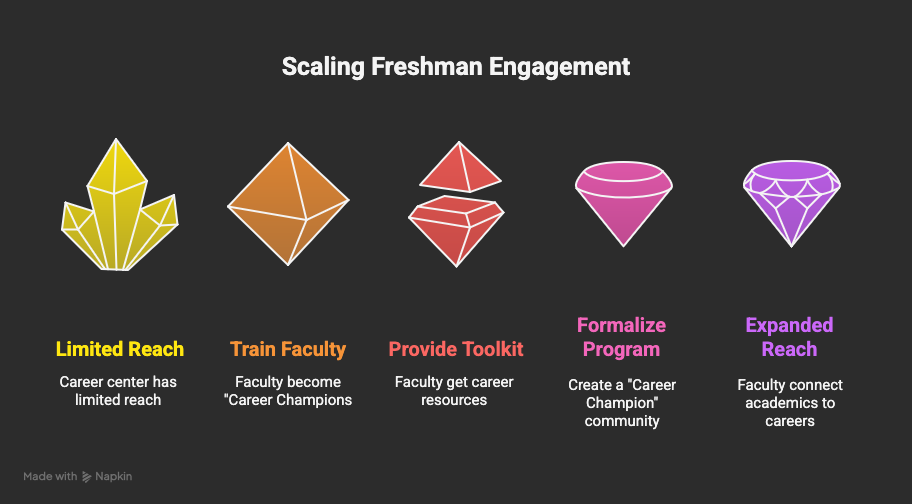
Train faculty to be "Career Champions." Freshmen trust their professors more than they trust you.
Gallup research explicitly states that students who have a mentor who encourages their goals and a professor who cares about them as a person are more than double as likely to be engaged at work later in life.
You need to operationalize this trust by providing faculty with a "career toolkit" - simple slides, assignments, or referral language, so they can seamlessly bridge academic content with career outcomes without adding to their workload.
The University of Connecticut (UConn) brilliantly executed this with their "Career Champion" program. They didn't just ask faculty to "help out"; they created a formalized community of over 500 faculty and staff.
- The Strategy: They provide Champions with exclusive data, plug-and-play content for syllabi, and specific training on how to have career conversations.
- The Result: A massive extension of the career center's reach. When a Biology 101 professor spends 5 minutes explaining how a lab report translates to industry skills, freshmen listen.
Actionable Step: Launch a "Career Champion" badge for faculty. Give them a pre-semester "Career Slide Deck" they can insert into their first lecture that lists 3 careers relevant to their specific subject.
Also Read: What are the top 5 career services benchmarks every center must track?
What is the best way to gamify career content for Gen Z?
Ditch the 50-page PDF guides. Gen Z demands interactivity and instant feedback. Use AI and gamification to turn static resources into quizzes or challenges.
If your content isn't bite-sized and visually engaging, it is invisible. You must meet them on their phones with formats that mimic the apps they already use.
According to NACE, Boston University recently revolutionized their engagement by using AI to gamify their career guides.
- The Innovation: They took standard guides (like "How to Network") and used Claude.ai to generate interactive quizzes. Students answer questions and get immediate, color-coded feedback explaining why an answer was right or wrong.
- The Stats: Engagement skyrocketed. Their cover letter guide, usually ignored, saw immediate traffic because it was presented as a "challenge" rather than a reading assignment.
Furthermore, uConnect reports that 91% of Gen Z students prefer learning via video. If you are sending long emails, you are wasting your time.
Short-form video (under 60 seconds) that answers specific questions (e.g., "What is a cover letter?") is the only format that consistently works for this demographic.
Also Read: What are some good DEI outreach strategies for career centers?
How do I force engagement without being annoying?
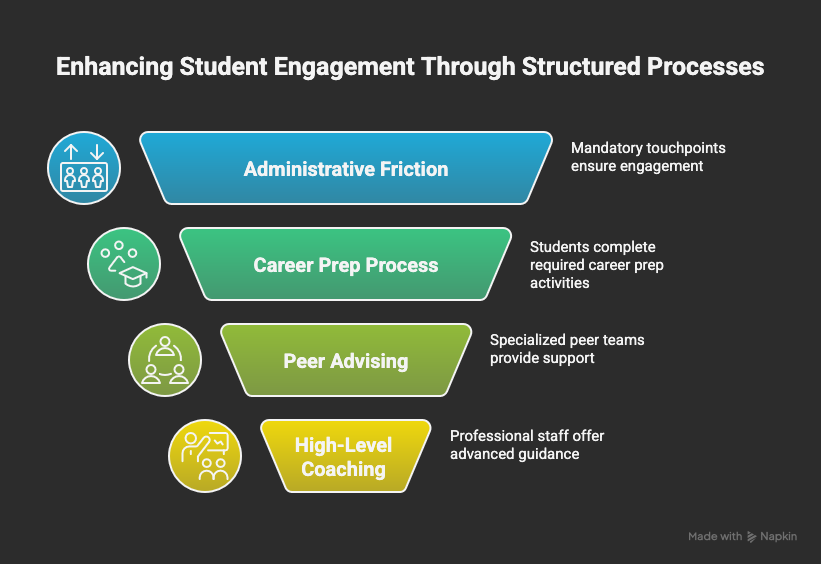
Implement "administrative friction" or mandatory touchpoints. Use registration holds or required onboarding modules that students must complete to unlock their next semester.
This sounds harsh, but it guarantees equity, ensuring first-generation students, who might not self-select into career services, receive the same baseline prep as legacy students.
For instance, the University of Florida (UF) uses a "Career Prep Process" that places a registration hold on students.
- How it works: To lift the hold and register for their second year, freshmen must complete specific actions, such as completing a "CHOMP" assessment (Career Help or Major Planning) or engaging with a module.
- The Impact: This creates a systemic safety net. It forces early self-reflection before students drift too far into a major that doesn't fit them.
Also Read: How to boost student attendance at career fairs?
Is peer advising actually effective for freshmen?
Yes, but only if you specialize the roles. The old "generalist" peer advisor model is inefficient. Instead, create specialized "Peer Teams" (e.g., a Resume Team, a LinkedIn Team, a First-Year Engagement Team).
Freshmen are far less intimidated by a sophomore than a professional staff member in a suit.
- The Strategy: Train a specific group of peers only on resume reviews. Train another group only on navigating the career portal.
- The Win: This frees up your professional staff to do high-level coaching (career anxiety, complex major changes) while peers handle the transactional volume.
- Real World Example: Denison University uses "Career Communities" where students can connect with peers and mentors within specific industry tracks (e.g., Technology & Data, Creative Arts). This peer-led community building helps freshmen see a path forward without needing a formal appointment.
Also Read: How does counselor burnout reveal a career center system that’s no longer working?
To Sum Up
When you get first-year career engagement right, everything else gets easier: retention, persistence, internship pipelines, and ultimately your graduate outcomes.
The thread running through all the strategies above is simple - don’t wait for students to find you.
Build career into the structure of their first year: their courses, their faculty touchpoints, their holds, their peers, and the digital spaces they already live in.
Hiration exists to make that shift more manageable.
Our Ethical AI-driven career suite supports every stage of student growth - self-assessment, exploration, resumes, interviews, and job matching - so your team can deliver more personalized, one-on-one guidance without burning out or losing the human core of your work.
If you’re reimagining how to reach freshmen early and often, the right infrastructure can turn these ideas from one-off pilots into sustainable practice.
Freshman Engagement — Data-Backed Tactics (FAQ)
What’s the fastest way to reach all freshmen?
Embed brief, credit-bearing career modules inside first-year seminars or core courses. Required placement ensures 100% reach and normalizes career prep as part of the curriculum.
How do we mobilize faculty without adding workload?
Launch a “Career Champion” program with plug-and-play slides, short scripts, and referral language. Offer a badge, periodic training, and early access to outcome data to sustain participation.
What content formats resonate with Gen Z?
Interactive micro-content: 60-second videos, quick quizzes with instant feedback, checklists, and swipeable guides. Convert long PDFs into modular challenges students can finish on mobile.
Should we use registration holds to guarantee engagement?
Consider light “onboarding holds” tied to short, equitable tasks (e.g., interests survey, basic resume draft, portal activation). They secure a baseline for all students without over-burdening any group.
Are peer advisors effective for first-years?
Yes, when specialized. Create focused peer teams (Resume, LinkedIn, First-Year 101) to handle high-volume tasks, freeing staff for complex coaching (anxiety, major changes, strategy).
What should we measure besides event attendance?
Leading indicators: module completions, first-term appointments, profile/resume drafts, quiz engagement, portal activation. Lagging indicators: internship conversions, first-destination outcomes, retention.
How do we support first-gen and under-resourced students?
Default them into required micro-milestones, embed career tasks in high-enrollment gen-ed courses, offer evening/async options, and provide templated assets that reduce time and jargon load.
What’s a simple first-semester roadmap we can deploy?
Week 1–4: Interests survey + portal login → Week 5–8: 1-page resume draft + peer review → Week 9–12: LinkedIn basics + short mock interview → Week 13–15: career community opt-in + advisor check-in.
How can AI help without replacing the human element?
Use AI for first drafts (resume, cover letter), micro-quizzes, and 24/7 FAQs. Keep counselors focused on judgment calls, confidence coaching, and employer alignment. Always provide human escalation paths.
What are common pitfalls to avoid?
Relying on optional workshops, long PDFs, generic peer roles, and tracking only attendance. Avoid inequitable barriers: keep tasks short, accessible, and embedded in courses students already take.
Note: Institutional examples and statistics referenced in the article are not independently verified here.