Most first-year students are pushed toward resumes and internships before they have the clarity to pursue either effectively.
This creates a sequencing problem - career centers end up measuring outputs like resume completion instead of the underlying behaviors that actually signal readiness, such as exploration, career literacy, and early identity formation.
At an institutional level, this gap shows up in lower engagement, misaligned internship applications, and weaker employer outcomes.
When students lack early direction, career services teams spend more time on rework instead of progression, and employers struggle to identify high-potential talent early in the pipeline.
This guide breaks down how career centers can redefine first-year internship readiness, design scalable alternatives to traditional internships, build stronger employer partnerships, and implement a structured, multi-phase pathway that moves students from exploration to meaningful engagement.
How Should Career Centers Define Early-Stage Internship Readiness?
Career centers should define first-year internship readiness not by resume quality, but by two observable precursors: career literacy and professional identity formation. Pushing resume workshops on students who cannot name three employers in their field of interest is a sequencing error. True readiness is about moving from passive curiosity to active, low-stakes exploration that builds a student's career narrative.

The core principle is that exploration must precede application.
Readiness for a first-year student isn't a polished document; it’s the ability to articulate connections between their academic work, personal interests, and potential career paths.
Tracking observable behaviors like conducting an informational interview or attending an industry-specific panel, provides a far more accurate signal of progress than resume completion alone.
These activities build the contextual foundation necessary for a student to eventually create a compelling application.
For instance, Wake Forest University embeds career development into its first-year advising model, framing the year around "discover" and "connect" rather than "apply."
This reframes exploration as a core developmental requirement, not an optional extracurricular.
By shifting the campus conversation from "What internship are you getting?" to "What are you curious about?", they give students institutional permission to be uncertain and prioritize foundational learning.
This is a model other institutions can adapt by integrating career touchpoints directly into mandatory first-year advising structures, making exploration a scalable and measurable part of the student journey.
For more on translating these ideas into practice, review our NACE career readiness competencies guide.
What Are Credible Alternatives to Traditional Internships?
Career centers should promote a portfolio of high-impact, short-duration experiences as readiness-builders, not as lesser substitutes for traditional internships. Since the 10-week summer internship is structurally inaccessible for most first-years, the strategic focus must shift to scalable alternatives like micro-internships, project-based work, structured externships, and mentored research. These are not just placeholders; they are critical tools for building a student's professional confidence and portfolio.
According to a 2025 NACE report, early experiential learning dramatically boosts a student's ability to clarify career goals.
For first-years, these shorter experiences are the essential bridge between the classroom and the professional world. They make students far more competitive for traditional internships later on.
One of the most effective alternatives is the micro-internship, a short-term, paid, professional assignment typically completed remotely.
These projects address the primary barriers for first-years: a lack of experience and limited time.
Students can "pressure-test" career interests in a low-risk setting by completing concrete tasks like "conduct a social media competitive analysis," which provides a verifiable skill for their resume.
Learn more in our guide on how micro-internships can benefit your career center.
Structured externships and career treks offer another scalable model.
The University of Chicago's "Discovery Treks" program takes student cohorts to industry hubs for curated, immersive experiences.
These are not simple tours; they are packed schedules of site visits, alumni panels, and networking events that demystify professional environments and make abstract career paths tangible.
By building out a diverse portfolio of these accessible alternatives, career centers can ensure every first-year has a meaningful opportunity to build career momentum.
Also Read: How to Engage Freshmen Early: Data-Backed Tactics for Career Centers
How Can We Educate Employers to Create First-Year Opportunities?
To convince employers to engage first-year students, career centers must shift the conversation from transactional hiring to strategic, long-term talent pipeline development. The pitch must reframe first-year engagement as an investment in early brand visibility and first-mover advantage on high-potential candidates, not as a source of cheap, temporary labor.

The core message is: "Engage them for who they will become, not just for what they can do now." This data-backed narrative emphasizes future returns.
For example, a 2025 NACE survey shows that nearly 52% of interns transition to full-time roles, demonstrating that early talent identification yields significant ROI.
Instead of asking for a formal 10-week internship, propose a tiered partnership model that provides low-barrier entry points for employers.
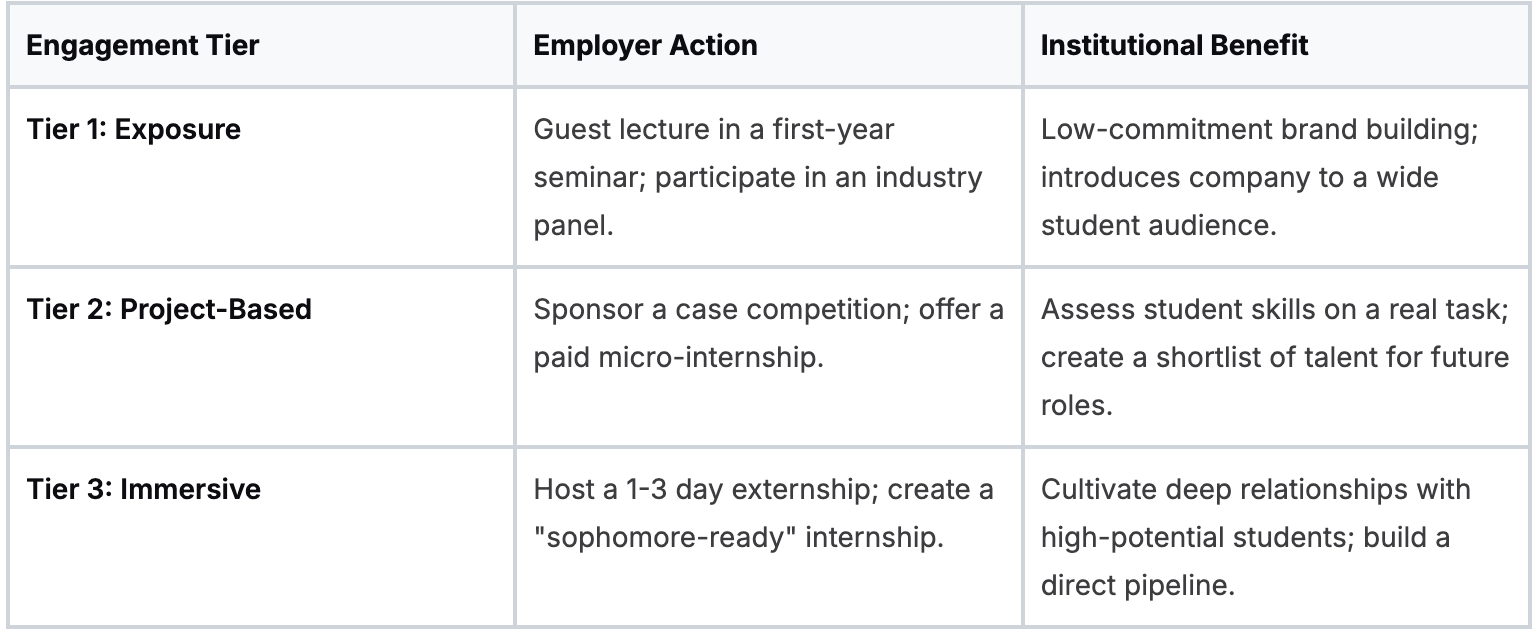
This tiered model lowers the perceived risk for employers and provides a structured path to nurture deeper relationships.
The gold standard, Northeastern University’s co-op program, thrives by positioning its employer relations team as year-round consultants who co-design developmentally appropriate experiences.
This transforms employers into active co-educators invested in a multi-year talent pipeline. For more on this, read our guide on recruiter expectations.
What Does a Scalable First-Year Pathway Look Like?
A scalable first-year program is not a random menu of services but an integrated, multi-phase journey that moves students from exploration to engagement. It requires a cohesive pathway with specific learning outcomes at each stage, using technology to automate, track, and report on progress. This model moves career services from a reactive service counter to the architect of a year-long developmental experience.

This pathway is typically broken into three distinct phases:
- Explore (Fall Semester): The goal is guided discovery to build foundational career literacy. Activities are low-stakes and include a mandatory career conversation in first-year academic advising, industry panels with relatable young alumni, and a career assessment paired with a mandatory debrief workshop. Technology should log completion of these items to create a baseline engagement score for every student.
- Prepare (Winter & Spring): The focus shifts to building tangible assets. This is the time for skill-building and low-stakes experiential learning. Key activities include creating a baseline resume and LinkedIn profile using an AI-powered platform like Hiration for instant, scalable feedback. This is followed by completing a paid micro-internship and practicing with an automated mock interview tool. Your CRM should run automated nudges to prompt students to the next step.
- Engage (Summer): This phase culminates in a significant summer experience that builds on the prior two phases. It may not be a traditional internship but a structured activity like a mentored research project, a multi-day externship, or a "bridge" program on advanced topics. The goal is a meaningful experience the student can articulate during sophomore-year recruiting. This structured approach prepares students for a landscape where, according to recent internship statistics and trends, employers plan recruiting cycles eight months in advance.
This three-phase system nurtures talent from day one.
Also Read: How can career centers align their annual program calendar with hiring cycles to improve student outcomes?
Wrapping Up
Shifting first-year internship readiness from a document-first mindset to a pathway-driven model requires more than new programming - it requires systems that can guide, scale, and measure progress across thousands of students.
From tracking early exploration behaviors to enabling skill-building and experiential learning, the challenge is operational as much as it is strategic.
This is where having the right infrastructure matters.
Hiration enables career centers to operationalize this entire journey - from career assessments and resume development to interview simulation, while giving counselors visibility into student progress through dedicated workflow and analytics tools.
Instead of treating each interaction as a one-off service, career centers can build a continuous, data-backed readiness pipeline - one that supports students at scale while preserving the depth and personalization that drive real outcomes.