What is a co-op program and how should career centers manage it?
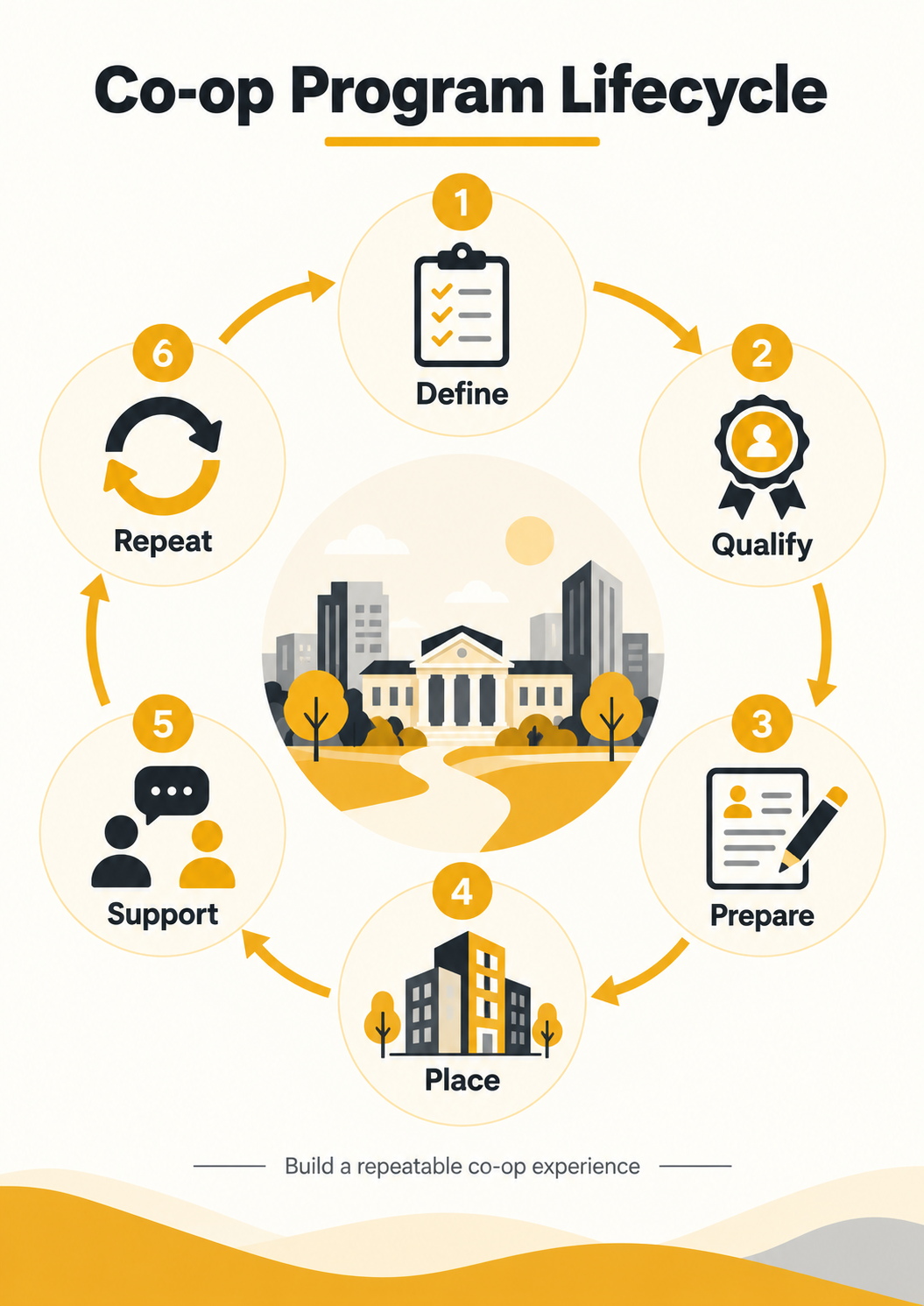
A co-op program is a structured work-learning model where employment is built into a broader academic sequence. Career centers should manage co-ops by defining eligibility, approved position criteria, campus ownership, student preparation, work-term support, employer expectations, and continuity across future hiring cycles.
If your career center is building or expanding a co-op program, finding employers is only one part of the work.
Since a traditional co-op is structured differently from an internship, you also need to decide who can participate, what qualifies as a co-op, how work terms fit around the academic calendar, and more.
That structure makes co-op programs more operationally complex than managing individual internships.
This guide explains how career centers can structure and manage a co-op program, from eligibility and campus ownership to student preparation, work-term support, and ongoing employer participation.
| Program Area | What You Need to Decide |
|---|---|
| Program structure | How many work terms students complete and how those terms fit around study |
| Eligibility | Which students can participate and what they must complete first |
| Co-op approval | What makes a position eligible for the program |
| Campus ownership | Which responsibilities sit with career services, academic programs, registrar functions, and other teams |
| Student preparation | What students must complete before applying |
| Placement process | Whether students apply independently, use a university system, or participate in matching |
| Work-term support | How your team stays involved once employment begins |
| Employer continuity | How you maintain enough quality opportunities across future co-op cycles |
What Makes a Co-op Program Different From an Internship Program?
A co-op program usually places employment inside a larger academic sequence rather than treating it as a single optional experience. You are managing not only a student's placement, but also the relationship between academic terms, work terms, employer commitments, student progression, and the requirements students must satisfy before graduation.
According to NACE, a typical co-op includes multiple work periods, with students often completing three or four work terms and accumulating a year or more of career-related experience before graduation.
NACE also notes that virtually all co-op positions are paid and that most involve some form of academic credit.
That structure can take different forms.
At the University of Cincinnati, engineering students generally alternate between classes and co-op semesters throughout their program.
While at Drexel University, undergraduate co-op students generally work for six months, with the university describing a model in which students alternate six months of classroom study with six months of employment.
And lastly at Northeastern University, standard co-op experiences are typically continuous four- or six-month assignments with one employer, although approved eight-month experiences are also possible.
Your model does not need to copy any one institution. But you should define the model before you start recruiting employers.
Decide:
- whether students complete one extended work period or several;
- whether work and academic terms alternate;
- how long a standard work term lasts;
- whether students work full time;
- whether co-op is required or optional within participating programs;
- whether students earn academic credit;
- whether participation changes graduation timing;
- and whether students can return to the same employer for another term.
The clearer these rules are, the easier it becomes for students, faculty, employers, and advisors to understand what your institution means when it calls an experience a co-op.
What Should Career Centers Decide Before Launching a Co-op Program?
Before you recruit employers, define the rules students and positions must meet. Your eligibility policy should answer who can enter the program, when they become eligible, what preparation they must complete, what constitutes an acceptable position, and what happens when a student cannot secure a qualifying co-op.
Set student eligibility requirements
Do not make eligibility a collection of unwritten advisor decisions.
You may need to define requirements around:
- class year;
- completed credit hours;
- academic standing;
- prerequisite courses;
- participating majors or programs;
- required career-preparation activities;
- international student requirements;
- previous co-op completion;
- and readiness to begin the job search.
Different institutions set these rules differently.
For example, according to Northeastern University, general co-op eligibility includes completion of at least 16 semester hours, enrollment in a full-time degree-seeking program, and no unresolved academic probation. Students also complete a co-op preparation course before participating.
You do not need to use Northeastern's thresholds. The useful lesson is that eligibility should be explicit enough that students can determine what they need to complete before entering the process.
Define what counts as an approved co-op
You also need a standard for the position itself. At minimum, consider whether an opportunity meets your requirements for:
- relationship to the student's academic or career interests;
- minimum duration;
- minimum working hours;
- compensation;
- appropriate supervision;
- substantive responsibilities;
- learning opportunities;
- employer legitimacy;
- workplace safety;
- start and end dates;
- and employer evaluation.
According to Waterloo's Co-operative Education program, its standard work term includes 12 to 16 weeks of work, at least 420 hours, and one continuous position with a single organization. Waterloo separately defines flexible work-term options for experiences that do not meet all standard-term criteria.
Your requirements may differ, but publishing them prevents your team from deciding whether something is a "real co-op" only after a student has already accepted it.
Decide how pay and credit work
As mentioned before, virtually all co-op positions are paid and the vast majority involve academic credit.
But, that does not mean you should automatically copy those characteristics into policy without reviewing your institution's requirements.
Your program should state clearly whether compensation and academic credit are required, expected, optional, or handled differently across participating programs.
You should also establish what happens when a student finds an opportunity independently.
Can your team approve it retroactively? Does it need approval before acceptance? Who reviews it? What documentation is required?
Build that approval step into your process before students begin searching.
How Should Career Services and Academic Departments Divide Responsibility?
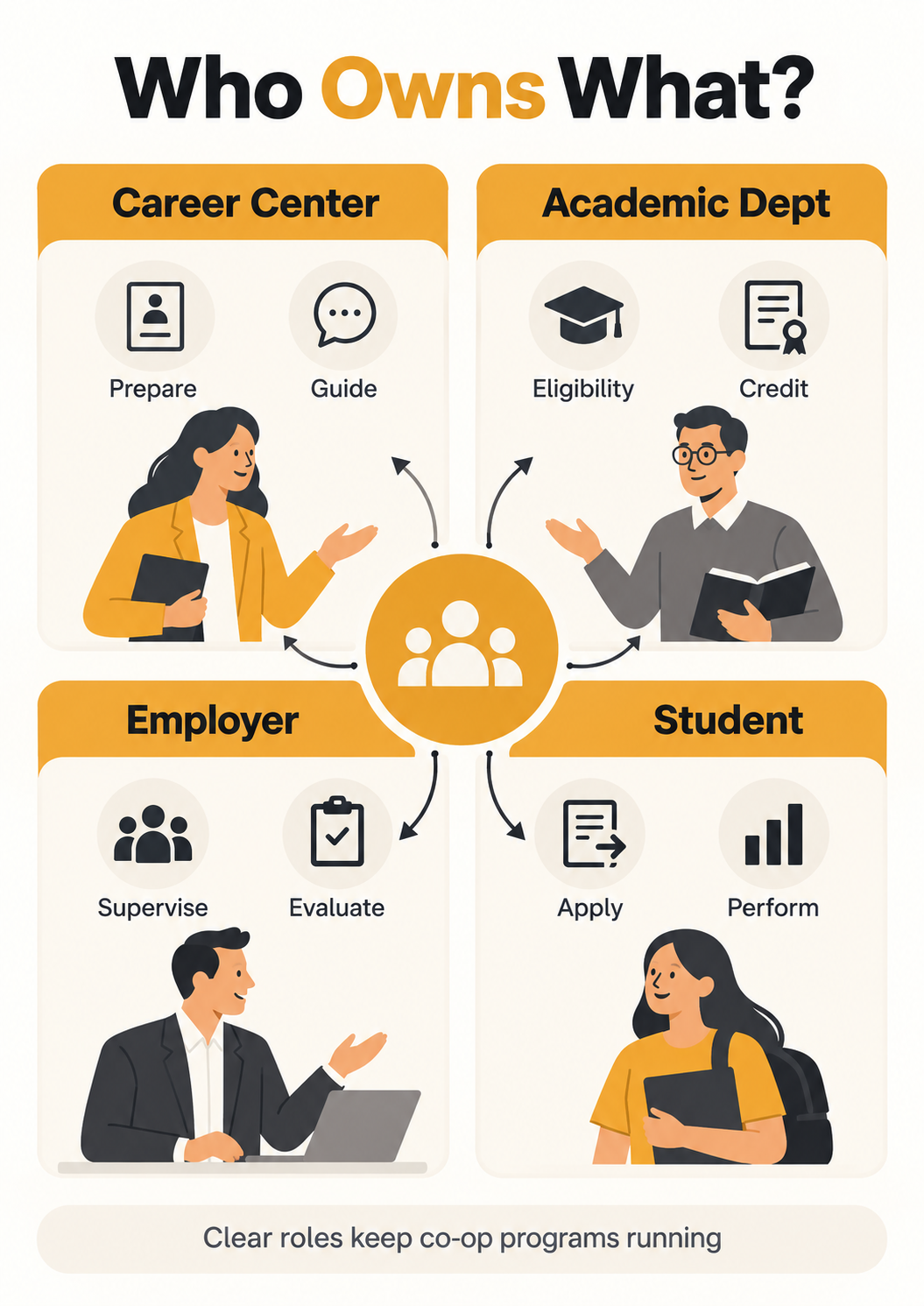
Your co-op program needs named owners for recruiting, academic eligibility, position approval, student preparation, work-term support, registration, and employer issues. Career services can coordinate much of the student-to-employer process, but academic and administrative decisions should remain with the campus teams authorized to make them.
Do not launch with a general statement that the program is "collaborative."
Write down who owns each decision.
| Responsibility | Possible Primary Owner | Other Teams That May Be Involved |
|---|---|---|
| Student career preparation | Career services/co-op team | Academic program |
| Employer development | Career services/employer relations | Faculty, alumni, advancement |
| Academic eligibility | Academic program | Registrar, co-op team |
| Position quality review | Co-op/career team | Academic program |
| Academic credit | Academic program | Registrar |
| Student registration | Registrar/academic administration | Co-op team |
| Application and interview support | Career services/co-op team | Faculty |
| Work-term check-ins | Co-op/career team | Academic program |
| Employer performance concerns | Co-op/career team | Student affairs, institutional offices as appropriate |
| Employer evaluation | Co-op/career team | Academic program |
| Learning assessment | Academic program/co-op team | Faculty |
| Program reporting | Co-op/career team | Institutional research, academic leadership |
The exact division will depend on your institution and the important part is eliminating gaps.
The University of Waterloo, for example, assigns its co-op operation responsibilities that include developing employment opportunities, maintaining employer relationships, administering recruiting, maintaining contact with students and employers during work terms, supporting both parties when problems arise, and maintaining co-op records.
Meanwhile, academic requirements still operate around the employment experience.
You should therefore map the full student journey and put an owner beside every point where a decision occurs:
Eligible → Prepared → Searching → Position approved → Hired → Registered → Working → Evaluated → Work term completed → Returning to academics or next co-op
If two offices believe the other owns one of those transitions, students will find the gap first.
How Should Students Be Prepared and Matched to Co-op Opportunities?
Prepare students before they enter employer selection, not after applications begin. Your co-op preparation should establish the job-search skills, professional expectations, application materials, and program rules students need before employers see them, while making clear that participation in the program does not automatically mean receiving a placement.
A structured preparation stage is common in established co-op programs.
For instacne, Northeastern University gets students to complete a mandatory co-op preparation course or equivalent before participating. The course covers skills needed to obtain and succeed in a co-op, and students must have their resumes approved before accessing co-op applications.
Your preparation process could therefore require students to complete a defined sequence before they enter the employer pool:
- Understand the co-op model. Explain work-term dates, academic implications, application rules, employer expectations, and what happens after accepting an offer.
- Clarify interests and target roles. Students should know what types of work they are prepared to pursue rather than applying indiscriminately.
- Build and review application materials. Require a usable resume before students begin submitting applications.
- Practice interviewing. Students may be entering their first professional selection process, so interview practice should happen before employer interviews begin.
- Set professional expectations. Cover communication, application follow-through, offer decisions, workplace conduct, and what students should do when problems arise.
- Explain the placement process. Students need to understand whether employers select candidates directly, your institution uses matching or ranking, or both models exist.
Should career centers match students or let them apply independently?
There is no single model you have to use. At Cincinnati, students are responsible for finding, applying to, interviewing for, and securing positions, while advisors and university resources support the process.
Waterloo operates a more structured recruiting environment through WaterlooWorks while also allowing students to find positions through employer sites, public job boards, networking, and other channels.
Your career center should decide which model fits your scale and resources. What you must avoid is ambiguity.
Students should know:
- where they can find approved opportunities;
- whether they may source their own;
- when independent opportunities require approval;
- whether they can decline offers;
- what accepting an offer commits them to;
- and what support is available if they remain unplaced.
What happens when a student does not secure a co-op?
Decide this before the first unsuccessful search. Possible questions include:
- Can the student continue searching after the work term starts?
- Do they return to classes?
- Can they move the work term to another semester?
- Does the program provide an alternative experiential option?
- Does missing a work term affect graduation?
- Who contacts the student when placement risk becomes apparent?
Your team should be able to answer those questions consistently rather than creating a solution individually for each student after deadlines have passed.
How Should Career Centers Manage Students While They Are on Co-op?
Your responsibility should not end when a student accepts an offer. Define how your team will check in during the work term, respond to problems, collect employer feedback, support reflection, and manage changes such as early termination, role changes, or a student returning for another co-op term.
A co-op is still part of the student's educational experience while the student is employed.
According to the University of Waterloo, its co-op team maintains contact with students and employers during work terms, provides support when difficulties arise, and requires an employer performance evaluation.
Waterloo also provides students with work-term consultations with their co-op advisors, performance evaluations, and reflection or professional-development activities during the experience.
Your work-term process does not need to be complicated, but it should have defined checkpoints.
| Point in the Work Term | What Your Team Can Check |
|---|---|
| Start | Student began as expected; role and supervisor are correct |
| Early check-in | Onboarding, responsibilities, supervision, immediate concerns |
| Midpoint | Progress, quality of work, learning, employer/student issues |
| Before completion | Employer evaluation, student reflection, next-term plans |
| Completion | Work term completed, requirements satisfied, next academic or co-op step confirmed |
Create an escalation process before you need one
Students and employers also need to know what to do when the placement does not go as planned.
Potential issues include:
- duties that differ materially from the approved role;
- inadequate supervision;
- performance concerns;
- workplace conflicts;
- schedule or location changes;
- employer withdrawal;
- early student departure;
- safety or conduct concerns;
- and changes to the agreed work period.
Do not leave the response entirely to the advisor receiving the email.
Document:
Who receives the concern → who assesses it → who needs to be involved → what gets documented → who communicates the decision
The issue may eventually need involvement from offices outside career services depending on its nature. Your operating process should make that handoff clear.
Require some form of employer evaluation
Employer feedback gives you information that a student self-report cannot. Your evaluation does not need dozens of questions.
Capture information you can actually use, such as:
- whether the student completed the term;
- quality of work;
- professional communication;
- reliability;
- application of relevant skills;
- areas for development;
- and whether the employer would consider hosting another co-op student.
Then bring useful feedback back into advising before the student's next application cycle.
How Should Career Centers Manage Employer Participation and Co-op Continuity?
Treat employers as recurring co-op partners rather than a list of individual vacancies. You need enough qualified positions for each scheduled work term, employers that understand your academic calendar and supervision expectations, and a simple way to identify which partners should return, expand, adjust their roles, or leave the program.
For a co-op program, focus on whether employers can reliably support the operating model.
Before approving or renewing an employer relationship, confirm:
- Term alignment: Can the employer hire according to your students' scheduled work periods?
- Role quality: Will students perform substantive work related to the program?
- Supervision: Is someone responsible for onboarding, feedback, and day-to-day support?
- Compensation: Does the opportunity meet your institution's co-op compensation policy?
- Capacity: How many students can the employer realistically support?
- Evaluation: Will the supervisor participate in your required check-ins or end-of-term evaluation?
- Repeat participation: Does the employer expect to hire again in upcoming cycles?
- Progression: If students return, can the employer provide more advanced responsibilities rather than repeating the same experience?
According to the University of Cincinnati, participating co-op employers are expected to provide paid work related to the student's field, appropriate supervision and mentoring, increasing responsibility where appropriate, and an end-of-term evaluation.
Waterloo similarly expects employers to provide appropriate compensation, supervision, training, and evaluation, and asks employers rehiring students for another work term to provide enhanced work rather than simply repeating the previous assignment.
That gives you a useful way to think about employer continuity. Do not measure success only by asking:
How many employers did we recruit?
Also ask:
- How many approved positions were available for each work term?
- How many positions were actually filled?
- Which employers returned for another cycle?
- Which employers expanded or reduced their hiring?
- Which placements repeatedly generated strong student experiences?
- Where did supervision or role quality create problems?
- Which employers rehired previous students?
- Which students received opportunities to continue with the organization?
The purpose is to see whether the employer side of the program is becoming more reliable as the co-op program grows.
Wrapping Up
A strong co-op program depends on more than employer participation.
Career centers need clear eligibility rules, defined ownership across campus, consistent student preparation, structured support during work terms, and reliable employer participation across future cycles.
The more clearly those pieces are defined, the easier it becomes to run the program consistently and support students without adding unnecessary manual work for advisors.
Hiration can support the student-preparation side of that process with career exploration, resume optimization, interview practice, LinkedIn support, and counselor visibility into student progress.
That gives your team a way to move repeatable preparation earlier while keeping advisor time focused on higher-value guidance.
Book a walkthrough to see how Hiration can support student preparation across your co-op program.
Co-op Programs — FAQs
How is a co-op different from an internship?
A co-op usually places employment inside a structured academic sequence, often with defined work terms, academic requirements, employer commitments, and progression rules.
What should career centers decide before launching a co-op program?
Career centers should define eligibility, approved position criteria, pay and credit rules, approval steps, employer requirements, and what happens if a student does not secure a placement.
Who should own different parts of a co-op program?
Career services may coordinate recruiting, preparation, and employer communication, while academic and administrative teams should own eligibility, credit, registration, and policy decisions.
How should students prepare for co-op opportunities?
Students should understand the co-op model, clarify target roles, prepare resumes, practice interviews, learn professional expectations, and understand the placement process before applying.
Should career centers match students or let them apply independently?
Either model can work. The important point is clarity: students should know where to find opportunities, whether they can source their own, and when approval is required.
How should career centers support students during a co-op?
Career centers should define check-ins, problem escalation, employer feedback, reflection activities, and processes for role changes, early termination, or returning for another work term.
What should employers provide in a co-op program?
Employers should provide substantive work, supervision, compensation, feedback, term alignment, evaluations, and where relevant, more advanced responsibilities for returning students.
How can Hiration support co-op preparation?
Hiration can support career exploration, resume optimization, interview practice, LinkedIn preparation, student progress tracking, and counselor visibility before students enter the employer selection process.