How does Big Interview compare to Hiration for career centers?
Big Interview is strongest as an interview-preparation platform with structured curriculum, practice sets, assignments, video feedback, answer-building tools, and reporting. Hiration supports interview preparation too, but connects it with a broader career-readiness journey that includes career exploration, gap analysis, job discovery, resume creation, cover letters, LinkedIn optimization, counselor review, cohort tracking, and advisor-controlled AI workflows. The main difference is that Big Interview is interview-led, while Hiration gives career centers one connected platform for helping students move from career direction to applications, interviews, and counselor-supported next steps.
Hiration and Big Interview both help career centers scale student preparation, but they are built around different priorities.
Big Interview focuses heavily on interview curriculum, recorded practice, assignments, and automated feedback.
Hiration connects interview preparation with career exploration, job discovery, resumes, cover letters, LinkedIn optimization, and counselor review.
The deeper difference also lies in how each platform uses AI.
This comparison examines both platform's interview, application, administrative, and AI capabilities to help career centers identify which platform better fits their student journey and advising model.
How do Hiration and Big Interview compare at a glance?
Big Interview is strongest as an interview-led learning and practice system. Hiration is the broader career-readiness platform, with stronger continuity across exploration, application preparation, interview practice, and counselor review. The clearest difference is Hiration’s counselor-controlled Ethical AI model.
| Comparison area | Big Interview | Hiration |
|---|---|---|
| Primary platform scope | Interview preparation, learning curriculum, recorded practice, resume analysis, assignments, and related application tools | Career exploration, resumes, CVs, cover letters, LinkedIn optimization, interview preparation, job tracking, AI-supported job search, and counselor operations |
| AI philosophy | AI generates questions and evaluates responses through defined scoring dimensions; administrators can customize questions, assignments, grading settings, and practice structure | Ethical AI model designed to preserve student thinking, let institutions define expectations, and combine automated guidance with counselor review |
| Interview preparation | VideoAI, dynamic audio-based PracticeAI, Answer Builder, large question libraries, learning tracks, custom sets, and certificates | Role-, resume-, job-description-, admission-, and institution-assigned interviews; video feedback, adaptive conversational practice, counselor-defined expectations, and interview access through codes |
| Interview evaluation | Feedback on factors such as role alignment, clarity, confidence, speech delivery, vocabulary, volume, and lighting | Evaluation of answer content, speech, communication, and nonverbal presentation, with the option to assess against platform criteria, sample answers, or institution-defined expectations |
| Resume creation | Primarily analyzes resumes created elsewhere | Native resume builder with customizable designs, institutional templates, guided section creation, and PDF or Word downloads |
| Resume review | Reviews uploaded resumes for readability, credibility, formatting, and ATS-related factors | Reviews resumes across more than 50 parameters, including structure, ATS compatibility, job alignment, section quality, and bullet-level evidence |
| Career-readiness analysis | No comparable competency-mapping feature is documented in the reviewed materials | NACE Skill Analysis can evaluate whether the resume demonstrates the eight NACE career-readiness competencies and show supporting evidence from the document |
| Bullet-level feedback | Provides resume feedback and automated analysis | Uses the WHO framework to assess what the student did, how it was done, and what outcome resulted, then identifies the specific evidence missing from weak bullets |
| Cover-letter support | Premium Cover Letter Generator available through Big Resume | Resume-to-cover-letter workflow, customizable templates, job-description alignment, directional AI guidance, optional generation, and counselor review |
| LinkedIn optimization | No comparable native LinkedIn optimization module is documented in the reviewed materials | Section-level profile scoring, experience analysis, improvement guidance, downloadable reports, and optional AI-assisted rewriting |
| CV support | No dedicated CV-building capability is documented in the reviewed materials | Supports CV creation for academic, research, graduate-school, healthcare, international, and professional pathways |
| Career exploration | Not a core documented capability | Career Compass uses student inputs, assessments, and O*NET-backed career information to support exploration and career-path discovery |
| Job search support | Not a core documented capability | Job Tracker and AI-supported job search help students organize opportunities and identify roles based on their preferences |
| Institutional administration | Custom sets, assignments, role-based access, bulk user management, privacy controls, due dates, attempt limits, and grading settings | Cohorts, assigned activities, custom interviews, evaluation controls, counselor reviews, performance grouping, engagement tools, and cross-product student visibility |
| Reporting | Daily-refreshed reporting on users, logins, curriculum activity, interviews, videos, and resumes analyzed | Tracks signups, resumes created and downloaded, interviews started and completed, reviews checked, low-scoring students, and adoption by cohort or group |
| Acting on student data | Administrators can review and export activity data | Career teams can identify students below a performance threshold, group them for support, and email them directly from the platform |
| Strongest institutional fit | Career centers primarily seeking structured interview curriculum and scalable practice | Career centers seeking one institution-controlled platform across exploration, applications, job search, interviews, and counselor-led support |
What is the main difference between Hiration and Big Interview?
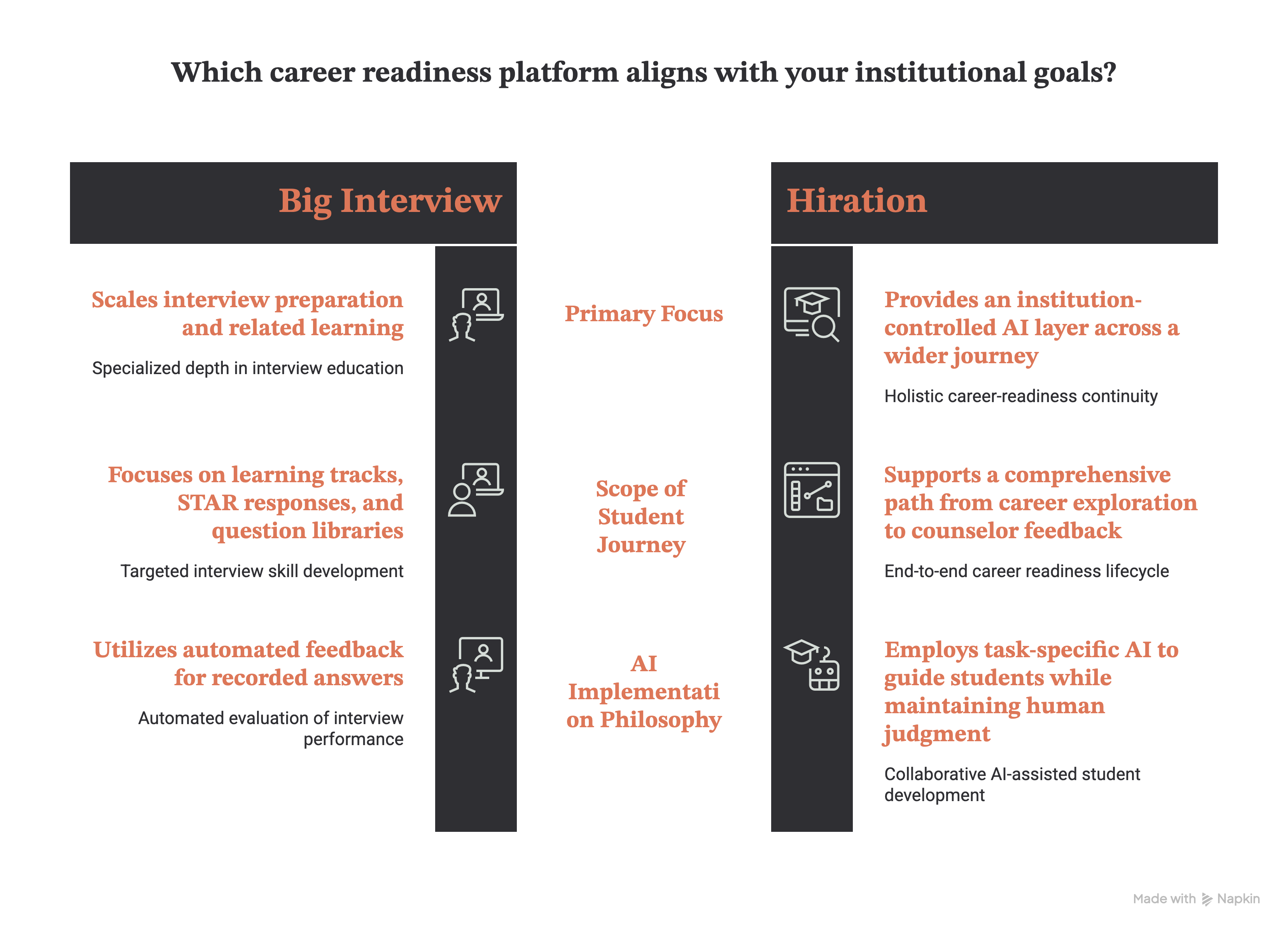
Big Interview helps career centers scale interview preparation and related learning. Hiration gives career centers an institution-controlled AI layer across a wider career-readiness journey.
Big Interview’s core strength is depth around interview education. Students can work through learning tracks, build STAR responses, use large question libraries, complete custom assignments, record answers, and receive automated feedback.
Hiration also supports structured interview practice, but it starts earlier and continues further. A student can:
Explore careers → compare occupations → identify gaps → build an action plan → discover jobs → create and tailor a resume → prepare a cover letter → improve LinkedIn → practise interviews → receive counselor feedback
The advantage is not simply the number of available modules. It is the continuity between them.
A career choice can influence the student’s gap analysis. The target role can shape the resume and cover letter. The resume and job description can inform the interview. Counselors can review the resulting work through one institutional environment.
Hiration’s AI philosophy supports this continuity without treating automation as the end goal. The platform can use AI differently depending on the task.
It can ask the student for evidence before improving a resume bullet, provide directions rather than replacing a full cover letter, or evaluate an interview against expectations established by the career center.
The student remains responsible for the underlying experience and judgment. The career center remains responsible for the standard.
Which platform offers stronger interview preparation?
Big Interview offers deeper prebuilt interview curriculum and learning content. Hiration offers stronger control over interview construction and evaluation, along with video analysis, adaptive conversational practice, and connections to the student’s wider application journey.
What does Big Interview provide?
Big Interview combines several interview-preparation formats:
- More than 1,000 practice sets
- A question library covering industries, roles, and interview types
- Recorded video responses
- VideoAI feedback
- Dynamic PracticeAI sessions
- STAR-based Answer Builder
- Custom interview sets and assignments
- Fast Track and Mastery Track learning pathways
- Video lessons, playbooks, quizzes, and certificates
VideoAI analyzes factors such as speech rate, tone, filler words, vocabulary, role alignment, confidence, volume, and lighting.
PracticeAI generates a dynamic, audio-only interview using a job advertisement and, optionally, the student’s resume. It evaluates answers across Role Alignment, Clarity, and Confidence and may show an optimized answer.
This gives Big Interview a clear advantage for institutions looking for a ready-made interview curriculum with substantial learning content.
What does Hiration provide?
Hiration allows students to generate interview practice from:
- A job title and experience level
- A target job description
- Their resume
- An interview created by the career center
- A prebuilt role-specific interview
Hiration also gives career centers practical ways to route students into the right practice experience.
Through its Start via Code workflow, a career center can direct students to a specific interview for a class, workshop, event, assignment, or targeted campaign. Students enter the code, review the interview details, and can continue an incomplete attempt without having to search through the wider platform.
Hiration can also support admission interview practice alongside job-, internship-, resume-, role-, and job-description-based interviews. This makes the interview product useful across more student pathways than employment preparation alone.
The value is operational as well as instructional. Career teams can create the relevant practice, distribute one code to the intended group, and preserve each student’s progress within the same workflow.
Its standard simulator examines answer content, speech, and nonverbal presentation. Students can receive feedback on response quality, structure, filler words, speaking pace, pitch, posture, screen position, shoulder alignment, and eye contact.
Hiration also supports conversational interviews. Instead of presenting a fixed sequence of unrelated questions, the AI can respond to the student’s previous answer and ask relevant follow-ups.
While Big Interview’s PracticeAI is also dynamic, the distinction lies in the format and institutional control.
Big Interview’s dynamic interview experience is audio-based and evaluates defined response dimensions.
Hiration combines adaptive conversation with a wider video-evaluation system and allows the career center to influence the assessment standard.
Counselors can define what a strong answer should include, use a sample answer, rely on standard platform parameters, or combine those approaches. They can also decide whether the submission receives automated feedback, direct counselor review, or both.
This supports different advising models across academic programs and student populations. A business school, nursing program, technical department, and first-year career course do not need to use the same interpretation of interview readiness.
Hiration's AI operates within the institution’s model rather than asking the institution to reorganize its model around a fixed AI score.
How do the resume capabilities compare?
Big Resume centers on evaluating an uploaded resume. Hiration supports the complete resume process, including creation, review, revision, tailoring, version management, and counselor feedback.
Big Resume analyzes PDF and DOCX documents across areas such as readability, credibility, formatting, and ATS-related factors. Students can revise their documents and rescan them, while institutions can upload preferred templates.
This can work well for career centers that already have a separate resume-writing process and primarily need automated evaluation.
Hiration includes:
- A native visual resume builder
- More than 25 customizable, ATS-friendly designs
- Institution-specific templates
- PDF and Word downloads
- Review across more than 50 parameters
- Section-level and structural analysis
- Bullet-level feedback
- Job-description matching
- Missing-skill identification
- Multiple tailored resume versions
- Direct counselor review
Hiration also connects resume review with career-readiness measurement.
When enabled, its NACE Skill Analysis evaluates the resume against the eight NACE competencies: Career and Self-Development, Communication, Critical Thinking, Equity and Inclusion, Leadership, Professionalism, Teamwork, and Technology.
It separates competencies that are demonstrated from those that are not yet clearly visible and can show the resume evidence behind the assessment.
This gives career centers more than a general resume score. It helps them see whether students are communicating the employability skills their institution is already trying to develop.
At the bullet level, Hiration uses the WHO framework:
- What the student did
- How the student did it
- What outcome or measurable impact resulted
The platform can identify whether a bullet lacks task clarity, methods, tools, or evidence of impact. Students then receive specific guidance on what is missing rather than a generic instruction to “make the bullet stronger.”
This also reinforces Hiration’s Ethical AI approach. The platform can prompt students to provide the missing facts before helping them improve the wording, keeping the final claim grounded in the student’s real experience.
The more important difference appears when a student has written a weak bullet.
Big Interview's platform could immediately generate a more polished sentence.
Hiration can instead ask contextual questions about the student’s actions, methods, scope, and results. The revised bullet then comes from information supplied by the student rather than assumptions created by the AI.
This reflects Hiration’s approach to Ethical AI through product design.
The question is not whether the software can produce a strong sentence. The question is whether the student remains accountable for the evidence behind it.
For career centers, this provides a more defensible way to use AI in resume education. Students still receive fast support, but the process requires them to examine their experiences, identify evidence, and understand why the original bullet was weak.
Big Interview helps students evaluate an existing resume. Hiration supports the full process of creating, reviewing, strengthening, tailoring, and submitting it for counselor feedback.
How do the cover-letter tools compare?
Both platforms now provide cover-letter functionality, but Hiration integrates cover letters more closely with the student’s resume, target job, counselor workflow, and broader application process.
Big Interview offers a Cover Letter Generator as a premium capability for organizations using Big Resume.
Career centers evaluating Big Interview should confirm whether Big Resume and the Cover Letter Generator are included in the institutional agreement or priced as separate modules.
Hiration’s Cover Letter Builder allows students to:
- Start with a blank letter
- Use customizable templates
- Select a design aligned with the resume
- Compare the letter with a job description
- Identify missing skills and keywords
- Download the letter in PDF or Word format
- Submit it for counselor review
Its AI can provide directional guidance rather than automatically replacing the complete document.
For example, the platform can identify where the opening lacks specificity, where the student has not connected an experience to the employer’s requirements, or where evidence needs to be added. The student then revises the content using personal knowledge and judgment.
Full generation can remain available where the institution considers it appropriate, but the platform does not have to apply the same level of automation to every workflow.
This gives career centers a way to distinguish between two very different uses of AI:
- Producing a finished document for the student
- Helping the student understand how to produce a stronger document
Hiration’s advantage is not merely that it includes a cover-letter tool. The application workflow can move from the tailored resume into the cover letter, LinkedIn profile, interview, and counselor review without losing the context of the target role.
Does either platform support LinkedIn optimization?
Hiration includes a native LinkedIn Profile Reviewer. No comparable native LinkedIn optimization module is documented in the supplied Big Interview materials.
Hiration evaluates the profile section by section and can provide:
- An overall profile score
- Feedback on the About section
- Analysis of individual experience entries
- Skills-related recommendations
- Actionable improvement guidance
- Samples and supporting resources
- A downloadable report
- Optional rewriting based on the student’s resume
This capability strengthens continuity across the student’s application materials.
Resume bullets, LinkedIn experience entries, cover-letter evidence, and interview stories should describe the same underlying experiences with appropriate adjustments for each format.
Housing these activities within one platform can help career centers reduce conflicting advice and fragmented student narratives.
Which platform provides stronger administrative control?
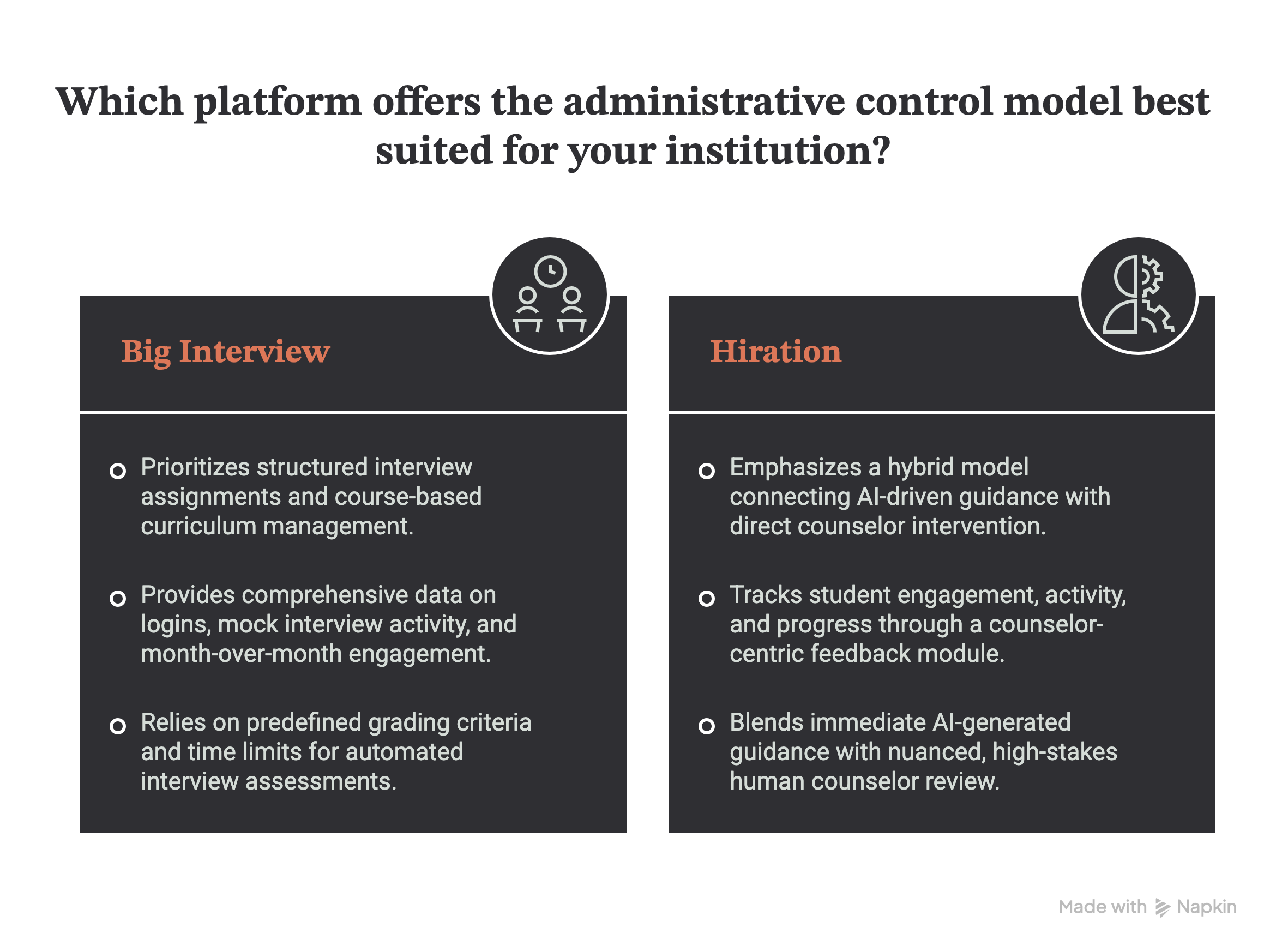
Both platforms offer credible administrative capabilities. Big Interview provides strong tools for assignments, users, custom interview sets, and activity reporting. Hiration extends administrative control across a broader set of student activities and places counselors closer to the AI-supported workflow.
Big Interview allows administrators to:
- Create custom practice sets
- Choose questions from its library
- Add institution-created questions
- Build assignments
- Configure due dates and attempt limits
- Set time limits and grading criteria
- Control privacy and sharing settings
- Import users through CSV
- Assign administrator roles
- Search, filter, and export user data
- Review daily-refreshed activity reports
Its reporting can include logins, new users, mock interview activity, curriculum use, resumes analyzed, videos analyzed, and month-over-month engagement.
These are meaningful strengths for institutions running structured interview assignments or career courses.
Hiration’s Counselor Module supports:
- Staff roles and permissions
- Cohort organization
- Custom interview creation
- Institution-defined answer expectations
- Think-time and retake controls
- Resume and interview submissions
- Direct counselor feedback
- Student and reviewer activity tracking
- Engagement analytics
- Student nudges
- Workshop and webinar invitations
Hiration’s administrative value also goes beyond displaying activity data by helping career teams turn career platform adoption and engagement signals into timely student support.
Career teams can identify students who fall below a defined performance threshold, group them for attention, and contact them directly from the platform. Instead of waiting for a student to request help, advisors can identify where support is needed and begin outreach from the same environment.
The reporting also focuses on meaningful career-readiness actions, including:
- Students who signed up
- Resumes created
- Resumes downloaded
- Interviews started
- Interviews completed
- Interview reviews checked
- Students below a defined score
- Adoption by cohort or student group
This distinction is important. A login shows that a student opened the platform. A completed interview, downloaded resume, or reviewed feedback report shows that the student took a concrete preparation step.
Big Interview offers credible usage and activity reporting. Hiration’s stronger advantage is the connection between insight and intervention: staff can identify students who need support and act on that information without moving into a separate outreach system.
The distinction becomes clearer when automated feedback reaches its limits.
A student may receive immediate guidance on a resume or interview between appointments. A counselor can then review the same work, examine the context, and add more nuanced advice. The institution does not have to choose between scalable automation and human coaching.
AI handles repetition, first-pass guidance, and practice availability. Counselors retain responsibility for complex feedback, institutional standards, individual circumstances, and higher-stakes decisions.
This AI-plus-advisor model is central to Hiration’s value for career centers. Human review does not sit outside the platform as an exception. It remains part of the operating model.
Which platform better supports capability development?
Big Interview provides strong structured learning through curriculum, Answer Builder, examples, practice sets, and repeated interview exercises. Hiration connects immediate feedback with a wider process designed to help students understand what to change and why.
A score can indicate performance. It cannot, by itself, establish whether the student understands the underlying skill.
Hiration’s resume workflow can ask for missing evidence. Cover-letter guidance can explain where the student needs to make a stronger connection. Interview reports can identify content, communication, and presentation issues while showing how the response could improve.
Counselors can then reinforce those lessons through direct review.
This makes the intended outcome broader than a higher platform score. The student should become better able to:
- Identify relevant evidence
- Explain an experience clearly
- Adapt an application to a target role
- Understand an institutional rubric
- Evaluate personal work
- Apply feedback independently in future situations
Big Interview also supports learning through curriculum and repeated practice. Hiration’s distinction is that skill development can continue across exploration, resumes, cover letters, LinkedIn, job targeting, and interviews within the same governed environment.
Which platform covers more of the career-readiness journey?
Hiration covers more of the student journey because it begins before application preparation and connects career decisions to job discovery, applications, interviews, and counselor support.
A student can use Hiration to:
- Complete career assessments.
- Explore and compare occupations.
- Review personal fit and skill gaps.
- Create an action plan.
- Discover suitable job opportunities.
- Build and tailor a resume.
- Prepare a cover letter.
- Improve a LinkedIn profile.
- Practise standard and conversational interviews.
- Submit work for counselor review.
The breadth also extends beyond the standard undergraduate job application.
Hiration supports CV creation for students pursuing academic, research, graduate school, healthcare, international, and other professional pathways where a conventional one- or two-page resume may not be sufficient.
Students can document research, publications, teaching experience, projects, certifications, and academic achievements within the same broader platform.
Hiration can also carry students into the active job-search stage. Its Job Tracker helps students organize opportunities, while its AI-supported job-search capability can help identify relevant roles based on preferences such as job type and location.
This means the journey does not stop once the resume and interview are ready. Students can move from exploration and preparation into opportunity discovery and job-search organization without shifting to another disconnected system.
Big Interview has expanded beyond mock interviews. Its resume tools, cover-letter functionality, learning content, assignments, and job-search curriculum give it meaningful breadth.
Its strongest concentration, however, remains interview preparation and associated learning.
Hiration supports a more connected progression from “Which path should this student pursue?” to “How should this student prepare and apply?”
This continuity can also reduce operational fragmentation. Career centers do not need separate systems for assessments, resumes, LinkedIn, cover letters, interviews, and job discovery, with separate records and adoption campaigns for each.
What should career centers compare before choosing?
Career centers should evaluate both platforms against actual institutional workflows rather than relying on a standard feature demonstration. A broader career technology due diligence process should also examine adoption, advisor impact, accessibility, compliance, implementation, and pricing.
Key questions include:
- Can the career center influence how AI evaluates student work?
- Can automated feedback and counselor review operate together?
- Does the platform require students to provide evidence before AI improves their content?
- Can different programs establish different interview expectations?
- Does the platform create application materials or mainly analyze existing documents?
- Can students move from career exploration into applications and interviews without changing systems?
- Is LinkedIn optimization included?
- Is cover-letter functionality included in the institutional package?
- Can the platform generate interviews from resumes and job descriptions?
- Does interview practice support adaptive follow-up questions?
- Can counselors review resumes and interviews inside the same environment?
- Can reporting be segmented by cohort, program, or assignment?
- What accessibility documentation is available?
- What current security attestations can the vendor provide?
- How are student documents, recordings, and AI inputs retained or deleted?
- Are there usage, seat, or student-population limits?
- Which integrations are included in the standard implementation?
- Can the career center pilot the system using its own rubric, assignments, and students?
Which platform is the stronger fit?
The stronger platform depends on the role the career center expects it to play.
| Institutional priority | Stronger fit |
|---|---|
| Extensive prebuilt interview curriculum | Big Interview |
| Large practice-set and question library | Big Interview |
| STAR-based answer learning and interview certificates | Big Interview |
| Documented Canvas LTI support | Big Interview |
| Counselor-defined AI evaluation expectations | Hiration |
| Contextual AI that requires student evidence | Hiration |
| Directional guidance instead of automatic full generation | Hiration |
| Combined AI and counselor review | Hiration |
| Career exploration and occupation comparison | Hiration |
| Skill-gap analysis and action planning | Hiration |
| Automated job discovery | Hiration |
| Native resume creation and job tailoring | Hiration |
| Native LinkedIn profile optimization | Hiration |
| Connected applications and interview preparation | Hiration |
| One counselor environment across the broader student journey | Hiration |
| Resume analysis mapped to NACE career-readiness competencies | Hiration |
| Bullet-level review based on action, method, and outcome | Hiration |
| Resume and CV creation for job, academic, and research pathways | Hiration |
| Interview access through codes for classes, workshops, and assignments | Hiration |
| Admission interview practice | Hiration |
| Identifying low-performing students and contacting them from the platform | Hiration |
| Tracking meaningful actions such as resume downloads and interview completion | Hiration |
What is the final verdict?
Big Interview is a strong interview-preparation platform. Its curriculum, PracticeAI, VideoAI, question libraries, assignments, Answer Builder, and reporting can help institutions provide structured practice at scale.
Hiration solves a broader problem.
It connects career exploration, gap analysis, job discovery, resume creation, application tailoring, cover letters, LinkedIn optimization, interviews, and counselor review within one platform.
Our Ethical AI philosophy strengthens that wider model through specific product choices. Students may need to provide evidence before AI improves their work.
Hiration does not always do the work for the student. It can guide them, let the career center define what good work looks like, and keep counselors involved when human judgment is needed.
The result is not simply more AI.
It is AI governed by the institution, informed by the student, and reinforced by human coaching.
Career centers primarily seeking interview curriculum may find Big Interview well suited to the requirement.
While career centers seeking a connected, institution-controlled platform across the student journey are likely to find Hiration the more complete alternative.
Book a walkthrough to see how Hiration can replace disconnected tools with one institution-controlled career readiness platform built around your rubrics, student journeys, and advising workflows.
Big Interview vs Hiration — FAQs
What is the main difference between Big Interview and Hiration?
The main difference is platform focus. Big Interview is built primarily around interview preparation, curriculum, practice sets, assignments, and automated feedback. Hiration supports interview preparation but connects it with career exploration, resumes, cover letters, LinkedIn optimization, job discovery, counselor review, cohort tracking, and advisor-controlled AI workflows.
Is Big Interview a strong interview-preparation platform?
Yes. Big Interview is a strong option for career centers that want structured interview curriculum, large question libraries, video practice, STAR-based answer development, custom assignments, learning tracks, and automated interview feedback.
Where does Hiration have the clearest advantage over Big Interview?
Hiration has the clearest advantage when a career center wants a broader career-readiness platform rather than an interview-led system. It connects exploration, gap analysis, job discovery, resume building, cover letters, LinkedIn review, interviews, counselor feedback, cohort management, engagement analytics, and targeted student intervention inside one environment.
How do Big Interview and Hiration compare for interview preparation?
Big Interview offers deeper prebuilt interview curriculum, practice sets, video lessons, answer-building tools, and structured assignments. Hiration offers role-based, resume-based, job-description-based, admission, assigned, and conversational interviews, along with counselor-defined evaluation criteria, video feedback, interview-code workflows, and direct counselor review.
Does Hiration support conversational interviews?
Yes. Hiration supports conversational interviews where the system can respond to a student’s previous answer and ask relevant follow-up questions. This creates a more realistic practice experience than a fixed question sequence and can support behavioral, technical, admissions, leadership, and role-specific interview preparation.
How do Big Interview and Hiration compare for resume support?
Big Interview’s Big Resume focuses on analyzing uploaded resumes across areas such as readability, credibility, formatting, and ATS-related factors. Hiration supports the full resume workflow, including resume creation, customizable templates, AI review across more than 50 parameters, bullet-level feedback, NACE Skill Analysis, job-description matching, version management, and counselor review.
How does Hiration help students improve weak resume bullets?
Hiration uses the WHO framework to review resume bullets: what the student did, how they did it, and what outcome resulted. When a bullet lacks evidence, method, scope, or impact, the platform can prompt the student for missing context before helping improve the wording.
Does Hiration support NACE career-readiness competencies?
Yes. Hiration’s NACE Skill Analysis can evaluate whether a resume clearly communicates evidence of the eight NACE career-readiness competencies, including communication, critical thinking, leadership, professionalism, teamwork, technology, career and self-development, and equity and inclusion.
How do the cover-letter tools compare?
Big Interview offers a Cover Letter Generator as part of its broader resume-related capabilities. Hiration’s Cover Letter Builder lets students create, tailor, format, download, and submit cover letters for counselor review. Hiration can also provide directional AI guidance so students understand what to improve rather than simply receiving a finished document.
Does Big Interview or Hiration support LinkedIn optimization?
Hiration includes a native LinkedIn Profile Reviewer that evaluates profile sections, provides improvement guidance, offers examples and resources, and can generate optional rewrites based on the student’s resume. No comparable native LinkedIn optimization module is documented in the supplied Big Interview materials.
Which platform gives career centers more administrative control?
Big Interview provides useful administrative tools for custom practice sets, assignments, due dates, attempt limits, user management, privacy settings, and activity reporting. Hiration extends administrative control across resumes, interviews, cohorts, counselor review, student nudges, performance thresholds, engagement analytics, and targeted outreach from the same platform.
How does Hiration’s Ethical AI model differ from Big Interview’s AI tools?
Hiration’s Ethical AI model is designed to keep students responsible for their evidence and career centers responsible for the standard. The platform can ask students for missing context before improving resume bullets, provide directional cover-letter guidance, and evaluate interviews against expectations set by the career center. This keeps AI inside the advising model rather than replacing the student’s judgment or the counselor’s role.
Which platform supports more of the career-readiness journey?
Hiration supports more of the career-readiness journey because it begins before interview preparation and continues through exploration, occupation comparison, gap analysis, job discovery, resumes, CVs, cover letters, LinkedIn profiles, interviews, counselor review, and active job-search organization.
Which career centers are a better fit for Big Interview?
Big Interview is a better fit for career centers that primarily need structured interview curriculum, practice libraries, video assignments, answer-building tools, interview feedback, and scalable interview preparation content.
Which career centers are a better fit for Hiration?
Hiration is a better fit for career centers that want one connected career-readiness platform across exploration, applications, interviews, advisor review, cohort workflows, student engagement, analytics, and institution-controlled AI.