How should candidates write an assistant professor cover letter that stands out?
A strong assistant professor cover letter demonstrates departmental fit through evidence, not summaries. It aligns research, teaching, and service with institutional priorities, uses measurable achievements, and presents a clear future trajectory. The goal is to show how the candidate adds value to the department, not just what they have done.
Landing a tenure-track position in today’s academic climate requires more than a listing of your publications.
With many institutions receiving hundreds of applications per opening, your cover letter acts as the narrative bridge between your CV and the specific needs of a hiring committee.
It must demonstrate "fit" through evidence, not just enthusiasm.
This guide explains how to position your cover letter strategically - demonstrating fit, structuring research and teaching based on priorities, and presenting a clear, forward-looking academic trajectory.
How do I personalize my cover letter for specific departments?
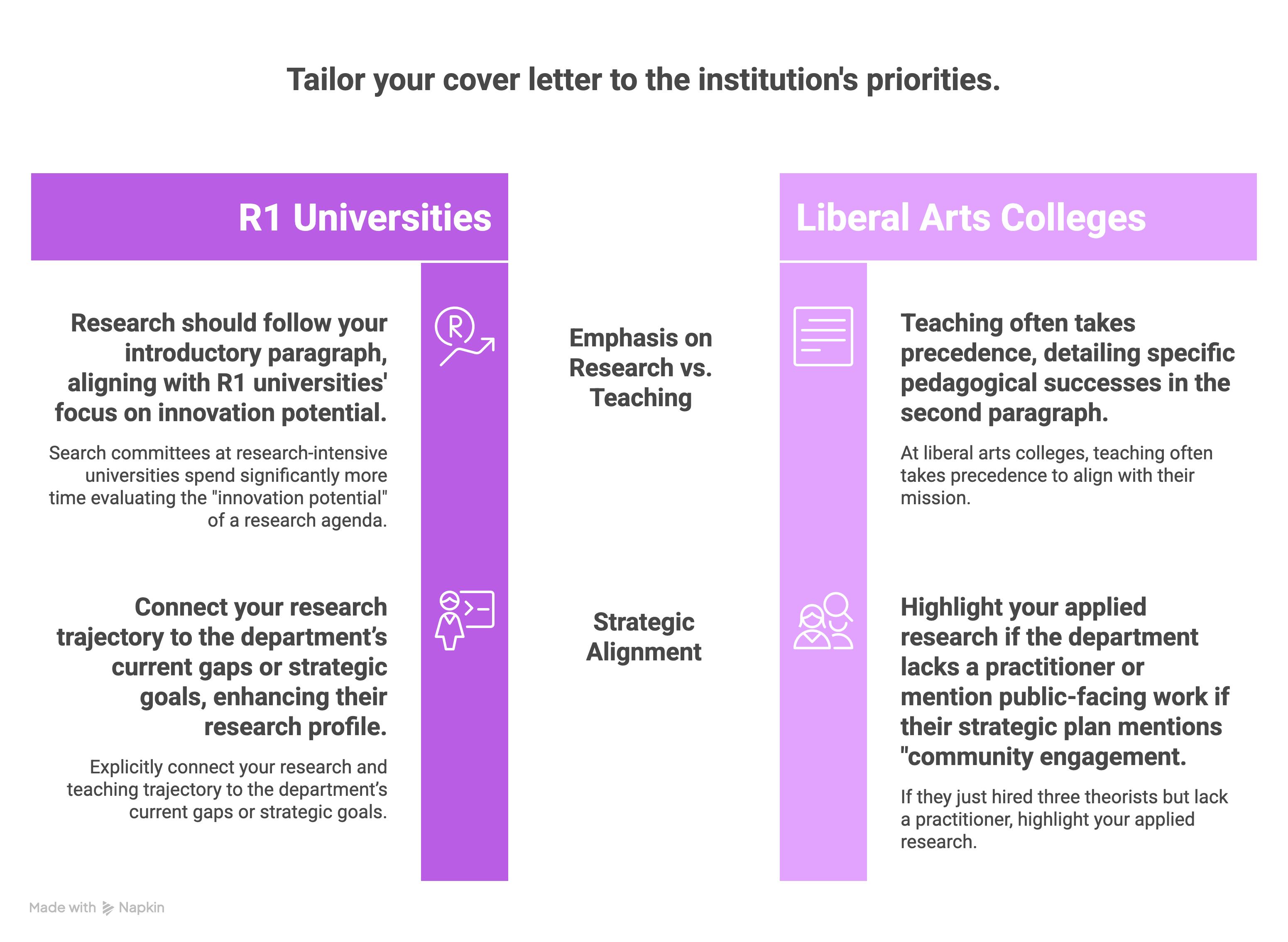
You personalize your cover letter by explicitly connecting your research and teaching trajectory to the department’s current gaps or strategic goals. Rather than summarizing your CV, use this space to explain how your presence will expand their course offerings, enhance their research profile, or bring in new grant opportunities.
Generic letters are the fastest way to the rejection pile. According to a survey, roughly 74% of search committee members prioritize "departmental fit" over the prestige of a candidate's PhD institution.
To achieve this, you need a high-quality assistant professor resume that serves as the foundation, while the cover letter explains the why behind your career moves. Research the department’s recent hires.
If they just hired three theorists but lack a practitioner, highlight your applied research. If their strategic plan mentions "community engagement," mention your public-facing work.
Should my research or teaching experience come first?
The order depends entirely on the institution's mission: at R1 universities, research should follow your introductory paragraph; at liberal arts colleges (SLACs), teaching often takes precedence. Always lead with the activity that aligns with the school's primary revenue driver and mission statement to show you understand their institutional priorities.
According to research published in The Journal of Higher Education, search committees at research-intensive universities spend significantly more time evaluating the "innovation potential" of a research agenda than teaching philosophy (The Journal of Higher Education).
When drafting your narrative, use a clean cover letter format that allows for easy skimming. If you are applying to a teaching-heavy institution, your second paragraph should detail specific pedagogical successes. Use action verbs for resume and cover letter writing, such as "pioneered," "mentored," or "revitalized," to describe your classroom impact.
How do I quantify my academic achievements in a narrative?
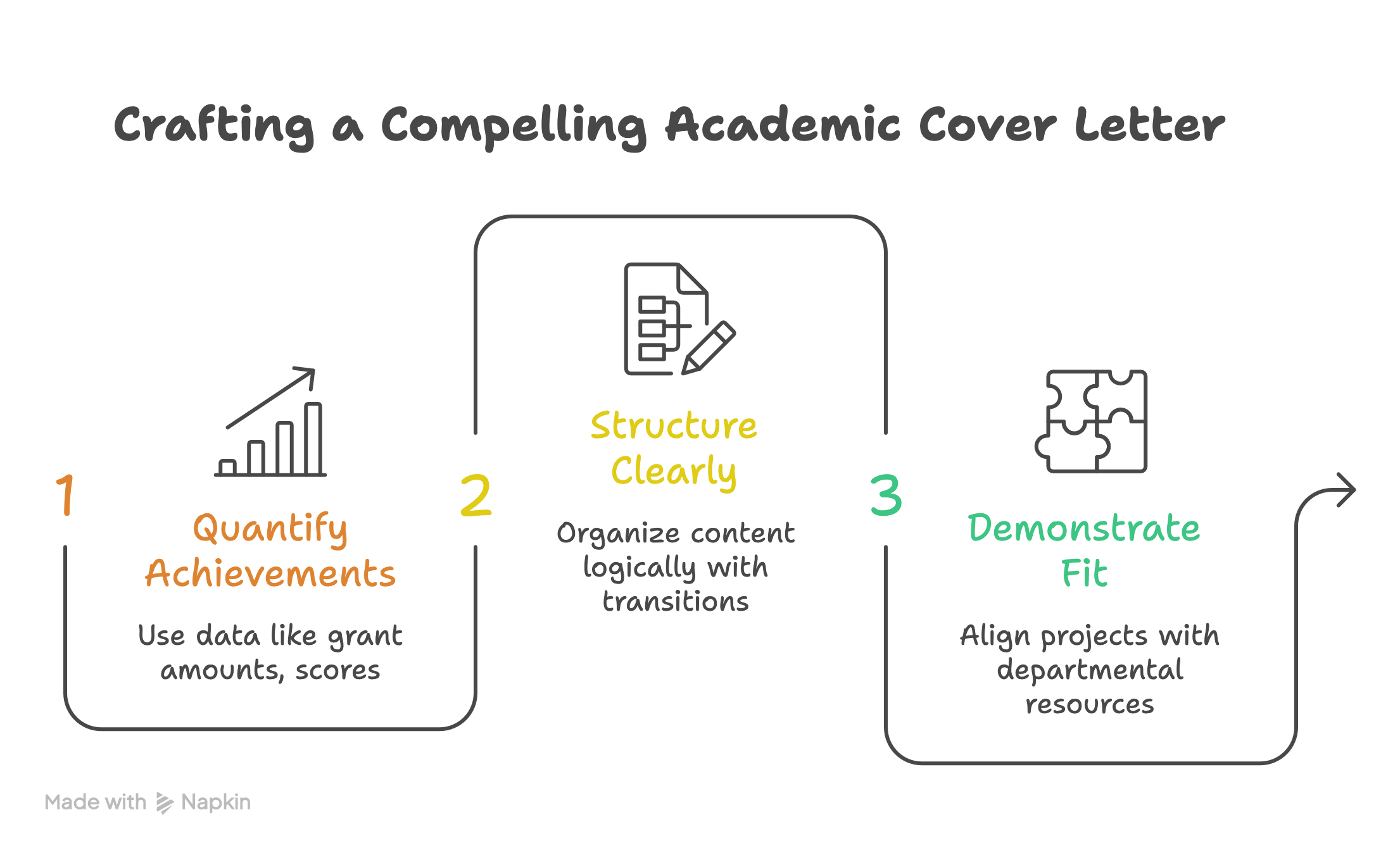
You quantify academic achievements by providing specific metrics such as grant dollar amounts, student evaluation scores, or citation indices within your prose. Instead of saying you "taught many students," state that you "instructed 150+ undergraduates across three distinct curricula," or mention a specific percentage increase in student retention or successful grant funding rates.
Academic committees are increasingly "data-driven." According to a report by the American Association of University Professors (AAUP), the "corporatization" of the university means that even faculty are often evaluated on "measurable outputs".
While your professional skills for resume list might mention "Grant Writing," your cover letter should say: "I secured $45,000 in internal seed funding to launch a longitudinal study." This provides a concrete "proof of concept" for your future success at their institution.
What is the ideal length for a tenure-track cover letter?
The ideal length for an assistant professor cover letter is two to two-and-a-half pages. Anything shorter than two pages suggests a lack of depth or a "one-size-fits-all" approach, while anything exceeding three pages risks losing the reader’s attention in an environment where committees review hundreds of files.
According to sources, search committee members often spend as little as two to five minutes on an initial read-through of an application package.
Because of this time constraint, your cover letter must be highly structured. Use clear transition sentences that signal a shift from research to teaching to service.
This ensures that even a tired committee member can find the information they need in seconds.
How do I address departmental "fit" without sounding desperate?
You address fit by identifying a specific "convergence" between your future projects and the department’s existing resources. Mention specific labs, archives, or interdisciplinary centers at the university where you could collaborate, framing your arrival as a mutually beneficial partnership rather than simply asking for a job.
"Fit" is often the most misunderstood part of the cover letter. According to a study in Higher Education Policy, "fit" is frequently used as a proxy for how easily a candidate can integrate into the existing departmental culture.
Avoid saying "I have always wanted to live in [City]." Instead, say "My current research on urban sustainability aligns with the university's 'Green Initiative,' and I see potential for collaboration with the Department of Civil Engineering."
This moves the conversation from personal desire to professional synergy.
How should I describe my future research agenda?
Describe your research agenda as a five-year roadmap that includes specific publication targets, potential funding sources, and a clear "next step" from your dissertation. You must demonstrate that you have moved beyond being a student and are now an independent investigator capable of sustaining a long-term scholarly program.
According to the National Postdoctoral Association, successful faculty candidates are those who can clearly articulate how their work will evolve over the tenure-track period.
When you explain your trajectory, it should mirror the clarity found in a professional resume format. Don't just list what you have done; list what you will do.
If you have a book under contract or a major article in the "revise and resubmit" stage, mention it explicitly as evidence of your forward momentum.
What is the best way to conclude an academic cover letter?
The best way to conclude is by summarizing your "unique value proposition" and expressing a specific interest in the next steps of the process. Reiterate how your specific combination of research, teaching, and service will advance the department’s mission, then thank the committee for their time and consideration.
A strong conclusion reinforces your professionalism. A "call to action" or a professional closing significantly improves the overall impression of the candidate.
Ensure your contact information matches what is on your resume header. Consistency across all documents - from the cover letter to the research statement, builds a brand of reliability and attention to detail that is essential for any future faculty member.
What Does a Strong Assistant Professor Cover Letter Sample Look Like?
Given below is a customizable assistant professor cover letter sample that brings these elements together. Use it as a starting point and tailor it to the specific department, role, and priorities.
Dear Members of the Search Committee,
I am writing to apply for the Assistant Professor position in [Department Name] at [University Name]. My research focuses on [research area], with particular emphasis on [specific topic or method]. Across my doctoral/postdoctoral work, I have developed a research agenda that connects [field/discipline] with [broader institutional or societal priority], and I am excited by the opportunity to contribute to your department’s work in [specific department strength, program, lab, or initiative].
In my current role as [current title] at [current institution], I have examined [brief research focus] through [methods, datasets, archives, fieldwork, or theoretical approach]. This work has resulted in [publication, conference presentation, grant, book project, or measurable research output]. At [University Name], I would be especially interested in expanding this work by [future research direction] and collaborating with [specific faculty, center, lab, or interdisciplinary program].
My teaching experience includes [courses taught or assisted], where I have worked with [student level or population]. In these courses, I have used [teaching method, assignment design, lab format, discussion model, or assessment approach] to help students build [specific skill or learning outcome]. I would be prepared to teach courses such as [Course 1], [Course 2], and [Course 3], while also developing new offerings in [new course area aligned with department needs].
Beyond research and teaching, I would welcome the opportunity to contribute to [department service, advising, curriculum development, community engagement, or institutional initiative]. My background in [relevant service/leadership experience] has prepared me to support students and collaborate across faculty teams.
Thank you for your time and consideration. I would be grateful for the opportunity to discuss how my research, teaching, and service can contribute to [Department Name] and [University Name].
Sincerely,
[Your Name]
Wrapping Up
A strong assistant professor cover letter does more than present your experience, it positions you as a clear addition to a department’s future.
When your narrative connects research direction, teaching impact, and institutional priorities with precision, you make it easier for committees to see both your fit and your long-term potential.
Getting there often takes more than a few edits.
Hiration supports every step of that process - helping you strengthen your resume, customize your cover letter for specific roles, and practice interviews with AI-driven feedback.
It brings structure to how you improve your application materials and prepare for real interview scenarios, so each application is more focused and effective.
Assistant Professor Cover Letter — FAQs
What makes an assistant professor cover letter effective?
An effective cover letter demonstrates fit with the department by connecting research, teaching, and service directly to institutional priorities.
How should candidates personalize their cover letter?
Candidates should tailor their letter by aligning their work with the department’s gaps, strengths, and strategic goals rather than repeating their CV.
Should research or teaching come first?
The order depends on the institution. Research-focused universities prioritize research, while teaching-focused institutions expect teaching to be emphasized earlier.
How can academic achievements be quantified?
Achievements should include measurable outcomes such as grant funding, student impact, publication metrics, or teaching scale to demonstrate impact clearly.
What is the ideal length of a cover letter?
A tenure-track cover letter is typically two to two-and-a-half pages, balancing depth with readability for time-constrained committees.
How should candidates demonstrate departmental fit?
Fit should be shown through specific alignment with faculty, programs, or initiatives, framed as a mutual opportunity rather than personal preference.
What should a research agenda include?
A research agenda should outline a clear multi-year plan, including future publications, funding opportunities, and the next phase beyond current work.
How should teaching experience be presented?
Teaching should highlight specific courses, methods, and outcomes, along with the ability to contribute new offerings aligned with department needs.
What is the best way to conclude a cover letter?
The conclusion should summarize the candidate’s value and express interest in contributing to the department, followed by a professional closing.
What is the biggest mistake to avoid?
The biggest mistake is submitting a generic letter that summarizes the CV instead of demonstrating clear fit and future contribution.