How can you find and secure high-value apprenticeships in competitive fields?
The best apprenticeships often aren’t advertised publicly — they’re filled through existing employment, pre-apprenticeship programs, or direct outreach to sponsors. To improve your odds, focus on employers known to offer training, target joint-sponsored programs for higher completion rates, and build credibility with foundation courses or certificates. By positioning yourself as a prepared, low-risk candidate, you can unlock high-paying, skill-based careers in trades, technology, or healthcare with long-term earning potential.
Finding an apprenticeship shouldn’t feel like a lottery - yet for many, it does.
You scroll through government listings, attend info sessions, and still come up short against programs that fill before they’re even posted.
The reality?
The best apprenticeships rarely make it to public job boards.
This guide breaks down research-backed tactics for securing competitive, high-completion apprenticeships to give you that edge.
What is the Best Way to Secure an Apprenticeship?
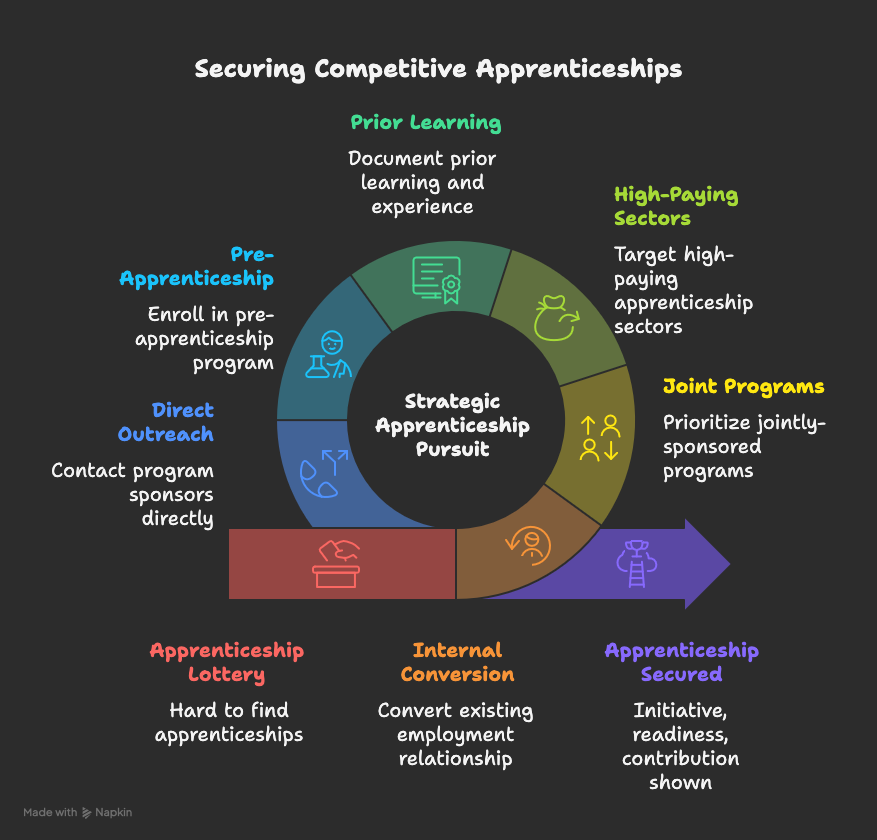
The most statistically successful path is often converting an existing employment or pre-apprenticeship relationship into a registered program, rather than starting cold.
Data suggests 88% of apprenticeships are filled internally, acting as upskilling opportunities for existing staff.
This means you should aim for a "foot-in-the-door" approach. Instead of exclusively searching for "Apprentice" job titles, look for entry-level jobs, trainee roles, or long-term internships at companies known to sponsor apprenticeships.
Get hired, demonstrate your value, and then approach management about transitioning to a registered program.
This flips the script from "Hire me, I have potential" to "I am already a proven asset; formalize my training."
Is a Joint-sponsored Program Better?
Yes, you should prioritize jointly-sponsored programs (those run by labor organizations and employers) as they have a higher probability of completion compared to programs run by single or multiple employers alone, according to research on U.S. construction trade apprentices.
While unilateral programs might finish faster, the certainty of a credential from a joint program is a strategic advantage.
When browsing opportunities, look for partnerships between an employer and a trade union or industry association, which often serve as an intermediary (a third-party organization that helps connect employers and apprentices).
These programs often provide superior support and structure, which significantly lowers the likelihood of cancellation, giving you the best chance to earn that recognized occupational credential.
Also Read: How to make a resume for electrical apprentice opportunities?
Which Apprenticeships Pay the Most?
Yes, some apprenticeship sectors offer far stronger financial returns.
The Bureau of Labor Statistics reports that elevator and escalator installers/repairers have an average wage of $48.11/hour - the top among occupations typically requiring apprenticeships.
While administration and retail roles also offer apprenticeships, the long-term financial payoff is clearer in fields requiring specialized technical training.
An evaluation of the American Apprenticeship Initiative found that apprentices’ earnings rose by 49% on average from the year before starting the apprenticeship to the year after completion.
Top earning fields among apprenticeship-based occupations include:
- Elevator & Escalator Installers & Repairers
- Boilermakers
- Structural Iron & Steel Workers
- Electricians
- Plumbers, Pipefitters, Steamfitters
What Documents Give You a Real Edge?
Don’t rely only on basic application materials - including documentation that supports credit (or recognition) of prior learning or experience can set you apart.
For example, Registered Apprenticeship (RAP) completers tend to command significantly higher wages than non-apprentices with similar demographic and educational backgrounds.
Average exit wages for RAP completers in 2022-2023 exceeded $80,000/year, higher than many associate degree holders.
Plus, for RAP programs, overall completion rates are relatively low (under 35%) meaning that anything you can do to reduce risk or shorten your path (by leveraging past experience) is valuable.
How Can You Stand Out with No Prior Experience?
If you lack direct experience, the most effective move is to enroll in a foundation or pre-apprenticeship program.
These programs act as entry-level pathways that help reduce the risk to employers by giving you foundational knowledge and technical exposure before applying to a full apprenticeship.
In the U.S., pre-apprenticeship programs have shown meaningful results:
- Participants’ earnings nearly doubled from an average of $14,699 in the year before the program to $28,150 in the year after.
- Large proportions of pre-apprentices move on to registered apprenticeships: for instance, 84% in construction and 93% in healthcare.
Including completion of such a program on your application demonstrates that you’re less of a risk and more ready for on-the-job training.
Actionable Steps
- Search for “pre-apprenticeship [Your Trade]” or “foundation program [Your City/Field]” via community colleges, trade schools, or workforce boards.
- Once completed, use your certificate and hours in your cover letter and application to highlight your progress and seriousness.
- Emphasize in your narrative that you have a baseline of training and are ready for mentorship rather than starting from zero.
How Do You Beat the Competition to Hidden Programs?
Skip the crowded job boards - go straight to the source: program sponsors.
Apprenticeship programs often grow through networks and partnerships. Where public information is weak, your outreach becomes your advantage.
Efforts to proactively engage employers show promise: a “consultative sales” outreach model led 12% of targeted employers to register new apprenticeship programs.
Use tools like the Department of Labor’s Partner Finder on Apprenticeship.gov to identify registered apprenticeship sponsors (e.g. industry groups, trade associations, colleges).
Then reach out to ask: “What companies are you developing apprenticeship programs with right now?”
Many employers don’t advertise their interest publicly, but will respond to a well-timed proposal from a training provider or candidate.
By doing this, you turn limited transparency into opportunity, making yourself visible to sponsors and employers before they issue public job postings.
To Sum Up
Securing an apprenticeship isn’t just about meeting eligibility criteria, it’s about showing initiative, readiness, and the ability to contribute from day one.
Whether you’re leveraging prior experience, completing a pre-apprenticeship, or reaching out directly to sponsors, each step strengthens your case.
If you’re preparing your application materials, a strong resume and cover letter can make a real difference.
Hiration’s AI-powered platform helps you craft tailored, professional documents that highlight your skills and training, giving you the confidence to stand out in competitive programs.
Prepare now, so when your ideal apprenticeship appears, you’re first in line to seize it.
High-Value Apprenticeships — FAQ
What’s the most effective way to secure an apprenticeship?
The best route is through internal pathways — get hired in an entry-level or trainee role with a company that sponsors apprenticeships, demonstrate value, and transition into a registered program. This approach works because nearly 9 in 10 apprenticeships are filled internally.
Are joint-sponsored programs better than employer-only programs?
Yes. Apprenticeships jointly sponsored by unions or industry associations and employers have higher completion and credentialing rates, providing stronger long-term career and wage outcomes.
Which apprenticeships offer the highest pay?
Top-paying trades include elevator and escalator repair, boilermaking, electrical work, plumbing, and structural steel. These fields combine technical skill with safety certification, offering average wages above $40 per hour.
How can I stand out if I don’t have prior experience?
Enroll in a pre-apprenticeship or foundation program offered by community colleges or workforce boards. These provide hands-on exposure and significantly boost placement rates into registered apprenticeships — up to 93% in healthcare fields.
What documents strengthen an apprenticeship application?
Include certifications, pre-apprenticeship completions, transcripts, and any documentation proving prior technical training or work hours. Recognition of prior learning can fast-track placement and higher wages post-completion.
Where can I find apprenticeship sponsors directly?
Use the Department of Labor’s Partner Finder to identify sponsors like trade unions, industry groups, or training intermediaries. Contact them directly to learn about upcoming opportunities before they go public.
How can Hiration help me prepare for apprenticeship opportunities?
Hiration’s AI-powered tools help you build targeted resumes, craft strong cover letters, and highlight transferable skills from pre-apprenticeships or prior experience — giving you a clear edge in competitive programs.