What should you master for RESTful API interviews?
Nail the fundamentals (resources/URIs, HTTP methods, status codes, statelessness), then show senior-level judgment: idempotency and retries, versioning strategies, caching (Cache-Control/ETags), authn vs. authz with OAuth2/OIDC and JWT, HATEOAS for evolvability, traffic protection (rate limits/throttling with 429/Retry-After), and API-first design with OpenAPI. For systems rounds, discuss observability (structured logs, metrics, distributed tracing), resilience (circuit breakers, timeouts), and how your choices map to business reliability and velocity. Note: External statistics referenced in the article draft were not independently verified here.
APIs have moved from being a backend utility to the backbone of modern software.
According to the Postman State of the API Report, 74% of organizations now follow an API-first approach, defining their APIs before a single line of code is written.
For developers, this has changed the bar entirely. RESTful API expertise isn’t just a “good to have” anymore, it’s a core skill that directly influences what roles you can land and how confidently you can perform in technical interviews.
But cracking these interviews takes more than memorizing what REST stands for.
To help you prepare at every level, we've compiled 15 high-impact RESTful API interview questions that cover everything from fundamentals to senior-level system design, so you can walk into your next interview with clarity and confidence.
General RESTful API Interview Questions
These questions test your foundational knowledge. Expect them in screening rounds or junior developer interviews.
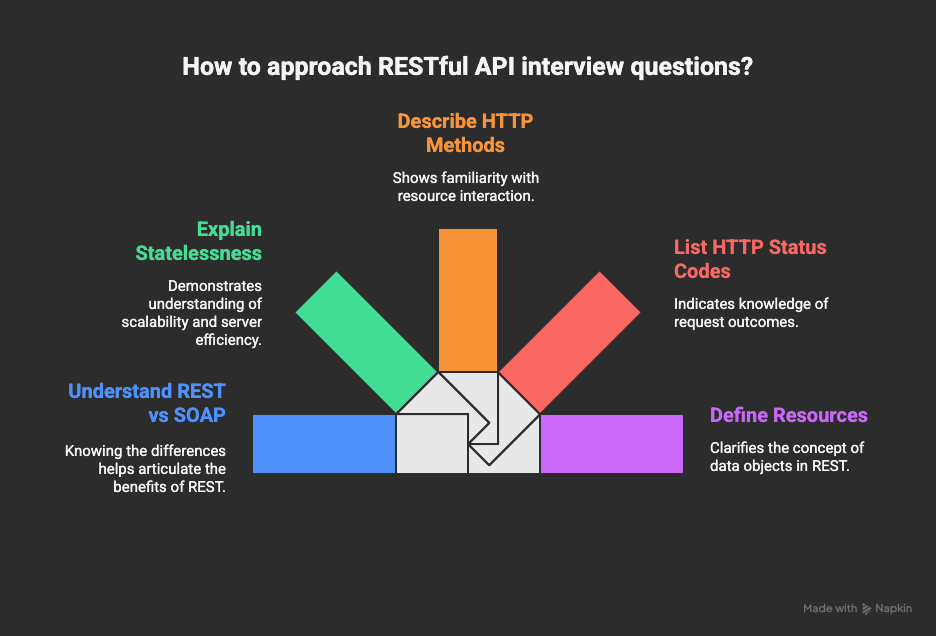
1. What exactly is a RESTful API and how does it differ from SOAP?
Sample Answer: REST (Representational State Transfer) is an architectural style that uses standard HTTP methods for communication, making it lightweight and scalable. SOAP (Simple Object Access Protocol), on the other hand, is a protocol that relies heavily on XML and strict standards.
- REST: Flexible, stateless, supports JSON/XML, better performance.
- SOAP: Protocol-based, stateful, rigid, built-in security (WS-Security).
- Insight: 93.4% of public APIs use REST due to its simplicity compared to SOAP.
2. Can you explain the concept of "Statelessness" in REST?
Sample Answer: Statelessness means the server does not store any client context between requests. Every request from the client must contain all the necessary information (like authentication tokens) for the server to understand and process it. This improves scalability because the server doesn't need to maintain session data, allowing any server to handle any request.
3. What are the most common HTTP methods and their specific uses?
Sample Answer: The core HTTP methods each serve a clear purpose when interacting with resources:
- GET is used to retrieve data. It doesn’t change the resource and is considered safe and idempotent.
- POST is used to create a new resource. It can change server state and is not idempotent.
- PUT updates or fully replaces an existing resource. It is idempotent because repeating the request results in the same outcome.
- PATCH applies a partial update to a resource. It generally is not idempotent because repeated operations may change the result.
- DELETE removes a resource and is treated as idempotent, since deleting an already deleted resource results in the same final state.
Also Read: How to make a job winning developer resume?
4. What are HTTP status codes? Name a few standard ones.
Sample Answer: Status codes are 3-digit numbers indicating the result of a request.
- 2xx (Success): 200 OK, 201 Created.
- 3xx (Redirection): 301 Moved Permanently, 304 Not Modified.
- 4xx (Client Error): 400 Bad Request, 401 Unauthorized, 404 Not Found.
- 5xx (Server Error): 500 Internal Server Error, 502 Bad Gateway.
5. What is a "Resource" in REST architecture?
Sample Answer: A resource is any content or data object accessible via the API, such as a user, product, or image. In REST, every resource is identified by a unique URI (Uniform Resource Identifier). The representation of this resource (e.g., JSON or XML) is what is transferred between client and server.
Also Read: How to make a stellar REST API resume?
Advanced RESTful API Interview Questions
These questions dig deeper into implementation details and best practices.
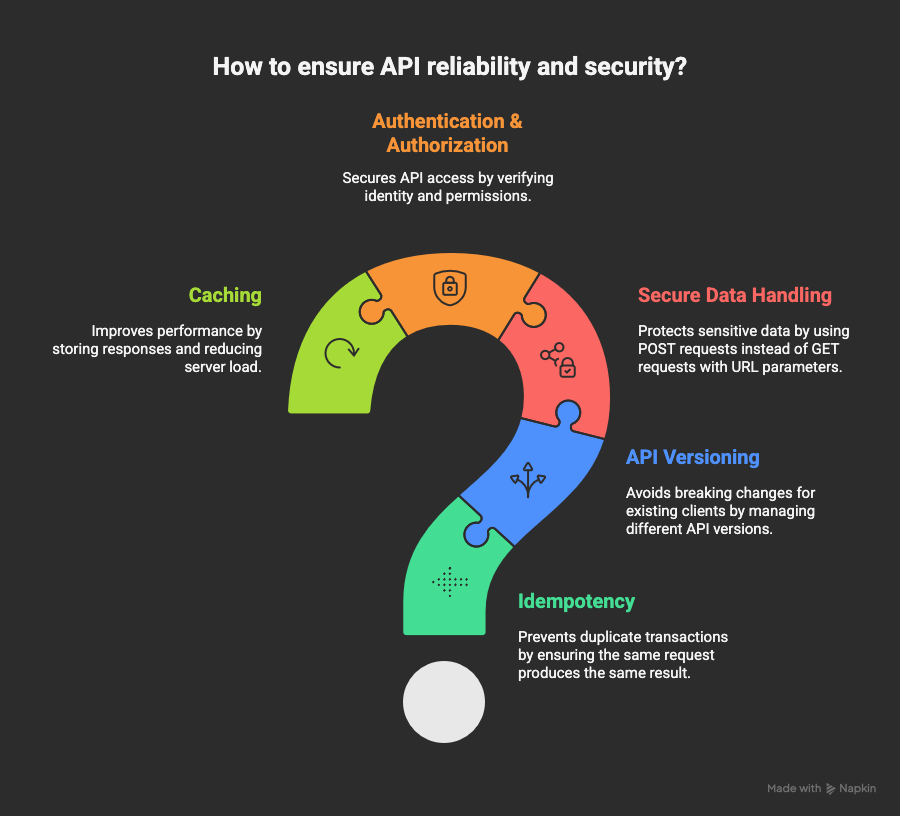
6. What is "Idempotency" and why does it matter?
Sample Answer: An operation is idempotent if making the same request multiple times produces the same result as doing it once.
- Examples:
GET,PUT, andDELETEare idempotent.POSTis NOT idempotent (sending it twice creates two resources). - Why it matters: It ensures reliability. If a client retries a failed request (like a payment), idempotency prevents duplicate transactions.
7. How do you handle API Versioning?
Sample Answer: Versioning is crucial to prevent breaking changes for existing clients. Common strategies include:
- URI Versioning:
/v1/users(Most common). - Header Versioning:
Accept: application/vnd.myapi.v1+json. - Query Parameter:
/users?version=1. - Tip: Always plan for versioning from day one to avoid "documentation debt."
Also Read: How to nail technical coding interviews?
8. Is it secure to send data in the URL of a GET request?
Sample Answer: No, never send sensitive data (like passwords or tokens) in the URL parameters of a GET request. URLs are often logged in server access logs and browser history, exposing that data. Use POST with a request body for sensitive information instead.
9. What is the difference between Authentication and Authorization in APIs?
Sample Answer: Authentication and authorization serve two different purposes in API security:
- Authentication answers “Who are you?” It verifies the identity of the user or system, often through methods like API keys, OAuth flows, or JWT tokens.
- Authorization answers “What are you allowed to do?” Once identity is confirmed, it determines whether that user has the required permissions to access or modify a specific resource.
Because these steps protect access to critical data, they’re central to API security. Recent industry reports show that about 91% of organizations have faced an API security incident, underscoring why both concepts matter.
Also Read: How to prepare for c# interview questions?
10. How does Caching work in REST APIs?
Sample Answer: Caching improves performance by storing copies of responses.
- Client-Side: Browsers cache responses based on headers like
Cache-ControlorExpires. - Server-Side: Reverse proxies (like Varnish) or CDNs cache content to reduce load on the origin server.
- ETags: Used to validate if the cached version is still current, saving bandwidth.
Senior Level RESTful API Interview Questions
Expect these in system design rounds or leadership roles. You will be judged on your ability to design scalable, maintainable systems.
11. What is HATEOAS and how do you implement it?
Sample Answer: HATEOAS, or Hypermedia As The Engine Of Application State, is a REST principle where the server includes actionable links inside its responses. This lets clients discover available actions dynamically. For example, a response from GET /account might include links for deposit, withdraw, or view-transactions. This reduces client-server coupling and allows the API to evolve without breaking existing clients.
Also Read: What are some commonly asked JavaScrirpt interview questions?
12. How would you design an API to handle high traffic and prevent abuse?
Sample Answer: High-traffic APIs need controls that limit how often clients can make requests. Common strategies include rate limiting and throttling using algorithms like Token Bucket or Leaky Bucket. When limits are exceeded, the API should return 429 Too Many Requests with a Retry-After header. With about 63% of developers producing APIs each week, strong traffic management is essential for stability and abuse prevention.
13. How do you manage the complexity of microservices communication?
Sample Answer: Microservices introduce challenges such as network latency, partial failures, and difficulty tracking requests across services. To manage this, teams often use an API gateway to centralize routing and aggregate multiple calls. Circuit breakers (like Hystrix) help contain failures, and distributed logs and tracing tools improve visibility across the system.
14. Explain the “API-First” approach and its benefits.
Sample Answer: API-first means defining the API contract before writing any implementation code, usually with OpenAPI or Swagger. This enables frontend and backend teams to work in parallel, produces consistent documentation, and improves the overall developer experience. API-first organizations report up to 2.3× faster time-to-market because the API becomes the blueprint for all development.
15. How do you prepare APIs for AI agents?
Sample Answer: APIs built for AI agents need precise, machine-readable documentation such as a complete OpenAPI specification. They also require consistent response formats and predictable error handling so agents can interpret responses autonomously. Security and rate controls matter even more now - about 51% of developers are concerned about unauthorized or excessive calls from AI agents, so enforcing limits and authentication is critical.
Also Read: How to ace your first job interview?
Final Thoughts
Preparing for RESTful API interviews isn’t just about knowing the right answers, it’s about being able to explain your reasoning clearly, structure responses under pressure, and translate complex concepts into simple language.
The more you practice, the more confidently you’ll show up in front of hiring managers.
If you want a space to rehearse these moments, Hiration’s interview prep can help you sharpen your delivery.
You can paste job descriptions to generate role-specific technical questions, practice unlimited mock interviews, and get instant feedback on clarity, structure, speech, and even non-verbal cues. It also helps refine your STAR responses so your explanations land with precision.
Strong technical knowledge matters - but knowing how to communicate it is what gets you hired. Hiration helps you bring both together.
RESTful API — Interview FAQs
What’s the fastest way to explain REST vs. SOAP in an interview?
Say: REST is an architectural style using standard HTTP verbs and representations (often JSON); SOAP is a strict XML-based protocol with built-in standards. REST prioritizes simplicity and web-native scalability; SOAP emphasizes rigid contracts and WS-* features.
How do I prove I understand statelessness beyond the definition?
Describe how every request carries auth and context (e.g., JWT, pagination cursor), enabling horizontal scaling and blue/green deployments without session affinity or sticky caches.
Which HTTP methods are idempotent, and why does that matter?
GET, PUT, DELETE (and HEAD/OPTIONS) are idempotent; PATCH and POST generally aren’t. Idempotency enables safe client retries and avoids duplicate side effects under network flakiness.
What’s a pragmatic versioning strategy?
Start with URI versioning (/v1/) and plan deprecation windows. Use semantic changes logs, include Deprecation/Link headers, and support header-based versions for advanced clients if needed.
How do you design secure auth for public APIs?
Use OAuth2/OIDC with short-lived JWT access tokens, audience/issuer checks, and key rotation (JWKS). Validate on the gateway and in services (“zero trust”). Never put secrets in URLs.
What’s your caching playbook?
Leverage Cache-Control/ETag/Last-Modified for client/proxy caches, vary by auth or content when needed, and place CDN or reverse proxy in front for hot endpoints. Always define validation paths to avoid stale data bugs.
How do you prevent abuse and smooth traffic spikes?
Rate limit per API key/IP with token bucket or leaky bucket; return 429 Too Many Requests + Retry-After. Add quotas, request timeouts, backoff guidance, and burst credits for UX.
HATEOAS sounds theoretical—when is it useful?
For discoverable, evolvable clients (SDKs, partner integrations), embed actionable links in responses (e.g., “next”, “cancel”, “refund”) to reduce tight coupling to URL structures and workflows.
How do you make APIs observable?
Emit structured logs with correlation/trace IDs, standard metrics (latency, error rate, saturation), and distributed traces across services. Surface SLIs/SLOs and alert on error budgets, not only CPU/RAM.
What does “API-first” look like in practice?
Author the OpenAPI spec first, review it cross-functionally, auto-generate stubs/SDKs, mock servers for parallel dev, and treat the spec as the contract that drives docs, tests, and governance.