What should job seekers understand before pursuing a Quality Analyst role?
You don’t need a computer science degree to start. Focus on SDLC basics, test case writing, bug documentation, SQL fundamentals, and understanding how software behaves. Build a resume that highlights transferable skills, learn manual testing first, and introduce automation once you grasp core concepts.
The role of a Quality Analyst (QA) has evolved from simple bug-catching to a strategic position that protects a company’s reputation.
With the global quality assurance service market projected to reach $26.5 billion by 2033, according to Market Mind Partners, the opportunities are vast, but the competition is fierce.
Whether you're entering the profession, switching from another domain, or mapping your path toward senior roles, understanding the skills, certifications, and realities of modern QA work can make all the difference.
This guide breaks down those essentials so you can move forward with clarity and confidence.
1. Do I need a computer science degree to get quality analyst jobs?
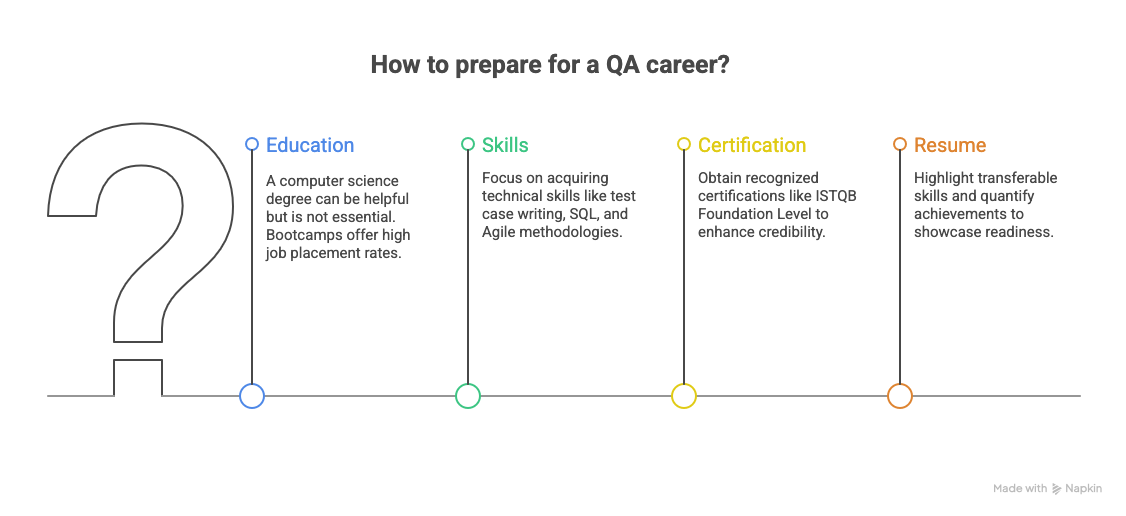
No, a degree is not strictly required. While a bachelor’s in computer science helps, reputable bootcamps now boast job placement rates of 72% to 90% within six months according to Switchup and Course Report statistics.
Employers prioritize demonstrable skills like knowing the Software Development Life Cycle (SDLC) and basic SQL, over university pedigree.
Many successful QAs transition from customer support or administrative roles because they understand the user perspective.
If you lack a degree, focus on obtaining a recognized certification like the ISTQB Foundation Level.
When building your application, review resume examples to see how others structure their non-traditional backgrounds to highlight transferable skills like attention to detail and process documentation.
2. What are some technical skills required for entry-level roles?
You must be proficient in writing test cases, executing manual tests, and documenting bugs in tracking tools like Jira. Additionally, basic knowledge of SQL for database validation and an understanding of Agile methodologies are now standard requirements.
In 2025, even entry-level roles often expect familiarity with API testing concepts.
Plus, "technical" does not always mean "coding." It means understanding how software is built.
You need to know the difference between a functional requirement and a bug.
For instance, if you are eyeing specialized sectors such as healthcare, you can get a competitive edge by showing you understand industry-specific compliance standards like HIPAA.
3. How do I format my quality analyst resume if I have no direct experience?
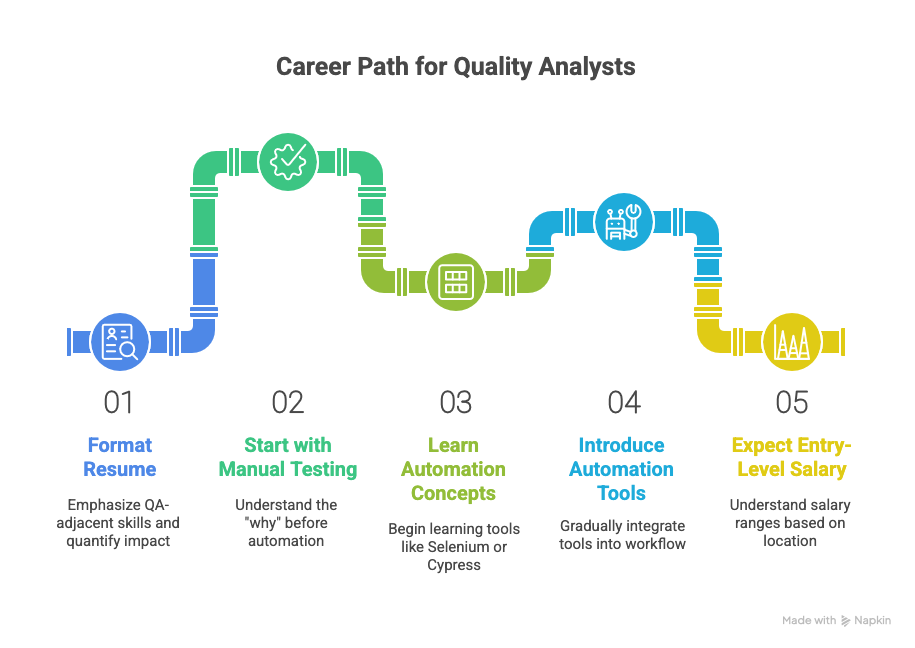
Use a functional resume format that emphasizes "QA-adjacent" skills. Highlight instances where you identified errors, improved processes, or documented detailed instructions in previous jobs.
Quantify your impact; for example, "Reduced data entry errors by 15% through new verification protocols."
Structure your resume to show you are ready for the modern workflow, showcasing your ability to think logically and systematically.
4. Is it better to start with manual testing or jump straight to automation?
Start with manual testing to understand the "why" before the "how." 89% of client requests still require manual expertise to handle complex user scenarios that scripts miss, according to Forbes. However, start learning automation concepts immediately, as hybrid roles are becoming the industry standard.
Manual testing teaches you empathy for the user and how to break the software creatively. Once you grasp the basics, you can slowly introduce tools.
Once you grasp the fundamentals, you can begin introducing tools like Selenium or Cypress to automate repetitive tasks.
5. What salary can I realistically expect in my first year?
In the United States, entry-level Quality Analyst jobs typically start between $55,000 and $70,000 annually, according to ZipRecruiter data.
However, this varies significantly by location and industry, with finance and tech hubs like San Francisco or New York offering higher starting packages closer to $80,000, according to Zippia.
Don't just look at the base salary; look at the learning potential.
A lower-paying job that offers mentorship in automation tools (like Selenium or Cypress) is worth more in the long run than a higher-paying dead-end manual testing role.
Also Read: What are the 7 things you must consider before accepting a job offer?
6. How do I transition from a Manual Tester to an Automation Engineer?
You must learn a scripting language, with Python or Java being the most in-demand. Start by automating your "smoke tests" - the simple, repetitive checks you do every morning. This provides immediate value to your team and gives you a safe sandbox to practice your coding skills.
The automation market is exploding, projected to reach $68 billion by 2025, according to Global App Testing.
You don't need to be a full-stack developer, but you must be comfortable reading developer code and understanding the procedural logic required for writing reliable test scripts.
7. Which certifications actually help me get a promotion?
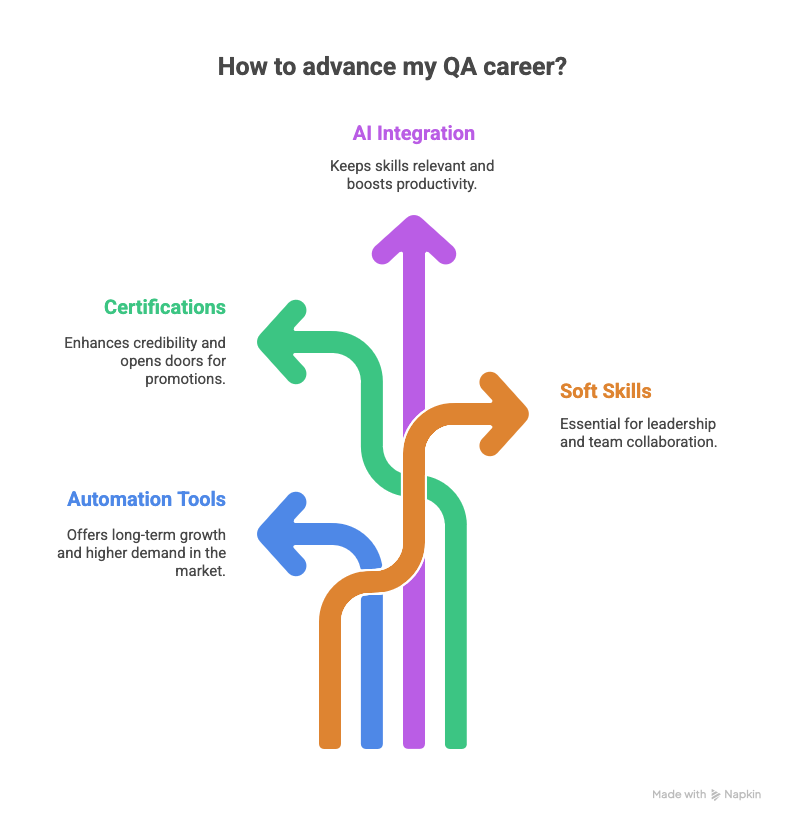
The ISTQB Advanced Level (Test Analyst or Test Manager) is widely respected globally. For agile teams, the Certified Agile Tester (CAT) is valuable. However, practical certifications in specific tools like AWS Certified Developer or a Selenium certification, often carry more weight for technical promotions.
92% of ISTQB-certified testers feel the certification demonstrates professional competency, according to TestDevLab.
Use these credentials to negotiate a raise or title change by focusing on how they translate into improved quality metrics for the company.
8. How can I stay relevant as AI tools enter the QA space?
Become an "AI-augmented" tester. Use AI tools to generate test data, write boilerplate code for automation scripts, and brainstorm edge cases. 40% of testers already use AI tools to assist their workflows, according to Testlio.
Position yourself as the expert who validates the AI's output. AI is a productivity multiplier, not a replacement.
It can write a test script, but it doesn't know what to test or why it matters to the business.
Your value lies in strategy, critical thinking, and empathy for the end-user experience.
9. What soft skills distinguish a Senior QA from a Mid-level QA?
Influence and negotiation are critical. A Senior QA doesn't just report bugs; they advocate for quality early in the design phase (Shift Left). You need the confidence to push back on unrealistic deadlines and the diplomacy to maintain good relationships with developers while critiquing their code.
Developing strong interpersonal skills is non-negotiable.
Senior roles require you to lead by example, mentoring junior team members and building consensus across cross-functional teams.
10. Should I specialize in a niche like Security or Performance testing?
Yes, specialization is the fastest route to a six-figure salary. Security QA Analysts (Penetration Testers) and Performance Engineers often earn 20-30% more than generalist QAs.
With cyber threats rising, security testing is particularly lucrative and future-proof.
If you enjoy breaking things, security is for you. If you love optimizing speed and scalability, look into performance testing.
11. What is the career ceiling for a Quality Analyst?
There is no ceiling if you pivot correctly. The natural progression is QA Lead -> QA Manager -> Director of Quality. However, many seniors move into product roles or even DevOps. A "Head of Quality" or "VP of Engineering" can easily command salaries upwards of $170,000 to $200,000, according to PayScope.
Your deep understanding of the product makes you a prime candidate for Product Management.
If you pivot towards a leadership role in Engineering, frame your experience not just as testing, but as process optimization, risk management, and overall delivery strategy.
12. What are the biggest hiring trends for quality analysts?
Managers are hiring "T-shaped" employees - people with deep expertise in one area (like automation) but broad skills in others (like CI/CD, security, and manual testing). They are also looking for soft skills, specifically the ability to adapt to rapid changes in AI and Agile environments.
The era of the "siloed tester" is over. As a hiring manager, you want problem solvers.
When applying for your next role, don't just list tools; tell stories of how you improved overall quality culture and team efficiency.
Also Read: What are some AI-driven job market changes that you must know about?
Wrapping Up
Breaking into Quality Assurance jobs or moving up the ladder, comes down to clarity, consistency, and staying ahead of how the industry evolves.
Whether you're positioning yourself for that first entry-level role or eyeing leadership pathways, the fundamentals remain the same: demonstrate impact, deepen your technical range, and show that you understand quality as a business function, not just a testing task.
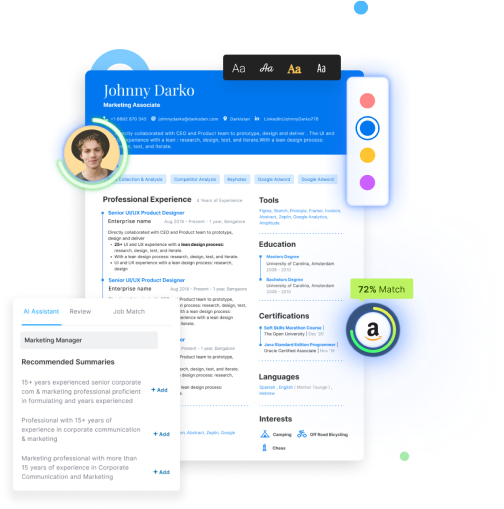
If you’re strengthening your resume/cover letter, refining your interview prep, or exploring ways to present your QA journey more confidently in LinkedIn, Hiration can help you put your best foot forward.
From role-aligned resume optimization to AI-driven interview practice, it’s built to support job seekers navigating competitive fields like QA, without the overwhelm.
Build the skills, show the value, and stay curious. The opportunities will follow.
Quality Analyst Jobs — FAQ
Do I need a computer science degree to become a QA?
No. Employers care more about SDLC understanding, test case writing, and basic SQL than your major. Certifications like ISTQB can strengthen your application if you’re coming from a non-technical background.
What technical skills should entry-level QAs focus on?
Start with manual testing fundamentals—test cases, bug reports, Agile basics, and tools like Jira. Add SQL for database checks and learn API testing concepts early.
How do I present QA-relevant skills if I have no prior experience?
Use a functional resume that highlights analytical tasks, error-spotting, process improvements, and documentation from previous roles. Quantify improvements wherever possible.
Should I start with manual testing or learn automation immediately?
Start with manual testing to learn how software behaves. Once you understand the foundations, introduce automation tools like Selenium or Cypress to expand your skillset.
What salary can an entry-level QA expect in the U.S.?
Most entry-level roles fall between $55,000 and $70,000, with higher ranges in major tech hubs. Look for roles that offer mentorship and growth rather than focusing only on salary.
How do I transition from Manual Tester to Automation Engineer?
Learn a scripting language like Python or Java and start automating simple, repetitive tests. Build comfort with automation frameworks as you progress.
Which certifications help with career growth in QA?
ISTQB Advanced, Certified Agile Tester, and tool-specific certifications (like Selenium or AWS) help demonstrate expertise and can support promotions or salary negotiations.
How can QAs stay relevant as AI tools enter the industry?
Use AI to generate test ideas, create sample data, and assist with automation boilerplate—but position yourself as the human who validates and interprets results.
What soft skills separate senior QAs from mid-level QAs?
Influence, communication, and the ability to advocate for quality early in the process. Senior QAs mentor others and collaborate closely with product and engineering teams.
Is it beneficial to specialize in areas like security or performance testing?
Yes. Specializations such as security, performance, or API automation are in high demand and often lead to higher salaries and faster career progression.
What is the long-term career path for a Quality Analyst?
Common paths include QA Lead, QA Manager, Director of Quality, or transitions into Product, DevOps, or Engineering leadership roles depending on interests and skills.
Can Hiration help me strengthen my QA job applications?
Yes. Hiration helps candidates refine resumes, prepare for interviews, and optimize LinkedIn profiles to present their QA skills confidently and clearly.