How can the Pomodoro effect help you work with more focus and less burnout?
The Pomodoro effect improves productivity by breaking work into short, distraction-free focus sprints followed by intentional breaks. This structure reduces the mental cost of interruptions, prevents multitasking, and helps you sustain energy across the day. It is especially useful for job seekers because it turns overwhelming tasks like resume writing, LinkedIn optimization, and interview preparation into clear, measurable sessions with defined outcomes.
Ever feel like you’ve worked a full eight-hour day but accomplished absolutely nothing?
You aren’t alone.
Between constant Slack pings and the urge to check "just one more" email, our focus is under siege.
Fortunately, a simple time-management strategy called the Pomodoro effect can help you reclaim your brain and your career.
What is the Pomodoro effect?
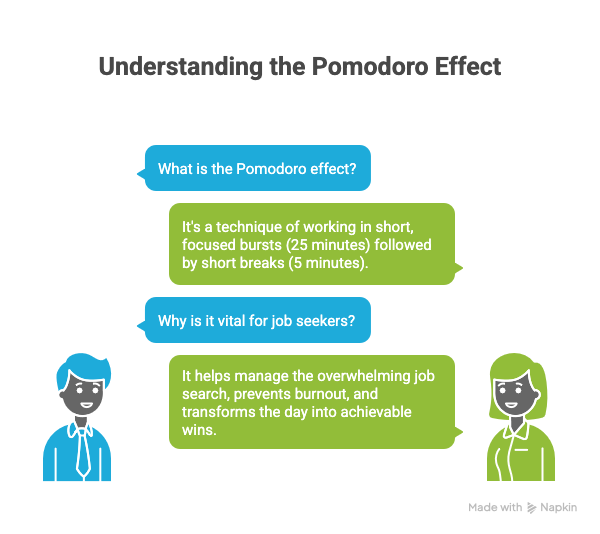
The Pomodoro effect refers to the psychological and productivity benefits of working in short, hyper-focused bursts followed by scheduled breaks. Traditionally, you work for 25 minutes (one "Pomodoro") and then rest for 5 minutes. This rhythm prevents mental fatigue, sustains high-level focus, and creates a sense of urgency that helps you beat procrastination.
According to Francesco Cirillo, who developed the technique in the late 1980s, breaking down work into indivisible units of time helps you treat time as a friend rather than an enemy.
This is backed by research published in PMC, which found a strong positive correlation (0.72) between using this technique and improved concentration levels.
Why is the Pomodoro effect vital for job seekers?
For job seekers, the Pomodoro effect provides a structured framework to manage the overwhelming "full-time job" of finding work. It prevents the burnout associated with endless application scrolling and helps you dedicate specific blocks to high-impact tasks. By setting a timer, you transform a vague, daunting day into a series of achievable wins.
Searching for new opportunities on various job search sites can quickly lead to "decision fatigue."
According to LifeAt, your brain can only maintain optimal focus for 20-45 minutes before it needs a reset to avoid cognitive overload.
Using Pomodoros ensures you spend your most alert intervals on critical tasks, like tailoring your resume for a specific role, rather than getting lost in the rabbit hole of LinkedIn browsing.
What does the research say about the cost of interruptions?
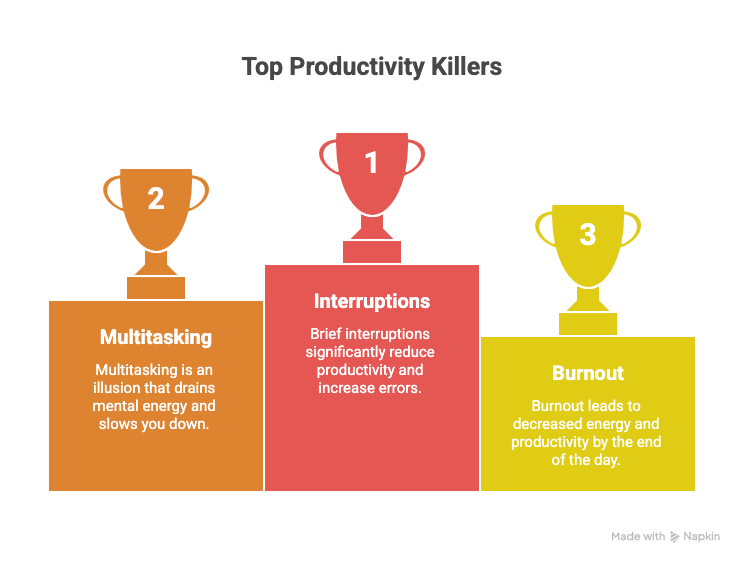
Research shows that even brief interruptions are productivity killers that cost far more than just the time of the distraction itself. Every time you switch tasks or answer a ping, your brain pays a "switching cost." This fragmentation of thought leads to more errors, higher stress levels, and a significant drop in the quality of your output.
According to Gloria Mark at the University of California, Irvine, it takes an average of 23 minutes and 15 seconds to regain deep focus after a single interruption.
This means if you check your phone just three times an hour, you never actually reach a state of deep work.
Furthermore, a Microsoft productivity study found that brief interruptions double the likelihood of making mistakes on complex tasks.
How can the Pomodoro effect improve your resume building?
The Pomodoro effect improves resume building by forcing you to focus on one section at a time without distractions. Instead of trying to "write a resume" in one go, you dedicate one Pomodoro to your header, another to your professional summary, and another to your experience. This granular focus ensures higher quality and fewer typos.
When you sit down to write a resume, the sheer volume of information can be paralyzing.
By using 25-minute sprints, you can focus purely on articulating your work experience section or refining your resume skills.
This approach leverages the Zeigarnik Effect, which suggests our brains remember unfinished tasks more vividly, keeping you motivated to "close the loop" in your next session.
How do you avoid the multitasking trap?
You avoid the multitasking trap by strictly adhering to the "one task per Pomodoro" rule and silencing all notifications. Multitasking is an illusion; your brain is actually just rapidly switching between tasks. By committing to a single objective for 25 minutes, you eliminate the cognitive friction that drains your mental energy and slows you down.
For instance, if you are trying to optimize your LinkedIn profile, while simultaneously responding to emails, you are essentially working at 60% capacity.
By using the Pomodoro effect, you protect your "flow state."
How does the Pomodoro effect prevent workplace burnout?
The Pomodoro effect prevents burnout by mandating regular "brain breaks" that allow your prefrontal cortex to recover. These breaks act as a "release valve" for stress and cognitive load. By resting before you feel exhausted, you maintain a consistent energy level throughout the day, rather than crashing by 3:00 PM and losing your evening.
A study published in PMC revealed that the Pomodoro technique significantly reduced academic burnout and stress levels in students by providing a built-in reward system.
Furthermore, DeskTime research found that the top 10% of most productive employees don't actually work more hours; instead, they take frequent, high-quality breaks to stay sharp.
Is the 25-minute interval always the best?
While 25 minutes is the standard, the best interval depends on your specific task and personal attention span. Some people find longer sessions more effective for "deep work," while others prefer shorter bursts for administrative tasks. The key is finding a consistent rhythm that balances intense focus with genuine rest.
According to the study by DeskTime's data, in a remote work environment, the most productive people have shifted to a 112-minute work session followed by a 26-minute break.
You can experiment to see which "Pomodoro" duration fits your current workflow.
To Sum Up
The Pomodoro effect ultimately works because it restores intention to how you spend your mental energy.
By working in focused intervals, protecting your attention, and building in real recovery time, you turn productivity from a constant struggle into a repeatable system.
And applying the Pomodoro effect to job searching works best when each session has a clear outcome, whether that is improving one resume section, practicing a single interview answer, or refining your LinkedIn profile.
Hiration are designed to fit naturally into these focused sprints, helping you break career prep into structured, high-impact tasks without overwhelming you.
When focus and structure work together, momentum follows.
Pomodoro Effect — FAQs
What is the Pomodoro effect?
The Pomodoro effect refers to the productivity benefits of working in short, focused bursts followed by planned breaks. The traditional structure is 25 minutes of focus and 5 minutes of rest, repeated across the day to sustain concentration and reduce fatigue.
Why does the Pomodoro effect work so well for job seekers?
Job searching can feel endless and cognitively draining. Pomodoro sessions reduce overwhelm by turning vague goals into clear sprints, helping you dedicate focused blocks to high-impact tasks like tailoring a resume, practicing one interview answer, or refining a LinkedIn section.
What does research say about interruptions and focus?
Interruptions impose a “switching cost,” making it harder to regain deep focus and increasing errors. The Pomodoro effect protects attention by encouraging single-task focus while minimizing disruptions during the sprint.
How can I use Pomodoros to build or improve my resume faster?
Break resume work into single-section sprints. Use one Pomodoro for your header and targeting, one for your summary, one for rewriting bullet points, and one for skills—so each session produces a concrete, high-quality output without scattered effort.
How do I avoid multitasking while using the Pomodoro effect?
Commit to one objective per Pomodoro and silence notifications. Multitasking is rapid task-switching, which drains energy and reduces output quality. A single-task sprint protects your flow state and improves results.
How does the Pomodoro effect help prevent burnout?
Regular breaks act as a recovery mechanism, reducing cognitive load before exhaustion builds. By resting predictably, you maintain steadier energy throughout the day instead of pushing until you crash.
Is 25 minutes always the best Pomodoro length?
Not necessarily. The ideal interval depends on your task and attention span. Some work benefits from longer deep-focus sessions, while admin tasks may benefit from shorter sprints. The core principle is consistent focus plus real recovery.
What should I do during Pomodoro breaks to reset properly?
Use breaks for true mental recovery: step away from the screen, stretch, hydrate, or take a short walk. The goal is to reduce cognitive load so the next sprint starts fresh rather than fragmented.