What does a market research analyst actually do?
A market research analyst studies consumers, competitors, and trends to guide business decisions. The role blends data analysis with clear storytelling—using surveys, statistical tools, and market insights to answer what customers want and why. Note: External statistics referenced in the draft were not independently verified here.
Today’s marketplace is flooded with signals, trends, and opinions - but data is the only thing that brings clarity.
That’s why companies are scrambling to hire professionals who can decode consumer behavior.
In fact, according to the U.S. Bureau of Labor Statistics (BLS), employment for market research analysts is projected to grow 7% from 2024 to 2034, which is much faster than the average for all occupations.
If you want to ride this wave, you need more than just a degree - you need a strategy.
Read on to learn everything related to market research analyst jobs.
What do you do as a market research analyst?
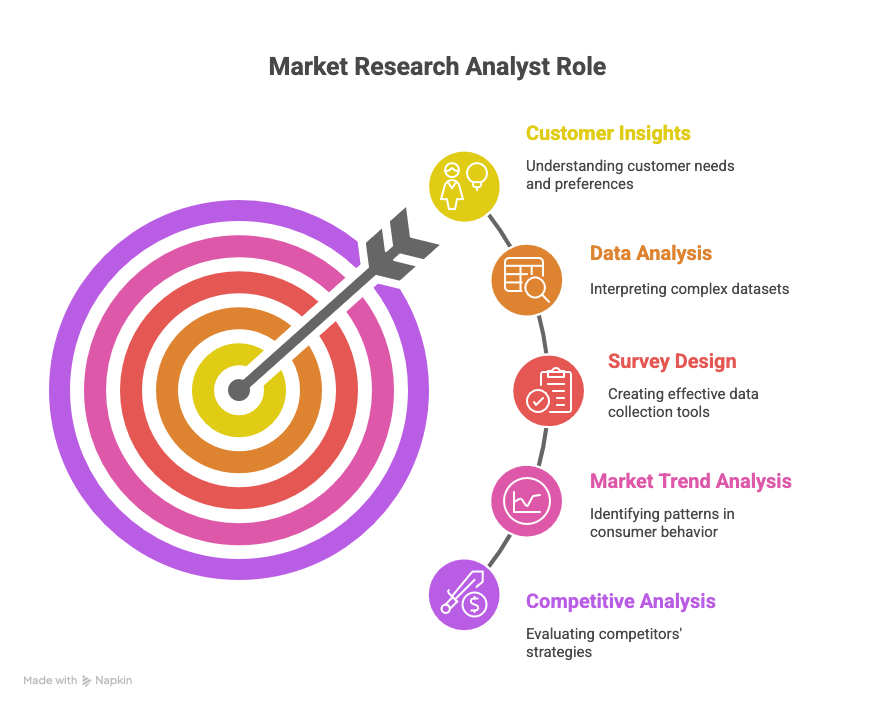
A market research analyst gathers data on consumers and competitors to help companies market their products effectively. They design surveys, analyze market trends, and interpret complex datasets to answer one burning question: What do customers actually want?
Their insights directly shape pricing, branding, and product features.
While the generic definition sounds simple, the day-to-day reality is a mix of detective work and storytelling.
You aren't just crunching numbers; you are translating them into a narrative that stakeholders can understand.
Also Read: What is the job description of an analyst?
What qualifications do I need to be a market research analyst?
You typically need a bachelor’s degree in marketing, business, statistics, or psychology, but a specific "market research" degree isn't mandatory. What matters most is your ability to handle data.
Employers value coursework in statistics, research methods, and communications over the specific name of your major.
For entry-level roles, a strong bachelor's is the standard ticket in.
However, if you are aiming for senior roles or highly technical positions, a master’s degree can be a significant differentiator.
Interestingly, many successful analysts transition from related fields by highlighting transferable abilities - similar to how one might leverage business analyst skills to pivot into market research.
What skills do you need to be a market research analyst?
You need a hybrid of "hard" data skills and "soft" psychological insights. Specifically, proficiency in SQL, Python, or R is becoming non-negotiable for high-paying roles, alongside mastery of visualization tools like Tableau or Power BI.
On the soft side, critical thinking and the ability to explain "the why" behind the data are paramount.
Don't just rely on Excel. According to Teal's 2025 skills report, technical proficiency in statistical software (SPSS, SAS) and programming languages is crucial for handling complex datasets.
What is a market research analyst's salary?
According to the U.S. Bureau of Labor Statistics, the median annual wage for market research analysts was $76,950 in May 2024, with the top 10% earning more than $144,610.
Entry-level positions generally start between $50,000 and $65,000, while specialized roles in finance and information sectors pay significantly more, often exceeding $100,000.
Plus, compensation varies heavily by industry. For instance, analysts in the publishing and finance industries often command higher salaries compared to those in wholesale trade.
If you want to maximize your earning potential early on, target industries known for data-driven decision-making, such as tech or finance.
Also Read: How much do business analysts make in a year?
Which certifications are worth my time?
The most valuable certifications come from recognized industry bodies like the Insights Association or the Project Management Institute. The "IPC Analytics" certificate or the "Certified Analytics Professional (CAP)" designation are highly credible.
What differentiates these from generic online courses is the depth of assessment.
They test your ability to design research frameworks, interpret complex datasets, and communicate findings responsibly - the exact competencies hiring managers look for when evaluating analysts.
If you're early in your career, even one well-chosen certification can signal seriousness and give you a competitive edge.
For mid-level professionals, certifications help demonstrate that you’ve expanded beyond tactical data work into strategic insight generation.
How do I crack the interview?
Prepare for "case study" questions where you must explain your process, not just your answer. Interviewers will ask you to forecast sales for a hypothetical product or analyze a failed marketing campaign. You must demonstrate a structured approach: define the problem, choose a data collection method, analyze the results, and present a recommendation.
For example, you might be asked, "How would you analyze a market with limited data?"
Your answer should show proactive problem-solving, such as using proxy data or conducting quick qualitative surveys.
To practice, you can look at related business analyst interview questions and answers which often share the same logic-based structure used in market research interviews.
Pro Tip: Most candidates only have a resume. You should build a portfolio. Pick a brand you love, run a small survey (using free tools like Google Forms), analyze the responses, and create a 3-slide deck with recommendations. Bring this to your interview. It proves you can do the job before you are even hired.
Wrapping Up
Breaking into market research is ultimately about proving you can do two things well: understand people and interpret data.
Degrees help, certifications help, but what truly moves your career forward is your ability to show clear thinking, structured analysis, and evidence that you can turn insights into decisions.
If you want support building that foundation - whether it’s refining a data-focused resume, practicing case-style interview answers, or showcasing your work on LinkedIn, Hiration can help.
After all, market research is built on one thing above everything else - the ability to turn data into direction.
Market Research Analyst — FAQs
What qualifications do I need to become a market research analyst?
A bachelor’s degree in marketing, business, statistics, psychology, or a related field is standard. Strong data skills matter more than the specific major, and advanced roles may prefer a master’s degree.
Do I need to know programming for this job?
For higher-paying roles, proficiency in SQL, Python, or R is increasingly expected. Visualization tools like Tableau or Power BI are also valuable.
How much does a market research analyst earn?
Median pay is around $76,950 annually, with senior or specialized roles exceeding $100,000. Industry and location significantly influence salary ranges.
Are certifications necessary?
Not required, but well-regarded certifications—such as CAP or Insights Association credentials—signal credibility and can help with career advancement.
How can I prepare for a market research analyst interview?
Expect case-style questions that test your process and structure. Build a small portfolio project, such as a survey analysis, to demonstrate real skills.