What should you expect in a final interview?
Final interviews shift from testing skills to evaluating judgment, strategic thinking, and long-term impact. Expect scenario-based questions, conversations about values, and deeper scrutiny from senior leaders. Treat this round as a consultation, not a Q&A session. Your goal is to show how your decisions drive business outcomes and how your leadership style aligns with the company’s future direction. Note: The success-rate statistics included above come from your draft; I cannot independently verify them.
Reaching the final interview means you’ve already cleared the toughest screens - but it also marks the point where expectations change.
These conversations are typically led by senior executives, VPs, or even the CEO, which means the focus shifts from skills to judgment, maturity, and impact.
Thus, this round often feels different with fewer technical questions, and more scenario-based discussions, deeper conversations about values, and sharper scrutiny on how you think under pressure.
Beyond listing the common final-round questions, this guide also explains why these questions are asked and how to structure your responses so you stand out as the candidate they can confidently choose.
What is the success rate of a final interview?
While it varies by industry, data suggests your chances of receiving an offer after a final interview generally hover between 30% and 50%.
Companies typically narrow the field to 2-3 finalists at this stage.
Many candidates falsely assume the final interview is just a "culture fit" formality. It is not.
According to SafeGraph, a healthy interview process often yields a "thumbs up" rate of roughly 30-50% for finalists.
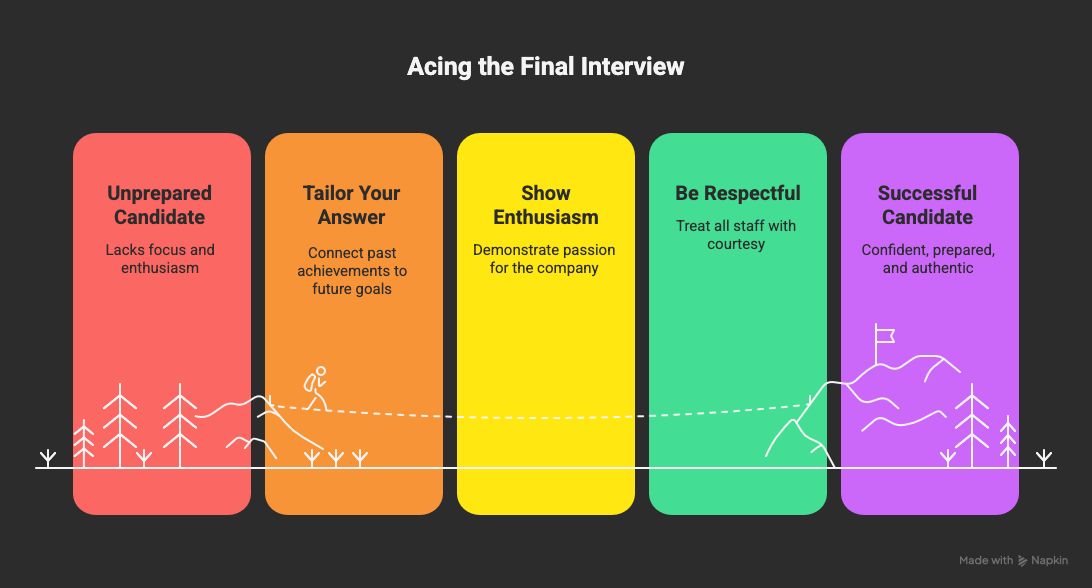
If you are one of four candidates, the math gives you a 25% shot - but you can improve those odds by treating this round as a consultation rather than an interrogation.
This is where you must demonstrate not just competence, but impact. You aren't just a candidate anymore; you are a potential investment.
What are some commonly asked final interview questions?
Listed below are 10 final interview questions commonly asked by employers to gauge your executive presence, strategic vision, and critical thinking.
At this elite stage, you are being vetted for your potential to be a long-term, high-impact leader, not just for basic competency.
Vision and Alignment
- "Where do you see the company/department in five years, and how will your contribution specifically accelerate that vision?"
Goal: This tests if the candidate has done enough research to internalize the company’s long-term strategy and can articulate their role beyond just their immediate job duties.
Stakeholder Conflict
2. "Tell me about a time you had to move forward with a critical decision where a key internal stakeholder (e.g., a peer, senior leader, or direct report) fundamentally disagreed with your approach. How did you handle that relationship and the ultimate outcome?"
- Goal: To assess maturity, influence, and the ability to navigate complex "disagree and commit" scenarios, which are common in senior roles.
Resource Scarcity
3. "If you had to choose between two equally promising, high-value projects, but only had the resources (budget, time, people) to pursue one, how would you make the final decision and justify the one you deferred?"
- Goal: This is a test of strategic prioritization, risk assessment, and financial acumen. It moves beyond simple task management to high-level trade-offs.
Hiring & Culture Building
4. "You'll be responsible for building a strong team. What is your philosophy for hiring and developing the best talent? What is one specific trait you look for that is not on a resume?"
- Goal: To understand their leadership philosophy, their standards for team quality, and their commitment to long-term mentorship and growth.
Handling Failure at Scale
5. "Describe a time when a major initiative or product launch you were leading completely failed. What was the post-mortem process, and more importantly, what did you do to rebuild team morale and trust with stakeholders?"
- Goal: Assesses accountability, resilience, and the ability to lead through crisis. The focus is on the lessons learned and subsequent actions, not the failure itself.
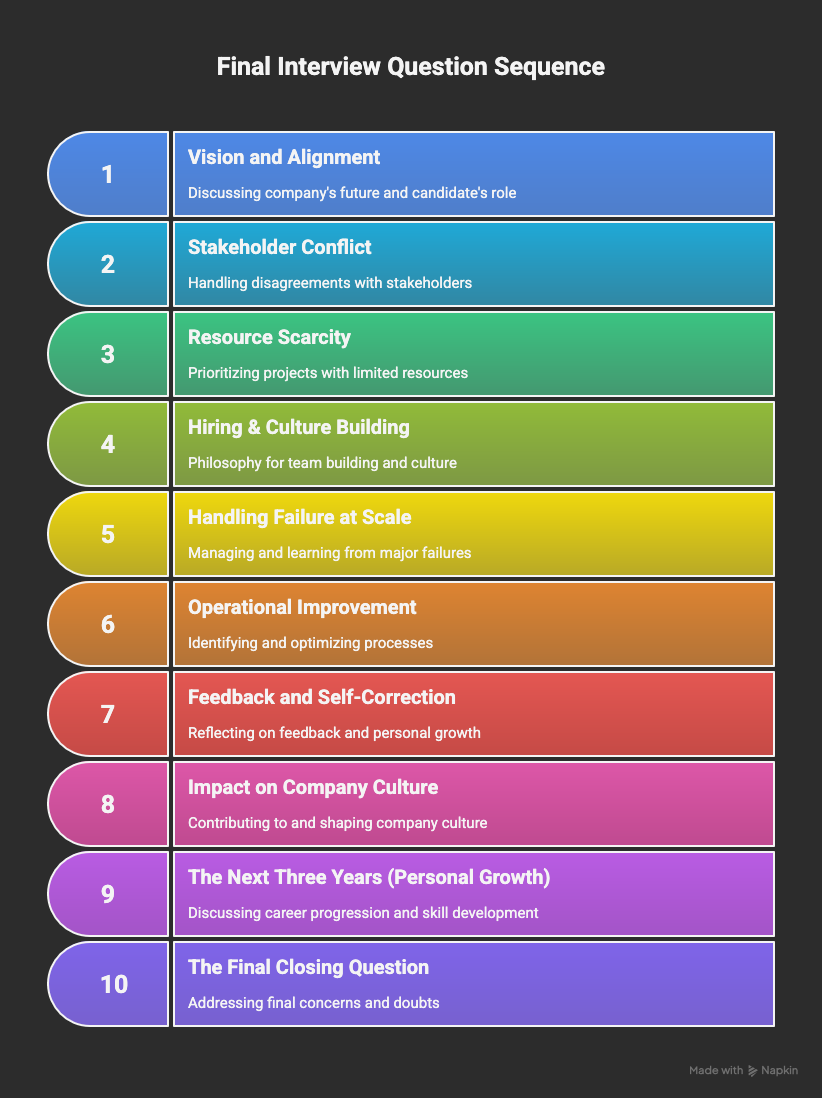
Operational Improvement
6. "If you started next week, what is one existing process or metric you would immediately question or seek to optimize, and what is the potential return on investment (ROI) you expect from that change?"
- Goal: Demonstrates their bias for action and whether they can quickly identify opportunities for improvement rather than just maintaining the status quo.
Feedback and Self-Correction
7. "What is the most constructive, yet difficult, piece of feedback you have received in your career, and what tangible action did you take to correct it?"
- Goal: A deep dive into self-awareness and coachability. A strong answer shows humility and a structured approach to personal and professional development.
Impact on Company Culture
8. "How would you describe your ideal team or company culture, and what three specific actions would you take to ensure you are contributing to, and not detracting from, our existing culture?"
- Goal: This assesses culture fit and whether they are a passive recipient of culture or an active contributor to shaping it.
The Next Three Years (Personal Growth)
9. "If you are successful in this role, what is the next logical step in your career progression, and what skills or experience are you hoping to gain here to prepare you for that move?"
- Goal: To gauge their ambition and ensure their long-term career path is compatible with the opportunities available at the company. It confirms they view this as a multi-year role, not a temporary stop.
The Final Closing Question
10. "Based on all your conversations so far, what is the one remaining hesitation or concern you have about this role or our company?"
- Goal: This is your chance to address any final doubts. It also measures the candidate's confidence and willingness to engage in a transparent dialogue. A great candidate will either express no concerns or articulate a well-thought-out, easily addressable question (e.g., "My only concern is around the capacity of X team, but I believe my approach to resource allocation can quickly mitigate that.")
Also Read: What are the different interview rounds and how to prepare for each one?
How to handle the "Tell me about yourself" question in the final round?
In the final round, this question isn't an invitation to recite your resume. You need to tailor your answer to the company's specific future goals.
Briefly recap your background, but spend 80% of your answer connecting your past achievements to the company's current challenges. It’s about the value you bring tomorrow, not just what you did yesterday.
Statistics show that 93% of hiring managers ask this question. Since you've already likely answered this in previous rounds, the final interviewer (often a senior leader) wants the "executive summary" version.
They want to know your "why."
Focus on results. For example, "I have 5 years of experience in sales, where I grew revenue by 20%, but the reason I'm here is that I see your company expanding into X market, and my background is perfect for accelerating that transition."
Also Read: 5 strategies to ace the "tell me about yourself" interview question.
What are the biggest deal-breakers in the final interview?
The biggest red flags are a lack of enthusiasm, treating staff poorly, and dishonesty. Statistics show that 68% of recruiters would disqualify a candidate for being rude to reception or junior staff. Additionally, 58% consider lateness a deal-breaker, and a significant portion will reject you if you have no questions at the end of the interview.
It sounds simple, but basic manners matter immensely. The final interview is a "chemistry check." If you are rude to the scheduler but charming to the CEO, you likely won't get the job.
Furthermore, 64% of hiring managers will automatically disqualify you if they catch a lie on your resume or during the interview. Authenticity is your best asset.
Also Read: How to ask for feedback after an interview?
Final Thoughts
Final interviews reward preparation, clarity, and self-awareness.
If you can show how your decisions create impact, how you navigate complexity, and how your experience aligns with the company’s future, you stand out in a way most candidates never do.
If you want to rehearse those moments - your judgment calls, your leadership stories, your “why”, Hiration gives you a place to test your answers, refine them, and understand how they land before you’re in front of a senior executive.
The more intentional your preparation, the clearer your strengths become.
Final Interview Guide — FAQ
What makes the final interview different from earlier rounds?
The final round focuses heavily on judgment, leadership, cultural alignment, and long-term impact. Senior executives want to see how you think, handle pressure, and align with the company’s mission.
What is the average success rate of a final interview?
Your chances typically range between 30% and 50%, depending on how many finalists remain. This varies by company and role. I cannot verify external statistics beyond what’s included in your draft.
How should I answer “Tell me about yourself” in the final round?
Give an executive-level summary: 20% background, 80% tying your past wins to the company’s future goals. The focus is not on chronology but on relevance and impact.
What qualities do final-round interviewers look for?
Clarity of thought, strategic vision, self-awareness, maturity, cultural alignment, and the ability to make high-impact decisions under pressure.
What types of questions should I expect?
Mainly scenario-based leadership questions: prioritization, conflict with stakeholders, hiring philosophy, culture-building, and post-failure accountability.
What are the biggest final-round deal-breakers?
Lack of enthusiasm, disrespect toward junior staff, dishonesty, poor listening, and not asking questions. Many hiring managers consider rudeness and lateness non-negotiable red flags.
What kind of questions should I ask the interviewer?
Ask about long-term strategy, team maturity, success metrics, cross-functional dependencies, and expectations for the first 90 days. Avoid generic or self-serving questions.
How can I stand out in the final interview?
Act like a future colleague. Demonstrate how your decisions drive ROI, how you handle complexity, how you develop others, and how your leadership philosophy aligns with the company’s mission.
How do I prepare for executive-style questions?
Review major company initiatives, think through trade-off decisions, craft leadership stories using STAR+, and be ready to articulate your reasoning and values with clarity.
How honest should I be when asked about concerns or hesitations?
Be transparent but constructive. Share a thoughtful question or express that you feel aligned and confident. This signals maturity and self-awareness.