What are the most important Hibernate interview questions to prepare for?
The strongest Hibernate interview prep centers on core ORM fundamentals (Session vs SessionFactory, entity states, caching, lazy vs eager loading), real-world performance pitfalls (N+1 queries, join fetch vs batch fetching), and practical judgment (save vs persist, Criteria vs HQL, inheritance strategies, and dirty checking). Great answers explain the “why” behind design choices, show awareness of trade-offs, and demonstrate how you debug generated SQL and prevent production issues.
The Java ecosystem is evolving, but Hibernate remains the heavyweight champion of Object-Relational Mapping (ORM).
According to the State of Developer Ecosystem Report 2024 by JetBrains, Java is a primary language for 30% of the global developer population, and Hibernate continues to be the dominant framework for handling complex data persistence.
As microservices and high-scale systems grow, recruiters are looking for developers who understand more than just "magic" annotations.
If you're preparing for a high-stakes meeting, mastering these hibernate interview questions is non-negotiable to ace your interview.
1. What is the difference between Session and SessionFactory?
The SessionFactory is a heavyweight, thread-safe, and immutable object that serves as a factory for Session instances; it is typically created once during application startup. In contrast, a Session is a lightweight, non-thread-safe object that represents a single unit of work with the database and should be closed after use.
- Why recruiters ask this: They want to see if you understand the architectural overhead of Hibernate. Using
SessionFactoryincorrectly (like creating it for every request) will crash an application's performance due to its high initialization cost. - How to answer: Focus on the scope and thread-safety. Emphasize that
SessionFactoryis global (singleton pattern) whileSessionis short-lived and local to a specific database transaction or user request. - Sample answer: "SessionFactory is a thread-safe, heavyweight object created once per database, acting as a cache for mappings. Session is a lightweight, non-thread-safe object used for a single unit of work. I always ensure SessionFactory is a singleton and sessions are properly closed to prevent connection leaks".
Also Read: How to bag Java developer jobs?
2. How do First-Level and Second-Level Caches differ?
The First-Level Cache is mandatory and associated with the Session object, ensuring that the same object is not re-fetched from the database within the same transaction. The Second-Level Cache is optional, maintained at the SessionFactory level, and shared across all sessions to improve performance across the entire application.
- Why recruiters ask this: Performance optimization is a top priority. According to Thorben Janssen, misusing caching is one of the top two causes of production bottlenecks.
- How to answer: Explain that First-Level is enabled by default and scoped to a session, whereas Second-Level requires a provider (like Ehcache) and is scoped to the application.
- Sample answer: "First-level cache is session-scoped and mandatory, preventing redundant queries within a single transaction. Second-level cache is session-factory scoped and optional, allowing data sharing across multiple sessions. In my previous projects, I used Ehcache for the second level to reduce database hits by 30%".
3. What are the three states of a Hibernate object?
An object in Hibernate can be in one of three states: Transient (not associated with a session or database), Persistent (associated with an open session and a database record), or Detached (previously persistent but the session is now closed). Changes made to a Persistent object are automatically synchronized with the database during transaction commit.
- Why recruiters ask this: This is a fundamental concept for anyone looking to become a Java developer. Misunderstanding these states leads to "stale data" or "unsaved changes" bugs.
- How to answer: Describe the lifecycle of an entity. Explain how an object moves from Transient to Persistent via
save()and to Detached viaclose()orevict(). - Sample answer: "The three states are Transient, Persistent, and Detached. A new object is Transient. Once saved to a session, it becomes Persistent, where Hibernate tracks its changes. When the session closes, it becomes Detached, meaning it still has database data but is no longer managed by Hibernate".
4. When should you use get() versus load()?
Use get() if you want to retrieve the object immediately and aren't sure if it exists, as it returns null if the record is missing. Use load() (or getReference() in JPA) if you only need a proxy reference to the object, as it delays the actual database hit until you access a property other than the ID.
- Why recruiters ask this: They are testing your knowledge of "Lazy Loading." Using
get()unnecessarily causes immediate database hits, which can slow down large-scale applications. - How to answer: Highlight that
get()hits the database immediately, whileload()returns a proxy. Mention thatload()throws an exception if the ID doesn't exist, whileget()returns null. - Sample answer: "I use
get()when I need to check if an object exists, as it returns null if missing. I useload()when I'm certain the object exists and I only need its proxy (e.g., to set a foreign key), which improves performance by avoiding an immediate database select".
Also Read: How to make a stellar Java Developer resume?
5. What is the N+1 problem and how do you solve it?
The N+1 problem occurs when Hibernate executes one query to fetch a parent entity and then N additional queries to fetch its related children, leading to severe performance degradation. You can fix this by using "Join Fetch" in HQL/JPQL or by configuring Entity Graphs to retrieve parents and children in a single SQL join.
- Why recruiters ask this: This is the #1 performance issue in Hibernate. According to Akamai, 57% of consumers abandon a site if it takes longer than 3 seconds to load, making query optimization critical.
- How to answer: Explain the cause (iterating over a list of lazily-loaded associations) and the solution (batch fetching or join fetching).
- Sample answer: "The N+1 problem happens when fetching a list of entities causes one query for the list and one extra query for each item's association. I solve this by using 'JOIN FETCH' in my queries or setting a batch size in the mapping to load multiple children in one go".
Also Read: How to make a Microservices Java resume?
6. What is the difference between save() and persist()?
While both methods transition an object to the Persistent state, save() is a Hibernate-native method that returns the generated identifier immediately. In contrast, persist() is a JPA-compliant method that returns void and does not guarantee the immediate generation of an ID if the transaction hasn't been flushed.
- Why recruiters ask this: This distinguishes between those who use Hibernate as a standalone tool versus those who understand the industry-standard JPA specification.
- How to answer: Contrast the return types and the timing of SQL execution. Note that
persist()is generally preferred for consistency across different JPA providers. - Sample answer: "
save()is Hibernate-specific and returns the generated ID immediately, which might trigger an early INSERT.persist()is the JPA standard; it returns nothing and respects the transaction boundary better, usually deferring the INSERT until the transaction flushes".
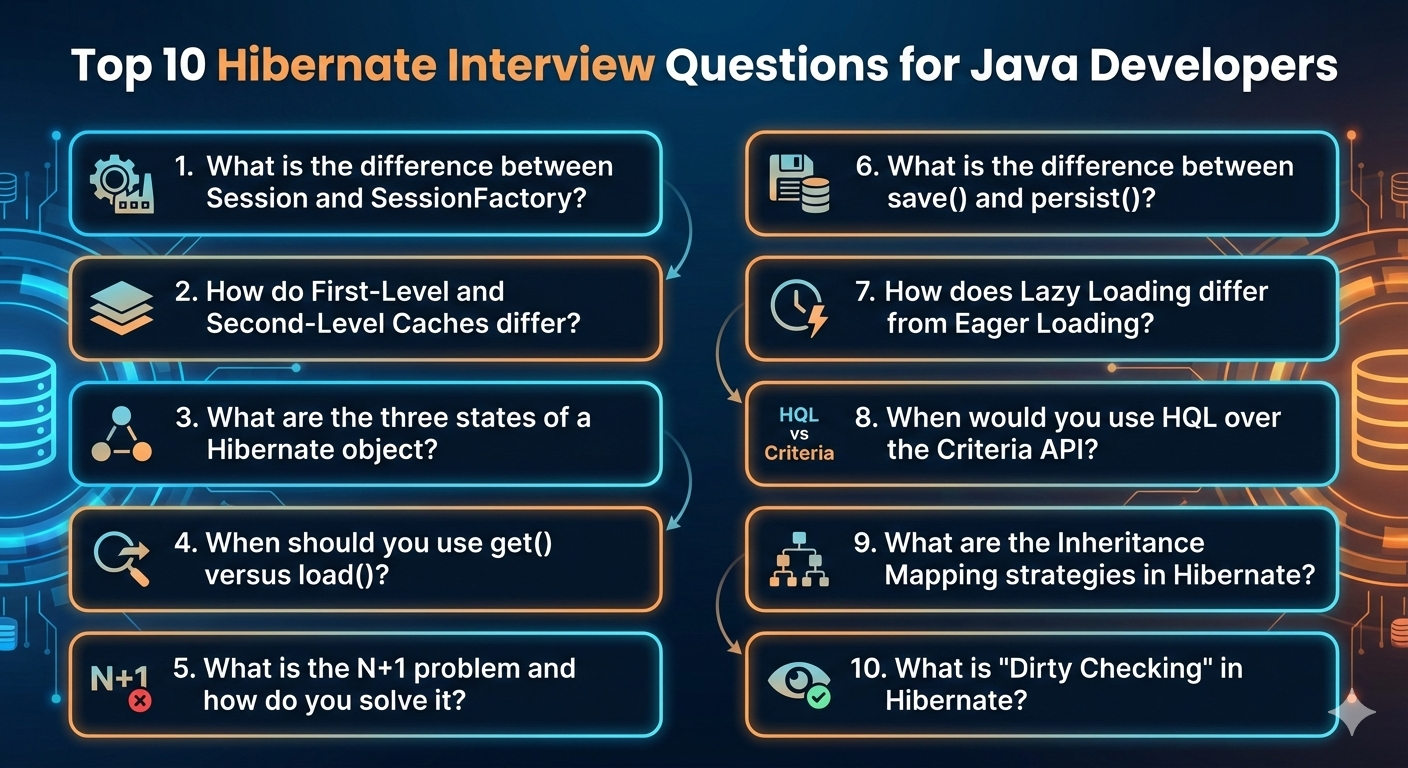
7. How does Lazy Loading differ from Eager Loading?
Lazy Loading (FetchType.LAZY) tells Hibernate to initialize an association only when it is accessed for the first time, whereas Eager Loading (FetchType.EAGER) forces the framework to load the related data immediately when the parent is instantiated. Lazy loading is the recommended default for all collections to prevent over-fetching of data.
- Why recruiters ask this: Improper use of Eager loading is a common source of memory issues. Recruiters want to know you can balance data availability with system memory.
- How to answer: Mention that Hibernate 3+ enables Lazy Loading by default for collections. Explain that Eager loading should only be used when the related data is almost always needed alongside the parent.
- Sample answer: "Lazy loading delays the initialization of child objects until they are explicitly called, which saves memory. Eager loading fetches everything at once. I prefer Lazy loading for collections to avoid 'fetching too much data,' which JRebel cites as a primary performance killer".
Also Read: What does a Java Developer do?
8. When would you use HQL over the Criteria API?
HQL (Hibernate Query Language) is a string-based language similar to SQL but operates on Java objects, making it ideal for static, complex queries. The Criteria API is an object-oriented, type-safe approach that is best suited for dynamic queries where the search parameters are determined at runtime.
- Why recruiters ask this: This tests your ability to choose the right tool for different scenarios. It’s a common part of Java developer interview questions.
- How to answer: Contrast readability vs. flexibility. HQL is easier to read for fixed queries, while Criteria is better for building search filters where users can select multiple optional fields.
- Sample answer: "I use HQL for fixed, complex queries because it's more readable and easier to debug. I switch to the Criteria API when I need to build dynamic queries based on user-selected filters, as it provides compile-time type safety and prevents syntax errors in strings".
9. What are the Inheritance Mapping strategies in Hibernate?
Hibernate supports three main strategies: Single Table (all classes in one table, fastest), Table per Class (each class gets its own table), and Joined Strategy (normalized approach with foreign keys, most flexible). Each strategy has a trade-off between database normalization and query performance.
- Why recruiters ask this: Database design is a core skill. They want to know if you can map complex object-oriented hierarchies into efficient relational tables.
- How to answer: Briefly define the three types and mention that the "Single Table" strategy is generally the most performant because it avoids complex SQL joins.
- Sample answer: "Hibernate offers Single Table, Table per Class, and Joined strategies. Single Table is best for performance as it uses one table with a discriminator column. I use the Joined strategy when I need a highly normalized schema and strict data integrity".
10. What is "Dirty Checking" in Hibernate?
Dirty Checking is an automated mechanism where Hibernate tracks changes to a Persistent object by comparing its current state with its original "snapshot" taken when it was first loaded. If any changes are detected, Hibernate automatically generates and executes an UPDATE statement during the transaction commit.
- Why recruiters ask this: This is the "magic" of Hibernate. Understanding it is crucial to avoid "accidental updates" in production systems.
- How to answer: Define it as an automated synchronization process. Explain that it saves the developer from manually calling
update()methods every time a field is changed. - Sample answer: "Dirty checking is Hibernate's way of automatically updating the database when a persistent entity changes. It compares the object's current state with its initial snapshot. This means I don't have to call
update()explicitly, as Hibernate handles the synchronization on commit".
Also Read: What are some commonly asked SpringBoot interview questions?
What are some Great Tips Help to Ace Your Hibernate Interview?
To truly stand out, don't just memorize definitions. In the current market, 85% of developers are using AI tools to assist their work, so recruiters are focusing more on your ability to handle "edge cases" and performance tuning.
When preparing:
- Discuss the "Why," Not Just the "How": Don't just explain N+1; explain why you chose
JOIN FETCHover@BatchSizein a specific scenario. Discuss the trade-off between developer productivity and database performance. - Whiteboard Your Mapping: Be ready to draw entity-relationship diagrams. Explain how
@OneToManyand@ManyToOnerelate at the database level (foreign keys) versus the object level (collections). - Mention Troubleshooting Tools: Stand out by mentioning how you debug. Talk about enabling
hibernate.generate_statisticsor using tools like P6Spy to analyze generated SQL. According to Thorben Janssen, checking these statistics during development is the best way to find performance issues before they hit production. - Talk About Virtual Threads: With the release of Java 21, mention how Hibernate interacts with Virtual Threads. Discuss the importance of not "pinning" carrier threads during database I/O, a topic that 30% of developers are already navigating, according to the Jakarta EE 2024 Survey.
- Simulate Real-World Scenarios: If asked about caching, don't just define it. Explain a time you had to clear the cache manually because of a bulk update or how you handled "stale data" in a multi-node environment.
By focusing on performance and real-world trade-offs, you will demonstrate the senior-level expertise that hiring managers are looking for in today's competitive market.
Also Read: How to be confident in an interview?
Wrapping Up
Hibernate interviews today aren’t about memorizing APIs, they’re about demonstrating judgment.
How you reason about performance trade-offs, data consistency, and real-world failure modes matters far more than recalling annotations from memory.
If you’re preparing for senior Java roles, pairing this kind of conceptual clarity with structured interview practice makes a measurable difference.
Hiration helps you do exactly that - rehearse explanations, refine trade-offs, and pressure-test your answers against real interviewer expectations.
That combination - depth plus delivery, is what ultimately separates “knows Hibernate” from “ready for production.”
Hibernate Interview Questions — FAQs
What is the difference between Session and SessionFactory?
SessionFactory is heavyweight, thread-safe, and typically created once at startup. Session is lightweight, not thread-safe, and represents a single unit of work that should be closed after use.
What is the difference between first-level and second-level cache in Hibernate?
First-level cache is mandatory and scoped to a Session. Second-level cache is optional, scoped to SessionFactory, and shared across sessions (requires a provider like Ehcache).
What are the three states of a Hibernate entity?
Entities can be Transient (new, not managed), Persistent (managed by an open session), or Detached (was persistent, but session is closed).
When should I use get() vs load() (or getReference())?
Use get() for immediate fetch and when the row might not exist (returns null). Use load()/getReference() for a proxy reference when you’re sure it exists; the DB hit is deferred until non-ID fields are accessed.
Note: load()/getReference() can throw an exception later if the entity doesn’t actually exist.
What is the N+1 problem in Hibernate, and how do you fix it?
N+1 occurs when Hibernate loads parents in one query and then loads each child collection with N additional queries (often due to lazy associations in a loop). Common fixes include JOIN FETCH, Entity Graphs, and batch fetching strategies.
What is the difference between save() and persist()?
save() is Hibernate-specific and returns an identifier. persist() is JPA-standard, returns void, and typically defers inserts more cleanly until flush/commit depending on ID strategy and persistence context behavior.
Lazy loading vs eager loading: what’s the practical difference?
Lazy initializes associations only when accessed, reducing upfront data load. Eager loads related data immediately. Lazy is usually safer for collections to avoid over-fetching and memory spikes.
Practical tip: default to LAZY for collections and explicitly fetch what you need per use case.
When should I use HQL/JPQL vs the Criteria API?
Use HQL/JPQL for fixed, readable queries. Use Criteria when building dynamic queries at runtime (multiple optional filters) where type safety and composability matter.
What inheritance strategies does Hibernate support?
Common strategies are Single Table (fastest reads, one table), Joined (normalized schema with joins), and Table per Class (separate tables per concrete class). Each trades off normalization vs query complexity/performance.
What is dirty checking in Hibernate?
Dirty checking is Hibernate’s mechanism for tracking changes to persistent entities and automatically generating UPDATE statements during flush/commit when it detects field changes compared to the original loaded snapshot.
How can I show “real-world Hibernate skills” in an interview?
Go beyond definitions: explain trade-offs (JOIN FETCH vs batch size), describe how you inspect generated SQL, mention how you prevent N+1 regressions, and talk about transaction boundaries, flush behavior, and handling stale data in multi-node deployments.