How do you become a Food Safety Supervisor and build a long-term career in food service?
Becoming a Food Safety Supervisor typically involves obtaining the correct food safety certification for your jurisdiction, developing practical experience with food safety controls, training staff, maintaining compliance records, and demonstrating leadership during real-world service operations. Success comes from combining certification with hands-on experience in risk management, staff coaching, documentation, and corrective action processes.
Food safety failures can shut down operations, damage a business's reputation, and put customers at serious risk.
That is why employers increasingly need supervisors who can do more than follow food handling rules.
They need people who can spot risks early, train staff effectively, maintain compliance, and keep food safety standards consistent during busy service periods.
If you're interested in stepping into that role, becoming a Food Safety Supervisor can be a practical path to greater responsibility, higher earning potential, and long-term career growth in the food service industry.
This guide breaks down the certifications, skills, experience, and strategies that can help you get there faster.
What does a Food Safety Supervisor actually do?
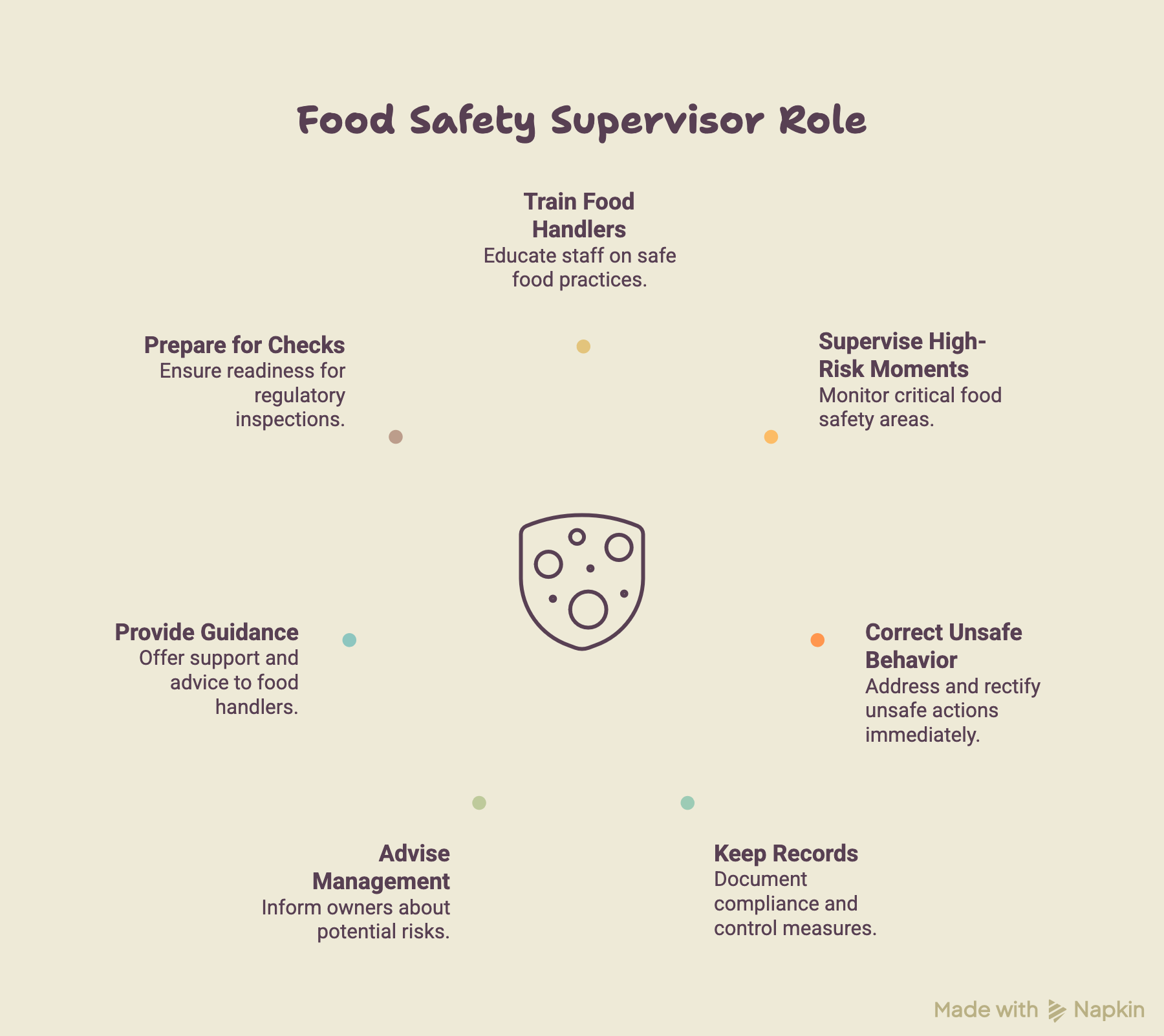
A Food Safety Supervisor makes sure food handlers prepare, store, display, serve, and clean in ways that reduce food safety risk. The role is part trainer, part checker, part problem-solver. In practice, you supervise high-risk moments: temperature control, allergens, cleaning, illness reporting, cross-contamination, and record keeping.
The best way to understand the role is to stop thinking of it as a certificate and start thinking of it as a control point.
A Food Safety Supervisor usually needs to:
- train food handlers before they handle high-risk food
- watch whether staff follow safe food procedures during real service
- correct unsafe behavior immediately
- keep records that prove controls were followed
- advise the business owner or manager when a process creates risk
- stay available when food handlers need guidance
- prepare the business for council, health department, or regulator checks
The important part: employers do not just need someone who passed a course. They need someone who can reduce risk during a busy shift.
Also Read: How to become a food scientist?
Who should become a Food Safety Supervisor?
You should become a Food Safety Supervisor if you work in a restaurant, cafe, catering business, takeaway outlet, deli, food van, supermarket food section, school canteen, aged care kitchen, hotel kitchen, or any business handling unpackaged, ready-to-eat, potentially hazardous food. Rules vary by state, territory, and country.
That means the role is common in:
- restaurants and cafes
- catering companies
- takeaways and food trucks
- supermarkets, delis, and bakeries
- pubs, hotels, and clubs
- hospitals and aged care food services
- childcare and school food services
- events where high-risk ready-to-eat food is prepared or served
In New South Wales, the NSW Food Authority says retail, hospitality, and food service businesses need at least one Food Safety Supervisor per premises if the food is ready-to-eat, potentially hazardous, and not sold in the supplier’s original package.
Here is the simple test:
| Business activity | Food Safety Supervisor likely needed? | Why it matters |
|---|---|---|
| Cafe cooks eggs, reheats food, and serves meals | Yes | Handles ready-to-eat potentially hazardous food |
| Supermarket sells sealed packaged snacks only | Usually no | Food stays in original sealed packaging |
| Caterer prepares meals for an event | Yes | High-risk handling, transport, and service |
| Coffee cart only heats milk | Depends on local rules | Some regulators exempt low-risk setups |
| Aged care kitchen prepares meals for residents | Yes | High-risk consumers and high-risk food handling |
| Deli slices and repacks ready-to-eat meat | Usually yes | Exposes ready-to-eat food to contamination |
Do not rely on job titles alone. Check what the business actually does with food.
Which food safety training and certification do you need?
In the US, food safety certification rules vary by state, county, city, and job type. Many food service supervisors need a Certified Food Protection Manager certification, but the exact requirement depends on where you work. Before enrolling, check your local health department’s rules and confirm that the provider is accepted in your area.
For most US food service roles, employers commonly look for certifications such as:
- ServSafe Food Protection Manager
- National Registry of Food Safety Professionals certification
- StateFoodSafety Food Protection Manager certification
- 360training / Learn2Serve food manager certification
- Other ANAB-CFP accredited Food Protection Manager programs
According to the FDA Food Code, the person in charge should demonstrate food safety knowledge, and many local health departments use Certified Food Protection Manager certification as one way to meet that expectation.
Do not choose a course only because it is cheap or fast. A certificate that is not accepted by your local health department may not help you qualify for the role.
Before you pay for a course, check these four things:
| Check before enrolling | What to verify | Why it matters |
|---|---|---|
| Local requirement | State, county, or city health department rule | Food safety rules vary by location |
| Certification type | Food handler card, food manager certification, or supervisor-level requirement | Entry-level and manager-level credentials are not the same |
| Provider approval | Whether the provider is accepted locally | Not every online certificate is valid everywhere |
| Renewal period | Expiry date and renewal process | Many food safety certifications must be renewed every few years |
The safest move is simple: search your local health department’s food manager certification rules, match the accepted provider list, then enroll.
How should you choose the right Food Safety Supervisor course?
Choose the course backward from the job or business you want to work in. First identify the state, sector, and regulator requirement. Then pick an approved provider. Do not start with price, course length, or “100% online” claims until you know the certificate will be accepted.
Use this 10-minute decision process:
- Search your state or local regulator’s Food Safety Supervisor page.
- Identify whether your business is hospitality, retail, catering, childcare, aged care, manufacturing, transport, or another category.
- List the accepted units or certification names.
- Check whether the provider is approved, not just “nationally recognised.”
- Confirm whether practical assessment is required.
- Check renewal rules.
- Save the course page, certificate rules, and receipt in one folder.
This matters because food safety requirements are not only about passing a quiz. Some roles require you to show workplace competence.
For example, NSW Food Authority says training may be delivered face-to-face, online, workplace-based, by correspondence, or through a combination of these methods, but the course must be completed through a single approved RTO for NSW FSS certification.
A strong course should cover more than basic hygiene. Look for training that tests:
- allergens and cross-contact
- high-risk foods
- temperature measurement
- cooling and reheating
- cleaning and sanitising
- personal hygiene and illness exclusion
- pest risk
- safe egg handling
- food receiving and supplier checks
- recall response
- record keeping
- corrective actions
Red flag: the course only teaches definitions and does not make you practice decisions.
A useful Food Safety Supervisor course should make you answer questions like:
- What do you do if cooked rice sat at room temperature for 4 hours?
- What do you do if a worker reports vomiting before a shift?
- What record proves the cool room was safe during a power outage?
- How do you stop allergen cross-contact during a rush?
- What is the corrective action if cooked chicken misses the required internal temperature?
That is the difference between passing and supervising.
What skills should you build before applying for Food Safety Supervisor jobs?
Build skills around real risk: temperature control, allergen control, staff coaching, cleaning verification, incident response, and documentation. Employers value candidates who can prove they have handled food safety decisions in real operations, not just candidates who can list a certificate.
Start with these seven practical skills.
| Skill | What to practice | Proof you can show |
|---|---|---|
| Temperature control | Receiving, storage, cooking, cooling, reheating, hot holding | Sample temperature logs, thermometer calibration notes |
| Allergen control | Identifying allergens, preventing cross-contact, checking labels | Allergen matrix, staff briefing notes |
| Cleaning verification | Checking concentration, contact time, surface cleanliness | Cleaning schedule and corrective-action log |
| Staff coaching | Correcting unsafe behavior without creating conflict | Training checklist or toolbox talk outline |
| Illness response | Knowing when workers should report symptoms or avoid food handling | Illness reporting script |
| Traceability | Supplier details, batch numbers, recall response | Mock recall record |
| Inspection readiness | Finding gaps before an inspector does | Self-audit checklist |
According to the CDC, restaurants with kitchen managers certified in food safety were less likely to have foodborne illness outbreaks.
The same CDC study found norovirus was the most common outbreak cause at 45%, while contamination from sick workers caused 65% of outbreaks and sick workers touching food with bare hands caused 35%.
That is a clear signal for candidates: learn employee health controls, not just cooking temperatures.
To build experience fast, ask your manager for small, specific ownership tasks:
- “Can I own the fridge temperature log for two weeks?”
- “Can I check sanitizer concentration at opening and closing?”
- “Can I update the allergen sheet for menu changes?”
- “Can I run a 5-minute handwashing refresher before Saturday service?”
- “Can I shadow the next delivery check?”
These tasks create resume proof. When updating your food service resume, do not write “knowledge of food safety.” Write what you controlled.
Better examples:
- Monitored cold-holding logs across 3 service stations and escalated out-of-range readings before lunch service.
- Trained 8 new staff on allergen cross-contact, cleaning procedures, and safe glove use.
- Completed daily sanitizer checks and documented corrective actions for low-concentration batches.
- Supported mock council inspection by preparing temperature, cleaning, and supplier records.
If you already work in a kitchen, the fastest path is not more theory. It is supervised ownership of one risk area at a time.
How can you get Food Safety Supervisor experience without already having the title?
Take ownership of one food safety control in your current role and document the results. You do not need the title first. You need evidence that you can supervise safe food handling, correct mistakes, maintain records, and train others under real shift pressure.
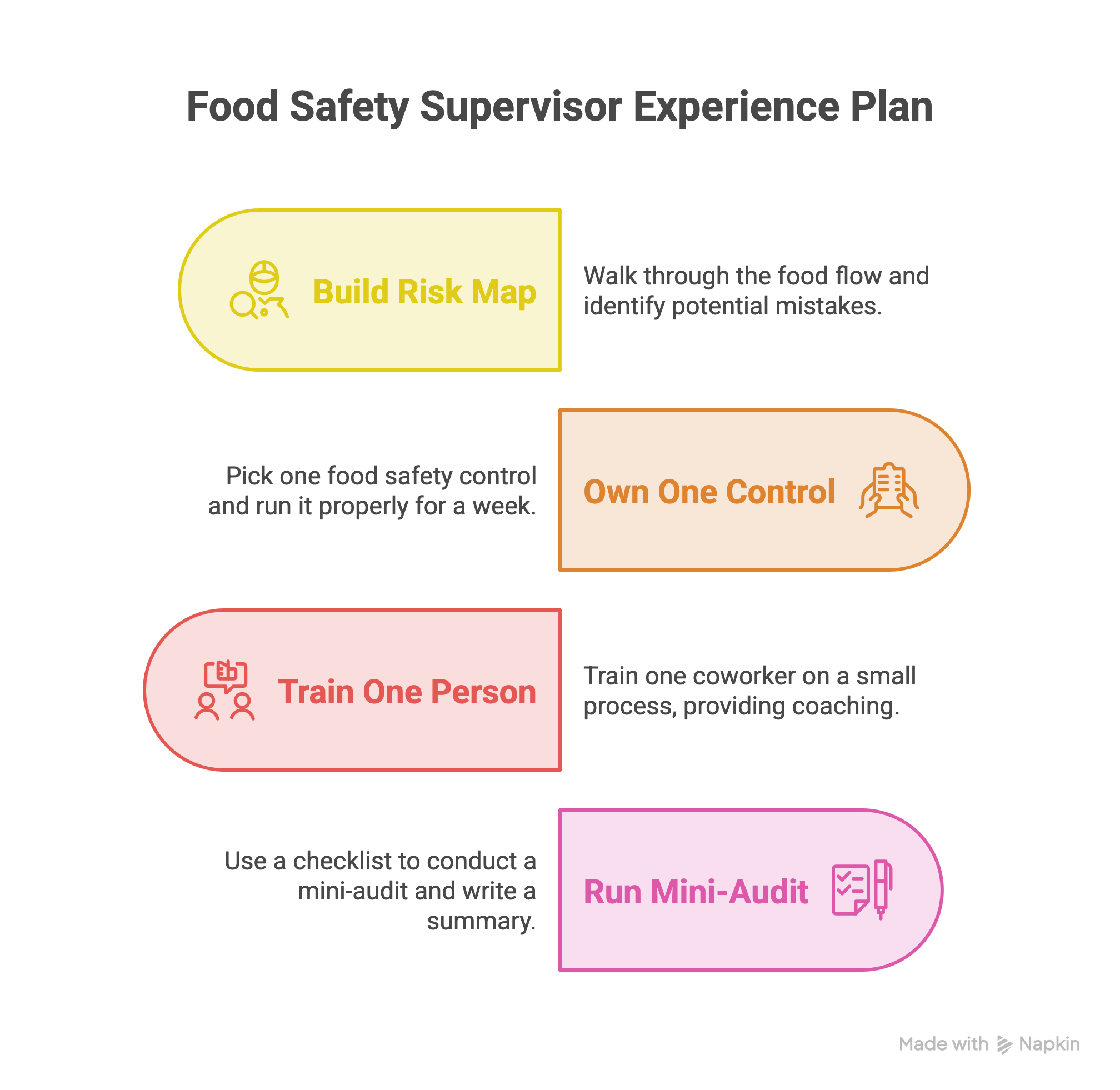
Here is a practical 30-day experience plan.
Week 1: Build your risk map
Walk through the food flow from delivery to service:
- receiving
- storage
- preparation
- cooking
- cooling
- reheating
- display
- service
- cleaning
- waste
Write down where mistakes are most likely. For example, a cafe may have risk around egg handling, milk storage, cross-contact on chopping boards, and cooling cooked rice. A catering business may have risk around transport temperature and time out of refrigeration.
Week 2: Own one control
Pick one control and run it properly for a week.
Good options include:
- fridge temperature checks
- food receiving checks
- sanitizer checks
- allergen board updates
- probe thermometer calibration
- cleaning checklist completion
- hot holding checks
Do not just fill the log. Notice patterns. If the same fridge rises above safe range at 2 pm, ask why. Is the door opened too often? Is it overloaded? Is hot food placed inside? This is where supervision begins.
Week 3: Train one person
Train one coworker on a small process.
Keep it short:
- explain the risk
- demonstrate the task
- watch them do it
- correct one thing
- sign off the checklist
This gives you real coaching evidence, which is valuable when applying for supervisor roles or preparing for restaurant manager interview questions.
Week 4: Run a mini-audit
Use a simple checklist:
- Are logs complete?
- Are thermometers working?
- Are chemicals labelled?
- Are allergens updated?
- Are high-risk foods stored correctly?
- Are raw and ready-to-eat foods separated?
- Are staff following handwashing and glove rules?
- Are expired items removed?
- Are corrective actions documented?
Then write a one-page summary:
- 3 things working well
- 3 risks found
- 3 fixes completed
- 1 issue escalated to management
This becomes your interview story.
How should you prepare for Food Safety Supervisor interviews?
Prepare with real examples, not textbook answers. Employers want to know how you act when food is late, staff are rushed, equipment fails, or a customer has an allergen concern. Use examples that show judgment, documentation, communication, and corrective action.
Expect questions like:
- How would you handle a worker who comes in sick?
- What would you do if a fridge temperature log shows repeated unsafe readings?
- How do you train staff who ignore food safety rules during rush hour?
- How would you manage an allergen complaint?
- What records would you prepare before an inspection?
- How do you respond if cooked food has been cooled incorrectly?
- How do you balance speed of service with safe handling?
Use the “risk-action-proof” format:
- Risk: What could go wrong?
- Action: What did you do immediately?
- Proof: What record, result, or change shows the issue was handled?
Example answer:
“In my last role, I noticed the under-counter fridge near the prep line was reading above the target range during peak lunch service. I moved high-risk items to the backup fridge, labelled the affected stock for manager review, recorded the reading, and escalated the issue. We later found staff were overloading the unit before service, so I helped change the prep setup.”
That answer works because it shows observation, immediate control, documentation, escalation, and prevention.
For kitchen roles, practice role-specific questions too. If you are moving up from a cook role, line cook interview questions can help you connect food safety examples to prep, service, cleaning, and teamwork.
What mistakes slow down Food Safety Supervisor candidates?
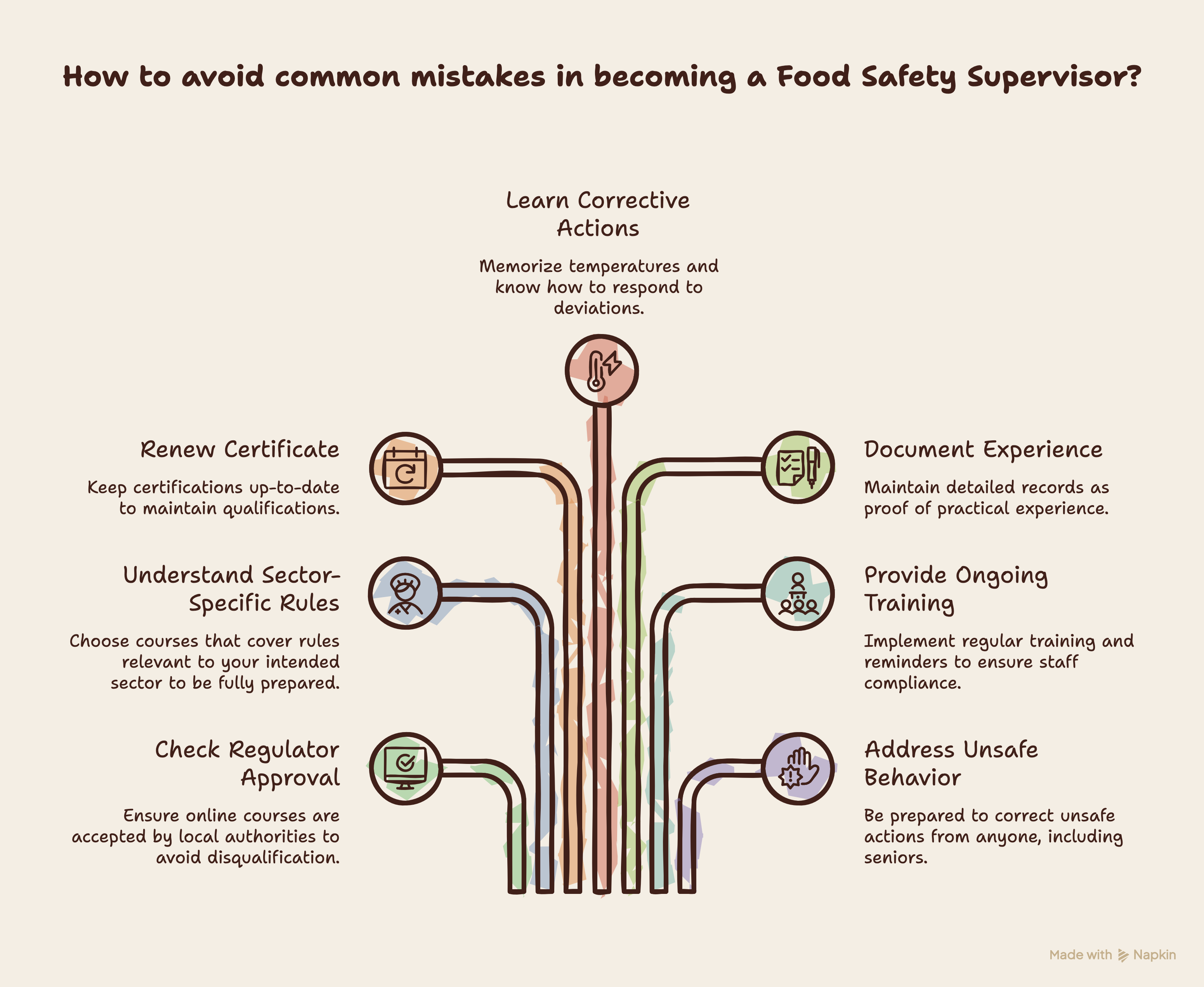
The biggest mistake is treating certification as the finish line. Certification helps you qualify, but employers promote people who can run safe shifts. The second mistake is choosing the wrong course for the wrong jurisdiction. The third is failing to document practical food safety experience.
Avoid these mistakes:
1. Taking a course before checking regulator approval
Do not assume every online course is accepted. Check your state, territory, council, health department, or regulator first.
2. Ignoring sector-specific rules
Hospitality, retail, aged care, childcare, manufacturing, and transport can have different expectations. A cafe certificate may not cover every specialised food environment.
3. Letting the certificate expire
Many Food Safety Supervisor and Food Protection Manager certifications need renewal. For example, NSW Food Authority says NSW FSS certificates must be renewed every 5 years.
4. Memorising temperatures without learning corrective actions
Knowing the target temperature is only half the job. You also need to know what to do when food misses the target.
5. Thinking records are “admin”
Records are your proof. If it was not written down, it is hard to prove it happened.
6. Training staff once and assuming they remember
Food safety training needs reminders, observation, correction, and sign-off. People drift back into shortcuts during busy service.
7. Avoiding conflict
A Food Safety Supervisor must stop unsafe behavior. That means correcting senior cooks, casual staff, delivery staff, and sometimes managers.
A simple correction script helps:
“Pause for a second. This creates a food safety risk because ____. Let’s fix it this way now, then I’ll update the log.”
That sounds better than blaming someone mid-shift.
What is a realistic path to becoming a Food Safety Supervisor?
The fastest realistic path is to check your local requirement, complete the accepted certification, take ownership of one food safety process at work, document your evidence, and apply for supervisor-level roles with proof. Most candidates can move faster by combining certification with practical shift ownership.
Use this path:
- Identify your regulator and food sector.
- Confirm the accepted certificate or units.
- Complete the approved course.
- Save your certificate, units, expiry date, and provider details.
- Ask to own one food safety control at work.
- Build a small evidence folder with logs, checklists, and training notes.
- Update your resume with certification and measurable food safety bullets.
- Prepare 3 interview stories: temperature issue, staff training, and corrective action.
- Apply for Food Safety Supervisor, kitchen supervisor, chef supervisor, catering supervisor, restaurant manager, or food service manager roles.
- Renew your certification before expiry.
According to the US Bureau of Labor Statistics, food service manager employment is projected to grow 6% from 2024 to 2034, with about 42,000 openings projected each year. The median annual wage for food service managers was $65,310 in May 2024.
Food Safety Supervisor roles are a practical step toward that kind of growth because they sit between kitchen execution and management accountability.
Wrapping Up
Becoming a Food Safety Supervisor is about more than earning a certification. The strongest candidates combine food safety knowledge with practical experience, clear communication, and the ability to make sound decisions under pressure.
By building hands-on experience, documenting your impact, and staying current with local requirements, you can position yourself for supervisory and management opportunities across the food service industry.
Once you're ready to apply, make sure your resume, LinkedIn profile, and interview answers reflect the food safety responsibilities you've actually handled.
Employers want evidence of leadership, compliance, training, and problem-solving, not just a certificate.
And if you need help presenting those skills effectively, Hiration's AI-powered career platform can help you build an ATS-friendly resume, optimize your LinkedIn profile, create tailored cover letters, and prepare for interviews with role-specific practice and feedback.
A strong application can help ensure your food safety expertise stands out to hiring managers.
The certification may open the door, but how you communicate your experience is often what gets you hired.
Food Safety Supervisor Career Guide — FAQs
What does a Food Safety Supervisor do?
A Food Safety Supervisor oversees safe food handling practices, trains staff, monitors compliance, manages records, responds to food safety risks, and helps prepare businesses for inspections.
Who should become a Food Safety Supervisor?
The role is suitable for food service professionals working in restaurants, cafes, catering operations, food trucks, supermarkets, healthcare facilities, schools, and other businesses handling high-risk food.
Do you need certification to become a Food Safety Supervisor?
In most locations, employers expect candidates to hold an approved food safety certification that meets local regulatory requirements. Exact requirements vary by state, county, city, and employer.
How do you choose the right food safety certification?
Start by checking local health department requirements, confirming accepted certification providers, reviewing renewal rules, and ensuring the credential is recognized in your jurisdiction.
What skills are most important for Food Safety Supervisors?
Key skills include temperature control, allergen management, sanitation verification, documentation, staff training, incident response, risk assessment, and regulatory compliance.
How can you gain Food Safety Supervisor experience before getting the title?
You can take ownership of food safety processes such as temperature logs, allergen management, sanitation checks, staff training, supplier verification, and internal audits.
What should you include on a Food Safety Supervisor resume?
Include certification details along with measurable examples of compliance monitoring, staff training, corrective actions, audits, food safety improvements, and risk management responsibilities.
How should you prepare for Food Safety Supervisor interviews?
Prepare real examples involving food safety risks, corrective actions, employee coaching, documentation practices, inspection readiness, and decision-making under pressure.
What common mistakes slow career progression?
Common mistakes include relying only on certification, choosing unapproved courses, failing to document practical experience, neglecting renewals, and avoiding difficult food safety conversations.
What careers can Food Safety Supervisors progress into?
Many professionals advance into roles such as Kitchen Supervisor, Catering Supervisor, Restaurant Manager, Food Service Manager, Operations Manager, or broader food safety and compliance leadership positions.