What makes a career development plan actually work?
Effective plans act like a compass, not a checklist. Start with a flexible Future-State Vision (impact, expertise, work style), run a 3-D gap analysis (skills, experiences, network), and build an experience portfolio rather than a course list. Systematize relationship growth (mentors, sponsors, peers) and review every 90 days to re-prioritize one clear development goal. This turns vague intentions into compounding progress. Note: Any third-party statistics referenced in the article (e.g., platform reports on skill changes or mentorship outcomes) are included from your draft; I cannot independently verify them here.
Most career development plans become forgotten files - full of vague goals and low-impact tasks that never translate into real progress.
And that’s exactly why so many people feel stuck: without a clear direction, careers drift instead of grow.
A real career development plan is different. It’s not a checklist, it’s a compass.
It helps you intentionally bridge the gap between who you are today and who you want to become, giving your decisions and efforts a clear sense of direction.
Here's a practical, 5-step process to build a plan centered on meaningful skills, experiences, and relationships that actually move your career forward.
Step 1: Define Your "Future-State Vision"
The problem with the classic "where do you see yourself in 5 years?" question is that it forces you to pick a job title. This is limiting.
The skills required for any given job are changing rapidly; according to LinkedIn, the skillset for jobs has changed by 25% since 2015 and is expected to hit 50% by 2027.
A better approach is to define your "Future-State Vision" based on impact, knowledge, and lifestyle.
Instead of "I want to be a Senior Director," ask yourself these questions:
- Impact: What problems do I want to be solving? What do I want to be known for in my industry?
- Knowledge: What do I want to be an expert in? What do I want to be the "go-to" person for?
- Work Environment: What is my ideal work environment? Do I thrive on collaboration or deep, solo work?
- Work Style: What is your work style? Do you prefer a flexible schedule? Do you need a clear-cut mission or creative freedom?
This "vision" becomes your North Star. It’s more flexible than a job title and allows you to evaluate opportunities based on whether they get you closer to your ideal career goals, not just the next rung on a ladder.
Step 2: Conduct a 3-Dimensional Gap Analysis
With your vision defined, you can now perform a skills gap analysis. This is critical in a market where 70% of leaders report a critical skills gap in their organization, according to Springboard.
Most people only think of the first dimension (hard skills), but there are three.
- Skill Gaps: These are the technical hard skills and soft skills you lack. Examples: "My vision requires me to analyze data, but I don't know SQL," or "I want to lead a team, but I need to develop my leadership skills."
- Experience Gaps: This is the most-overlooked and most valuable part of the analysis. These are the scenarios you've never been in. Examples: "I've never managed a project budget over $10,000." "I've never presented to a C-suite executive." "I've never built a marketing campaign from scratch." "I've never had to hire or fire someone."
- Network Gaps: These are the people and insights you don't have access to. Examples: "My vision is in product marketing, but I don't know anyone in that department." "My entire network is at my current company." "I don't have a sponsor who will advocate for me in rooms I'm not in."
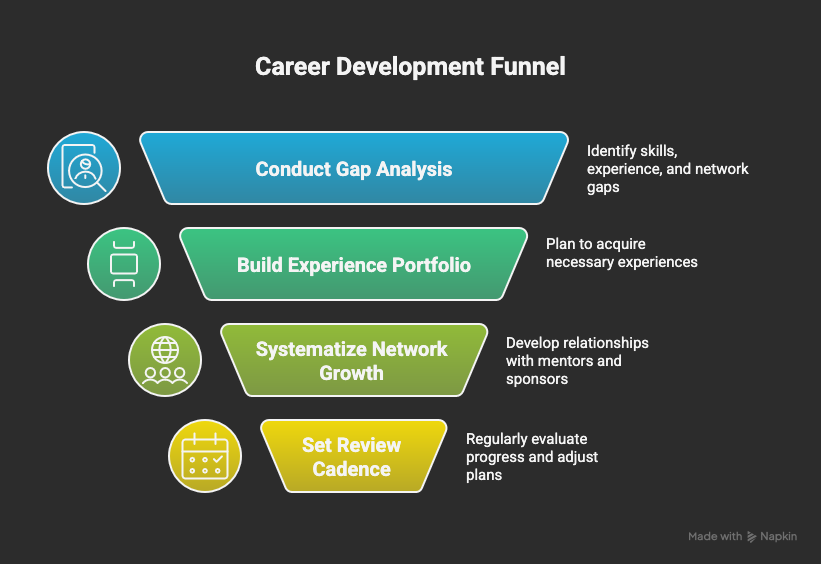
Step 3: Build Your "Experience Portfolio"
This is where you design your plan to close the gaps you just identified. Forget "take a course." Your goal is to acquire experiences. A course is a tactic, not the goal.
Your plan should look less like a class schedule and more like a portfolio of projects.
- To close a Skill Gap (e.g., SQL): Don't just "learn SQL." Your action item is: "Volunteer for the data analytics-light project next quarter and use SQL to pull the primary report."
- To close an Experience Gap (e.g., budget management): "Propose a small, new project with a $5,000 budget that I can manage end-to-end."
- To close a Network Gap (e.g., no marketing contacts): "Ask for a 20-minute coffee chat with the head of marketing to learn about her career path."
You can acquire these experiences in 4 primary ways:
- At Your Job (Internal Mobility): This is the best-case scenario. Pitch a project, ask to lead a small initiative, or join a cross-functional team.
- Through Projects: Create your own challenges. Build a new app, write a white paper, or create a mock-up of a new marketing strategy.
- Volunteering: This is the "secret weapon" for gaining experience. Want to manage a team? Volunteer to lead a committee for a non-profit.
- Formal Programs: This is where things like micro-internships or returnship programs (for those re-entering the workforce) come in.
Step 4: Systematize Your Network Growth
Your career will be built by mentors who give you advice and sponsors who give you opportunities. The data is clear: mentees are 5 times more likely to receive promotions, according to Emergimentors.
You need a plan to find both.
- Mentors (Advice): Identify 3-5 people who are in a role you admire. Don't ask, "Will you be my mentor?" That's a huge, awkward commitment. Instead, ask someone to be your mentor by starting small: "I've been following your work on X, and I'm trying to build my own skills in that area. Would you be open to a 20-minute chat so I could ask you 2-3 specific questions?"
- Sponsors (Advocacy): You don't ask for a sponsor; you earn one. You find a potential sponsor (usually a senior leader in your orbit) and make them look good. Deliver excellent work, offer to help on their high-visibility projects, and make their life easier. They will begin to advocate for you because your success is a reflection of their good judgment.
- Peers (Support): Build a "career board of directors" with 2-3 peers you trust. Meet once a quarter to hold each other accountable for your development plans.
Your plan should include action items like "Send two networking emails per month" or "Identify one potential sponsor and find a way to contribute to their keystone project."
Step 5: Set Your Review Cadence
Your career plan is a living document. The economy changes, your company changes, and you will change. Don't look at this plan once a year.
Set a recurring 90-day check-in.Put it on your calendar. This quarterly review is non-negotiable.
During your review, ask:
- What new skills or experiences did I gain in the last 90 days?
- What new "gaps" (skill, experience, or network) have I identified?
- Is my "Future-State Vision" still correct? Or has it changed?
- What is my one key development priority for the next 90 days?
This iterative process turns career development from a "someday" wish into a concrete, manageable project.
To Sum Up
A great career development plan isn’t something you draft once and forget, it’s something you build, refine, and grow into.
The more intentional you are about your skills, experiences, and relationships, the faster your career starts compounding in the right direction.
If you want support along the way, whether it’s strengthening your resume or cover letter, preparing for interviews, or optimizing your LinkedIn profile, Hiration can help you do it with clarity and confidence.
Close the gaps, track your progress, and keep moving toward the future you’ve defined. Your next step matters.
Career Development Plan — FAQ
How do I write a “Future-State Vision” without picking a title?
Describe the problems you want to solve, the expertise you want to be known for, and the conditions you work best in (collaboration, autonomy, flexibility). Use this as your filter for roles and projects.
What’s the difference between skill, experience, and network gaps?
Skills = capabilities you lack (e.g., SQL). Experiences = scenarios you haven’t faced (e.g., owning a $5k budget). Network = people and insight you can’t access yet (e.g., a sponsor in target function).
Courses vs. projects — which should I prioritize?
Lead with projects that force you to apply skills (build/report/ship). Use courses tactically to unblock those projects. Evidence of outcomes beats certificates in most reviews and interviews.
How do I create an “experience portfolio” inside my current job?
Pitch a small, time-boxed initiative, join a cross-functional working group, or volunteer to own a metric or report. Tie each item to a gap you mapped (skill, experience, or network).
What if my company has limited opportunities?
Use side projects, volunteering, hackathons, community leadership, or short freelance gigs to simulate the missing experience. Keep artifacts (dashboards, decks, demos) as proof of impact.
How do I find mentors and sponsors without being awkward?
Mentors: request a 20-minute chat with 2–3 specific questions. Sponsors: deliver excellent work on a leader’s high-visibility priorities; advocacy follows results, not requests for “sponsorship.”
What does a simple networking system look like?
Monthly: 2 outreach messages, 1 follow-up, 1 give-first intro or resource share. Quarterly: review contacts, list one potential sponsor, and identify how you can help on their key project.
How do I measure progress without overcomplicating it?
Track three counters: (1) skills used in shipped work, (2) new scenarios faced (e.g., exec presentation), and (3) meaningful relationships deepened. Update during your 90-day review.
How often should I update the plan?
Every 90 days. Capture wins, reassess gaps, and choose one “biggest next needle-mover” for the coming quarter. Keep the plan to one page to ensure you actually use it.
What are the most common mistakes to avoid?
Vague goals, course-only plans, no artifacts, zero networking cadence, and annual (not quarterly) reviews. Replace each with a concrete action and a 90-day checkpoint.